
Personality Chapter Eleven Personality and Its Assessment Module
- Slides: 36
Personality Chapter Eleven: Personality and Its Assessment Module Twenty-Five: Psychodynamic & Humanistic Perspectives
What is Personality? Ø An individual’s characteristic pattern of thinking, feeling, and acting
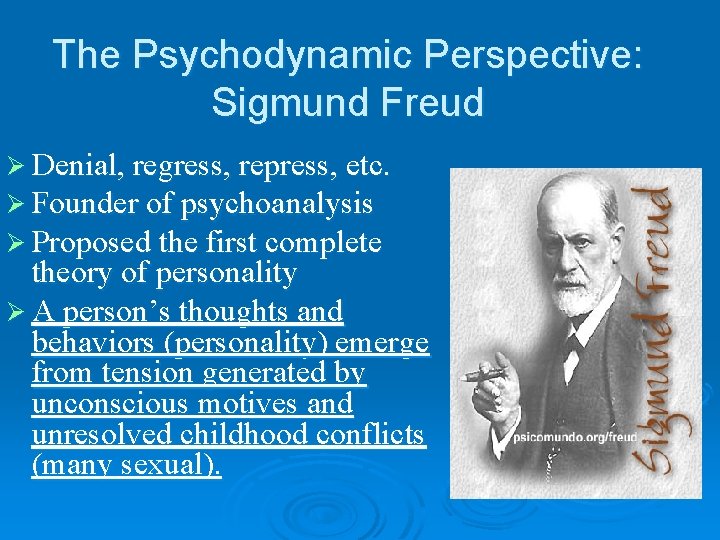
The Psychodynamic Perspective: Sigmund Freud Ø Denial, regress, repress, etc. Ø Founder of psychoanalysis Ø Proposed the first complete theory of personality Ø A person’s thoughts and behaviors (personality) emerge from tension generated by unconscious motives and unresolved childhood conflicts (many sexual).
Psychoanalysis & Psychodynamic Perspective Freud’s theory of personality Ø A more modern view of personality that retains Ø Also a therapeutic technique that attempts to provide some aspects of insight into one’s thoughts Freudian theory but and actions by exposing rejects other aspects and interpreting the Ø Retains the importance underlying unconscious of the unconscious mind motives and conflicts Ø Less emphasis on unresolved childhood conflicts Ø
The Psychodynamic Perspective: Freud’s View of the Mind Ø Free Association: Ø Freudian technique of exploring the unconscious mind by having the person relax and say whatever comes to mind no matter how trivial or embarrassing. Ø Freud’s alternative to hypnosis.
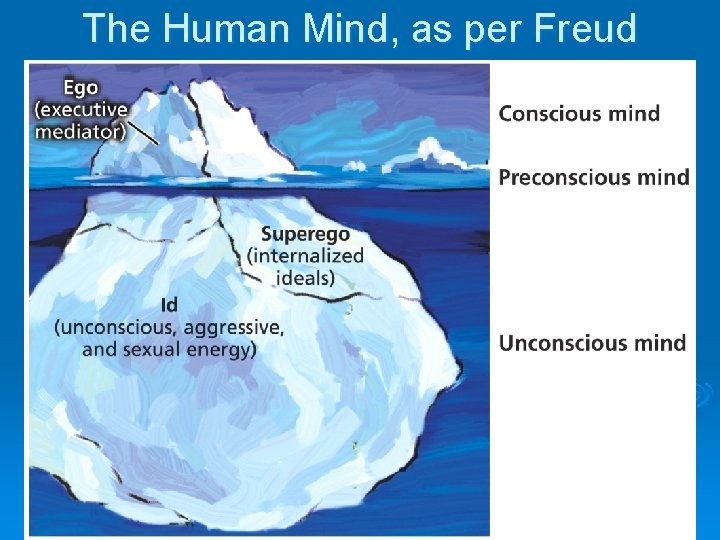
Different consciousness’ of the mind Ø Conscious mind: The thoughts and feelings one is currently aware of Ø Preconscious mind: l Holds thoughts and memories not in one’s current awareness but can easily be retrieved Ø Unconscious mind: l A region of the mind that includes unacceptable thoughts, wishes, feelings, and memories. l Open patients to these unwanted memories, accept them, and become better! l
Freud’s Concepts of the: Id, Ego, and Superego Ø The Id Ø The part of personality that consists of unconscious energy from basic aggressive and sexual drives Ø Operates on the “pleasure principle” - the id demands immediate gratification Ø Is present from birth Ø Ex: newborns cry for whatever they need!
Superego Ø The part of personality that consists of internalized ideals and standards Ø One’s conscience; focuses on what the person “should” do Ego Ø Largely conscious part of personality. Ø Mediates demands of id, superego, and reality. Ø Operates on the reality principal. l Satisfies id’s desires in ways that will bring more pleasure that pain.
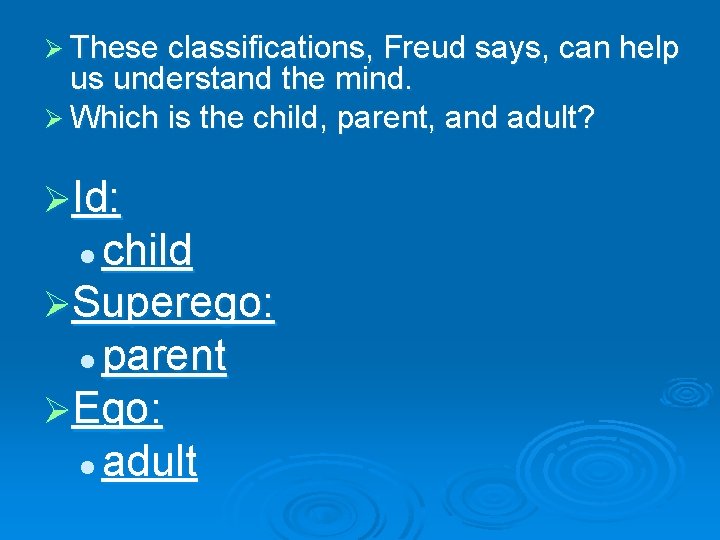
Ø These classifications, Freud says, can help us understand the mind. Ø Which is the child, parent, and adult? ØId: child ØSuperego: l parent ØEgo: l adult l
The Human Mind, as per Freud
More Freud!!! Ø Defense Mechanisms l Means by which Freud believed the ego protects itself by reducing anxiety; unconsciously distorts reality Ø Don’t forget about: l Repression, regression, and denial
Ø Repression Puts anxiety-arousing thoughts, feelings, and memories into the unconscious mind l The basis for all other defense mechanisms Ø Regression l Allows an anxious person to retreat to a more comfortable, infantile stage of life Ø Denial l Lets an anxious person refuse to admit that something unpleasant is happening l
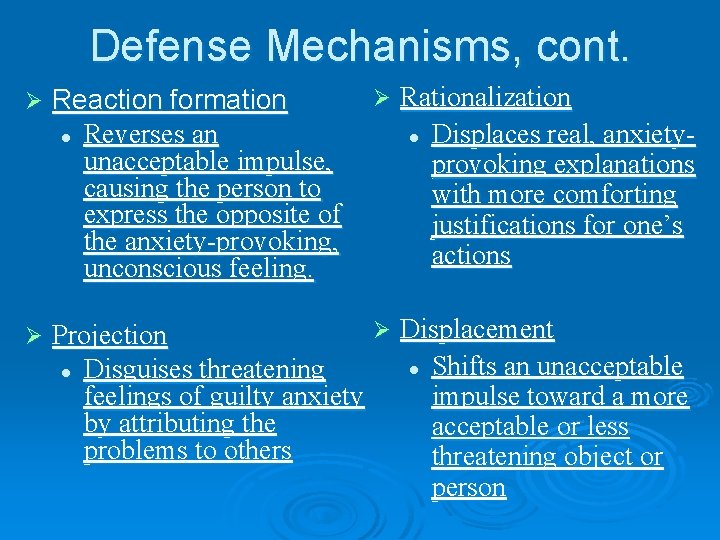
Defense Mechanisms, cont. Rationalization l Displaces real, anxietyprovoking explanations with more comforting justifications for one’s actions Ø Reaction formation l Reverses an unacceptable impulse, causing the person to express the opposite of the anxiety-provoking, unconscious feeling. Ø Ø Displacement Projection l Shifts an unacceptable l Disguises threatening feelings of guilty anxiety impulse toward a more by attributing the acceptable or less problems to others threatening object or person Ø
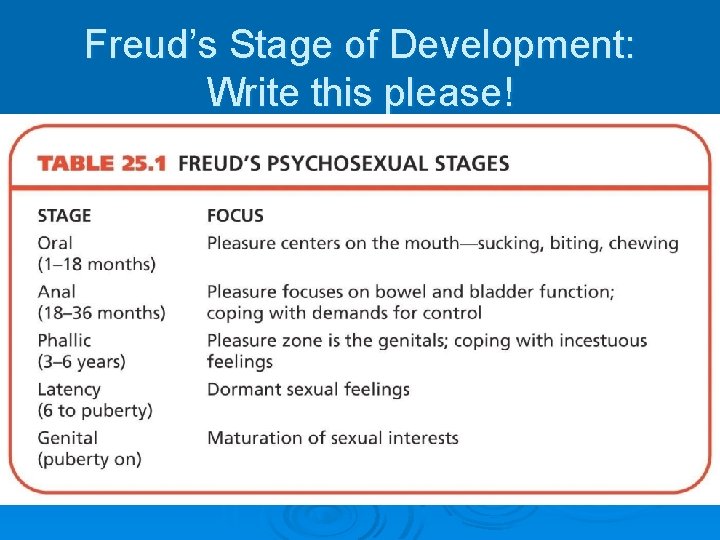
Psychosexual Stages Ø In Freudian theory, the childhood stages of development during which the id’s pleasure seeking energies are focused on different parts of the body Ø Develops in the first five or six years Ø The stages include: oral, anal, phallic, latency, and genital Ø A person can become “fixated” or stuck at a stage, leading to problems as an adult
Freud’s Stages of Development Ø 1. ) Oral Stage Pleasure comes from chewing, biting, and sucking. l Weaning can be a conflict at this stage. l Ø 2. ) Anal Stage Gratification comes from bowel and bladders functions. l Potty training can be a conflict at this stage. l
Freud’s Stages of Development Ø 3. ) Phallic Stage l The pleasure zone shifts to the genitals. l Boys cope with incestuous feelings toward their mother and rival feelings toward their dad (Oedipus conflict). Ø 4. ) Latency Stage l Sexual feelings are dormant. l Child identifies with and tries to mimic the same sex parent to learn gender identity. Ø 5. ) Genital Stage l Begins at puberty with the maturation of sexual interests
Freud’s Stage of Development: Write this please!
The Psychodynamic Perspective: Neo-Freudians Ø Followers of Freud’s theories but developed theories of their own in areas where they disagreed with Freud Ø Include Adler, Jung, and Horney
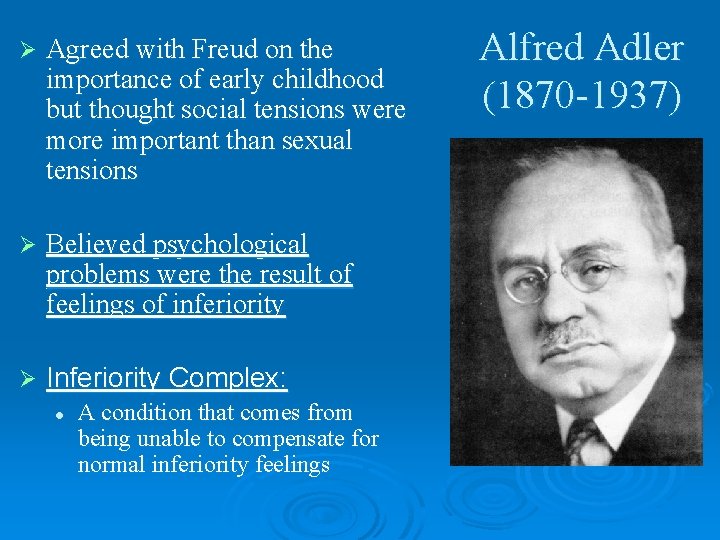
Ø Agreed with Freud on the importance of early childhood but thought social tensions were more important than sexual tensions Ø Believed psychological problems were the result of feelings of inferiority Ø Inferiority Complex: l A condition that comes from being unable to compensate for normal inferiority feelings Alfred Adler (1870 -1937)
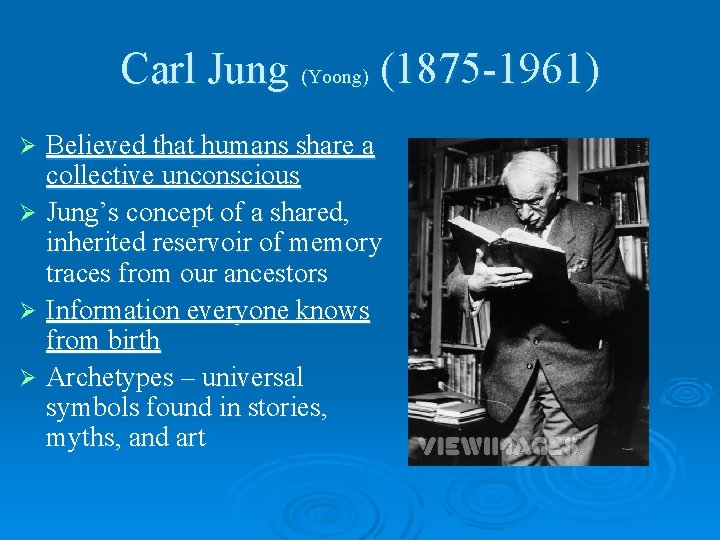
Carl Jung (Yoong) (1875 -1961) Believed that humans share a collective unconscious Ø Jung’s concept of a shared, inherited reservoir of memory traces from our ancestors Ø Information everyone knows from birth Ø Archetypes – universal symbols found in stories, myths, and art Ø
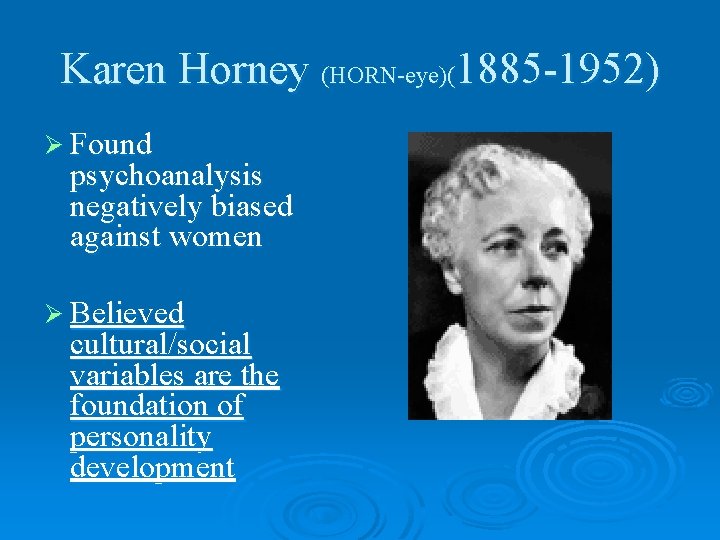
Karen Horney (HORN-eye)(1885 -1952) Ø Found psychoanalysis negatively biased against women Ø Believed cultural/social variables are the foundation of personality development
The Psychodynamic Perspective: Assessing Personality
Projective Tests Ø Personality tests that provide ambiguous stimuli to trigger projection of one’s inner thoughts and feelings Ø Include: l Thematic Apperception Test (TAT) l Rorschach Inkblot Test
Thematic Apperception Test A projective test in which people express their inner feelings and interests through the stories they make up about ambiguous scenes Ø The person makes up a story of a picture they are shown Ø Rorschach Inkblot Test Most widely used projection test Ø Personality test that seeks to identify people’s inner feelings by analyzing their interpretations of 10 inkblots Ø
Updating Freud’s Theory Ø Most psychodynamic psychologists agree: l l Sex is not the basis of personality. People do not “fixate” at various stages of development. Much of a person’s mental life is unconscious. People struggle with inner conflicts, and childhood experiences shape us.
Looking at Personality Through: The Humanist Perspective Ø A perspective that focuses on the study of conscious experience and the individual’s freedom to choose and capacity for personal growth Ø Studies fulfilled and healthy individuals rather than troubled people
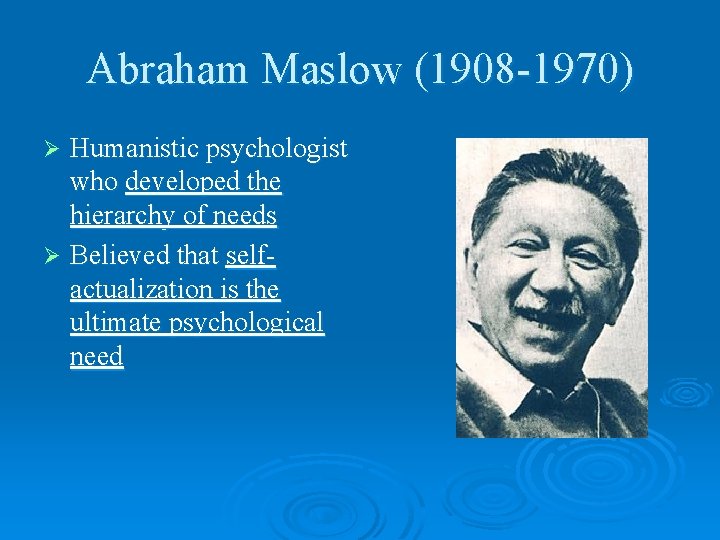
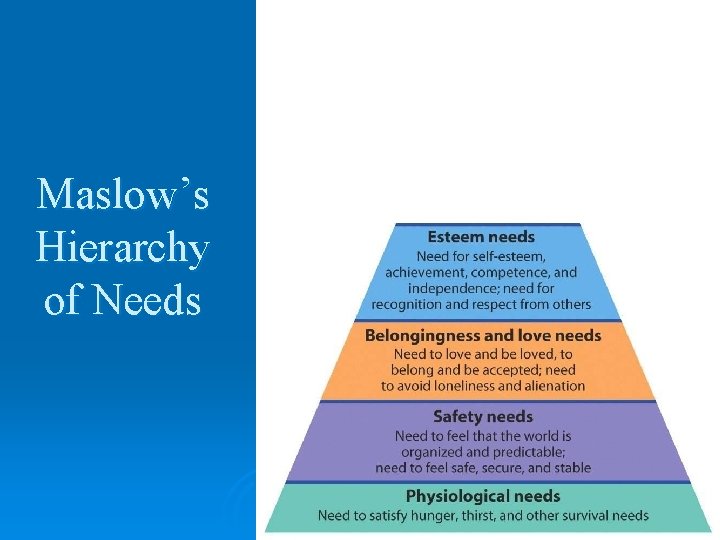
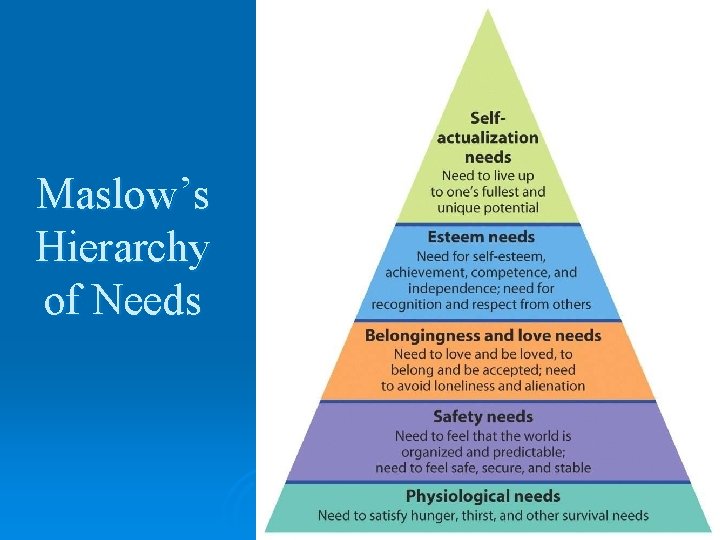
Abraham Maslow (1908 -1970) Humanistic psychologist who developed the hierarchy of needs Ø Believed that selfactualization is the ultimate psychological need Ø
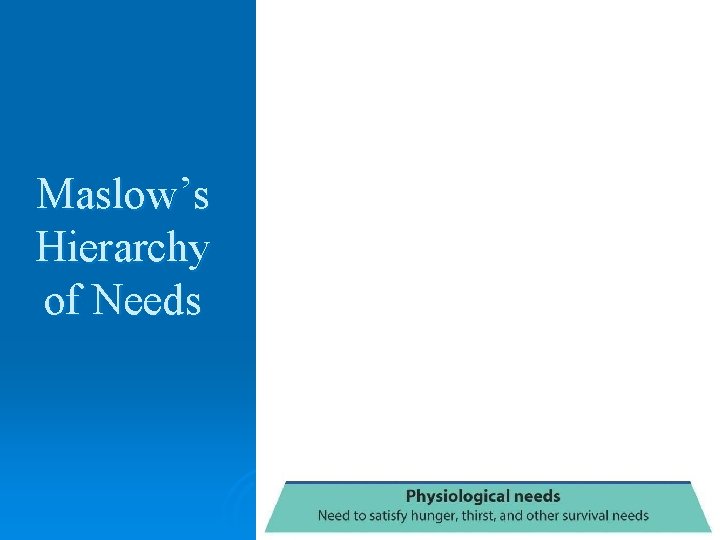
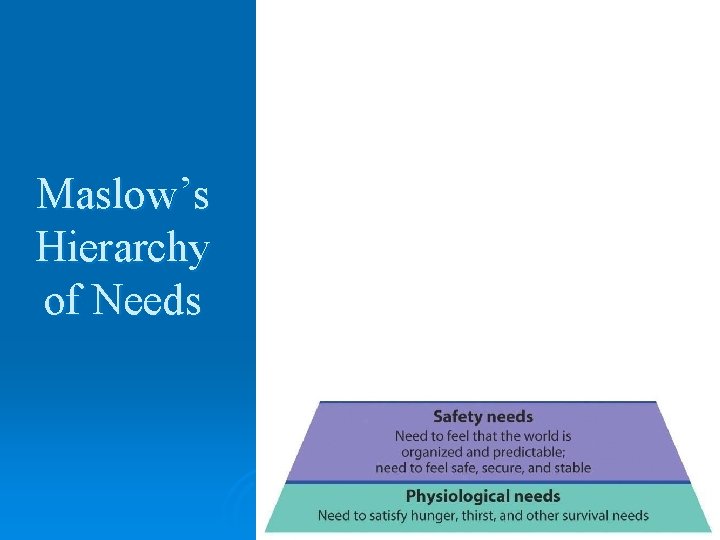
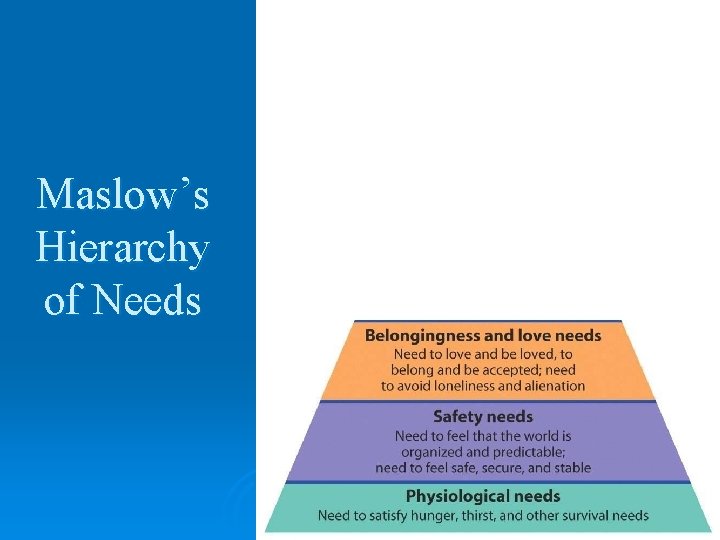
Hierarchy of needs Ø Maslow’s pyramid of human needs, beginning at the base with physiological needs, proceeding through safety needs and then to psychological needs Ø Higher-level needs won’t become active until lowerlevel needs have been satisfied. Self-Actualization According to Maslow, the need to live up to one’s fullest and unique potential Ø Characteristics include: l Self aware and self accepting l Open, spontaneous, loving, and caring l Not paralyzed by other’s opinions l Focused on a particular task Ø
Maslow’s Hierarchy of Needs
Maslow’s Hierarchy of Needs
Maslow’s Hierarchy of Needs
Maslow’s Hierarchy of Needs
Maslow’s Hierarchy of Needs
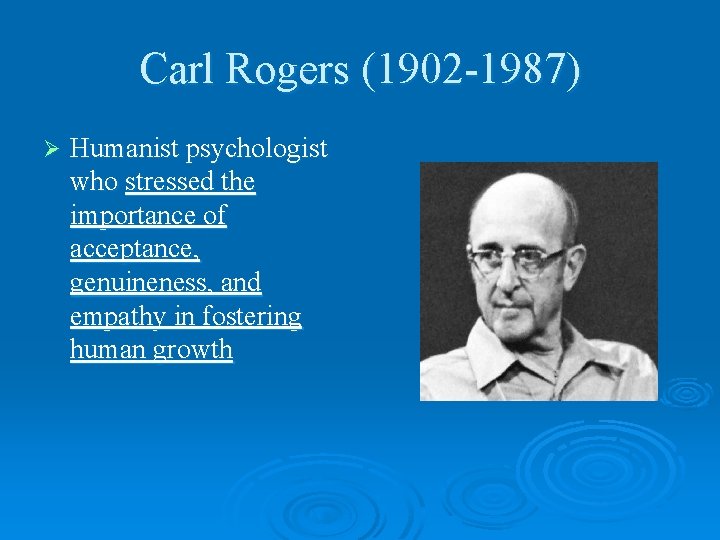
Carl Rogers (1902 -1987) Ø Humanist psychologist who stressed the importance of acceptance, genuineness, and empathy in fostering human growth
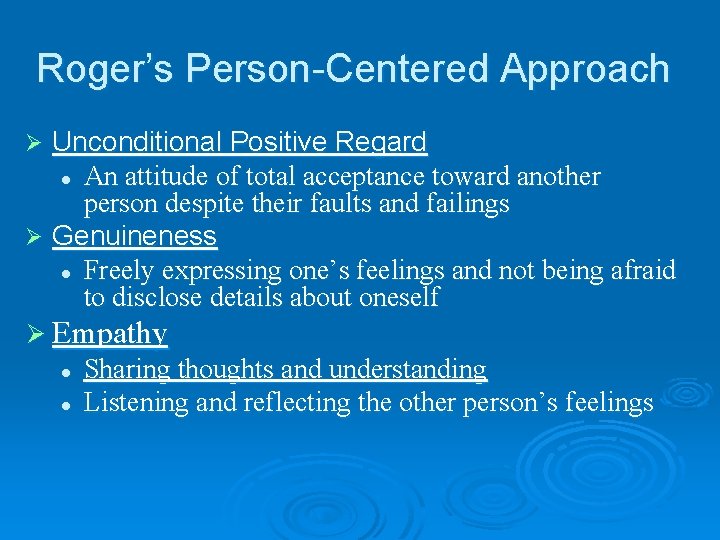
Roger’s Person-Centered Approach Unconditional Positive Regard l An attitude of total acceptance toward another person despite their faults and failings Ø Genuineness l Freely expressing one’s feelings and not being afraid to disclose details about oneself Ø Ø Empathy l l Sharing thoughts and understanding Listening and reflecting the other person’s feelings
Assessing Personality and the Self: Humanistic Measures Ø Humanistic measures of personality center on evaluating a person’s self concept--all of our thought and feelings about ourselves Ø Answer the question “Who Am I? ” Ø Evaluating the Perspective: Humanism has influenced therapy, child-rearing, and the workplace Ø Laid the foundation for positive psychology Ø