
Personality Chapter 13 What is personality Its patterns
- Slides: 15
Personality Chapter 13
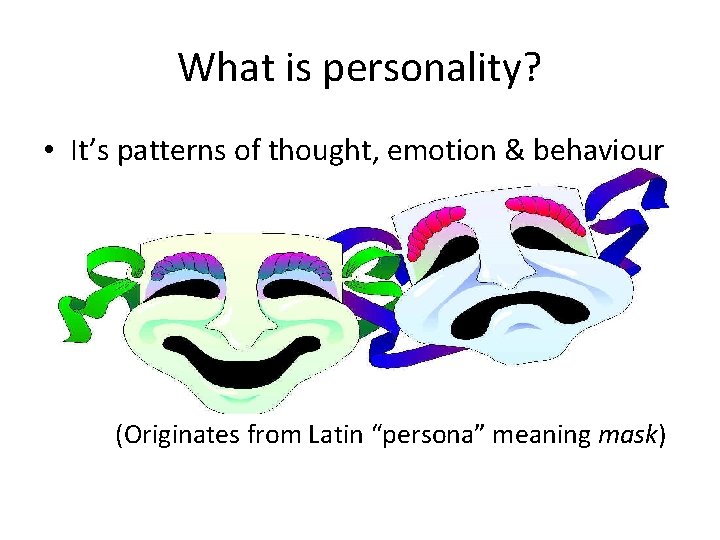
What is personality? • It’s patterns of thought, emotion & behaviour (Originates from Latin “persona” meaning mask)
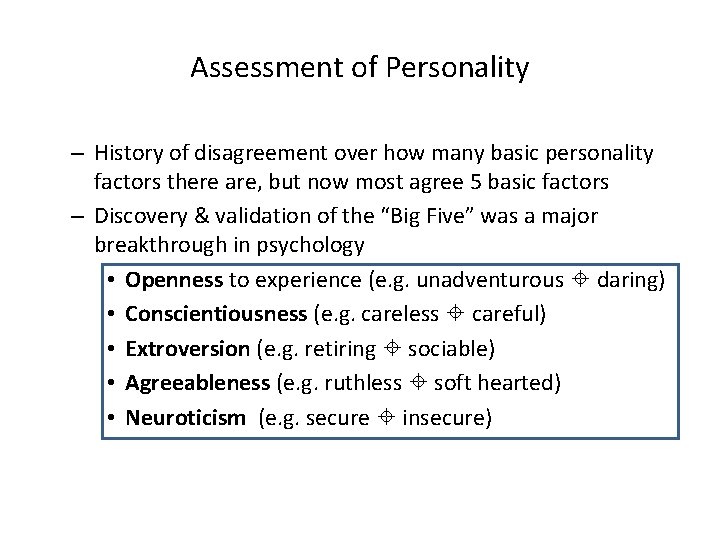
Assessment of Personality – History of disagreement over how many basic personality factors there are, but now most agree 5 basic factors – Discovery & validation of the “Big Five” was a major breakthrough in psychology • Openness to experience (e. g. unadventurous daring) • Conscientiousness (e. g. careless careful) • Extroversion (e. g. retiring sociable) • Agreeableness (e. g. ruthless soft hearted) • Neuroticism (e. g. secure insecure)
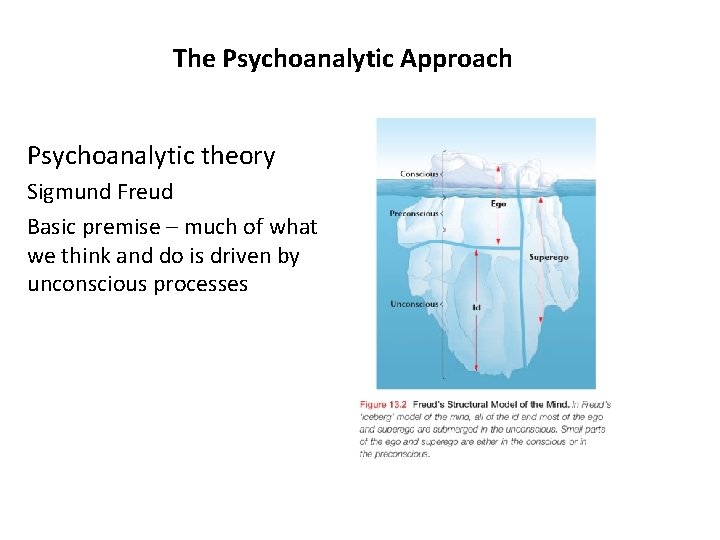
The Psychoanalytic Approach Psychoanalytic theory Sigmund Freud Basic premise – much of what we think and do is driven by unconscious processes
The Psychoanalytic Approach • Personality structure – Iceberg model was too simple so Freud developed a structural system with three major systems governing behavior – The id • Operates on pleasure principle seeking immediate gratification of basic biological drives – The ego • Obeys reality principle – gratification must be delayed until appropriate situation – mediates demands of the id, realities of the world & demands of the superego – The superego • Internalised representations of values & morals of society
The Psychoanalytic Approach • Personality dynamics – Conservation of energy • Constant amount of psychic energy (libido) for each individual – if forbidden act/impulse suppressed, its energy will seek outlet somewhere else, e. g. through dreams – Anxiety & defence • Urges to so something forbidden causes anxiety which can be reduced using defence mechanisms – Repression • Excludes from conscious awareness memories/impulses that are too frightening/painful
The Psychoanalytic Approach • . . . Personality dynamics – Rationalization • Assignment of logical/socially desirable motives to what we do so that we seem to have acted rationally – Reaction formation • Tendency to conceal motive from self by giving strong expression to the opposite motive – Projection • Protects us from recognizing own undesirable qualities by assigning them to others in exaggerated amounts
The Psychoanalytic Approach • . . . Personality dynamics – Intellectualization • Attempt to gain detachment from stressful situation by dealing with it in abstract, intellectual terms – Denial • Refusal to acknowledge that undesired reality exists – Displacement • A motive that cannot be gratified in one form directed into a new channel
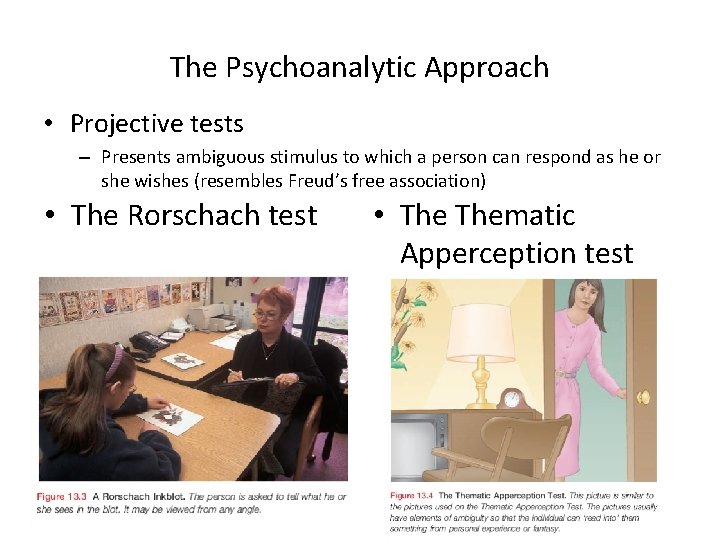
The Psychoanalytic Approach • Projective tests – Presents ambiguous stimulus to which a person can respond as he or she wishes (resembles Freud’s free association) • The Rorschach test • Thematic Apperception test
The Psychoanalytic Approach • Problems with projective tests – Rorschach tests too often misclassify normal people as pathological & reliability is also poor – TAT does better with reasonable interscorer reliability & is useful for predicting some specific behaviors • A psychoanalytic portrait of human nature – Freud emphasised that human behavior determined by forces beyond our control (“psychic determinism”) – Human nature basically evil, restrained by societal forces & the superego
Humanistic theories • These theories seem much more upbeat than psychoanalytic theories; humans can improve themselves and aspire to be beautiful people • Rogers – self actualization – unconditional positive regard
Social learning theories • Rotter: Locus of control • Mischel: people differ in their life goals and strategies to achieve them • Bandura: reciprocal determinism
Self theories • William James: self is Physical, Social, and “Spiritual” (Reflective / Self-awareness) • Cultural constructions of self: We construe ourselves differently depending on where we’re from, and how we’re primed – Independent self – Interdependent self
Reading assignment • Required: p. 360 -366 – Recommended: 368 -379