
Personality Chapter 10 Personality A persons unique and














- Slides: 64
Personality §Chapter 10
Personality § A person’s unique and relatively consistent patterns of thinking, feeling, and behaving.
Theories of Personality Different theories tell us how and why we have the personality we do.
Psychoanalysis- Freud § Personality is determined from your unconscious desires/ conflicts (sexual & aggressive)
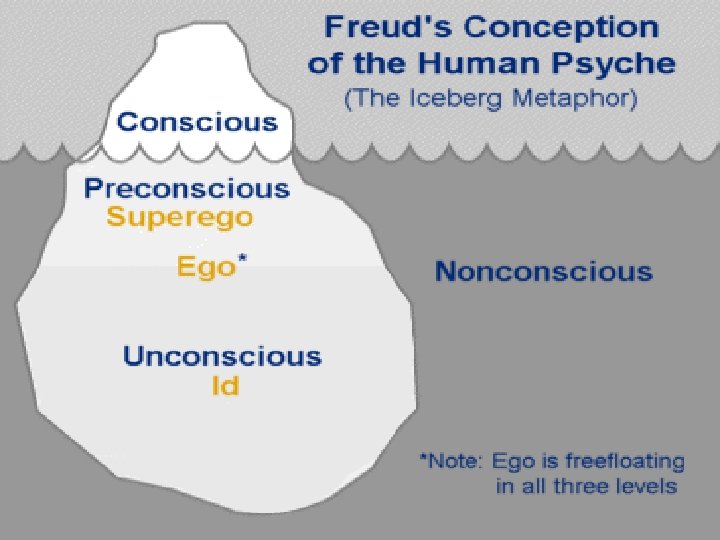
Consciousness • Unconscious- what you don’t know is there- formed in early childhood • Preconscious- you don’t know, but can get easily • Conscious- what you know and can remember
Psychoanalytical Approach The Unconscious Mind § Unconscious Mind – the most basic of all human instincts and desires. Primitive, uncontrolled thoughts of sex, aggression, hunger.
Psychoanalytical Approach The Unconscious Mind § Unconscious Mind – contains all of our repressed thoughts, passions, desires, wishes, feeling, etc. Repressed feelings are blocked because they would be too unsettling to acknowledge
Psychoanalytical Approach How do we access the Unconscious Mind?
Psychoanalytical Approach Accessing the Unconscious Mind § Dream Interpretation § Manifest Content – the actual content of dreams § Latent Content – the interpreted content of a dream and unconscious wishes
Psychoanalytical Approach Accessing the Unconscious Mind § Free Association § Patient reports all thoughts, feelings, and mental images that come to mind. § Ie. Say the first thing that comes to mind when I say “Cat”
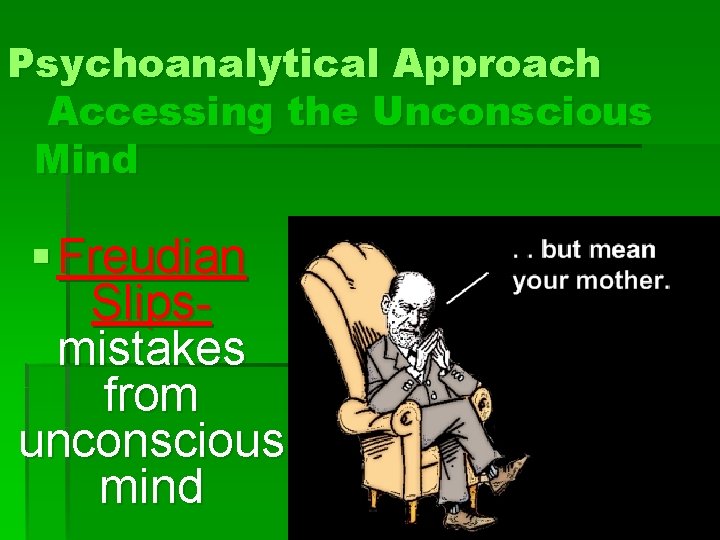
Psychoanalytical Approach Accessing the Unconscious Mind § Freudian Slipsmistakes from unconscious mind
Psychoanalytical Approach Accessing the Unconscious Mind • The Freudian Slip - Speech • "As I was telling my husb—" before abruptly breaking off and correcting herself: "As I was telling President Bush. " • Condeleeza Rice • Does the Secretary of State have a tormented life? ?
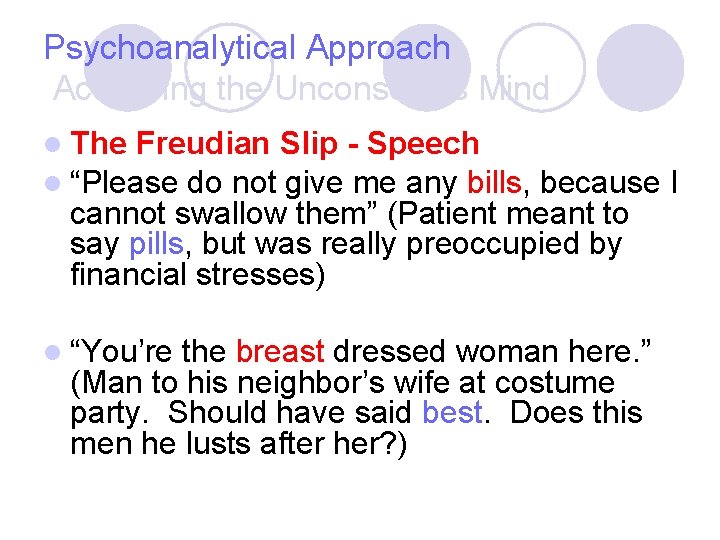
Psychoanalytical Approach Accessing the Unconscious Mind l The Freudian Slip - Speech l “Please do not give me any bills, because I cannot swallow them” (Patient meant to say pills, but was really preoccupied by financial stresses) l “You’re the breast dressed woman here. ” (Man to his neighbor’s wife at costume party. Should have said best. Does this men he lusts after her? )
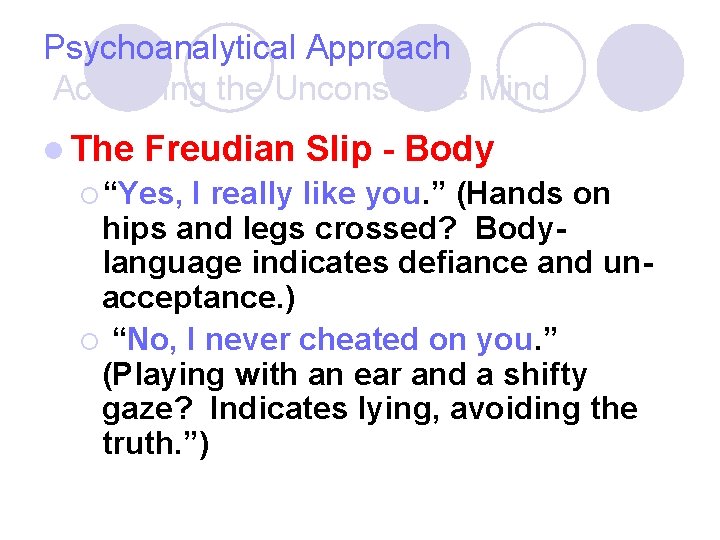
Psychoanalytical Approach Accessing the Unconscious Mind l The Freudian Slip - Body ¡ “Yes, I really like you. ” (Hands on hips and legs crossed? Bodylanguage indicates defiance and unacceptance. ) ¡ “No, I never cheated on you. ” (Playing with an ear and a shifty gaze? Indicates lying, avoiding the truth. ”)
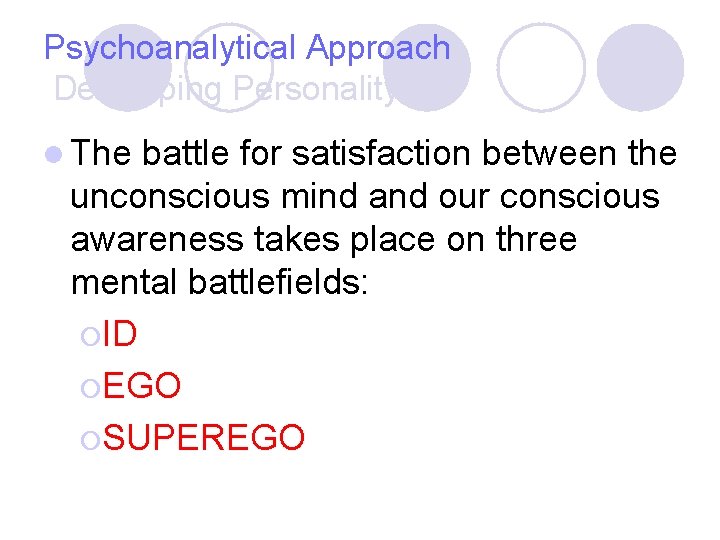
Psychoanalytical Approach Developing Personality l The battle for satisfaction between the unconscious mind and our conscious awareness takes place on three mental battlefields: ¡ID ¡EGO ¡SUPEREGO
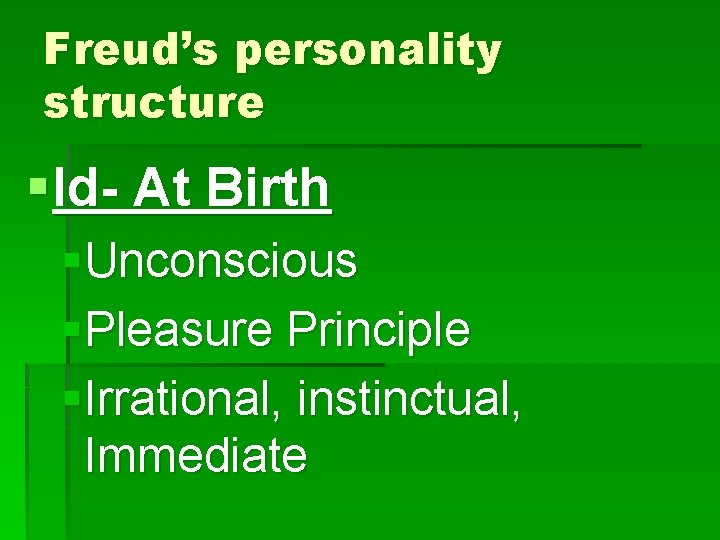
Freud’s personality structure § Id- At Birth §Unconscious §Pleasure Principle §Irrational, instinctual, Immediate
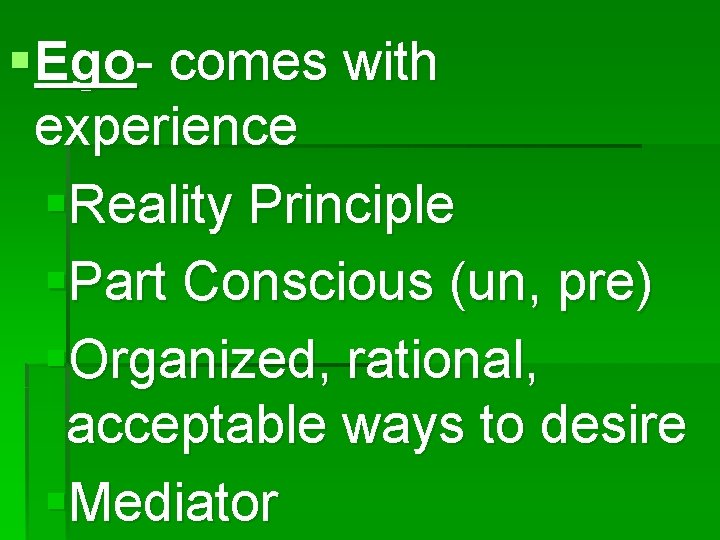
§ Ego- comes with experience §Reality Principle §Part Conscious (un, pre) §Organized, rational, acceptable ways to desire §Mediator
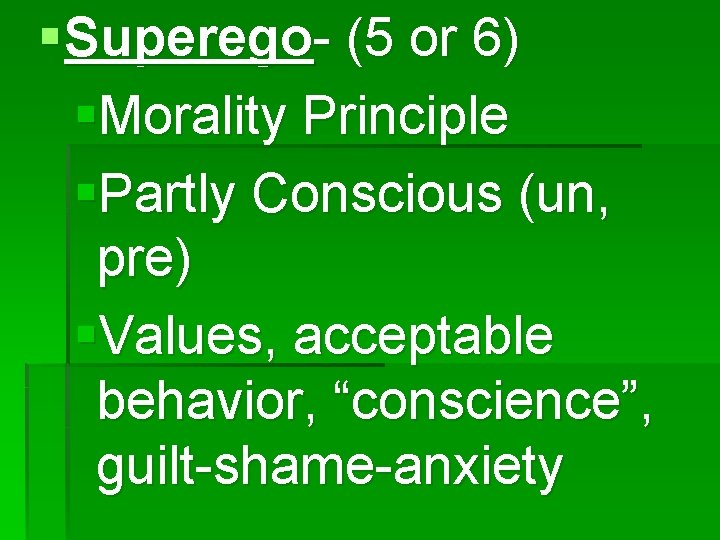
§ Superego- (5 or 6) §Morality Principle §Partly Conscious (un, pre) §Values, acceptable behavior, “conscience”, guilt-shame-anxiety
Ego Defense Mechanisms § Your EGO must safely and responsibly satisfy your ID, while keeping in mind your SUPEREGO
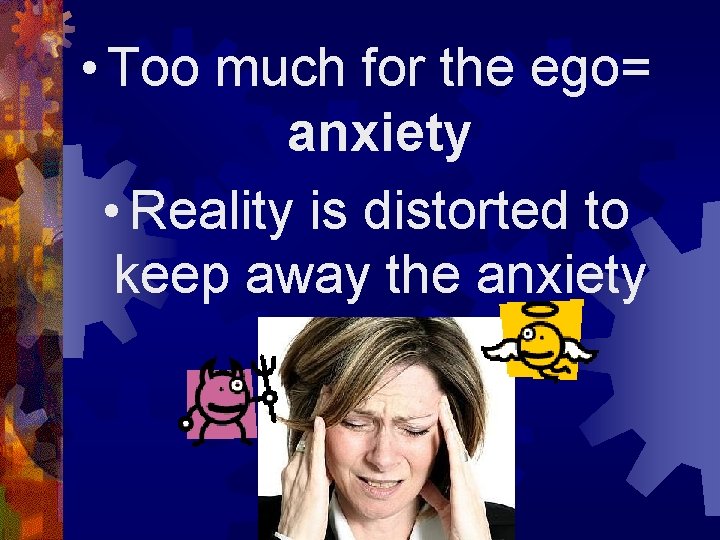
• Too much for the ego= anxiety • Reality is distorted to keep away the anxiety
Defense Mechanism • Your mind’s way of reducing internal stress caused by excess anxiety
Repression Excluding from consciousness all anxiety producing thoughts, feelings, impulses
n n You can’t remember anything about a car accident you had two weeks ago The accident produces too much anxiety- so it “goes away”
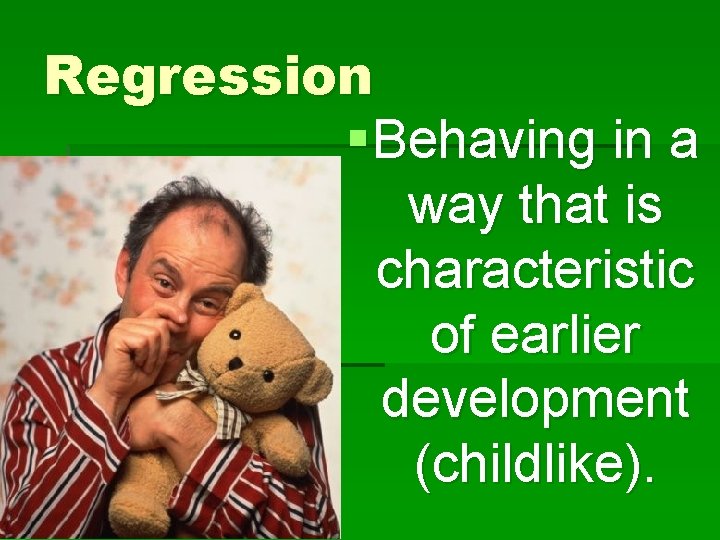
Regression § Behaving in a way that is characteristic of earlier development (childlike).
§ My 10 year old is sucking her thumb all of a sudden, she stopped at age 2. § After a divorce (she can’t handle the idea) she reverts back to a “safer” time
Identification u u When a person changes some aspect of their personality to be more like others – thus reducing anxiety. Occurs on a subconscious level – not just mimicking
Psychoanalytical Approach Defense Mechanisms § Reaction Formation § The EGO enacts behavior that is exactly opposite of the decision it made
Psychoanalytical Approach Defense Mechanisms § A child, angry at his or her mother, may become overly concerned with her and rather dramatically shower her with affection. § An abused child may run to the abusing parent. Or someone who can't accept a homosexual impulse may claim to despise homosexuals
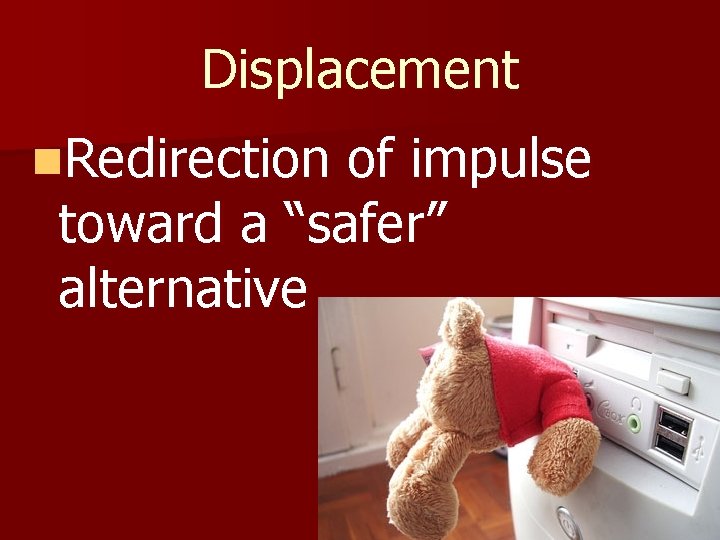
Displacement n. Redirection of impulse toward a “safer” alternative
n. I was really upset because my seniors miss too many days of class, I can’t hurt them, so I pick something I can hurt I go home and kick my dog instead…
Rationalization § Justifying your actions/ feelings with another explanation- not your true feelings
§ I’m glad I didn’t get into that college- the drive would have been too far. § You were really upset about not getting in, but can’t face that anxiety
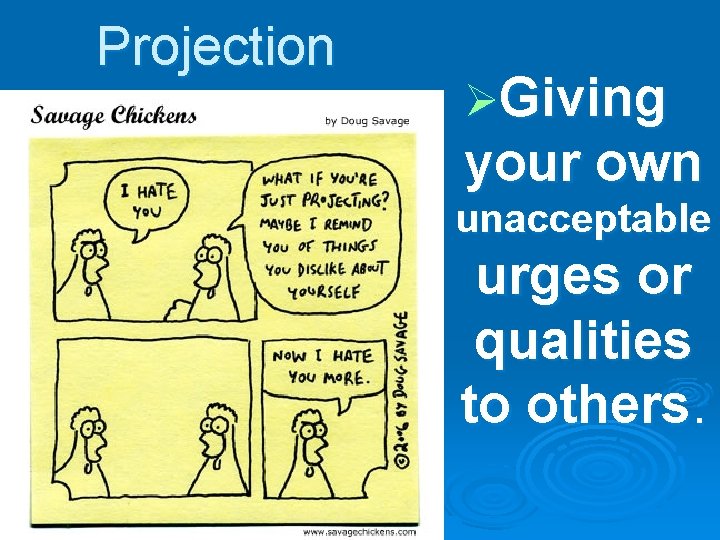
Projection ØGiving your own unacceptable urges or qualities to others.
ØI don’t understand how he doesn’t get a detention- he is always late to class! ØYou have been late 15 times, but you don’t talk about YOU.
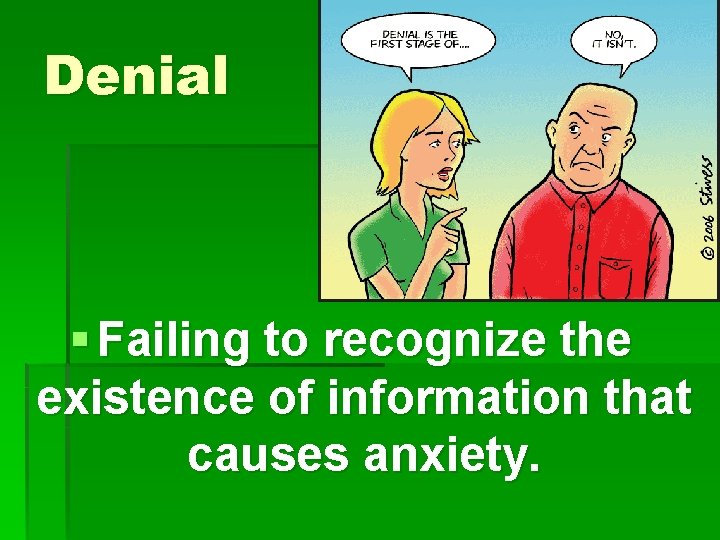
Denial § Failing to recognize the existence of information that causes anxiety.
§ No, I don’t have a drinking problem, I can stop anytime I want. § You are an alcoholic- your friends and family all know it, but you won’t admit it.
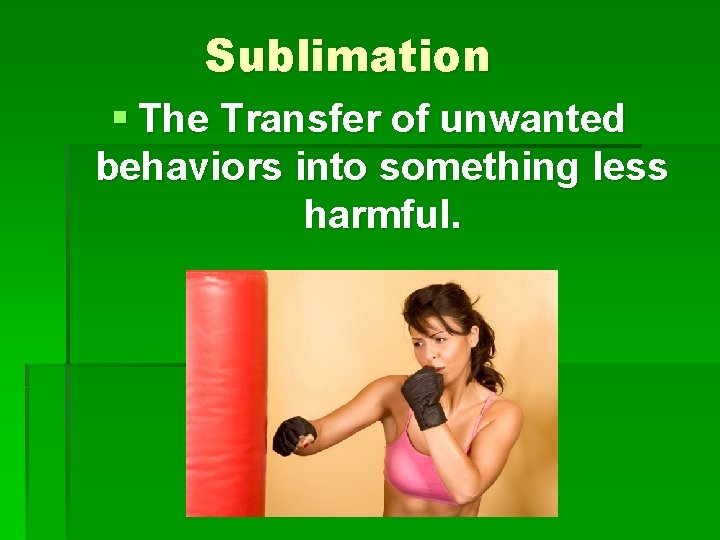
Sublimation § The Transfer of unwanted behaviors into something less harmful.
§ A person who is angry may work out and get in shape as a result § A person that is sexually frustrated may become an artist and release the pent up energy and emotion into great works of art.
Compensation § Emphasize our talents and abilities to cover up real or imagined weaknesses § Under compensate = inferiority complex § Over compensate = superiority complex
Psychosexual Stages § Freud’s theory of sexual development § “Sexual” means whatever brings pleasure, not procreation
l. Your Sexual Energy (Libido) is focused on different parts of the body at different ages.
§ If too much or too little “energy” is expressed during each stage- a person can become “fixated” § Fixated stages affect your personality
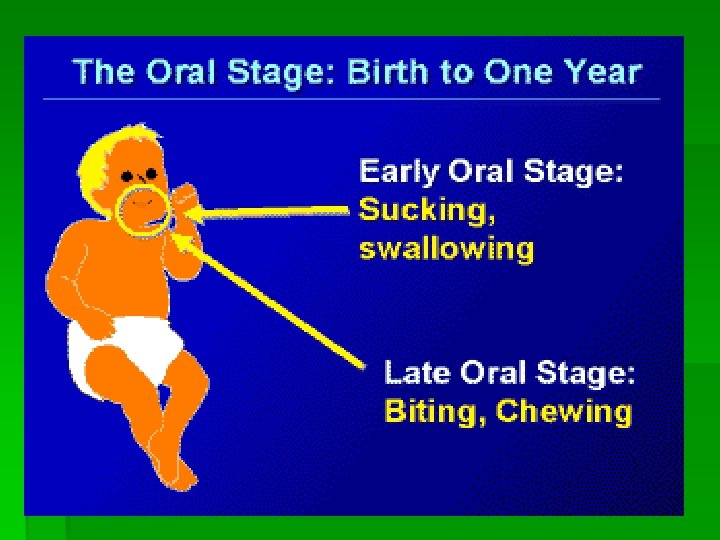
Oral Stage § Birth to 1 ½ § Pleasure through eating, biting, putting everything in mouth § The primary conflict at this stage is the weaning process (becoming less dependent)
Fixated? § If child has a problem developing independence, fixation will occur § Personality is highlighted by dependency issues, aggression, gullibility, sarcasm, lack of confidence § Bites on pens, smokes, bites fingernails, addicted to chap stick, chews a lot of gum
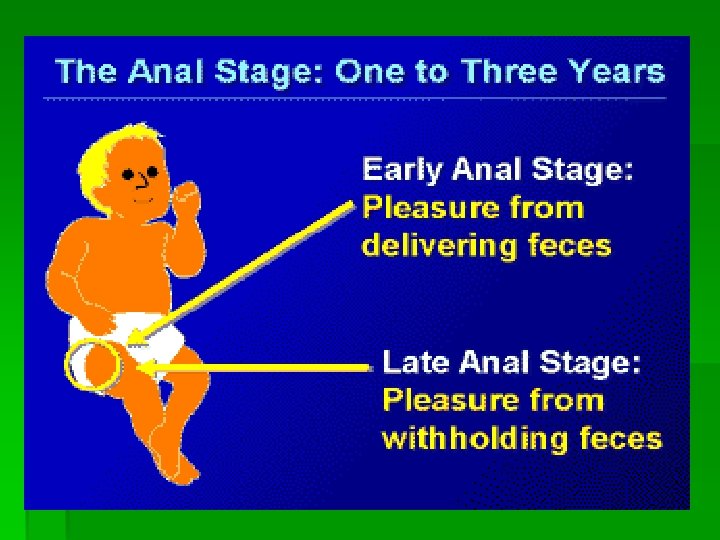
Anal Stage § 1 ½ to 3 § Potty training is the major conflict § Pleasure through control of elimination § Developing this control leads to a sense of accomplishment and control.
Fixated? inappropriate parental responses during potty training can result in negative outcomes. § too lenient: an anal-expulsive personality could develop in which the individual has a messy, wasteful, or destructive personality. § too strict or too early: an anal-retentive personality develops in which the individual is stringent, orderly, rigid, and obsessive.
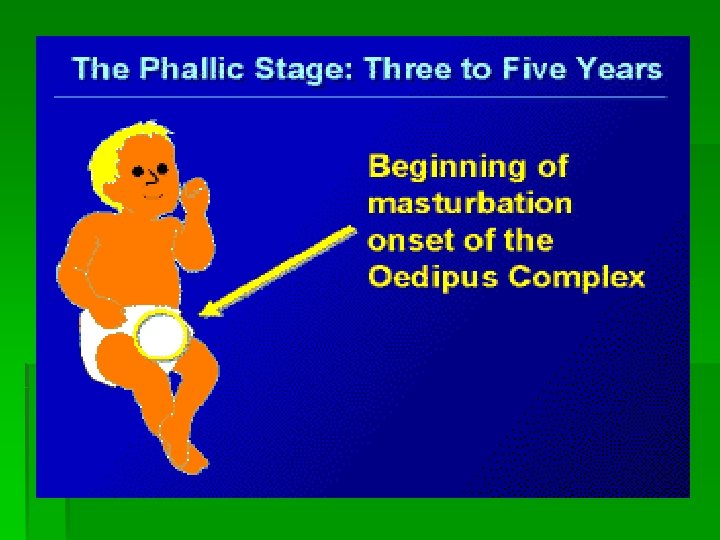
Phallic Stage § Age 3 -5 § Discover genitals (& difference between girls & boys) § Attachment to opp. sex parent, Jealous of same sex parent
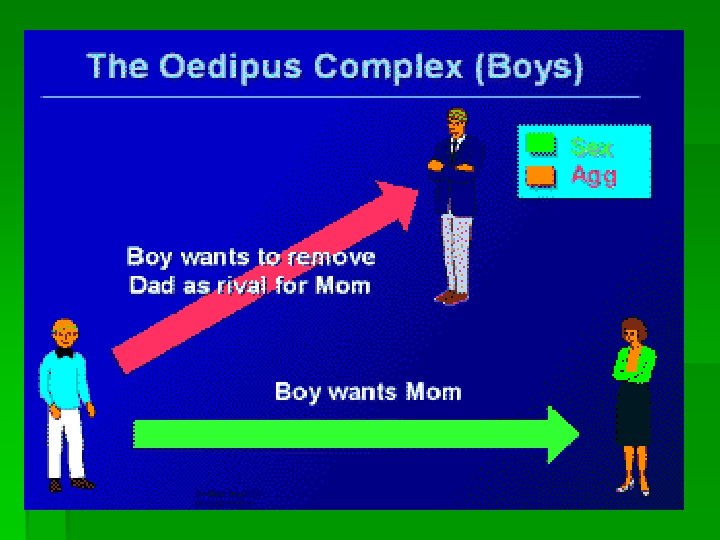
Oedipus Complex § Unconscious desire for opposite sex parent – hostility toward same sex parent § Boys & Mommies
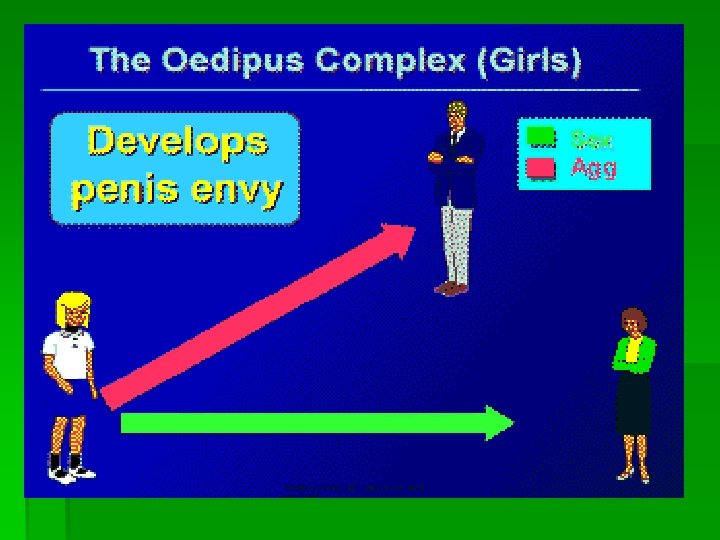
Electra Complex § Unconscious desire for opposite sex parent – hostility toward same sex parent § Girls & Daddies § Penis Envy
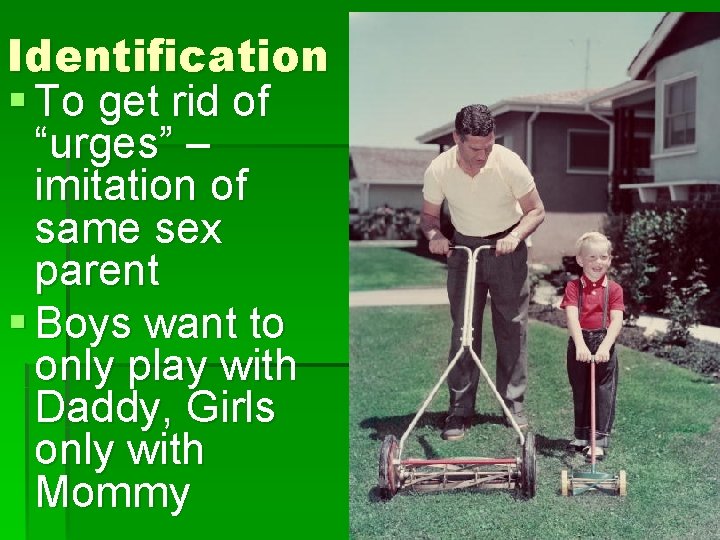
Identification § To get rid of “urges” – imitation of same sex parent § Boys want to only play with Daddy, Girls only with Mommy
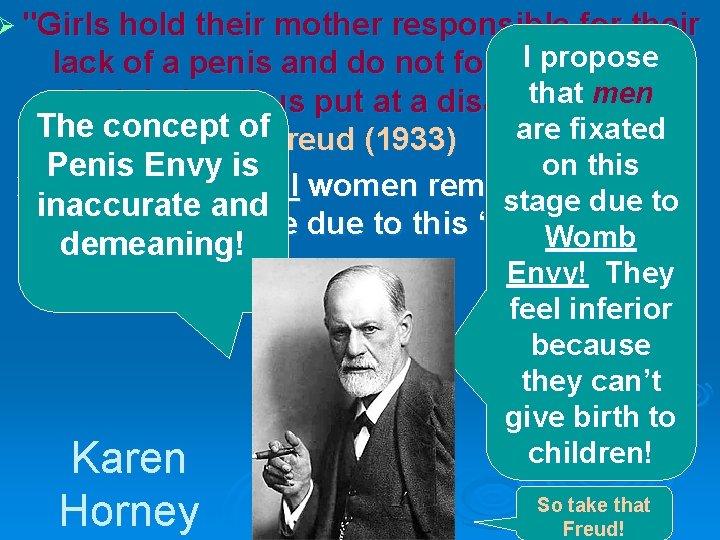
Ø "Girls hold their mother responsible for their I propose lack of a penis and do not forgive her for that men their being thus put at a disadvantage" The concept of. Freud (1933) are fixated on this Penis Envy is Ø Freud felt that all women remain fixated in stage due to inaccurate and the phallic stage due to this “penis envy” Womb demeaning! Karen Horney Envy! They feel inferior because they can’t give birth to children! So take that Freud!
Fixation in the Phallic Stage u. For men: Anxiety and guilty feelings about sex, fear of castration, and narcissistic personality. u. For women: It is implied that women never progress past this stage fully and will always maintain a sense of envy and inferiority
Latency Stage § Age 5 - Puberty § No sexual energy (absence of libido) – in part due to the growth of the ego and superego § Learns gender identity
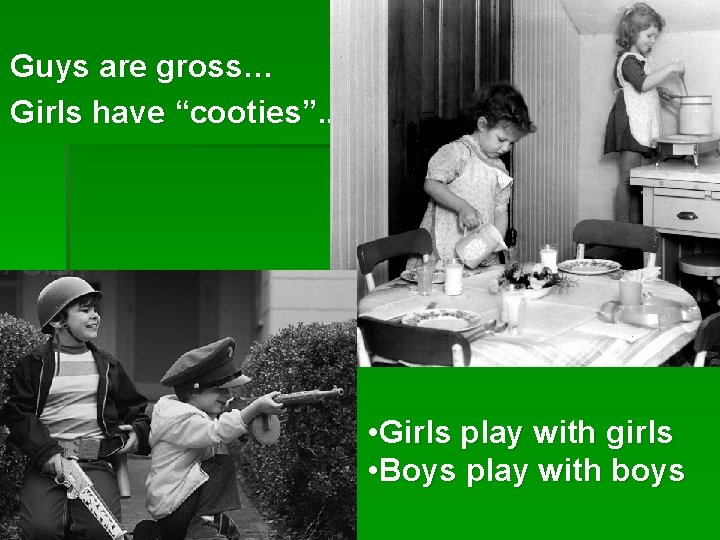
Guys are gross… Girls have “cooties”. . • Girls play with girls • Boys play with boys
Latent Stage § Fixations do not develop in this stage…
Genital Stage n Puberty + n Reproduction capable n Mature, responsible urges and pursuit of relationships n No Fixation – any problems arising during this phase is due to a fixation from a previous stage…
Updating Freud’s Theory § Modern Psychologists put less emphasis than Freud on: § Sexual basis of personality § Men vs. women § Freud’s Theories are updated by the likes of Erikson, Piaget, etc…