
Personality and Politics Personality is central concept in
- Slides: 40
Personality and Politics
• Personality is central concept in psychology, the most fundamental element • Personality not only affects how people think and behave in the political arena but it is also affected by the life experience of individual
Central questions • How does personality affect political behavior? • What personality characteristics are most politically relevant? • How should we study personality since we can’t put a political figure on the couch and ask him or her questions?
• Personality: study of political behaviors, psychology of political leaders, psychopathologies of people who have committed politically motivated atrocities, role of personality factors play in attitudes toward race and ethnicity, willingness to obey authority
• Personality refers “important and relatively stable aspects of a person’s behavior that account for consistent patterns of behavior, ” aspects of which “may or maybe observable or unobservable, and conscious or unconscious (Ewen, 1998: 3 -4)
• Personality theorist include cognition, affect, motivation, identification, and process of egodefense in conception of personality • There are different theories of personality in psychology organized into 9 categories: psychoanalytic, neo-psychoanalytic, interpersonal, trait, developmental, humanistic, cognitive, behavioristic, and limited domain. • However, political psychology chapter 2 focuses on commonly used theories in political psychology: psychoanalytic, traits, and motivation
• Political psychology literature focus on how particular aspects of personality translate into political behavior. • study of personality in political psychology refers to the study of individual differences
When do personality matter in politics? • When individuals have the personal power resources due to their position in the political system (i. e. , president, prime minister) and the situation allows the to exert this power to influence the policy progress, what these people are like will have an impact on policy • Role of Saddam Hussein in Iraq’s invasion of Kuwait • American presidents have weaker influence upon domestic policy, where the Congress and interest groups are determining policy outcomes
Theories and approaches to studying personality • Psychoanalytic Approach: • Focus on the role of unconscious in human behavior and motives and drives that underline behavior • Sigmund Freud: mind is like an iceberg, only small part of the iceberg is visible floating above water (conscious), around 90% (unconscious)is under water and unobservable
• According to Freud human begins are motivated to satisfy aggressive and sexual drives, which is called pleasure principle, and behavior is a product of those drives and unconscious efforts by individuals to suppress and channel the desire to act in search of satisfaction.
• Freud argues that personality is based on three elements: • 1 - Id: instincts and responses to bodily functions which follows pleasure principle • 2 - ego: between Id and desire for pleasure and the realities of the social world which follow reality principle • 3 - superego: moral arm or conscience of the personality
• If you interact with individual whom you do not like id may inspire you to lash angrily, but ego keeps you from doing it because it socially inappropriate, and superego tells you to be kind to all people and forgive them
psychobiography • Lack of direct person-to-person psychoanalysis access in political psychology (unlike Freud’s the couch and dream analysis) • Analysis of political figures by using the psychbiographical method • Examination of life history of an individual • In depth case studies of individual leaders tracing their personality, social and political devepolment from early childhood onwards through young adulthood.
• Study of Woodrow Wilson written by Alexanders and Juliette George in 1964 • His behavior pattern was developed through his childhood and young adult life, followed him into the White House
• Examination of political leaders’ behavior as a possible product of psychopathologies (Lasswell, Psychopathology and Politics, 1930/1960) • Behavior of some people in political role is affected by their psychopathology or psychological disorders • A personality disorder is characterized in individuals by anxiety, self-consciousness, vulnerability, hostility, depression
• Narcissism, Volkan (1980) argues that narcissistic people seek leadership roles in relentless search for power and use others in their climb to power • Paranoia, Brit’s (1993) analysis of Joseph Stalin, his personality fit the pattern associated with paranoia • Paranoid personalities: combination of aggression and narcissism.
• Stalin’s paranoia not only affected the international policies of the Soviet Union but Stalin’s career as well. • Political psychologists seeks to examine personality disorders which is widely accepted by American Psychiatric Association’s
Criticisms • Critics of Freud: research was not controlled, relies upon his recollections of therapy sessions with patients, without the original data, subject to biases as a result of the fact that he relied on his own recollections of discussions • Lack of empirical testing, unobservable abstract ideas, difficult to develop testable and therefore falsifiable hypothesis • As a result of these criticism number of additional personality theories emerged in psychology
Trait Theories • Traits are personality characteristics that are stable over time and in different situations • Traits produce predispositions to thin, feel, or act in particular pattern toward people, events, and situations • Disagree with Freud’s contention that personality dynamics are governed by unconscious and also childhood experiences are less important than adult's personality
• Personality traits to be central in determining how people respond their environment • Cardinal traits: dominate person’s life (authoritarianism) • Central traits: affect people regularly but not in every situation (honesty) • Secondary traits: irregular affecting behavior
• Motivation as driving force in human behavior, motivation through cognitive processes
• Eysenck (1975) identified three personality trait dimensions of a person by using questionnaires (statistical analysis called factor analysis): • 1 - introversion-extroversion: how outgoing • 2 - neuroticism: how emotionally stable • 3 - psychoticism: how isolated and insensitive to others
• Five central personality traits: neuroticism, extroversion, agreeableness, openness to experience and conscientiousness
Motive Theories • Motives “energize, direct, and select behavior” (Emmons, 1997: 486) • Big Three in both psychology and political psychology: need for power (concern for prestige), need for affiliation intimacy (concern for close relations with others, and need for achievement (concern with excellence and tack accomplishment)
• Distance measurement technique: content analysis • Content analysis: due to the lack of direct access to policy makers we look at their statements and inner from those statements • Systemic content analysis: collection of statements and coding
The Authoritarian Personality • Interest in exploring authoritarian personality characteristics increased as result of WWII and the Nazi regime in Germany. • Authoritarian personalities are the product of authoritarian patterns of childhood upbringing a resultant weak ego • Demanding, controlling and disciplinary techniques , as a result children did not develop effective ways of controlling their sexual and aggressive impulses, and thus feared thise impulses
• Authoritarian personality study by using questionnaires and clinical measures (interviews) • Scales are used to measure several elements of authoritarian political attitudes • Politically right-wing authoritarianism is submission to perceived authorities particularly those in the established system of governance (for ex: right wing system as in apartheid South Africa, a communist system as in the People’s Republic of China)
• Right-wing authoritarianism is a product of social learning, combination of personality predispositions, and life events. • Being prohibited from challenging that authority • Authority figure is accepted as correct • See the world as a very dangerous place
Leader Framework Analysis • Frameworks used to study political leaders: presidential character, trait-assessment approach, and operational codes • Lack of common empirical approach to study political leaders, methodologically diverse, interdisciplinary literature
Presidential Character • Employs psychobiography to explain personalities, styles, and character of moden presidents • Seek patterns in the early lives or political careers of leaders that create through a process of socialization (style, personality and leadership) • As a result of the component of presidential personality (character, world view, style) are patterned, fitting together in a “dynamic package understandable in psychological terms.
• Style: reflects the habitual way a president performs his three political roles (rhetoric, personal relations, and homework) • World view: leader’s primary politically relevant beliefs regarding such things as social causality, human nature, and the central n oral conflicts • Character: the way a president orients himself toward life and his own merits (self-esteem, achievement or affection)
• In order to put these pieces together Barber (1972) employs psych biographical approach to trace back first independent politically access which set pattern that follows giving the leader template for successful action and positive feedback
Leaders’ Characteristics: Motives and Traits • A wealth of research also exists surrounding the impact that various individual characteristics of leaders have upon their styles of decision making, interpersonal interactions, information processing, or management behaviors in office
• The need for power (or dominance): concern with establishing, maintaining, or restoring one’s power, i. e. , one’s impact, control, or influence over others • The cognitive complexity of decision makers is another individual characteristic that has long been argued to have a significant impact upon the nature of decision making, style of leadership, assessment of risk, and character of general information processing within decision groups
• Leader Trait Assessment: content analytic technique most widely utilized leaders assessment approach to leadership analysis based on computer-based expert system, Profiler-Plus • Coeds million of words of text systemically with ease
Operational Code Analysis • Operational code analysis emerged during early 1950 s as a leadership assessment tool to study political leaders’ belief systems that were embedded in leaders’ personalities. The study of operational code analysis was developed at RAND by Nathan Leites’ in 1951 and 1953 to analyze Soviet leaders’ sets of beliefs and strategies (operational code created by cultural and psychological sources).
• In 1969, Alexander George developed Leites’ work by identifying a set of questions to reveal the philosophical and instrumental beliefs of leaders • He highlights the importance of belief systems which filter incoming information from the outside world and influence the perceptions of individuals as well as their preferences by establishing a systemic study method of leaders’ operational codes
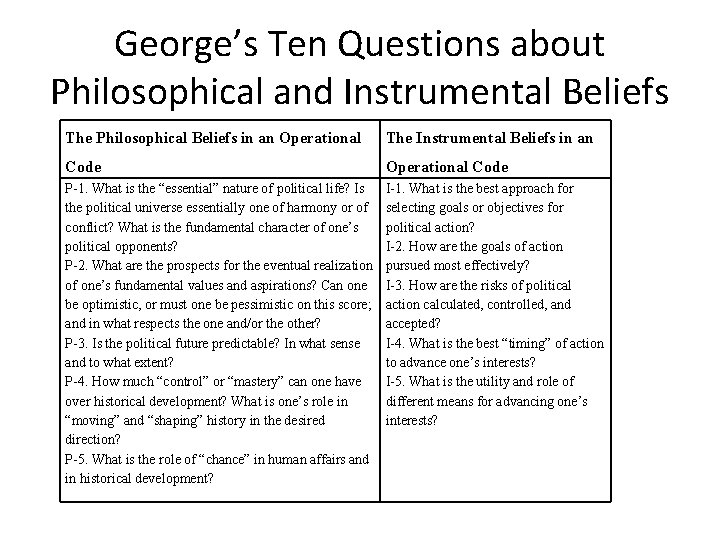
• In his work George focused on philosophical and instrumental beliefs of individuals and introduced ten sets of research questions to establish a typology of operational code in order to analyze belief systems and cognitive process of leaders
George’s Ten Questions about Philosophical and Instrumental Beliefs The Philosophical Beliefs in an Operational The Instrumental Beliefs in an Code Operational Code P-1. What is the “essential” nature of political life? Is the political universe essentially one of harmony or of conflict? What is the fundamental character of one’s political opponents? P-2. What are the prospects for the eventual realization of one’s fundamental values and aspirations? Can one be optimistic, or must one be pessimistic on this score; and in what respects the one and/or the other? P-3. Is the political future predictable? In what sense and to what extent? P-4. How much “control” or “mastery” can one have over historical development? What is one’s role in “moving” and “shaping” history in the desired direction? P-5. What is the role of “chance” in human affairs and in historical development? I-1. What is the best approach for selecting goals or objectives for political action? I-2. How are the goals of action pursued most effectively? I-3. How are the risks of political action calculated, controlled, and accepted? I-4. What is the best “timing” of action to advance one’s interests? I-5. What is the utility and role of different means for advancing one’s interests?
• Philosophical beliefs aim to explain how leaders identify other actors and view the external environment (political universe) and instrumental beliefs specify leaders’ preferences for the most effective strategies or tactics to achieve certain goals. • In 1998 Schafer, Walker and Young developed a revolutionary computer software program Verbs In Context System (VICS) analyzes leader’s belief systems to understand the political world.