
Personality and its assessment Chapter 12 1 Defining
- Slides: 47
Personality and its assessment Chapter 12 1
Defining Personality and Traits. • Personality – a pattern of relatively permanent traits, dispositions, or characteristics that leads to some consistency in a person’s behaviour • Trait – A characteristic of an individual – Describes their habitual way of: • Behaving • Thinking • Feeling 2
Theories of Personality should: • Answer the what, how and why of human behavior • Explain personality: – Development, structure, processes, psychopathology and change • Be tested and evaluated for validity and reliability 3
Psychodynamic Influences on Personality • Defining key terms • Freud and psychoanalysis • Other psychodynamic approaches 4
Key terms • Psychodynamic theories – Psychodynamic theories focus on how unconscious processes direct day-to-day behaviour 5
Freud and the unconscious • The most famous of the psychoanalytic approaches was the psychoanalytic theory of Sigmund Freud • Freud was an Austrian physician who developed his theory while treating people with physical and mental problems 6
Freud • From his work with these patients, Freud began to formulate a theory that centred on early childhood experiences and fantasies 7
Psychodynamic Theories Freud’s psychoanalytic theory rests on several assumptions: 1. Human experience takes place on three levels of consciousness • 2. Human functioning is influenced by three basic structures of the mind 3. The foundation of personality is shaped by early childhood experiences 8
Psychodynamic Theories 4. Parental punishment of a child’s sexual and aggressive behaviours results in repression of part of these experiences and leads to psychological conflict 5. Conflict creates anxiety, and people protect themselves against anxiety with defence mechanisms 9
Freud: Levels of Mental Life • Freud said that mental life occurs on three levels: • Consciousness occupies a minor place in theory and refers to those experiences we are aware of at any given moment 10
Freud: Levels of Mental Life • The preconscious is the level that contains experiences not currently conscious, but which can become so • The unconscious contains experiences that are beyond the realm of awareness 11
Freud: Structures of the Mind • The id is the source of a person’s instinctual energy either sexual or aggressive and works by the pleasure principle • The ego seeks to satisfy an individual’s instinctual needs in accordance with reality • The superego provides an ego ideal and a conscience 12
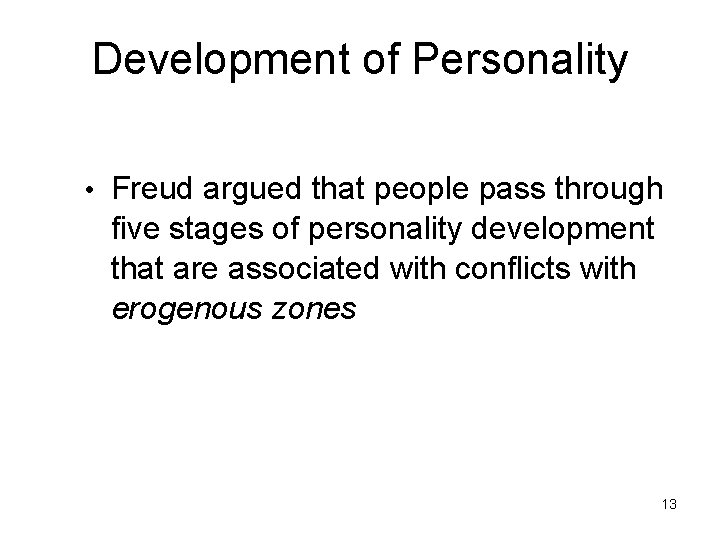
Development of Personality • Freud argued that people pass through five stages of personality development that are associated with conflicts with erogenous zones 13
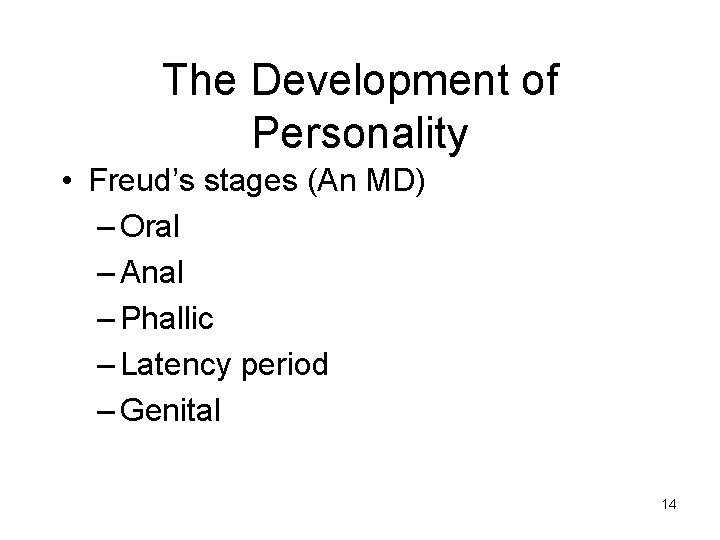
The Development of Personality • Freud’s stages (An MD) – Oral – Anal – Phallic – Latency period – Genital 14
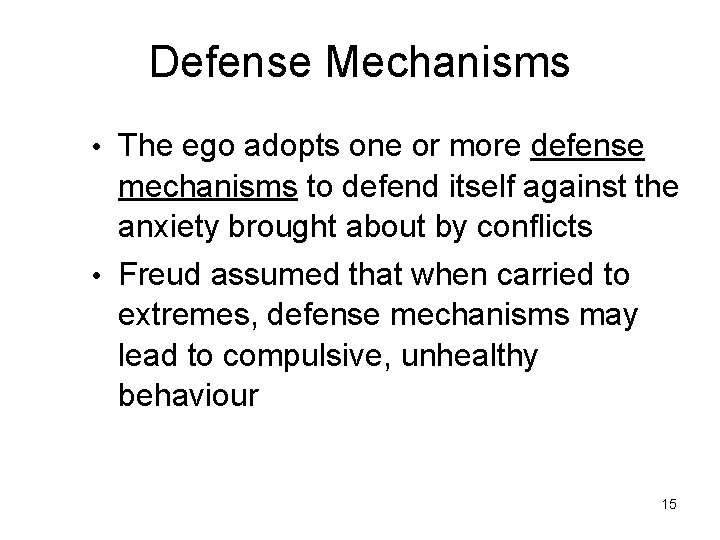
Defense Mechanisms • The ego adopts one or more defense mechanisms to defend itself against the anxiety brought about by conflicts • Freud assumed that when carried to extremes, defense mechanisms may lead to compulsive, unhealthy behaviour 15
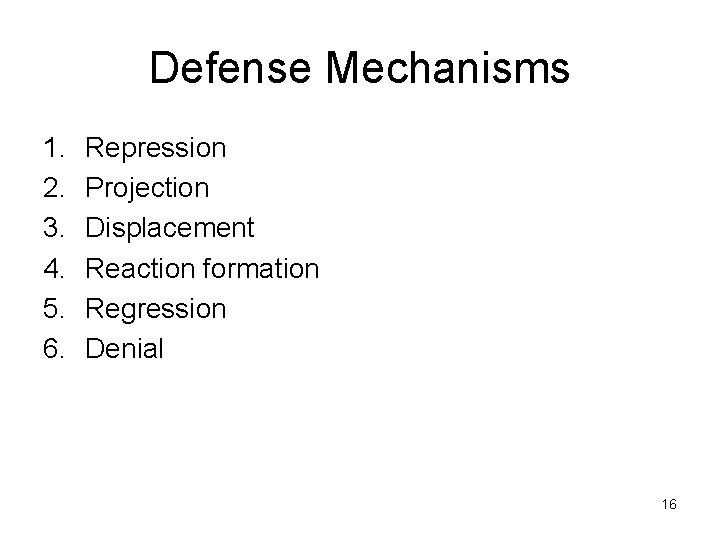
Defense Mechanisms 1. 2. 3. 4. 5. 6. Repression Projection Displacement Reaction formation Regression Denial 16
Projective Tests • Projective tests – Based on the assumption that the test taker will transfer (“project”) unconscious conflicts and motives onto an ambiguous stimulus. – The basic idea underlying projective assessment is that the unconscious directs daily behaviour and thoughts • Projective tests are used to uncover unconscious motives – Examples include the Thematic Apperception Test and the Rorschach 17
Other Psychodynamic Approaches • Another important theorist to break from Freud was Carl Jung • Jung believed people are motivated to attain self -realization or perfection 18
Jung • Jungian Theory – Collective unconscious • The universal memories, symbols, and experiences of humankind, • Archetypes or universal symbolic images that appear in myths, art, stories, and dreams. – 2 important archetypes: • Maleness and femaleness 19
Analytical Psychology • The collective unconscious is a shared storehouse of primitive ideas and images • These inherited images are called archetypes • One important archetype is the shadow, the dark side of our personality 20
Adler and Individual Psychology • Alfred Adler was one of the original members of Freud’s Vienna Psychoanalytic Society before having a falling out with Freud • Adler chose the term “individual” to suggest that personality must not be divided into levels of consciousness or regions of the mind 21
Individual Psychology • Adler felt people are motivated by feelings of inferiority that leads people to strive for superiority or success • Striving for superiority or success involves adoption of a style of life • All people seek to compensate for feelings of inferiority, but may overcompensate and strive in a rigid manner 22
Adler: Unity of Personality • Adler felt all of our thoughts, feelings, and actions serve a single purpose • This purpose is consistent with the final goal we set at age 4 or 5 years 23
Adler: Family Constellations • Adler believed one can learn about personality by studying family constellations • First-borns are pushed by parents toward success, leadership, and independence, and have a high need for achievement • Second-borns are more relaxed about achievement • Youngest children tend to be pampered 24
Evaluating Psychodynamic Theories • Three scientific failings – Violating the principle of falsifiability. – Drawing universal principles from the experiences of a few atypical patients. – Basing theories of personality development on retrospective accounts and the fallible memories of patients. 25
The Power of Learning • Behaviourists do not look within the psyche • Behaviourists believe personality is acquired through reinforcement, natural selection and cultural evolution 26
Cognitive Approaches • Cognitive theories emphasize the interaction of thoughts and behaviour • Cognitive theorists assume that humans are decision makers 27
Rotter and Locus of Control • Locus of control, a concept devised by Julian Rotter, is the extent to which individuals believe a reinforcer is contingent on their own behaviour • Rotter focused on whether people place their locus of control inside themselves (internal) or in the environment (external) 28
Rotter and Locus of Control • People with an internal locus of control feel a need to control their lives • People with an external locus feel little responsibility for their actions 29
Bandura and Self-Efficacy • Albert Bandura has proposed that self- efficacy has a major influence on behaviour • Self-efficacy is a person’s belief about whether he or she can successfully engage in and execute a specific behaviour 30
Mischel’s Cognitive-Affective Personality System • Walter Mischel claims that thought is crucial in determining behaviour • Unlike Bandura, Mischel is an interactionist • People change their responses on the basis of past experience and their assessment of the situation, a process called self-regulation 31
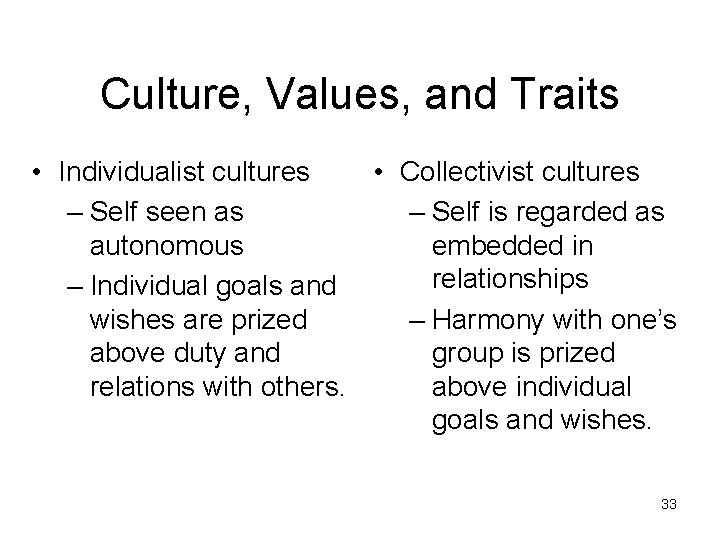
Personality in Cultural Context • Culture refers to the norms, values, rules, and beliefs adopted by a group • Personality must be viewed in a cultural context • Western concepts of personality focus on the individual • Many non-Western cultures value interdependence and cooperation 32
Culture, Values, and Traits • Individualist cultures • Collectivist cultures – Self seen as – Self is regarded as autonomous embedded in relationships – Individual goals and wishes are prized – Harmony with one’s above duty and group is prized relations with others. above individual goals and wishes. 33
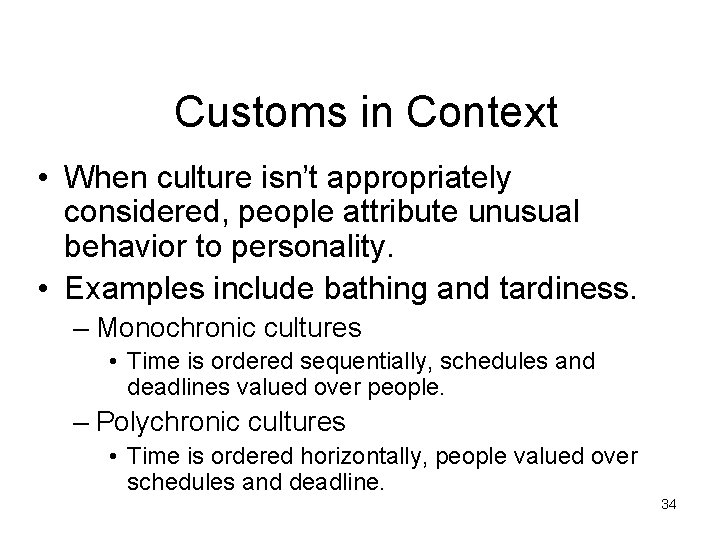
Customs in Context • When culture isn’t appropriately considered, people attribute unusual behavior to personality. • Examples include bathing and tardiness. – Monochronic cultures • Time is ordered sequentially, schedules and deadlines valued over people. – Polychronic cultures • Time is ordered horizontally, people valued over schedules and deadline. 34
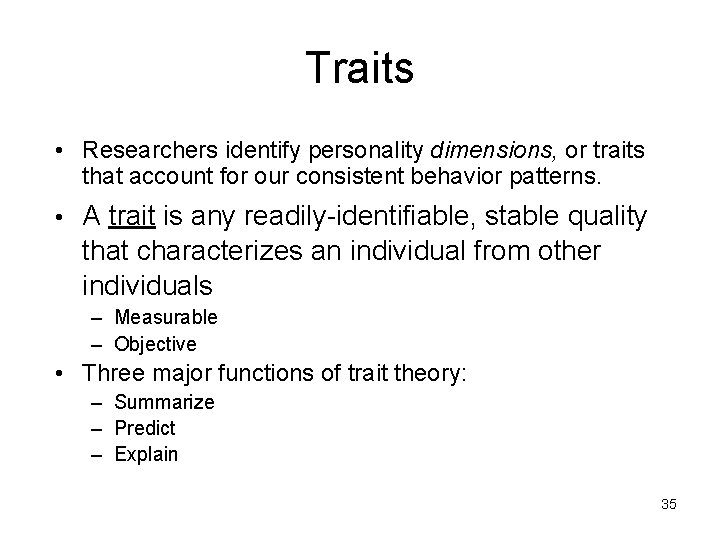
Traits • Researchers identify personality dimensions, or traits that account for our consistent behavior patterns. • A trait is any readily-identifiable, stable quality that characterizes an individual from other individuals – Measurable – Objective • Three major functions of trait theory: – Summarize – Predict – Explain 35
Types • Types are personality categories in which broad collections of traits are loosely tied together and interrelated 36
The Birth of Trait Theory • Freud vs. Allport – What about manifest motives? • Allport’s Trait Theory (Allport & Odbert, 1936) – Defining “trait” • Difference between traits and states 37
Allport’s Personal Disposition Theory • Gordon Allport suggested that each individual has a unique set of personality traits called personal dispositions • Cardinal trait is a trait so dominant that a person’s entire life revolves around it • Central traits are qualities that characterize a person’s daily interactions 38
The Five Factor Model • Many theorists agree there are five broad categories of traits • These categories have become known as the Five Factor Model, or Big Five (Mc. Crae and Costa) • Researchers think of the five factors as “supertraits” 39
Minnesota Multiphasic Personality Inventory • One of the most widely used personality tests is the Minnesota Multiphasic Personality Inventory 2 nd Edition (MMPI-2) • The norms of the MMPI-2 are based on profiles of normal people and groups of psychiatric patients – Clinical & Employment settings • Measures aspects of personality that, if extreme, suggest a problem – e. g. , extreme suspiciousness • Long test ‑ 567 questions 40
The Humanistic Approach • • Abraham Maslow Carl Rogers Rollo May Evaluating Humanists 41
Humanistic Psychology • Humanist psychology – Humanistic theories assume people are motivated to achieve personal goals by internal forces • Humanistic theories usually take a phenomenological approach that focus on the individual’s unique experiences and ways of interpreting the world 42
Abraham Maslow • Abraham Maslow was one of the founders of the humanistic approach • Maslow conceives of motives as forming a hierarchy • Lower needs, such as those for food and water, are at the bottom of the hierarchy • For Maslow, personality development can be viewed as a gradual progression toward self-actualization - achieving one’s full potential. 43
Maslow and Self-Actualization • Self-actualization is the final level of psychological development • Self-actualized individuals accept themselves, others, and nature 44
Evaluating Humanists • Hard to operationally define many of the concepts. • Have added balance to the study of personality. • The approach has encouraged others to focus on “positive psychology. ” • The argument that we have the power to choose our own destiny has fostered a new appreciation for resilience. 45
Positive Psychology • Humanistic psychology did not generate a body of research to confirm its views • Positive psychology attempts to study wellbeing, contentment, happiness, and optimism using scientific methods 46
Personality Inventories • Personality inventories generally consist of true/false or multiple choice items to which people respond • Well-constructed inventories tend to be valid predictors of performance in a wide array of situations 47