
PERSONAL VALUES AND ETHICAL CODES OF CONDUCT Learning



- Slides: 7
PERSONAL VALUES AND ETHICAL CODES OF CONDUCT
Learning Objectives (i) To understand the influence of culture on personal values (ii) To explain personal values and professional code of conduct (iii) To apply culturally sensitive professionalism in order to build trust in the community during infectious disease interventions from a One Health perspective
Professionalism and ethical conduct • Different professionals with similar goals in One Health • Identify key professionals in One Health and generate discussions on their professional codes of conduct and their core values
Professional Codes of Conduct: Exercise • Learners should be asked to identify their professional code of conduct and be guided to discuss when dealing with other professional. • Try to match the values ethics and professional codes of conduct of the different professionals. • The above learning should be held in the realm of a culturally sensitive ethical conduct
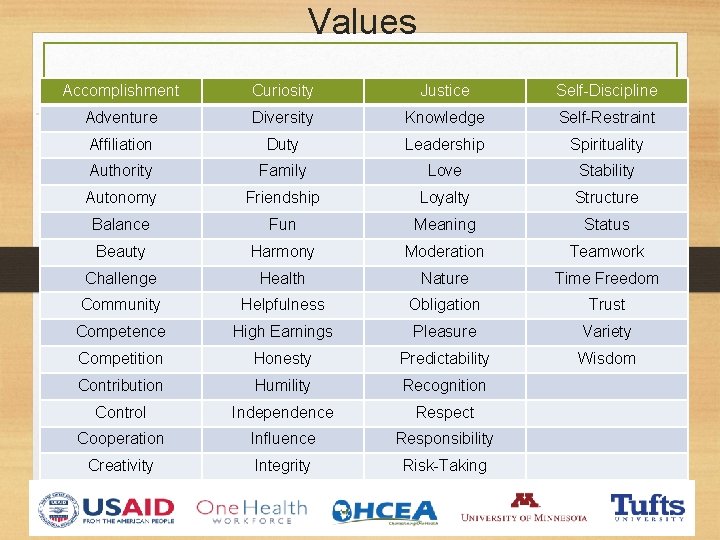
Values Accomplishment Curiosity Justice Self-Discipline Adventure Diversity Knowledge Self-Restraint Affiliation Duty Leadership Spirituality Authority Family Love Stability Autonomy Friendship Loyalty Structure Balance Fun Meaning Status Beauty Harmony Moderation Teamwork Challenge Health Nature Time Freedom Community Helpfulness Obligation Trust Competence High Earnings Pleasure Variety Competition Honesty Predictability Wisdom Contribution Humility Recognition Control Independence Respect Cooperation Influence Responsibility Creativity Integrity Risk-Taking
CASE STUDY 2 EBOLA DISEASE
Case Study 2: Ebola Disease After reading the case study on Ebola and using your own personal experience in your communities i. Identify the different categories of stakeholders that would be useful to work with to design a culturally sensitive control program fro Ebola or similar disease ii. List and discuss some of your core values that would applicable to endure appropriate response to Ebola or similar disease iii. Identify local beliefs and cultural practices in your own communities that would jeopardise efforts to respond and control Ebola or similar disease in your own communities •