
Personal Statements What are they Different from your
- Slides: 26
Personal Statements
What are they? • Different from your college admission essay • Personal Statement – General Comprehensive Statement – Response to a Question • Research Statement • Teaching Philosophy Statement 2
Who wants them? • Graduate schools • Research grants • Academic jobs • Upper-Level Positions 3
Why Write them? • Highlight your achievements and skills • Describe your interests – i. e. research or career interests • Describe your teaching style – Pedagogy 4
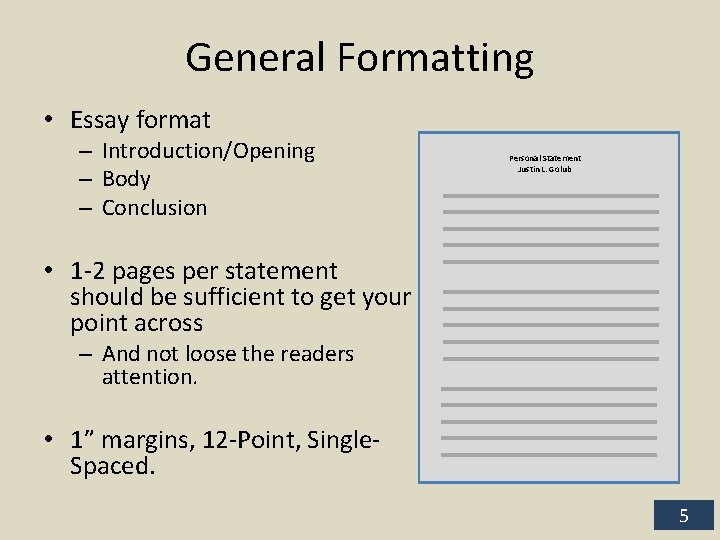
General Formatting • Essay format – Introduction/Opening – Body – Conclusion Personal Statement Justin L. Golub • 1 -2 pages per statement should be sufficient to get your point across – And not loose the readers attention. • 1” margins, 12 -Point, Single. Spaced. 5
General Personal Statements • Free response – Allow applicants latitude in their writing • Should include the following: – Career Goals – Personal Background – What distinguishes you 6
General Personal Statements • Career Goals – What are your reasons for applying – What have you done so far towards these goals • Personal Background – What experiences have brought you to this point • What distinguishes you – What sets you apart 7
General Personal Statements • Things to include: • Experience or activities you would like to expand upon – Military Service – Research Experience – Volunteer Experience 8
Response to a Question • What are your Career Goals? • What are you Research Interests? • How did you become interested in this career path – Or research area – Or specific program 9
Research Statements • Explain the Science • Identify your main research questions • Findings (summarized!) • Goals – Immediate – Long term 10
Research Statements • Why is it interesting? • Why is it important? • Opportunities your research will bring? 11
Teaching Philosophy • Interest in teaching • Past Experience • Teaching style • What courses 12
General • Demonstrates writing abilities • A good metric by which to compare individuals – Better than standardized tests (memorization) • Demonstrate you can follow directions 13
General Tips • If responding to a specific question • Make sure you answer the question • Its ok to go beyond what the question asks, – Don’t stray to far – But make sure you answer the question FIRST! • Demonstrates an ability to follow directions/instructions 14
General Tips • Have a theme – Thesis Personal Statement Justin L. Golub • Map it out BEFORE you start writing – Revolves around your theme 15
General Tips Opening Paragraph Personal Statement Justin L. Golub • Most important – Sets the tone – Most memorable • Grab the readers attention – Make it Memorable • Get to the point early – Thesis 16
Use Attention Grabbers • “The ability to use olfaction for detection and avoidance of danger is ancient and persistent. I am interested in the ability of fish to use these cues before hatching. ” • That's an attention-grabber that hooks the reader in • Thinking of a catchy opener is easier than you think. 17
General Tips Details Personal Statement Justin L. Golub • Be specific • Use evidence to support and demonstrate • Experiences 18
General Tips Conclusion Personal Statement Justin L. Golub • Summarize – Stress the major points • Restate your thesis 19
Revise & Review • You should revise at least three times – Outline Draft – Draft Polished Draft – Polished Draft Final Personal Statement Justin L. Golub • Have someone critique between each revision – Give them ample time to review • Proofread 20
Revise & Review • You should revise at least three times – Outline Draft – Draft Polished Draft – Polished Draft Final Personal Statement Justin L. Golub • If you need someone to read over your personal statements: Justin Golub Biology Department Feigenbaum Center for Science & Innovation Massachusetts College of Liberal Arts 21
Word Limits • While most personal statements do not have word limits Personal Statement Justin L. Golub • Check – Including formatting instructions • Some applications can be VERY specific 22
Things to Avoid • Clichés • Fawning over the school • Talking about money as a motivator • Complain about your life • Spell the school name wrong • Gimmicks • Boredom • Informal tone • Slang • Poor grammar and spelling • Politics and Religion 23
Avoid Clichés • Stay away from often-repeated or tired statements – “I always keep my eyes on the road. ” – “I want to be a doctor because I am good at science and want to help people. ” • “My grandfather was an extremely significant part of my life. Without him, I would not have many of the advantages I have today. ” – These two sentences, though expressive and correct, have essentially said nothing. 24
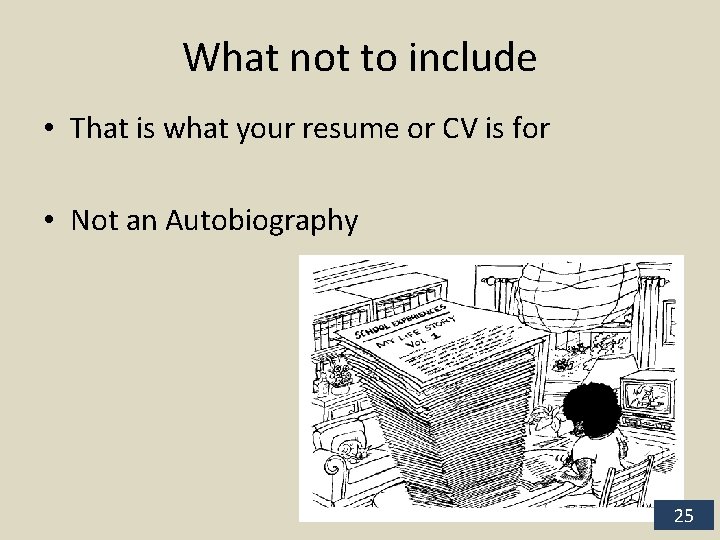
What not to include • That is what your resume or CV is for • Not an Autobiography 25
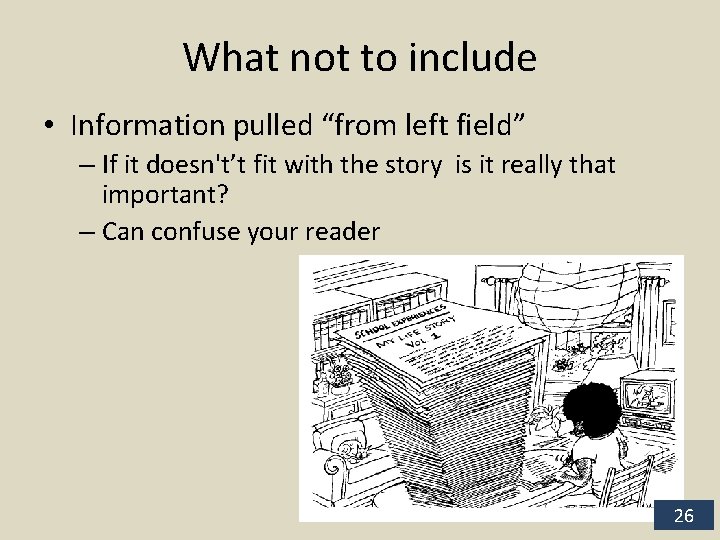
What not to include • Information pulled “from left field” – If it doesn't’t fit with the story is it really that important? – Can confuse your reader 26