
Personal software process Mohammed ahmed ali What is

- Slides: 16
Personal software process Mohammed ahmed ali
What is psp The personal software process (psp) is a structured set of process descriptions, measurements and methods that can help engineers improve their personal performance The goal of the personal software process is to discipline software process
PSP evolution ► The personal software process has been developed by Watts Humphrey and software engineering institute (sei). ► The research work on the psp was started in 1989. it resulted in a process model which proved to be very beneficial for software engineers
Benefits of PSP ► It helps the software engineers in developing high quality software products ► It guides the engineer for personal improvement ► It gives the confidence to do the job the way you know you should ► The psp gives the command over your work
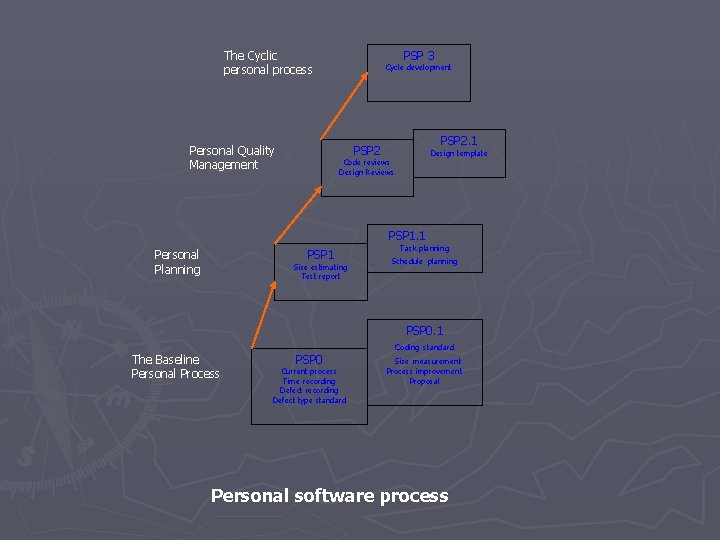
PSP process The psp introduces process concepts in a series of steps. Each step includes all the elements of the prior steps together with one or two additions. As shown in the figure below
The Cyclic personal process Personal Quality Management PSP 3 Cycle development PSP 2. 1 PSP 2 Design template Code reviews Design Reviews PSP 1. 1 Personal Planning PSP 1 Size estimating Test report Task planning Schedule planning PSP 0. 1 Coding standard The Baseline Personal Process PSP 0 Current process Time recording Defect type standard Size measurement Process improvement Proposal Personal software process
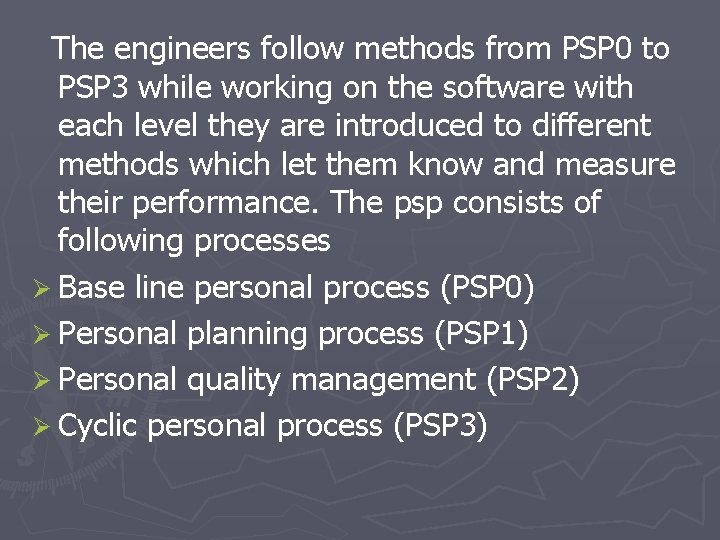
The engineers follow methods from PSP 0 to PSP 3 while working on the software with each level they are introduced to different methods which let them know and measure their performance. The psp consists of following processes Ø Base line personal process (PSP 0) Ø Personal planning process (PSP 1) Ø Personal quality management (PSP 2) Ø Cyclic personal process (PSP 3)
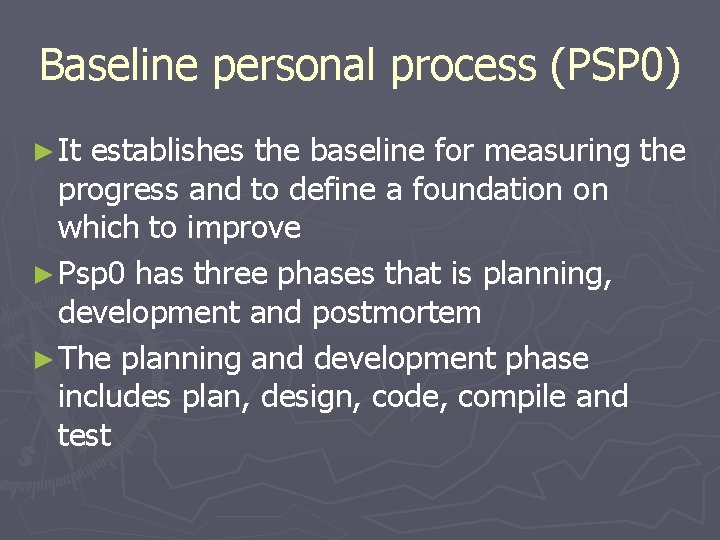
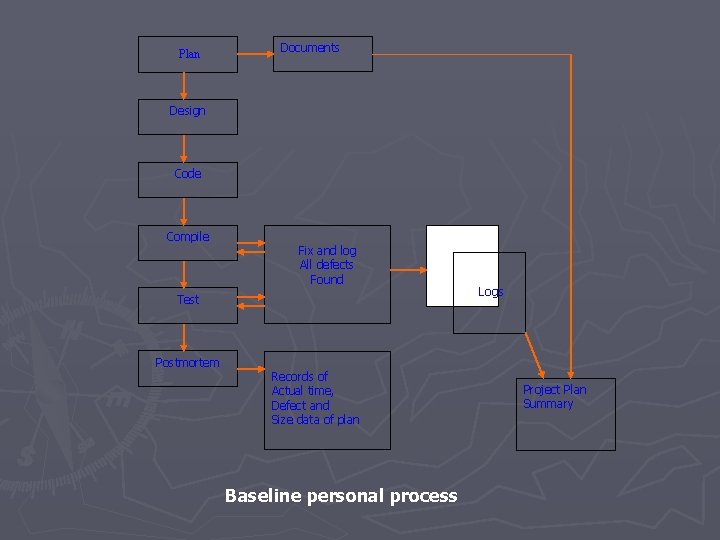
Baseline personal process (PSP 0) ► It establishes the baseline for measuring the progress and to define a foundation on which to improve ► Psp 0 has three phases that is planning, development and postmortem ► The planning and development phase includes plan, design, code, compile and test
► In postmortem a comparison of actual performance with the plan is made. This provides a basis for measuring progress and defines a foundation on which to improve ► Psp 0. 1 defines coding standard, size measurement and personal improvement proposal
Plan Documents Design Code Compile Fix and log All defects Found Test Postmortem Records of Actual time, Defect and Size data of plan Baseline personal process Logs Project Plan Summary
Personal planning process(psp 1) ► Psp 1 and psp 1. 1 focus on personal project management techniques, introducing size and effort estimating, schedule planning and schedule tracking methods ► Size and effort estimates are made using PROBE (PROxy Based Estimating) method ► With PROBE engineers use the relative size of proxy to make their initial estimate
Personal quality management(psp 2) ► Psp 2 introduces defect management. This phase adds personal design and code reviews and quality management and evaluation to psp 1 ► There are two tasks involve in psp 2 they are code review and design review ► Code review: whose goal is to improve the quality of the software by reviewing the program and its associated documentation
► Design review: whose task is to verify program logic, verify function use, ensure that requirements, specifications are completely covered by the design ► The psp 2. 1 introduces design completeness and design verification ► The psp 2. 1 adds four design templates and design verification systems. This improves the design process and design verification
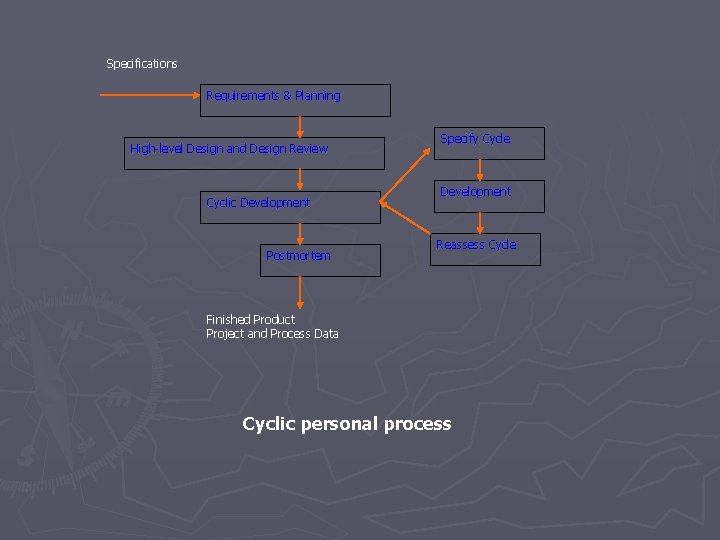
Cyclic personal process (psp 3) ► This is the final step of psp. Till now what we have discussed is about related to small programs ► Psp 3 is used for large programs the technique is to divide the larger programs into small programs of psp 2. 1 size then psp 3 combines multiple psp 2. 1 process into large scale software development ► This is a iterative process
Specifications Requirements & Planning High-level Design and Design Review Cyclic Development Postmortem Specify Cycle Development Reassess Cycle Finished Product Project and Process Data Cyclic personal process
Thank you