
Personal Psychology 20 Theme 3 Intelligence Power Point

- Slides: 41
Personal Psychology 20 Theme 3 – Intelligence Power. Point 004 1
What we will cover in Theme 3 Intelligence: • • The meaning of intelligence Individual intelligence tests Group intelligence tests Practical applications of intelligence tests Mental retardation Intellectually gifted children Criticisms of intelligence tests 2
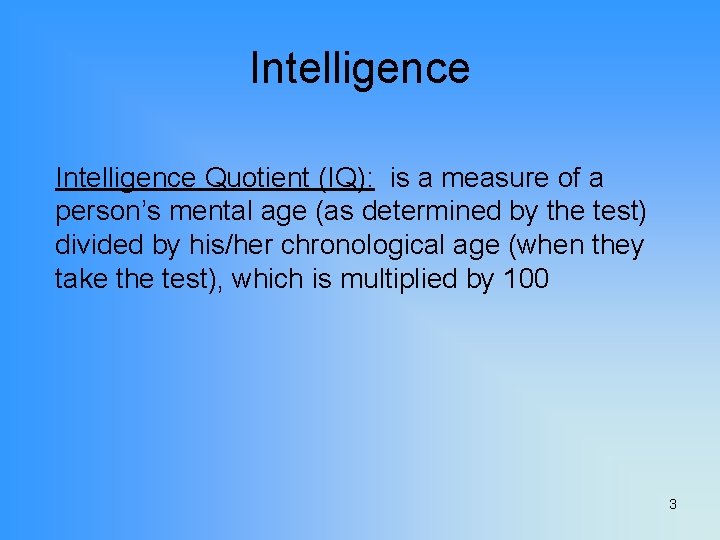
Intelligence Quotient (IQ): is a measure of a person’s mental age (as determined by the test) divided by his/her chronological age (when they take the test), which is multiplied by 100 3
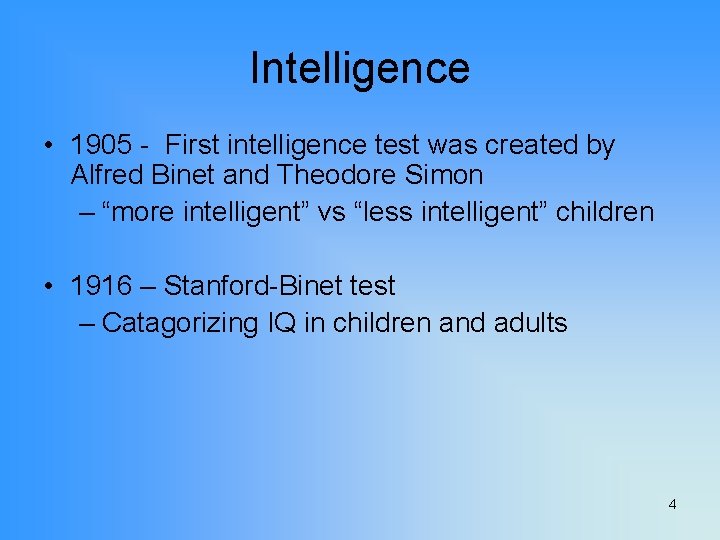
Intelligence • 1905 - First intelligence test was created by Alfred Binet and Theodore Simon – “more intelligent” vs “less intelligent” children • 1916 – Stanford-Binet test – Catagorizing IQ in children and adults 4
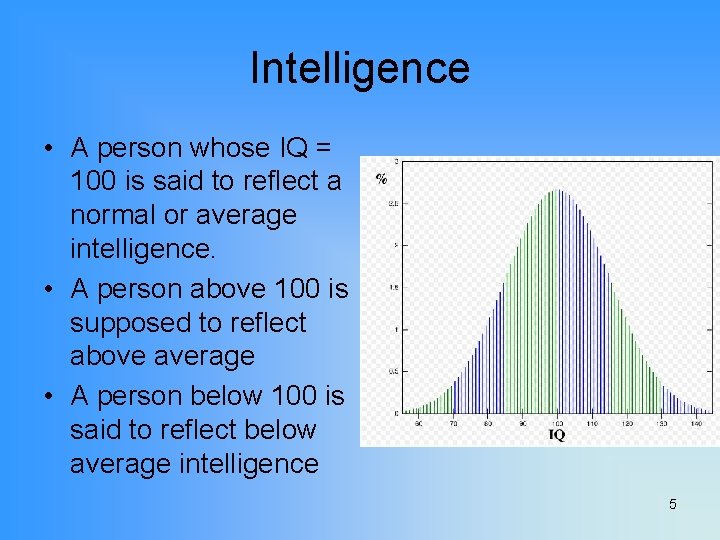
Intelligence • A person whose IQ = 100 is said to reflect a normal or average intelligence. • A person above 100 is supposed to reflect above average • A person below 100 is said to reflect below average intelligence 5
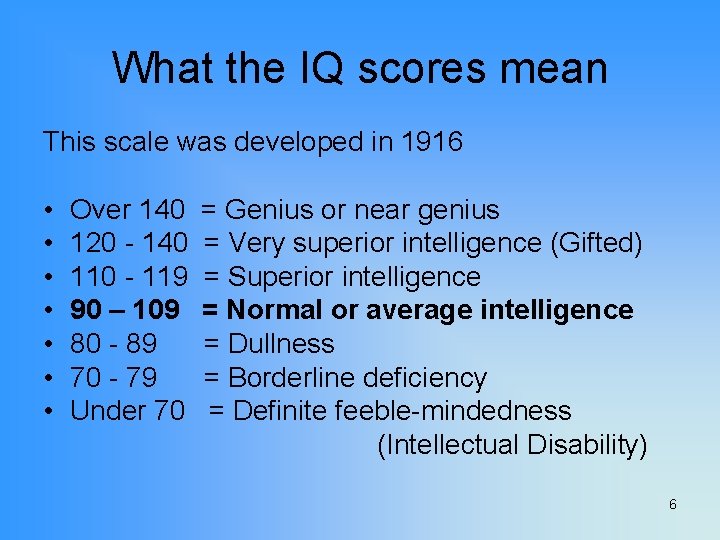
What the IQ scores mean This scale was developed in 1916 • • Over 140 120 - 140 110 - 119 90 – 109 80 - 89 70 - 79 Under 70 = Genius or near genius = Very superior intelligence (Gifted) = Superior intelligence = Normal or average intelligence = Dullness = Borderline deficiency = Definite feeble-mindedness (Intellectual Disability) 6
Gifted Children • Intellectual giftedness: is an intellectual ability significantly higher than average • Giftedness can be difficult to diagnose • Gifted children are not always the best students 7
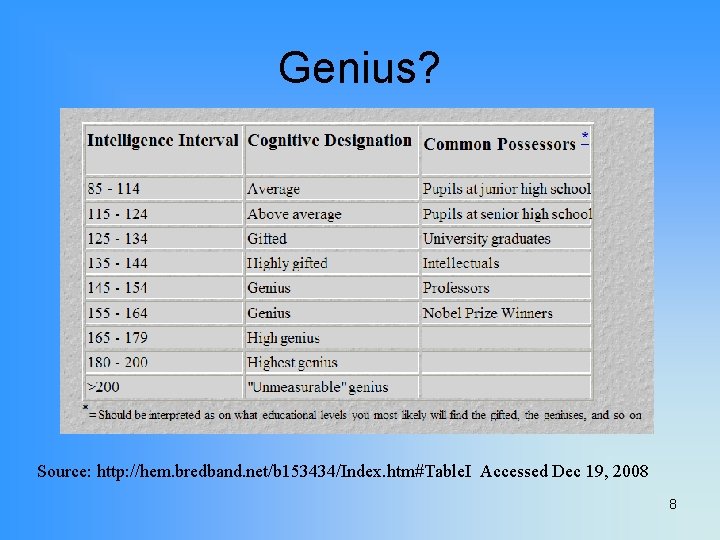
Genius? Source: http: //hem. bredband. net/b 153434/Index. htm#Table. I Accessed Dec 19, 2008 8
Gifted? – The Man with the Incredible Brain • This is the story of Daniel Tammet. • Daniel is one of the world’s few savants. • This documentary follows Daniel as he travels to America to meet the scientists who are convinced he may hold the key to unlocking similar abilities in everyone. 9
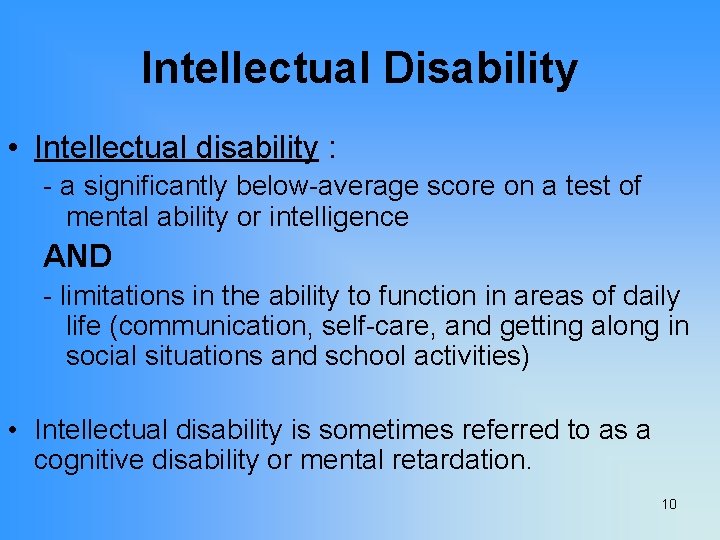
Intellectual Disability • Intellectual disability : - a significantly below-average score on a test of mental ability or intelligence AND - limitations in the ability to function in areas of daily life (communication, self-care, and getting along in social situations and school activities) • Intellectual disability is sometimes referred to as a cognitive disability or mental retardation. 10
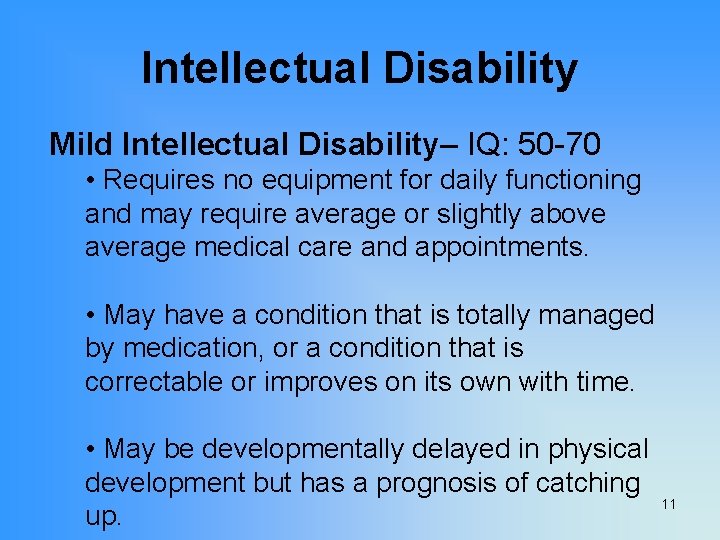
Intellectual Disability Mild Intellectual Disability– IQ: 50 -70 • Requires no equipment for daily functioning and may require average or slightly above average medical care and appointments. • May have a condition that is totally managed by medication, or a condition that is correctable or improves on its own with time. • May be developmentally delayed in physical development but has a prognosis of catching up. 11
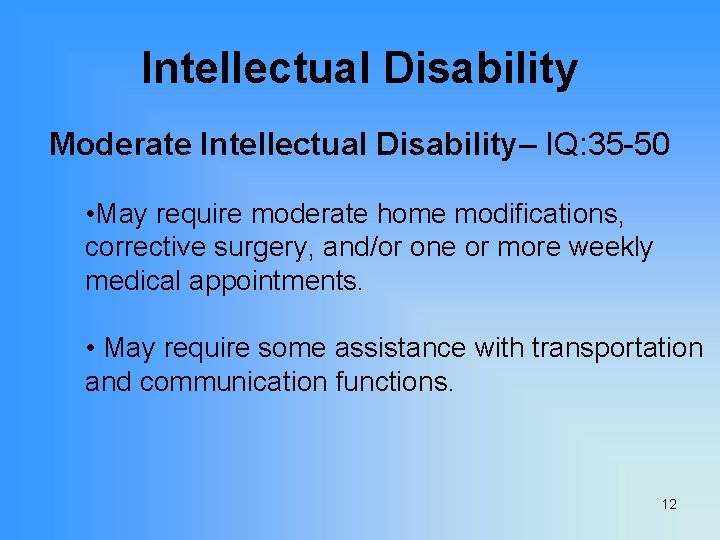
Intellectual Disability Moderate Intellectual Disability– IQ: 35 -50 • May require moderate home modifications, corrective surgery, and/or one or more weekly medical appointments. • May require some assistance with transportation and communication functions. 12
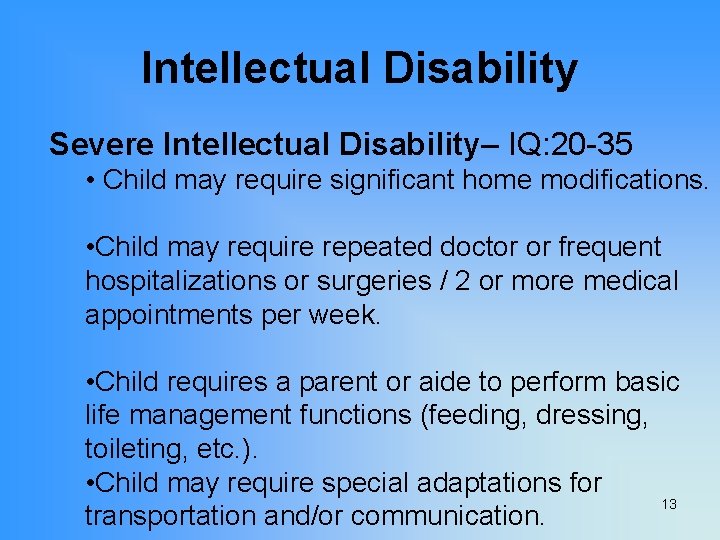
Intellectual Disability Severe Intellectual Disability– IQ: 20 -35 • Child may require significant home modifications. • Child may require repeated doctor or frequent hospitalizations or surgeries / 2 or more medical appointments per week. • Child requires a parent or aide to perform basic life management functions (feeding, dressing, toileting, etc. ). • Child may require special adaptations for 13 transportation and/or communication.
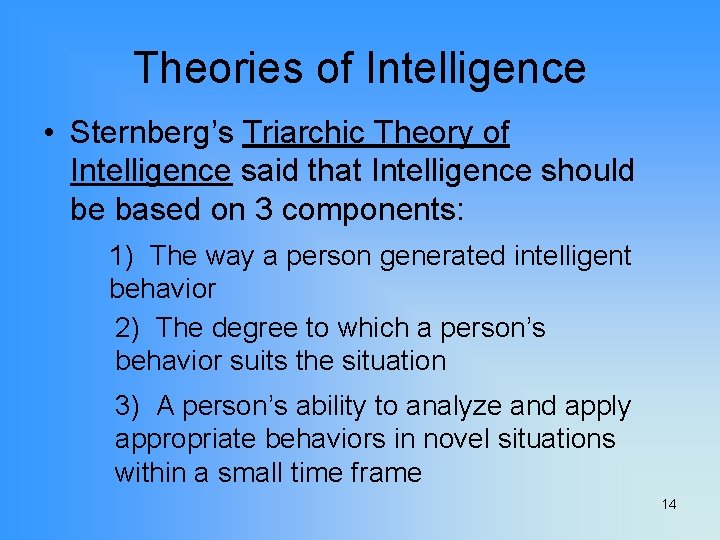
Theories of Intelligence • Sternberg’s Triarchic Theory of Intelligence said that Intelligence should be based on 3 components: 1) The way a person generated intelligent behavior 2) The degree to which a person’s behavior suits the situation 3) A person’s ability to analyze and apply appropriate behaviors in novel situations within a small time frame 14
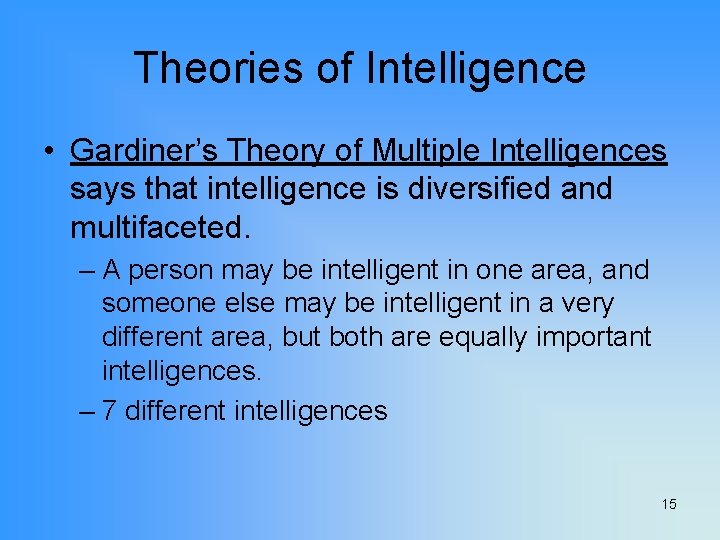
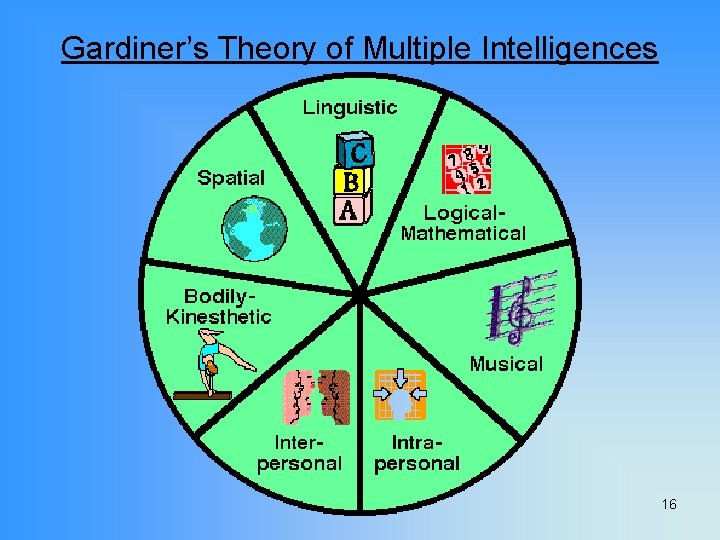
Theories of Intelligence • Gardiner’s Theory of Multiple Intelligences says that intelligence is diversified and multifaceted. – A person may be intelligent in one area, and someone else may be intelligent in a very different area, but both are equally important intelligences. – 7 different intelligences 15
Gardiner’s Theory of Multiple Intelligences 16
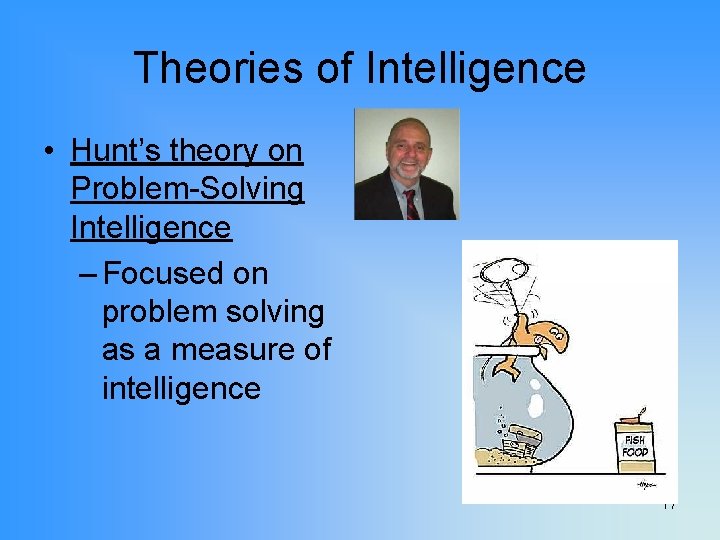
Theories of Intelligence • Hunt’s theory on Problem-Solving Intelligence – Focused on problem solving as a measure of intelligence 17
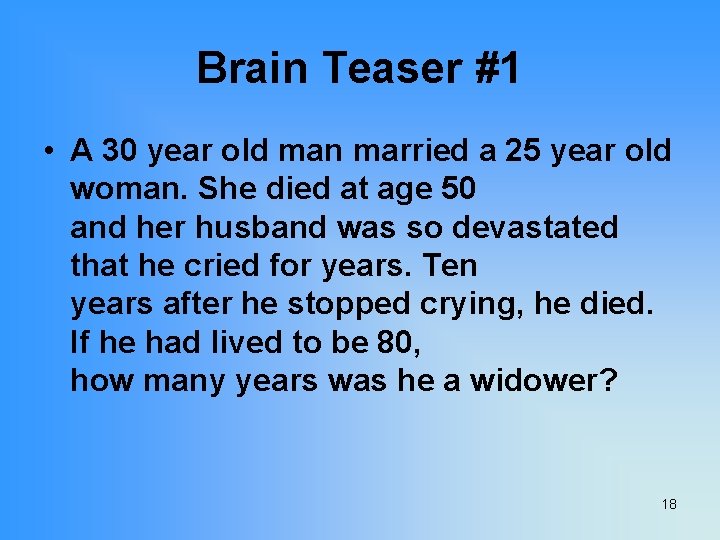
Brain Teaser #1 • A 30 year old man married a 25 year old woman. She died at age 50 and her husband was so devastated that he cried for years. Ten years after he stopped crying, he died. If he had lived to be 80, how many years was he a widower? 18
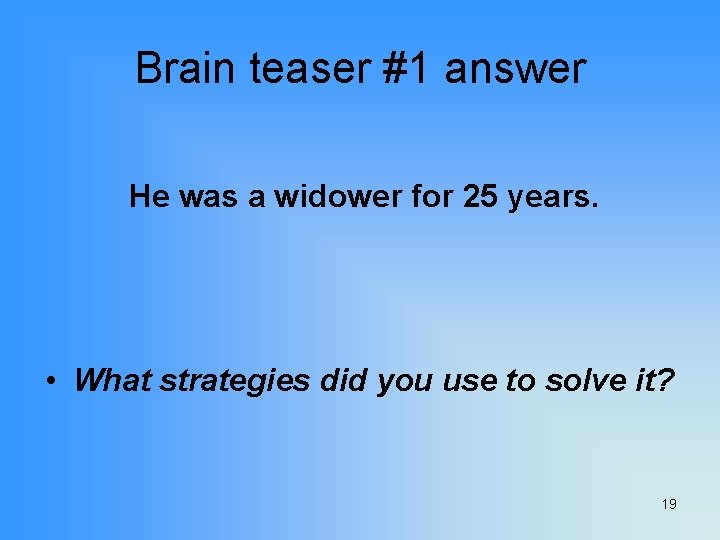
Brain teaser #1 answer He was a widower for 25 years. • What strategies did you use to solve it? 19
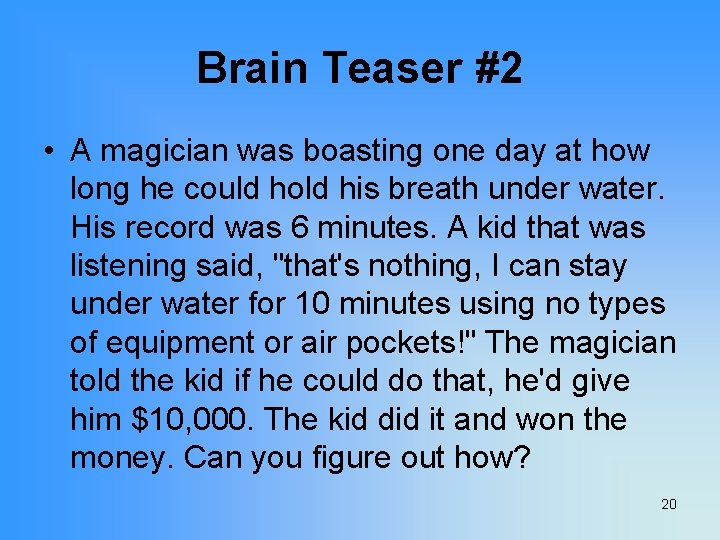
Brain Teaser #2 • A magician was boasting one day at how long he could hold his breath under water. His record was 6 minutes. A kid that was listening said, "that's nothing, I can stay under water for 10 minutes using no types of equipment or air pockets!" The magician told the kid if he could do that, he'd give him $10, 000. The kid did it and won the money. Can you figure out how? 20
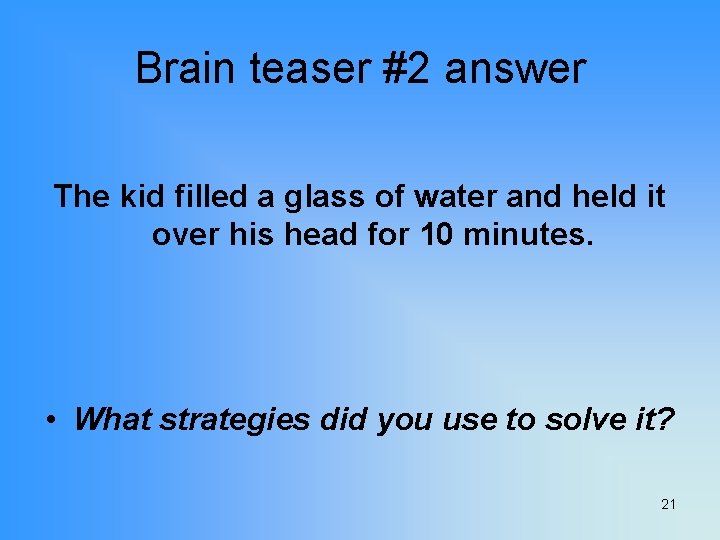
Brain teaser #2 answer The kid filled a glass of water and held it over his head for 10 minutes. • What strategies did you use to solve it? 21
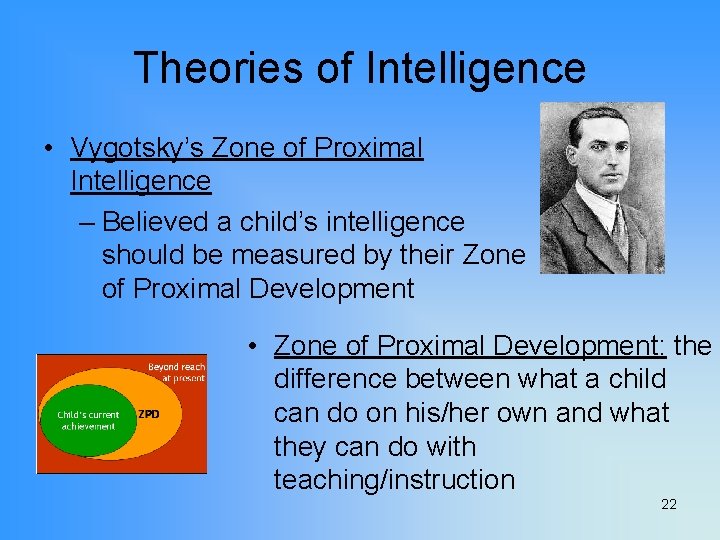
Theories of Intelligence • Vygotsky’s Zone of Proximal Intelligence – Believed a child’s intelligence should be measured by their Zone of Proximal Development • Zone of Proximal Development: the difference between what a child can do on his/her own and what they can do with teaching/instruction 22
Theories of Intelligence • Cattell’s Two Factor Theory of Intelligence – People have two types of intelligence – Both types are equally important when considering intelligence • Fluid intelligence: the type of intelligence a person is born with. It is not learned in school (Street Smarts) • Crystallized intelligence: The type of knowledge a person learns in school 23
Theories of Intelligence • Cattell’s Two Factor Theory of Intelligence – People have two types of intelligence – Both types are equally important when considering intelligence • Fluid intelligence: the type of intelligence a person is born with. It is not learned in school (Street Smarts) • Crystallized intelligence: The type of knowledge a person learns in school 24
Intelligence Tests Group tests • Less expensive to administer • Fairly quick to administer • Easily marked with computer • mostly measures the person’s ability to take a test • not able to measure different types of intelligences 25
Intelligence Tests Individual tests • More expensive to administer • Time consuming to administer • Mostly marked / evaluated by a trained professional • Tester must be trained in administering that test • Able to measure different types of intelligences 26
Intelligence Tests • Revised Stanford-Binet Test – Administered individually – Measures intelligence in 4 areas • Verbal reasoning • Quantitative reasoning • Abstract/visual reasoning • Short-term memory – Usually used to identify individuals who may be considered gifted or with serious learning problems – Different tests for different age groups 27
Intelligence Tests • Weschler Intelligence Scale for Children (WISC-III) – Administered individually – Full-scale IQ score: measures vocabulary, block design ability, number span, and ability of child to understand – Children answer verbally AND perform tasks – Revised several times to counteract cultural bias – Adult version also available 28
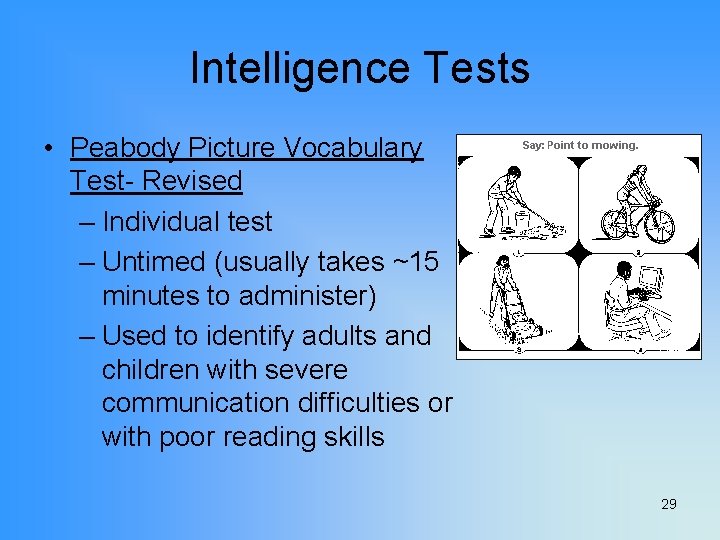
Intelligence Tests • Peabody Picture Vocabulary Test- Revised – Individual test – Untimed (usually takes ~15 minutes to administer) – Used to identify adults and children with severe communication difficulties or with poor reading skills 29
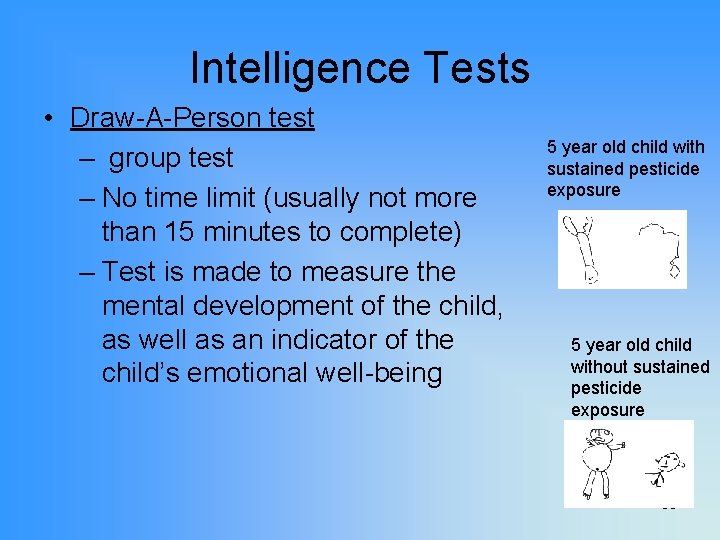
Intelligence Tests • Draw-A-Person test – group test – No time limit (usually not more than 15 minutes to complete) – Test is made to measure the mental development of the child, as well as an indicator of the child’s emotional well-being 5 year old child with sustained pesticide exposure 5 year old child without sustained pesticide exposure 30
Intelligence Tests • Cognitive Abilities Test (Cog. AT) – Group test – Grades 3 -13 – Scores for reasoning, nonverbal reasoning and quantitative reasoning – Is used to assess how well a child is doing in school compared to other children of the same age 31
Intelligence Tests • Grade Level Standardized Tests – Very similar to Cog. ATs and measure how well a student has done in Math and English compared to other students in the same grade – You may be familiar with the Stanfords – this is a similar idea – What about PATs and Diplomas? ? Who are these meant to test? 32
Bias and Testing • Is the test culture specific? • Raymond Cattell (developer of Fluid/Crystallized Intelligences) recognized that many Intelligence tests discriminated against the less privileged and people from other cultures • Tests today have reduced cultural bias but it has not been completely eliminated 33
Acing the test • Can you study for an IQ or standardized test? • The more preparation a person does or the more time a person has to take the test, the better they will do on it • Some say a test that can be prepared for is only a measure of how well a person can study, not their level of intelligence / knowledge 34
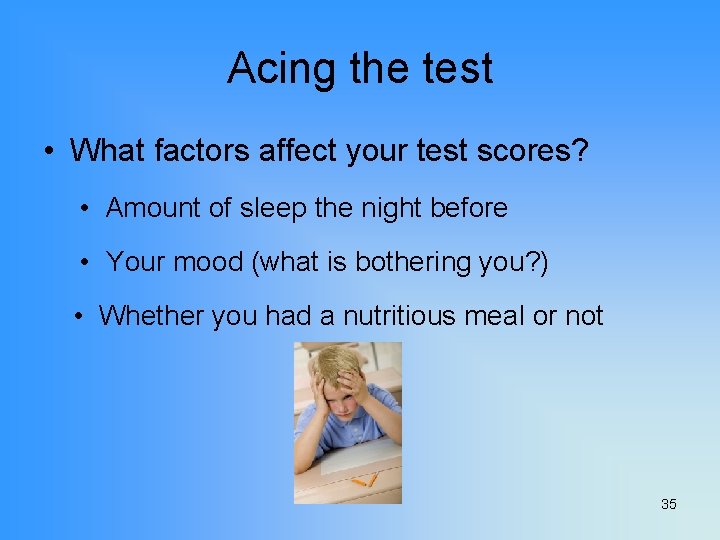
Acing the test • What factors affect your test scores? • Amount of sleep the night before • Your mood (what is bothering you? ) • Whether you had a nutritious meal or not 35
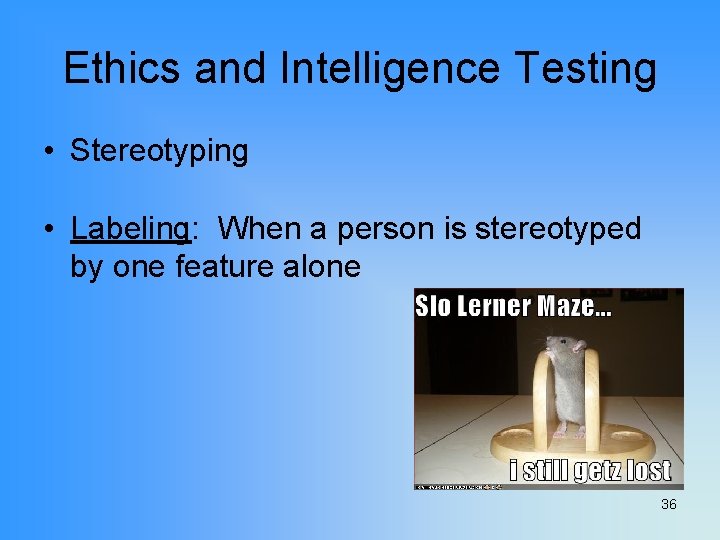
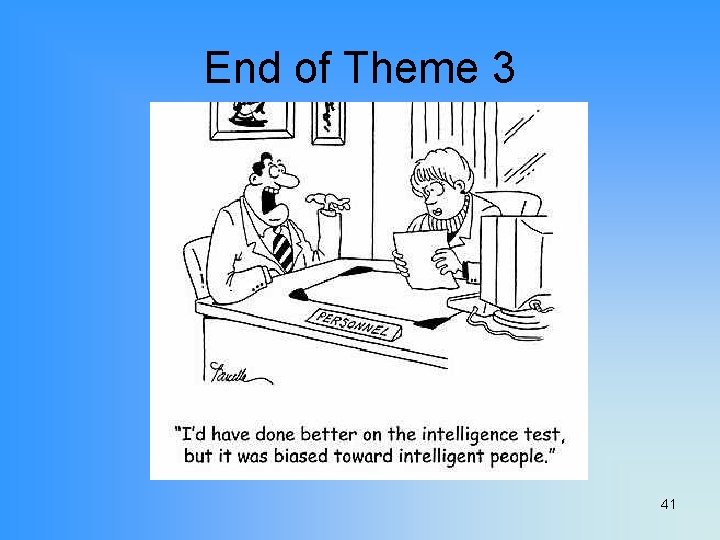
Ethics and Intelligence Testing • Stereotyping • Labeling: When a person is stereotyped by one feature alone 36
• IQ and ethics clip… Race vs Intelligence What do you think… is this an ethical issue? 37
IQ Correlations • IQ and Birth Order – Many noted intellectuals were first-born children IQ and Birth Order video 38
IQ Correlations • IQ Stability Across Different Ages – At one time people believed IQ remained constant regardless of age – In 1987 the Flynn Effect was discovered: IQ scores increase as people get older 39
IQ Correlations • IQ and Family Income – Higher IQ scores usually mean an increased family income • IQ correlation with relatives’ IQ – If a child’s parents have a high IQ, then the child will most likely have a high IQ 40
End of Theme 3 41