
Personal Protective Equipment Workplace assessments u Criteria for
- Slides: 12
Personal Protective Equipment Workplace assessments u Criteria for selection u Proper use, care, and maintenance u
Hierarchy of controls u Engineering controls u Administrative controls u PPE
PPE Hazard Assessment Categories u Impact (falling objects or potential for dropping objects) u Penetration u Compression u Chemical u Heat/cold u Abrasion u Harmful dust u Light (optical) radiation
Overview of topics u Head protection u Eye & face protection u Hearing protection u Hand protection u Foot protection u Whole body protection
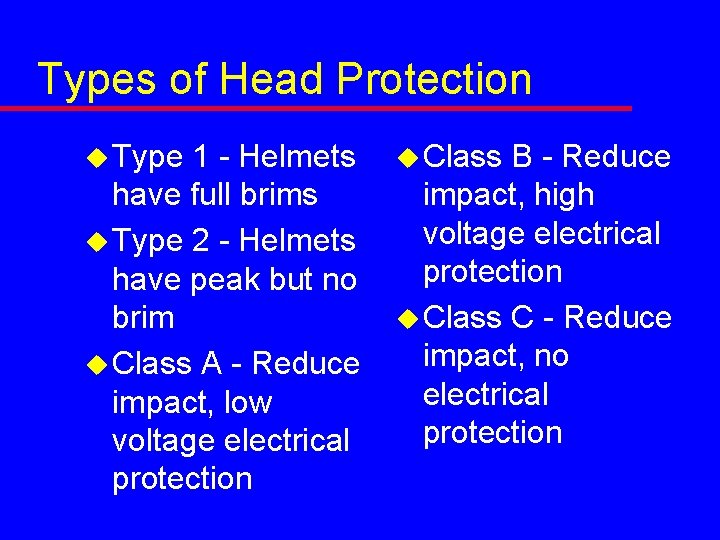
Types of Head Protection u Type 1 - Helmets have full brims u Type 2 - Helmets have peak but no brim u Class A - Reduce impact, low voltage electrical protection u Class B - Reduce impact, high voltage electrical protection u Class C - Reduce impact, no electrical protection
Eye & Face Protection u Eye protection - Safety glasses and goggles u Face protection - Faceshields u Welding protection - Faceshields and goggles
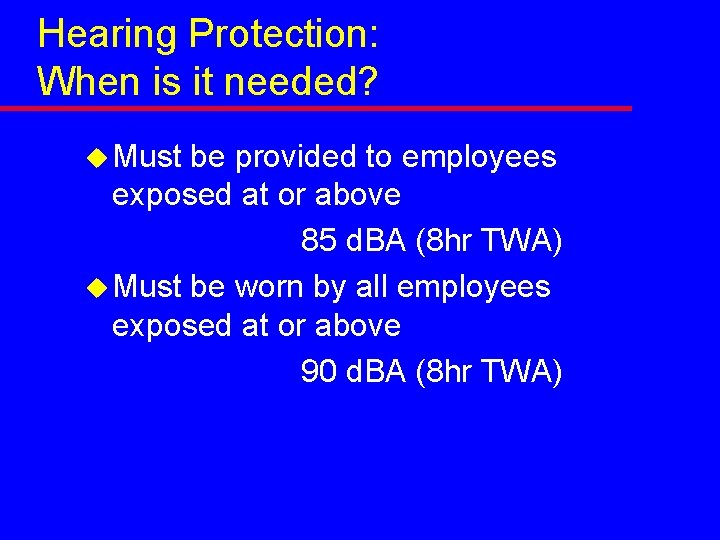
Hearing Protection: When is it needed? u Must be provided to employees exposed at or above 85 d. BA (8 hr TWA) u Must be worn by all employees exposed at or above 90 d. BA (8 hr TWA)
Hand Protection CFR 29 1910. 138 u Chemical absorption and burns u Cuts, abrasion, and punctures u Thermal burns and temperature extremes
Foot Protection u Toe box impact resistance u Toe box compression resistance u Metatarsal protection when required u Electrical protection u Sole puncture resistance u Static dissipative footwear
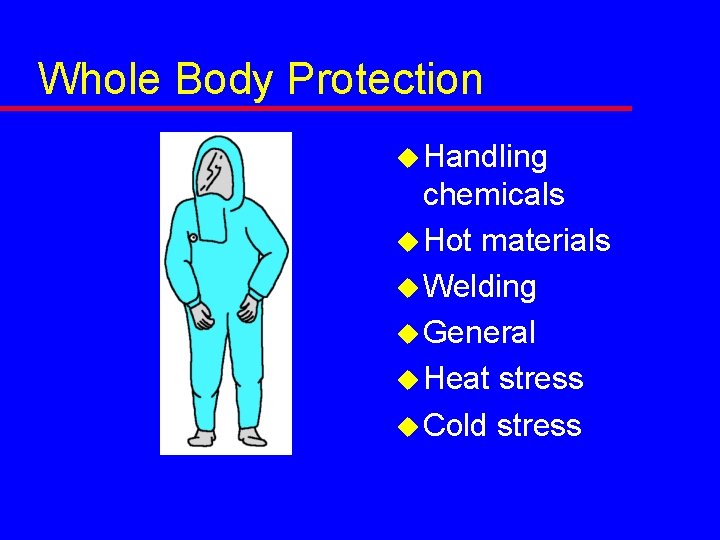
Whole Body Protection u Handling chemicals u Hot materials u Welding u General u Heat stress u Cold stress
General Body Protection u Hazards Skin cancer Cuts Abrasions Sunburn Frostbite Insects u Prevention Long pants Shirts Sunscreen Repellent Barrier creams
In conclusion…. u The EMPLOYER is responsible for: ØCompleting a PPE assessment for each employee, and ØProviding PPE to employees, except for prescription glasses and some types of footwear. u The EMPLOYEE is responsible for: ØMaking the employer aware of their needs, and ØUsing and maintaining PPE properly.