
Personal Protective Equipment Gloves Choose Hand Safety A
- Slides: 14
Personal Protective Equipment: Gloves
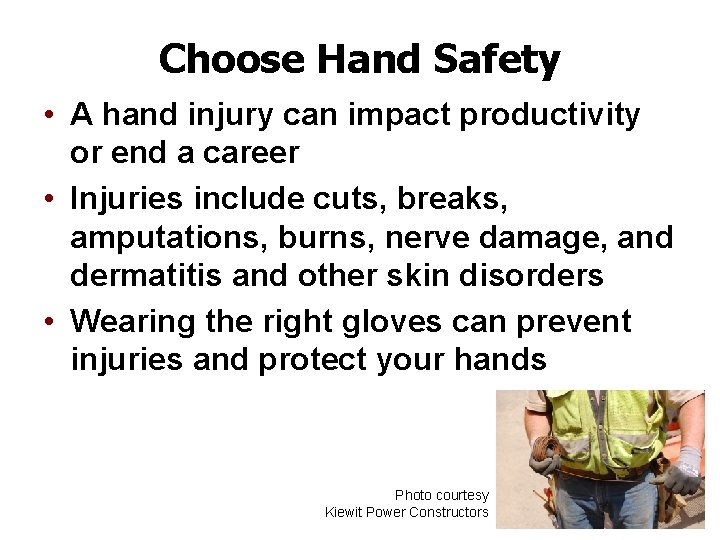
Choose Hand Safety • A hand injury can impact productivity or end a career • Injuries include cuts, breaks, amputations, burns, nerve damage, and dermatitis and other skin disorders • Wearing the right gloves can prevent injuries and protect your hands Photo courtesy Kiewit Power Constructors
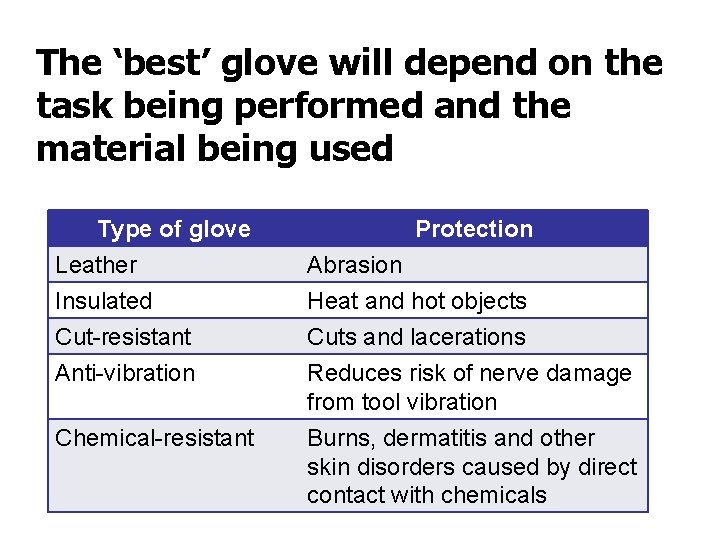
The ‘best’ glove will depend on the task being performed and the material being used Type of glove Leather Insulated Cut-resistant Anti-vibration Chemical-resistant Protection Abrasion Heat and hot objects Cuts and lacerations Reduces risk of nerve damage from tool vibration Burns, dermatitis and other skin disorders caused by direct contact with chemicals
What do you need to know to select chemical protective gloves? 1. The chemical you are using and how long the glove will protect against that chemical. 2. The differences in protection among glove materials for the same chemical. What works for one chemical may not for another! 3. Chemical resistance decreases as gloves break down (crack, weaken). Some offer more physical resistance, but all should be thrown out once they begin to break down.
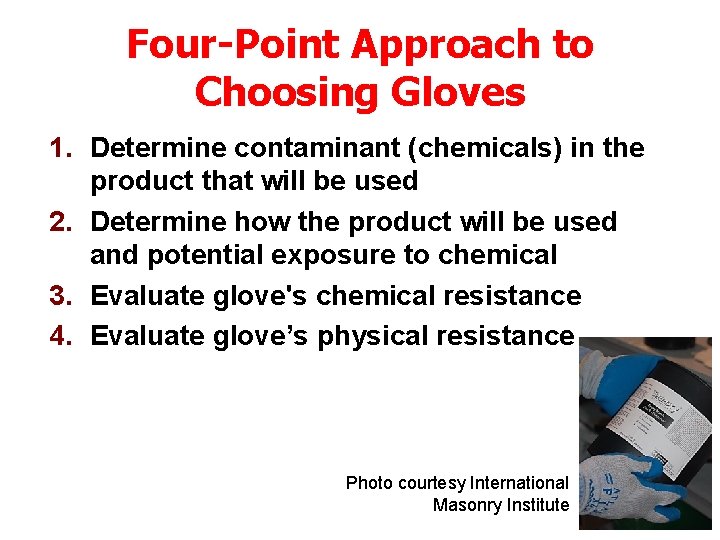
Four-Point Approach to Choosing Gloves 1. Determine contaminant (chemicals) in the product that will be used 2. Determine how the product will be used and potential exposure to chemical 3. Evaluate glove's chemical resistance 4. Evaluate glove’s physical resistance Photo courtesy International Masonry Institute
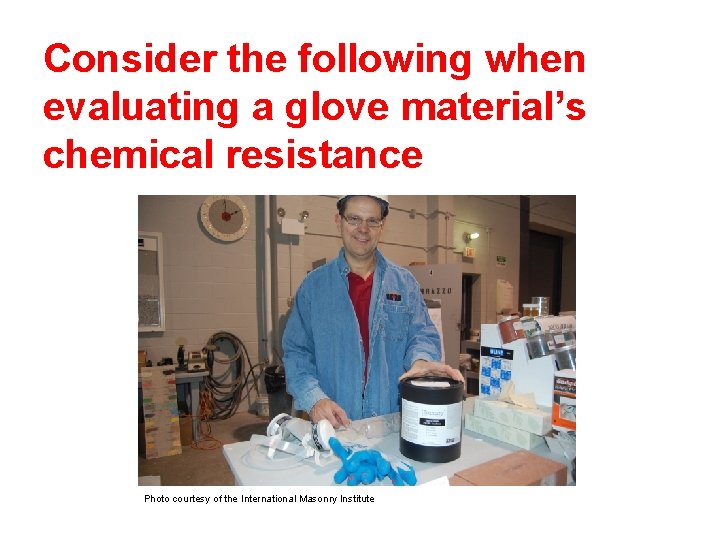
Consider the following when evaluating a glove material’s chemical resistance Photo courtesy of the International Masonry Institute
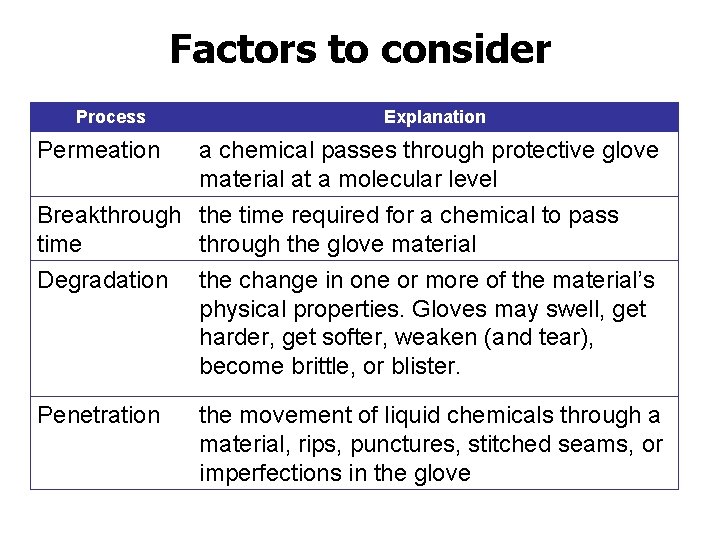
Factors to consider Process Permeation Explanation a chemical passes through protective glove material at a molecular level Breakthrough the time required for a chemical to pass time through the glove material Degradation the change in one or more of the material’s physical properties. Gloves may swell, get harder, get softer, weaken (and tear), become brittle, or blister. Penetration the movement of liquid chemicals through a material, rips, punctures, stitched seams, or imperfections in the glove
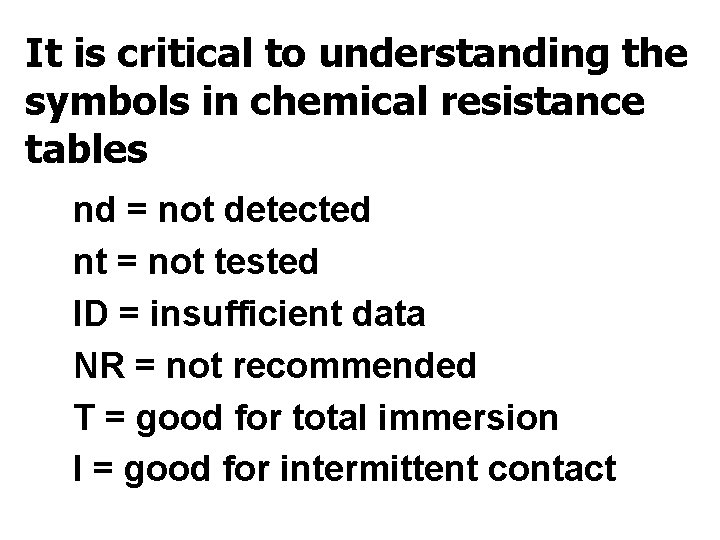
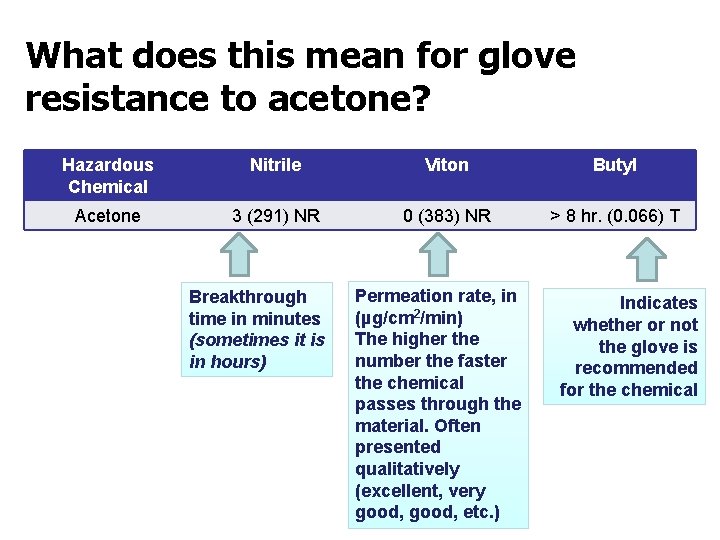
It is critical to understanding the symbols in chemical resistance tables nd = not detected nt = not tested ID = insufficient data NR = not recommended T = good for total immersion I = good for intermittent contact
What does this mean for glove resistance to acetone? Hazardous Chemical Nitrile Viton Butyl Acetone 3 (291) NR 0 (383) NR > 8 hr. (0. 066) T Breakthrough time in minutes (sometimes it is in hours) Permeation rate, in (µg/cm 2/min) The higher the number the faster the chemical passes through the material. Often presented qualitatively (excellent, very good, etc. ) Indicates whether or not the glove is recommended for the chemical
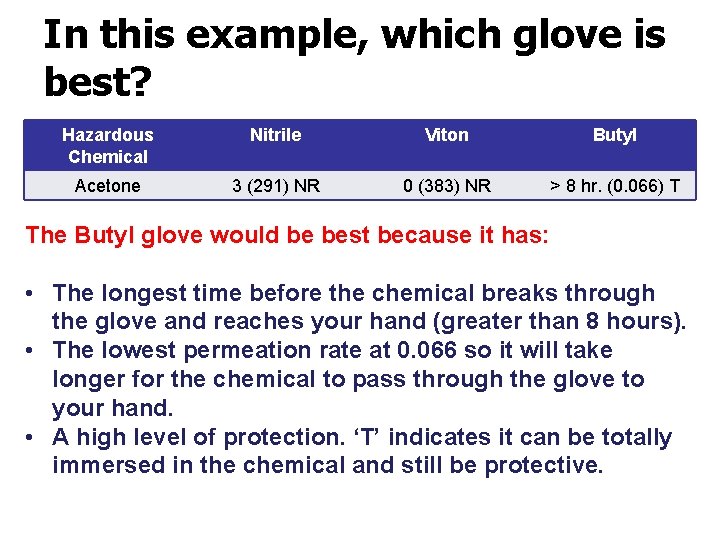
In this example, which glove is best? Hazardous Chemical Nitrile Viton Butyl Acetone 3 (291) NR 0 (383) NR > 8 hr. (0. 066) T The Butyl glove would be best because it has: • The longest time before the chemical breaks through the glove and reaches your hand (greater than 8 hours). • The lowest permeation rate at 0. 066 so it will take longer for the chemical to pass through the glove to your hand. • A high level of protection. ‘T’ indicates it can be totally immersed in the chemical and still be protective.
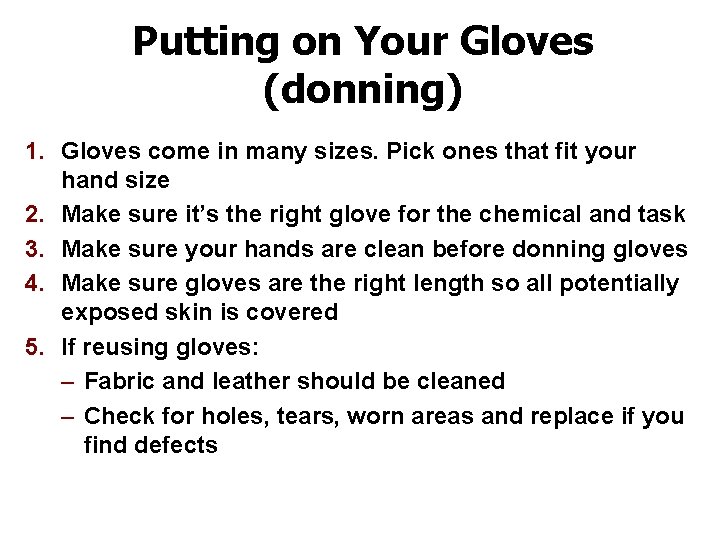
Putting on Your Gloves (donning) 1. Gloves come in many sizes. Pick ones that fit your hand size 2. Make sure it’s the right glove for the chemical and task 3. Make sure your hands are clean before donning gloves 4. Make sure gloves are the right length so all potentially exposed skin is covered 5. If reusing gloves: – Fabric and leather should be cleaned – Check for holes, tears, worn areas and replace if you find defects
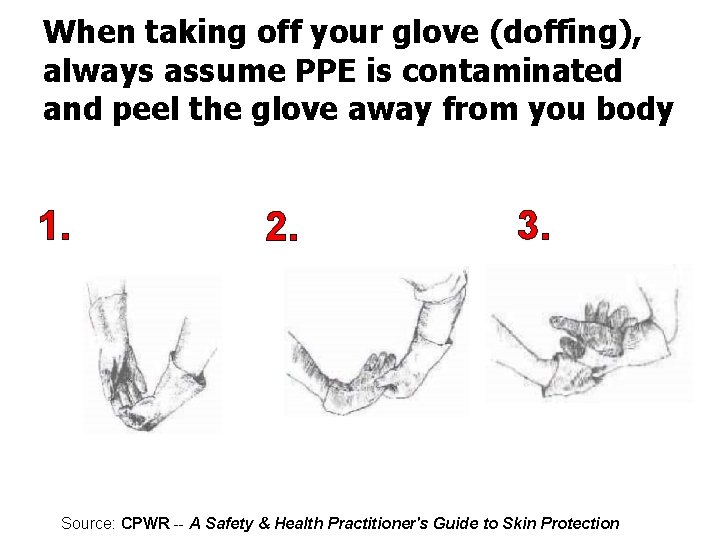
When taking off your glove (doffing), always assume PPE is contaminated and peel the glove away from you body 1. 2. 3. Source: CPWR -- A Safety & Health Practitioner's Guide to Skin Protection
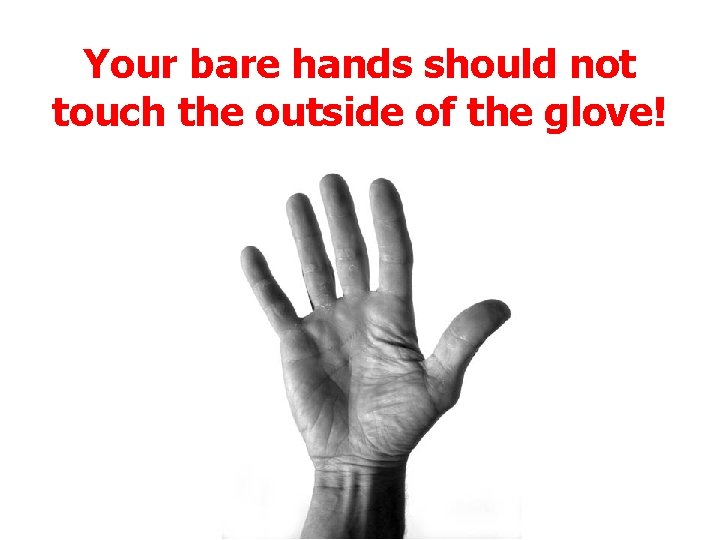
Your bare hands should not touch the outside of the glove!
To learn more visit: Research for this presentation was funded by CPWR – The Center for Construction Research and Training, using grant U 60 OH 009762 from the National Institute of Occupational Safety and Health (NIOSH). The contents are solely the responsibility of the authors and do not necessarily represent the official views of NIOSH. CPWR is a 501(c)(3) nonprofit research and training institution created by the Building and Construction Trades Department (BCTD), AFL-CIO, and serves as the research arm of the BCTD. CPWR provides safety and health research and information for the construction trades and industry. For more information, visit www. cpwr. com. © 2013, CPWR – The Center for Construction Research and Training. All rights reserved.