
Personal Pathways to Success Preparing all South Carolina

- Slides: 75
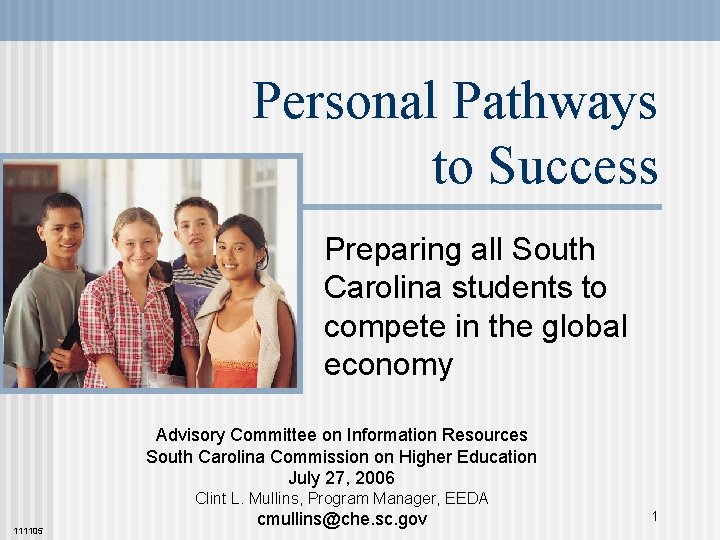
Personal Pathways to Success Preparing all South Carolina students to compete in the global economy Advisory Committee on Information Resources South Carolina Commission on Higher Education July 27, 2006 Clint L. Mullins, Program Manager, EEDA 111105 cmullins@che. sc. gov 1
How Can Today’s Students Best Prepare for Tomorrow’s Opportunities? 2 111105
What Careers Hold the Most Promise for Personal and Professional Rewards? 3 111105
What Kind of Graduates Will Contribute Most to the State’s Economic Success? 4 111105
The Challenges: 1. Globalization 5 111105
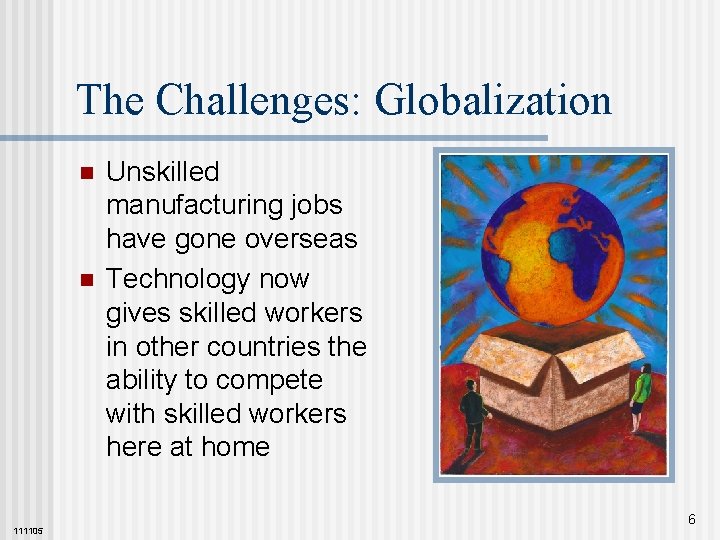
The Challenges: Globalization n n 111105 Unskilled manufacturing jobs have gone overseas Technology now gives skilled workers in other countries the ability to compete with skilled workers here at home 6
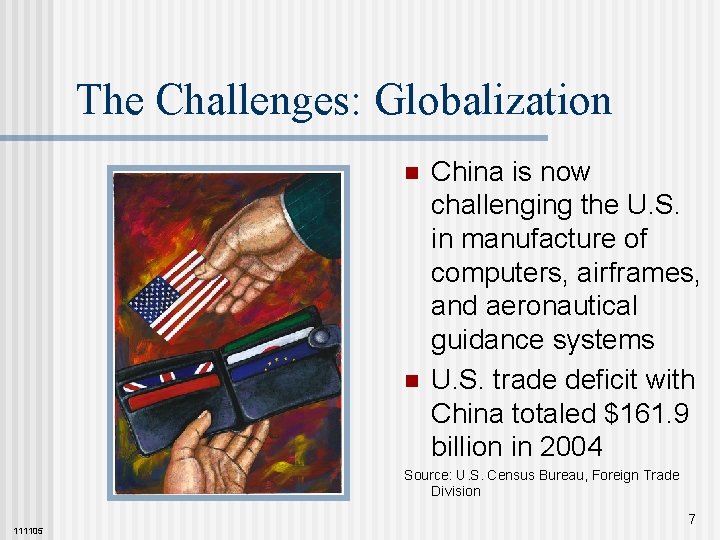
The Challenges: Globalization n n China is now challenging the U. S. in manufacture of computers, airframes, and aeronautical guidance systems U. S. trade deficit with China totaled $161. 9 billion in 2004 Source: U. S. Census Bureau, Foreign Trade Division 111105 7
The Challenges: Globalization n India is experiencing a boom in IT outsourcing n n Skilled labor formerly based in U. S. now performed in Indian technology and IT services exports totaled $17. 2 billion in the year ending March 2005 Up 34. 5 percent over previous year U. S. market accounts for 68 percent of Indian IT services exports Source: National Association of Software Companies 111105 8
The Challenges: Globalization “When I was growing up, my parents used to say to me, ‘Tom, finish your dinner. People in China and India are starving. ’ Today I tell my girls, ‘Finish your homework. People in China and India are starving for your jobs. ’” —Thomas Friedman, Author The World is Flat: A Brief History of the Twenty-first Century 111105 9
The Challenges: 1. Globalization 2. South Carolina Education Can Improve 10 111105
Challenges: South Carolina is a Leader in Education Reform No. 1 among the states in SAT improvement (The College Board) n No. 2 in improving teacher quality (Education Week magazine) n No. 11 in quality of state testing system (The Princeton Review) n No. 12 in raising academic standards (Education Week) n But. . . 111105 11
Challenges: South Carolina Education Can Improve n South Carolina still has a significant challenge improving the percentage of students who finish high school Source: South Carolina Department of Education 111105 12
Challenges: South Carolina Education Can Improve n n Students leave SC schools with substandard reading skills Level 3 is the minimum standard for today’s labor market n 52 percent of adult South Carolinians read at levels 1 or 2 Source: National Institute for Literacy 111105 13
Challenges: South Carolina Education Can Improve Source: Skills-that-Work III, 2003 111105 14
Challenges: South Carolina Education Can Improve n “The bottom line: Workers are not ready for the modern workplace. The world of technology requires strong mathematics and science skills, plus the abilities to read, write well, to think and reason, and to explain complex concepts. ” —Mike Watson, Vice Chairman Bell South Foundation 111105 15
The Challenges: 1. Globalization 2. South Carolina Education Can Improve 3. The Workforce Gap 16 111105
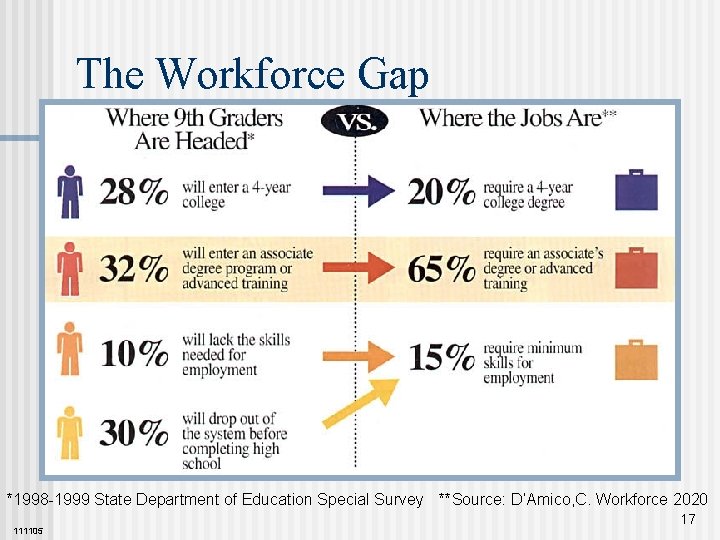
The Workforce Gap *1998 -1999 State Department of Education Special Survey **Source: D’Amico, C. Workforce 2020 111105 17
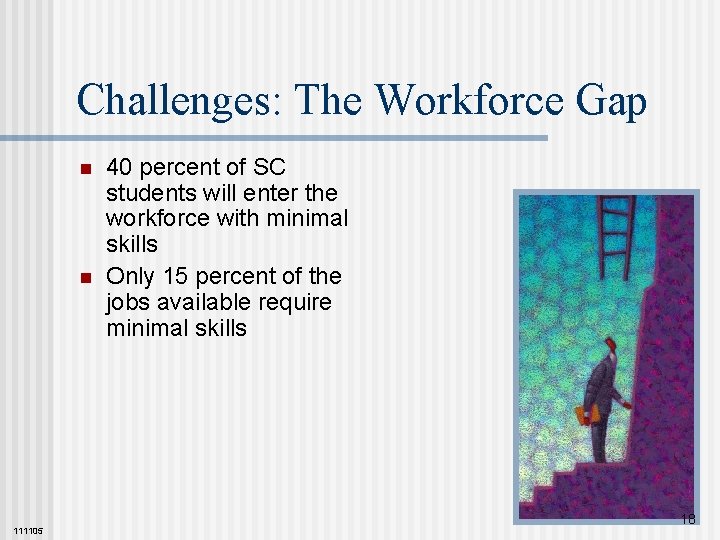
Challenges: The Workforce Gap n n 111105 40 percent of SC students will enter the workforce with minimal skills Only 15 percent of the jobs available require minimal skills 18
Challenges: The Workforce Gap n n 111105 Only 32 percent of SC students will enter a two-year associate degree program or advanced training 65 percent of jobs available require two years of postsecondary education—the skilled jobs 19
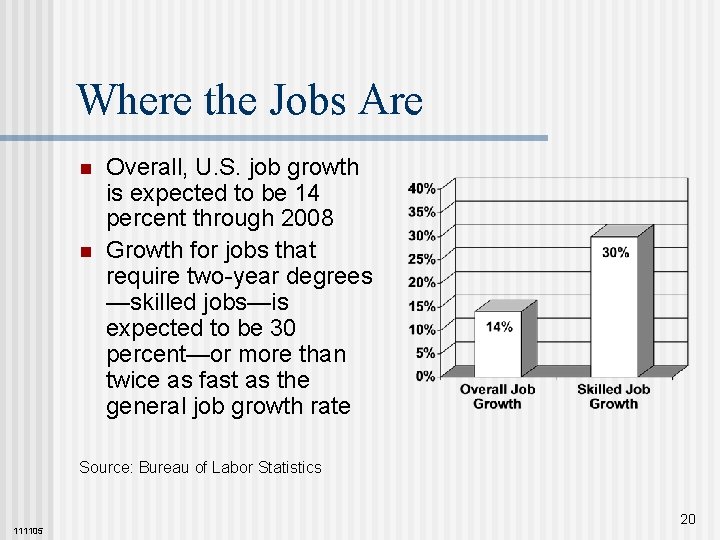
Where the Jobs Are n n Overall, U. S. job growth is expected to be 14 percent through 2008 Growth for jobs that require two-year degrees —skilled jobs—is expected to be 30 percent—or more than twice as fast as the general job growth rate Source: Bureau of Labor Statistics 111105 20
Where the Jobs Are n 90 percent of the fastest growing jobs require technical skills training n n Computer support specialist Desktop publisher Database administrator 48 of the 50 best paying jobs require a minimum of two years postsecondary education Source: U. S. Department of Labor, Bureau of Labor Statistics 111105 21
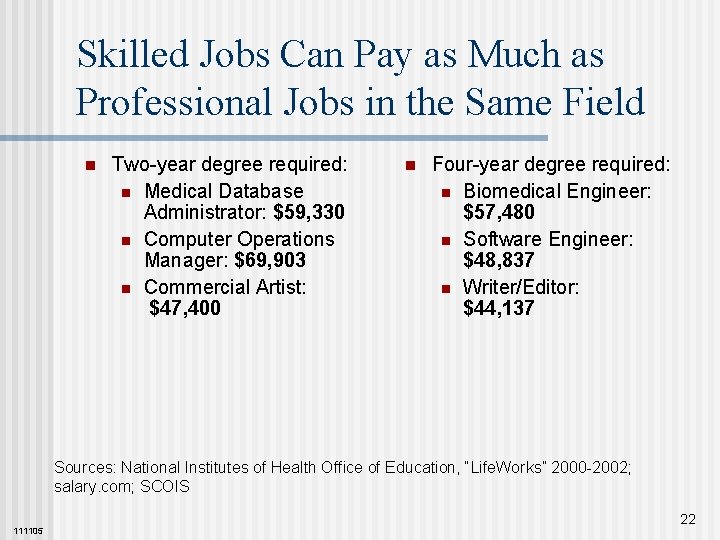
Skilled Jobs Can Pay as Much as Professional Jobs in the Same Field n Two-year degree required: n Medical Database Administrator: $59, 330 n Computer Operations Manager: $69, 903 n Commercial Artist: $47, 400 n Four-year degree required: n Biomedical Engineer: $57, 480 n Software Engineer: $48, 837 n Writer/Editor: $44, 137 Sources: National Institutes of Health Office of Education, “Life. Works” 2000 -2002; salary. com; SCOIS 111105 22
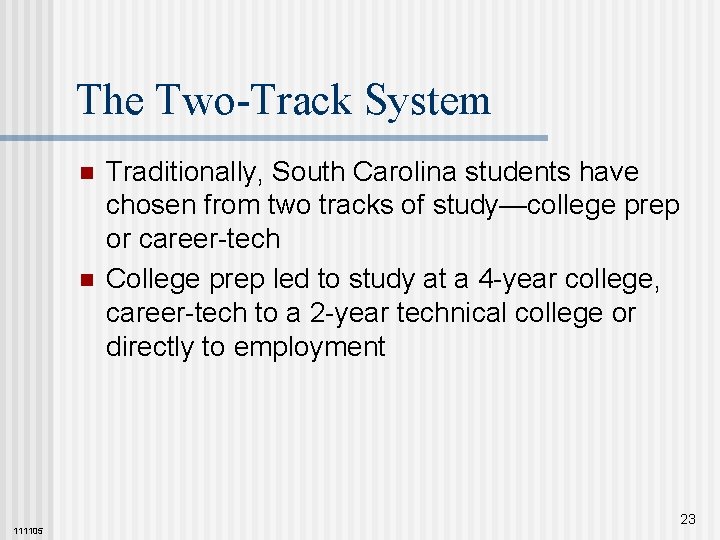
The Two-Track System n n 111105 Traditionally, South Carolina students have chosen from two tracks of study—college prep or career-tech College prep led to study at a 4 -year college, career-tech to a 2 -year technical college or directly to employment 23
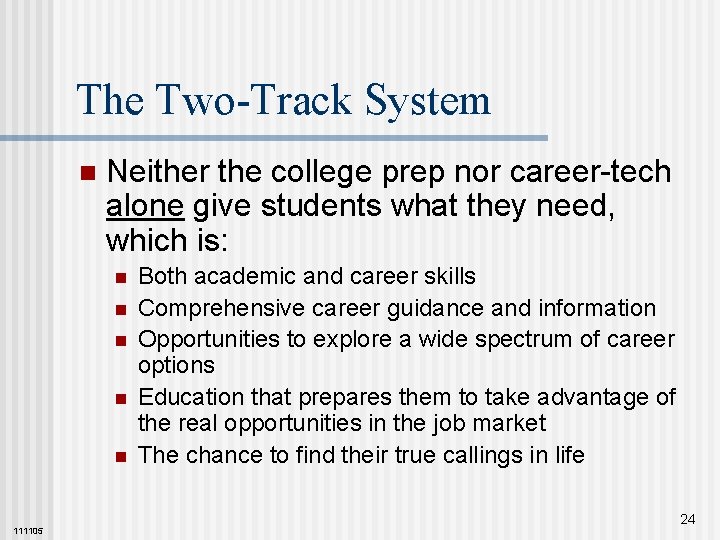
The Two-Track System n Neither the college prep nor career-tech alone give students what they need, which is: n n n 111105 Both academic and career skills Comprehensive career guidance and information Opportunities to explore a wide spectrum of career options Education that prepares them to take advantage of the real opportunities in the job market The chance to find their true callings in life 24
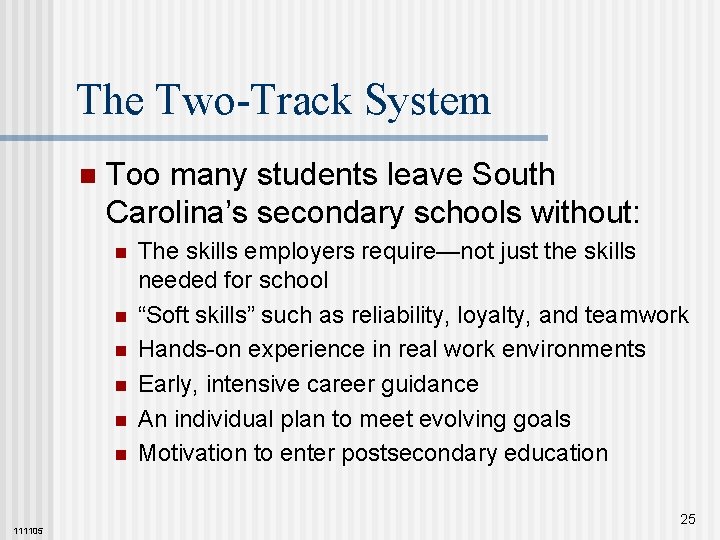
The Two-Track System n Too many students leave South Carolina’s secondary schools without: n n n 111105 The skills employers require—not just the skills needed for school “Soft skills” such as reliability, loyalty, and teamwork Hands-on experience in real work environments Early, intensive career guidance An individual plan to meet evolving goals Motivation to enter postsecondary education 25
Results of the Two-Track System n n n 111105 Students have not gotten the mix of education that truly prepares them for postsecondary options Students are not being readied for the real opportunities in the job market Students are not being started on pathways to success 26
What Students Really Need to Succeed n n n 111105 Fundamental academic knowledge Excellent technical skills Workplace habits that maximize employability Flexibility to update or change skills It is not a question of college or career education—everyone needs a mix of both based on his or her individual goals 27
It’s Time for a Fresh Approach n n n 111105 One that integrates both academic and career skills for all students One that aligns South Carolina’s education system and the demands of the global economy One that develops a strong workforce One that personalizes education to each student’s unique needs One that opens up many pathways to success for all South Carolina students One that gives all students chances to succeed, choice about direction, and control over their futures 28
Personal Pathways to Success: A New Vision for Education The Education and Economic Development Act (EEDA) of 2005 establishes a new vision for education based on the idea of “Personal Pathways to Success” for all students n This system integrates academic and career-tech education into a unified system that offers more and better ways for all students to succeed n 111105 29
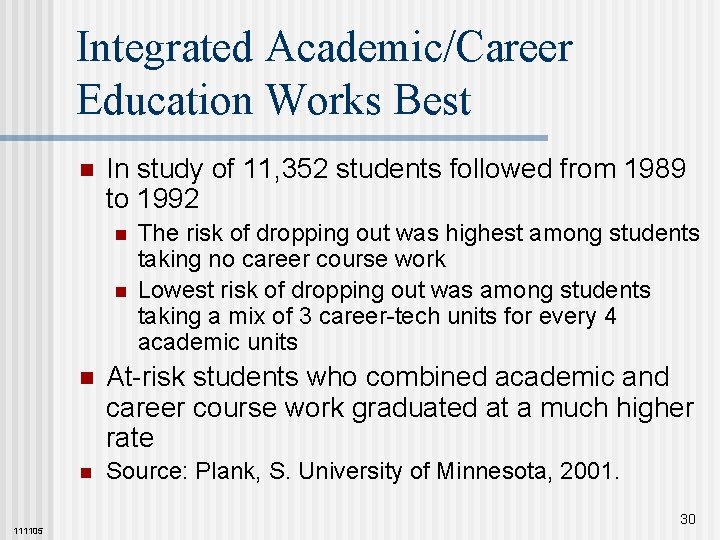
Integrated Academic/Career Education Works Best n In study of 11, 352 students followed from 1989 to 1992 n n 111105 The risk of dropping out was highest among students taking no career course work Lowest risk of dropping out was among students taking a mix of 3 career-tech units for every 4 academic units n At-risk students who combined academic and career course work graduated at a much higher rate n Source: Plank, S. University of Minnesota, 2001. 30
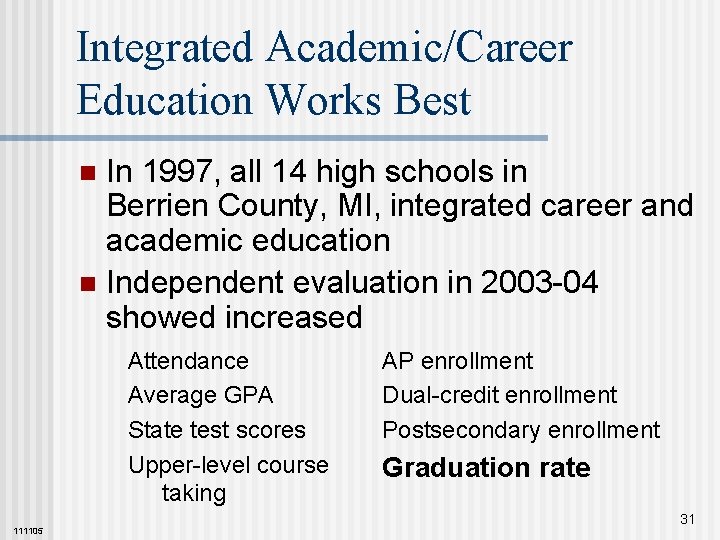
Integrated Academic/Career Education Works Best In 1997, all 14 high schools in Berrien County, MI, integrated career and academic education n Independent evaluation in 2003 -04 showed increased n Attendance Average GPA State test scores Upper-level course taking 111105 AP enrollment Dual-credit enrollment Postsecondary enrollment Graduation rate 31
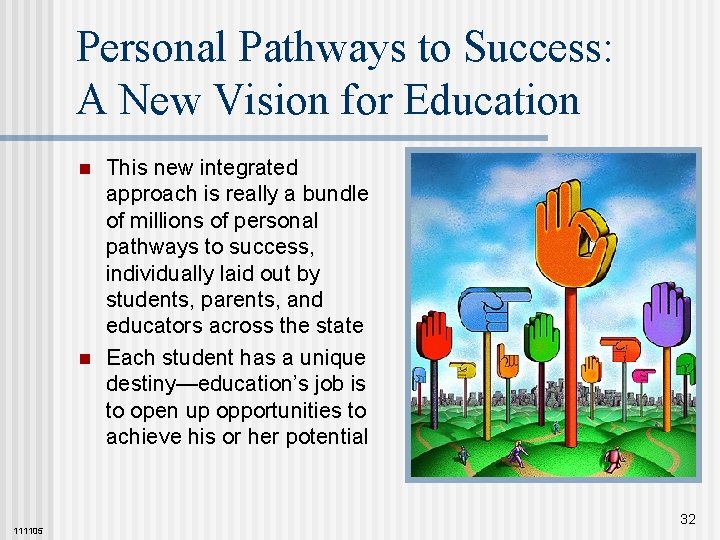
Personal Pathways to Success: A New Vision for Education n n 111105 This new integrated approach is really a bundle of millions of personal pathways to success, individually laid out by students, parents, and educators across the state Each student has a unique destiny—education’s job is to open up opportunities to achieve his or her potential 32
Why Personal Pathways? n n n 111105 To ground all students in rigorous academic fundamentals To give all students skills relevant to their chosen career paths To give all students the guidance they need to plan their individual futures To give all students the motivation to stay in school To create a workforce tailored to real opportunities in the South Carolina economy To create a workforce fully prepared for global competition 33
The Vision: How Personal Pathways Will Work 34 111105
Personal Pathways System n Mandated for all South Carolina schools by the Education and Economic Development Act of 2005 n Institutionalizes best practices already proven to work in the state n Puts South Carolina at the forefront of the national career clusters movement 111105 35
Elements of the Education and Economic Development Act n n n 111105 Help students connect education to careers of their choice Require strong academic core courses Increase the number of guidance counselors to achieve a 300 students to one counselor ratio Establish clusters of study and Individual Graduation Plans (IGPs) for students Provide for parental review and approval of IGP with student and counselor Identify at-risk students and provide programs to increase graduation rate 36
Elements of the Education and Economic Development Act n n 111105 Align requirements for high school graduation with college entrance Establish articulation agreements making K-16 education seamless Create dual-enrollment agreements for high school and college coursework Create a Coordinating Council to oversee implementation of EEDA 37
Personal Pathways System n n 111105 Organized around 16 Career Clusters are broken down into dozens of Career Majors guiding students’ high school preparation for specific careers 38
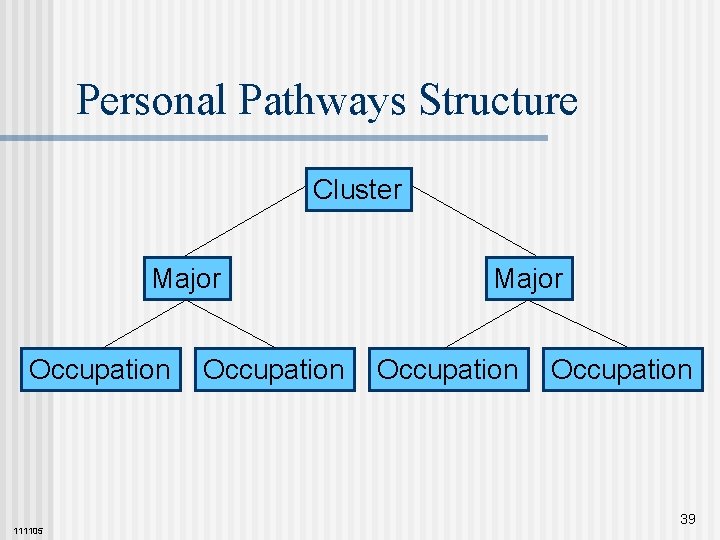
Personal Pathways Structure Cluster Major Occupation 111105 Occupation Major Occupation 39
What are Career Clusters? n n Groups of related occupations requiring varied skills and education levels Educational components aligned with sectors of the South Carolina job market Tools for making academic and technical education relevant to future careers A seamless way to integrate: n instruction guidance n transition n 111105 40
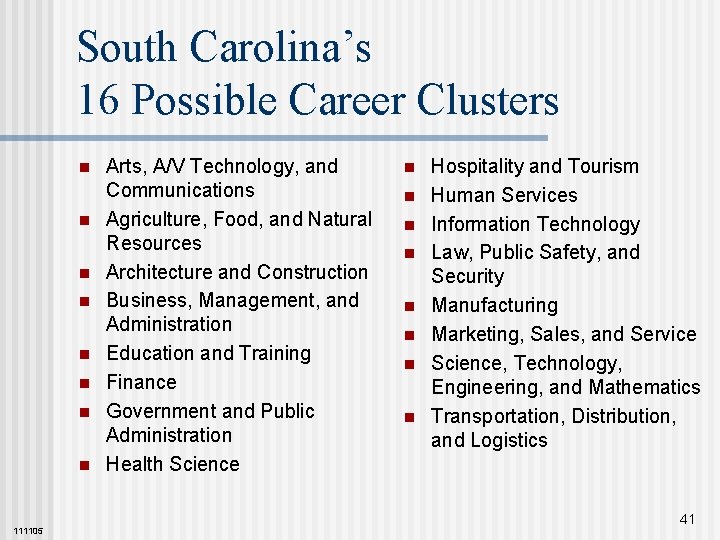
South Carolina’s 16 Possible Career Clusters n n n n 111105 Arts, A/V Technology, and Communications Agriculture, Food, and Natural Resources Architecture and Construction Business, Management, and Administration Education and Training Finance Government and Public Administration Health Science n n n n Hospitality and Tourism Human Services Information Technology Law, Public Safety, and Security Manufacturing Marketing, Sales, and Service Science, Technology, Engineering, and Mathematics Transportation, Distribution, and Logistics 41
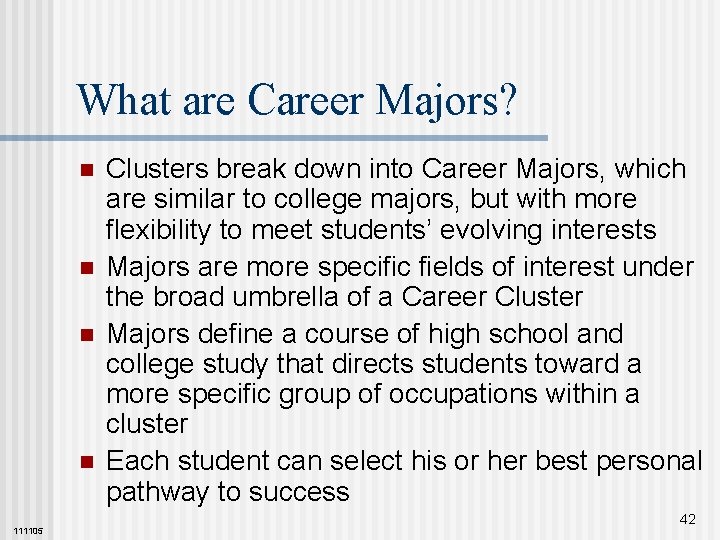
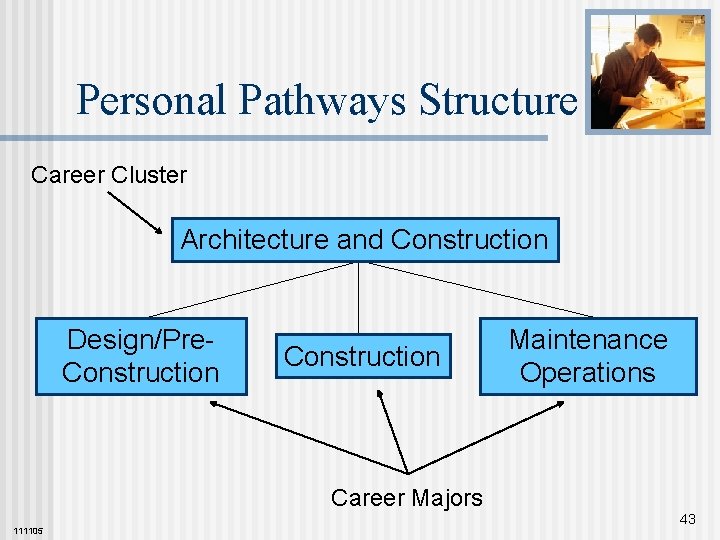
What are Career Majors? n n 111105 Clusters break down into Career Majors, which are similar to college majors, but with more flexibility to meet students’ evolving interests Majors are more specific fields of interest under the broad umbrella of a Career Cluster Majors define a course of high school and college study that directs students toward a more specific group of occupations within a cluster Each student can select his or her best personal pathway to success 42
Personal Pathways Structure Career Cluster Architecture and Construction Design/Pre. Construction Maintenance Operations Career Majors 111105 43
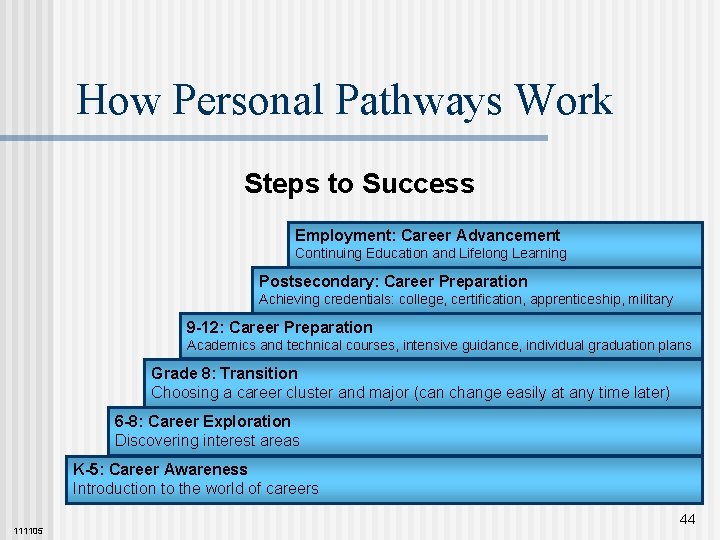
How Personal Pathways Work Steps to Success Employment: Career Advancement Continuing Education and Lifelong Learning Postsecondary: Career Preparation Achieving credentials: college, certification, apprenticeship, military 9 -12: Career Preparation Academics and technical courses, intensive guidance, individual graduation plans Grade 8: Transition Choosing a career cluster and major (can change easily at any time later) 6 -8: Career Exploration Discovering interest areas K-5: Career Awareness Introduction to the world of careers 111105 44
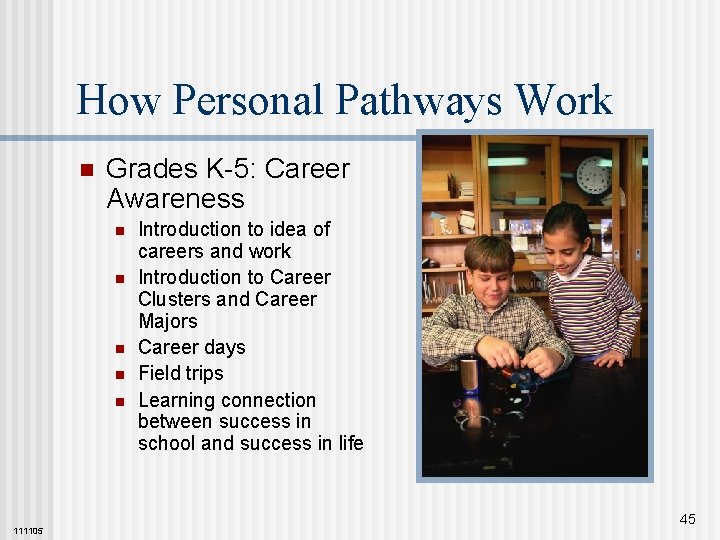
How Personal Pathways Work n Grades K-5: Career Awareness n n n 111105 Introduction to idea of careers and work Introduction to Career Clusters and Career Majors Career days Field trips Learning connection between success in school and success in life 45
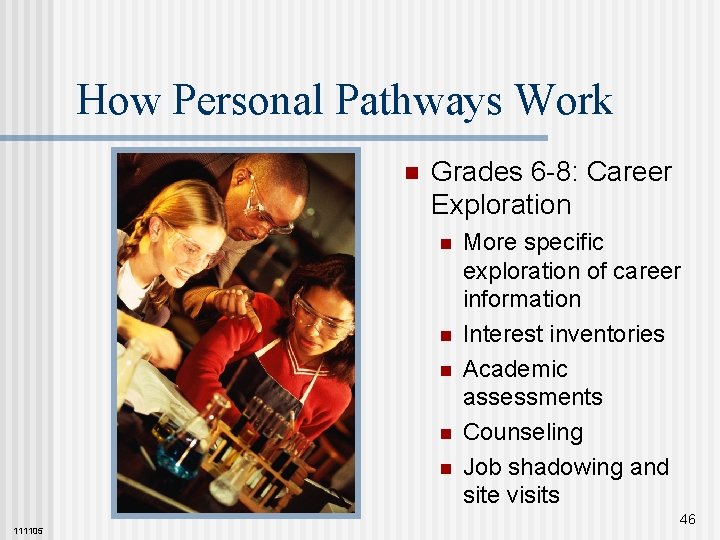
How Personal Pathways Work n Grades 6 -8: Career Exploration n n 111105 More specific exploration of career information Interest inventories Academic assessments Counseling Job shadowing and site visits 46
How Personal Pathways Work n Grade 8: Transition Use information gained in awareness and exploration activities n Consider personal talents and interests n Make initial choice of Career Cluster and Career Major n • Students are not locked into a choice forever n 111105 Develop an Individual Graduation Plan (IGP) with parental and adviser support 47
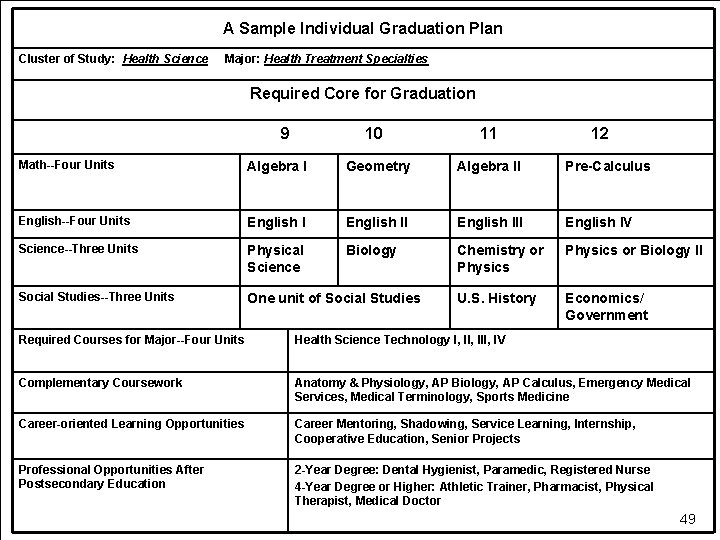
What is an Individual Graduation Plan (IGP)? n n 111105 A document that captures decisions about the direction in which the student wishes to go in high school and postsecondary education Specifies cluster, major, postsecondary goals, planned high school schedule, planned out-ofclass activities, and more Reviewed at least annually throughout high school by students, parents, and guidance counselors Puts students and parents in control of education and career decision-making 48
A Sample Individual Graduation Plan Cluster of Study: Health Science Major: Health Treatment Specialties Required Core for Graduation 9 10 11 12 Math--Four Units Algebra I Geometry Algebra II Pre-Calculus English--Four Units English III English IV Science--Three Units Physical Science Biology Chemistry or Physics or Biology II Social Studies--Three Units One unit of Social Studies U. S. History Economics/ Government Required Courses for Major--Four Units Health Science Technology I, III, IV Complementary Coursework Anatomy & Physiology, AP Biology, AP Calculus, Emergency Medical Services, Medical Terminology, Sports Medicine Career-oriented Learning Opportunities Career Mentoring, Shadowing, Service Learning, Internship, Cooperative Education, Senior Projects Professional Opportunities After Postsecondary Education 2 -Year Degree: Dental Hygienist, Paramedic, Registered Nurse 4 -Year Degree or Higher: Athletic Trainer, Pharmacist, Physical Therapist, Medical Doctor 111105 49
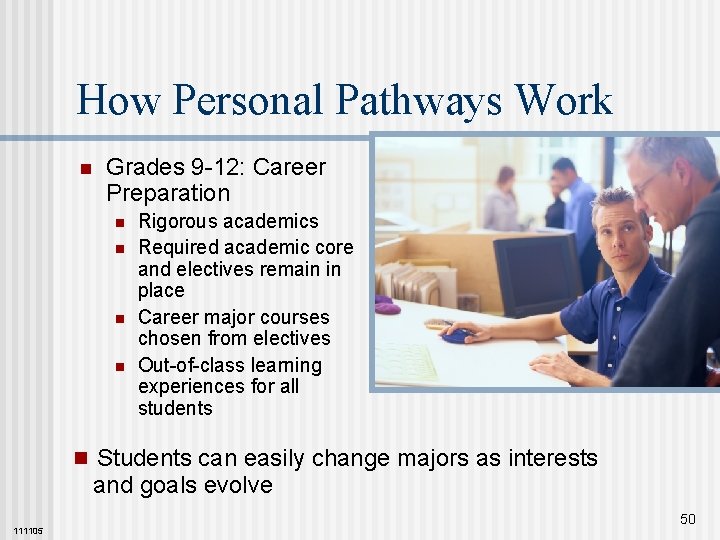
How Personal Pathways Work n Grades 9 -12: Career Preparation n n Rigorous academics Required academic core and electives remain in place Career major courses chosen from electives Out-of-class learning experiences for all students n Students can easily change majors as interests and goals evolve 111105 50
How Personal Pathways Work n n Grades 9– 12: Work-based Learning Under the Personal Pathways System, all students engage in work-based learning experiences related to classroom studies: n n n 111105 job shadowing internships co-op education service learning Real-world work experience complements what students learn in school to reinforce the motivation to achieve 51
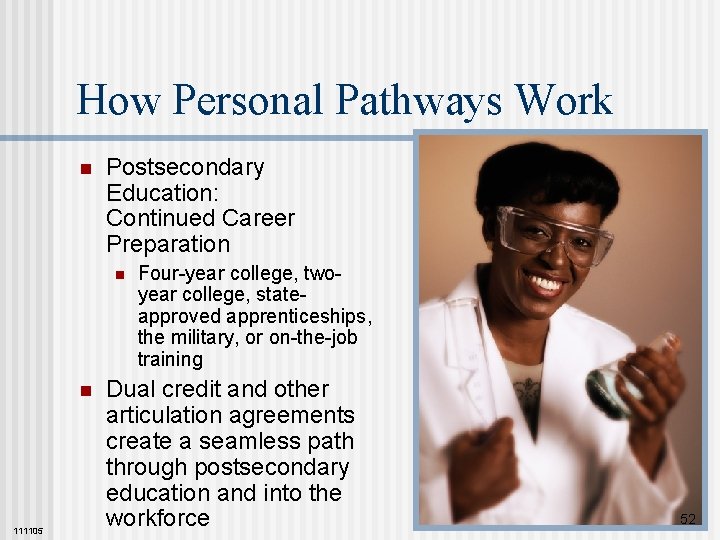
How Personal Pathways Work n Postsecondary Education: Continued Career Preparation n n 111105 Four-year college, twoyear college, stateapproved apprenticeships, the military, or on-the-job training Dual credit and other articulation agreements create a seamless path through postsecondary education and into the workforce 52
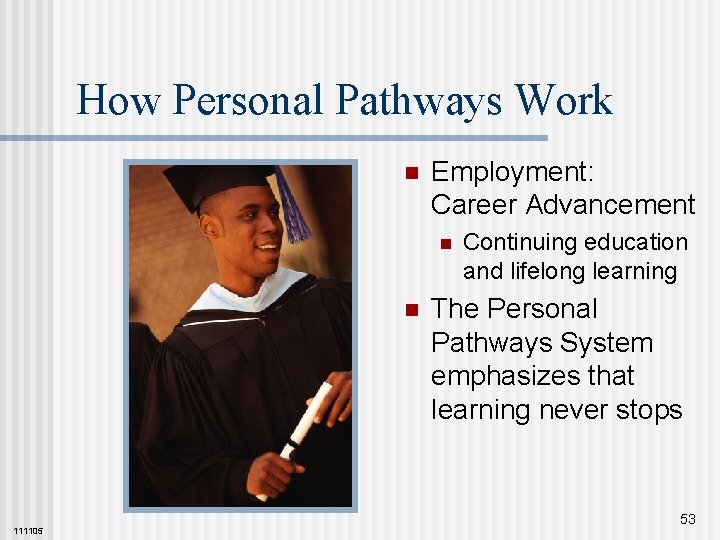
How Personal Pathways Work n Employment: Career Advancement n n 111105 Continuing education and lifelong learning The Personal Pathways System emphasizes that learning never stops 53
Personal Pathways to Success: Protection Against Tracking n n 111105 EEDA includes provisions that protect against students being forced into pathways they and their parents/guardians don’t choose Parents can designate someone to represent them if they cannot participate in IGP process An appeals process will be created to resolve any conflicts Every student will have equal access to opportunities 54
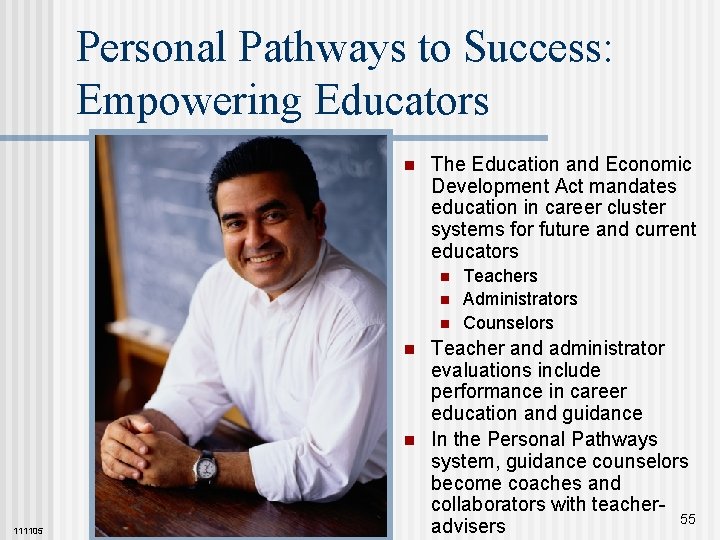
Personal Pathways to Success: Empowering Educators n The Education and Economic Development Act mandates education in career cluster systems for future and current educators n n n 111105 Teachers Administrators Counselors Teacher and administrator evaluations include performance in career education and guidance In the Personal Pathways system, guidance counselors become coaches and collaborators with teacher 55 advisers
Personal Pathways to Success: Individual Attention to Students n n n 111105 Under the Personal Pathways system, more guidance counselors will be hired to achieve a ratio of one counselor for every 300 students Career specialists will be hired Parent/designee conferences will ensure every student has a say in his or her future Students at risk for dropping out identified early Model procedures established to help at-risk students graduate 56
Personal Pathways to Success: Seamless Academic Transitions n Advisory Committee on Academic Programs will recommend n n n 111105 statewide agreements of accepted course credit among high schools, technical colleges, and fouryear colleges and universities statewide system of policies and coursework for dual enrollment Personal Pathways will help establish seamless educational transitions from K through 16 and beyond 57
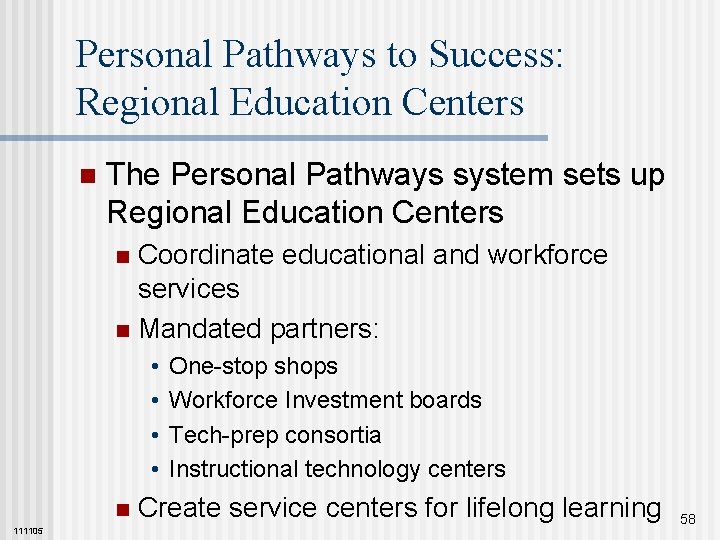
Personal Pathways to Success: Regional Education Centers n The Personal Pathways system sets up Regional Education Centers Coordinate educational and workforce services n Mandated partners: n • • n 111105 One-stop shops Workforce Investment boards Tech-prep consortia Instructional technology centers Create service centers for lifelong learning 58
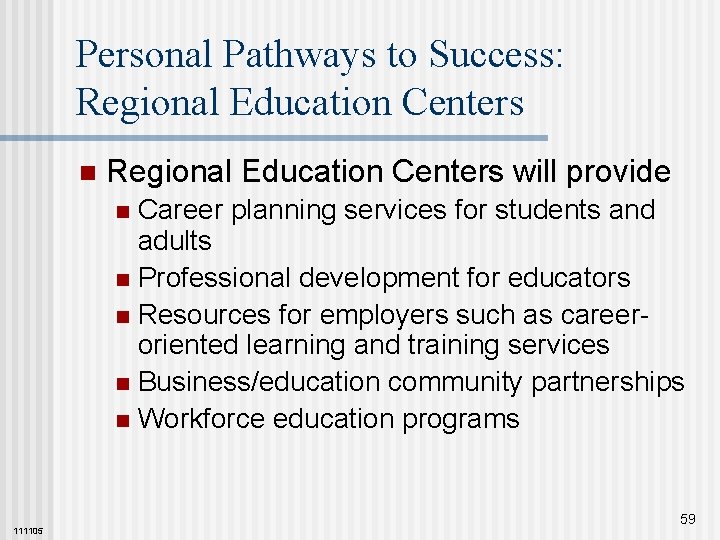
Personal Pathways to Success: Regional Education Centers n Regional Education Centers will provide Career planning services for students and adults n Professional development for educators n Resources for employers such as careeroriented learning and training services n Business/education community partnerships n Workforce education programs n 111105 59
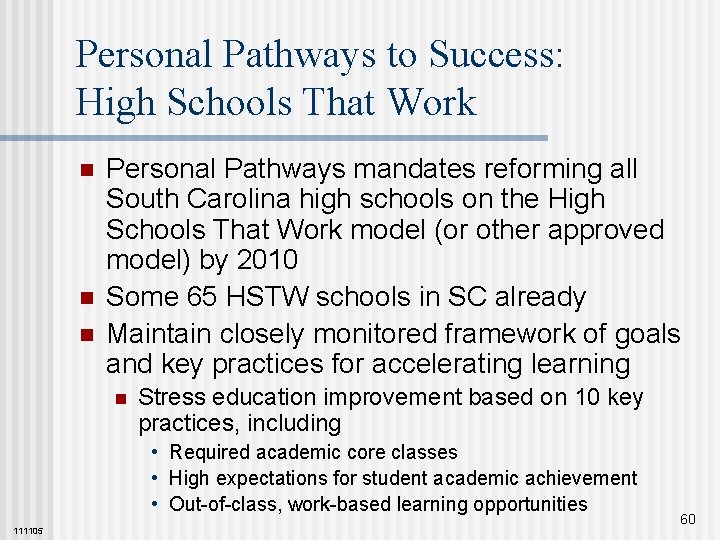
Personal Pathways to Success: High Schools That Work n n n Personal Pathways mandates reforming all South Carolina high schools on the High Schools That Work model (or other approved model) by 2010 Some 65 HSTW schools in SC already Maintain closely monitored framework of goals and key practices for accelerating learning n Stress education improvement based on 10 key practices, including • Required academic core classes • High expectations for student academic achievement • Out-of-class, work-based learning opportunities 111105 60
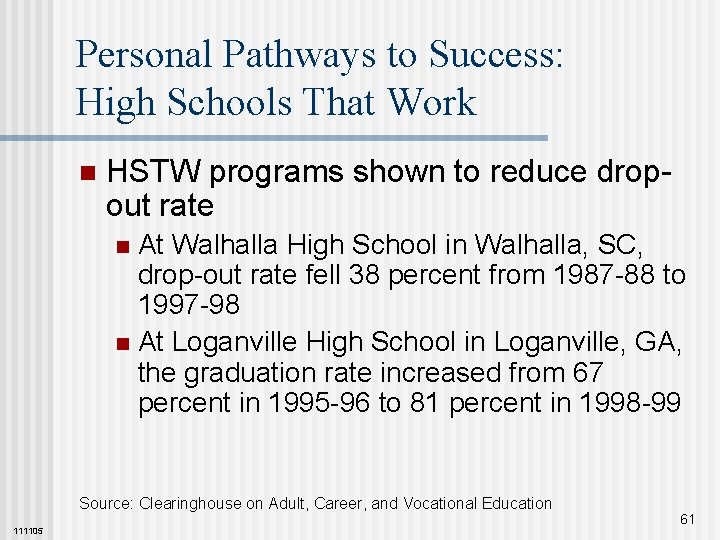
Personal Pathways to Success: High Schools That Work n HSTW programs shown to reduce dropout rate At Walhalla High School in Walhalla, SC, drop-out rate fell 38 percent from 1987 -88 to 1997 -98 n At Loganville High School in Loganville, GA, the graduation rate increased from 67 percent in 1995 -96 to 81 percent in 1998 -99 n Source: Clearinghouse on Adult, Career, and Vocational Education 111105 61
Personal Pathways to Success: A Statewide Effort n The Education and Economic Development Act sets up a statewide council to oversee implementation of Personal Pathways to Success n n n 111105 The Education and Economic Development Council is made up of a cross-section of SC education, government, and business leaders Sets up accountability and performance measures Reports annually on progress toward full implementation of Personal Pathways System 62
A Timeline for Success n The Education and Economic Development Act mandates full implementation of Personal Pathways to Success by July 1, 2011 n n n 111105 Education and Economic Development Council in place by October 1, 2005 Models for Individual Graduation Plans and cluster curricula developed by July 1, 2006 Regional Education Centers set up by July 1, 2006 Articulation agreements outline course work for statewide dual enrollment by July 1, 2006 All districts to have at least three clusters of study in place by July 1, 2007 63
A Timeline for Success n n n 111105 Career awareness and exploration curricula to be in place in grades 1 -5 during 2006 -07 school year Counseling and career awareness programs for grades 6 -8 in place by 2006 -07, including Individual Graduation Plans for 8 th graders Student to guidance counselor ratio reaches 300: 1 by 2006 -07 Identification of students at risk for dropping out begins by July 1, 2007 Model programs for helping at-risk students in place by 2007 -08 High Schools That Work (or similar approved model) in place in all high schools by 2009 -10 64
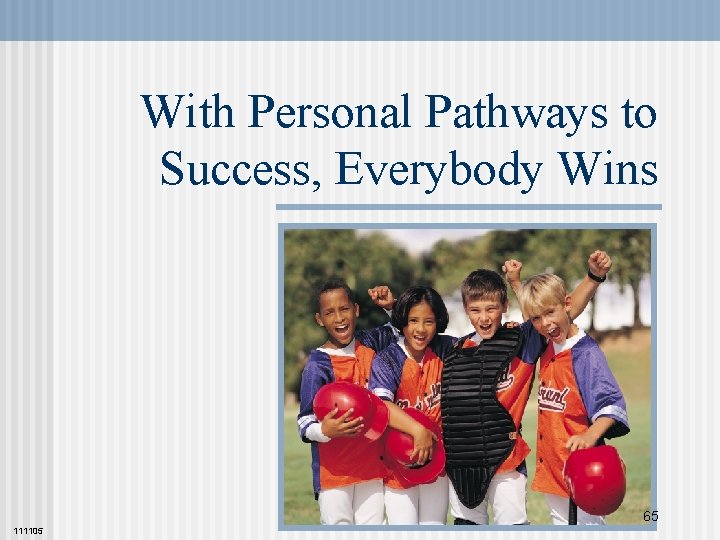
With Personal Pathways to Success, Everybody Wins 65 111105
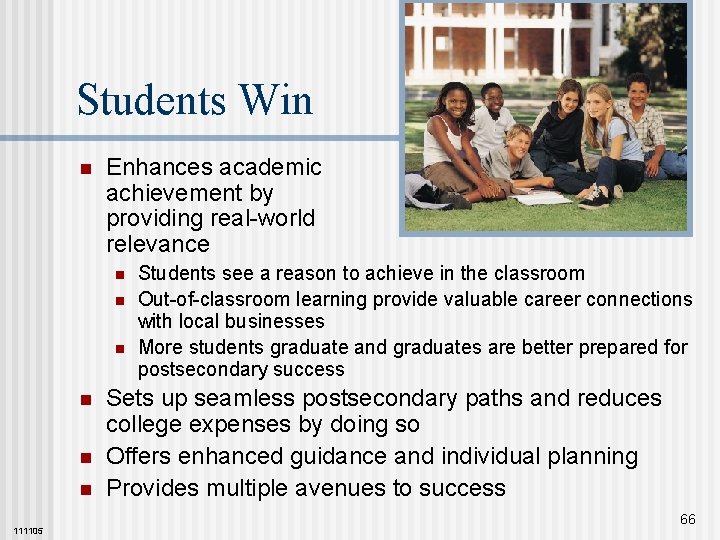
Students Win n Enhances academic achievement by providing real-world relevance n n n 111105 Students see a reason to achieve in the classroom Out-of-classroom learning provide valuable career connections with local businesses More students graduate and graduates are better prepared for postsecondary success Sets up seamless postsecondary paths and reduces college expenses by doing so Offers enhanced guidance and individual planning Provides multiple avenues to success 66
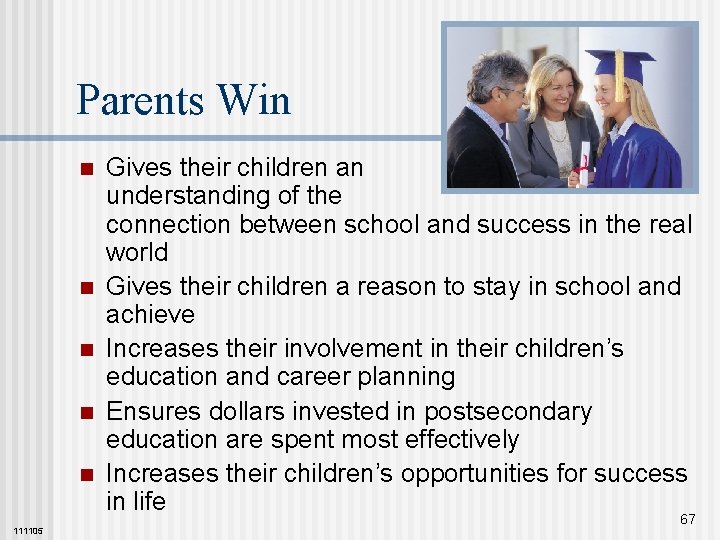
Parents Win n n 111105 Gives their children an understanding of the connection between school and success in the real world Gives their children a reason to stay in school and achieve Increases their involvement in their children’s education and career planning Ensures dollars invested in postsecondary education are spent most effectively Increases their children’s opportunities for success in life 67
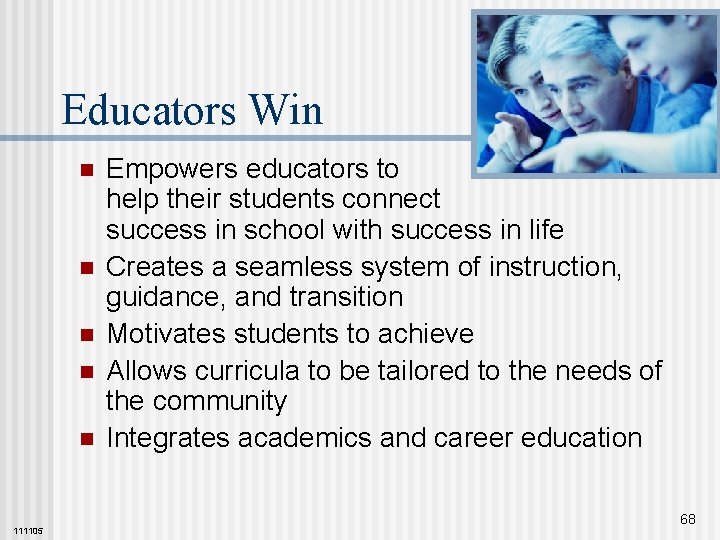
Educators Win n n 111105 Empowers educators to help their students connect success in school with success in life Creates a seamless system of instruction, guidance, and transition Motivates students to achieve Allows curricula to be tailored to the needs of the community Integrates academics and career education 68
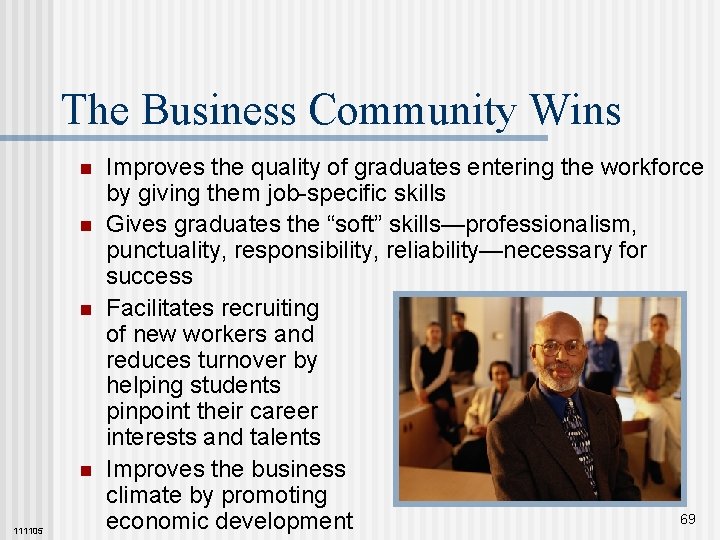
The Business Community Wins n n 111105 Improves the quality of graduates entering the workforce by giving them job-specific skills Gives graduates the “soft” skills—professionalism, punctuality, responsibility, reliability—necessary for success Facilitates recruiting of new workers and reduces turnover by helping students pinpoint their career interests and talents Improves the business climate by promoting 69 economic development
Policymakers Win Supports high standards and accountability n Supports statewide economic development n Positively addresses problems such as: n high school drop-out rates n workforce quality n 111105 70
South Carolina Wins n n 111105 Uses educational resources more effectively Grows a highly qualified workforce Expands the state’s role as a global competitor that can respond to rapid economic change Demonstrates the state’s understanding that the key to South Carolina’s growth is a welleducated and technically skilled workforce 71
Personal Pathways Must Be Fully Funded to Work n n n 111105 The Education and Economic Development Act has passed the General Assembly, but funding has only been provided for the first year The General Assembly must decide whether to provide additional funding during the next session to make the system a reality The legislature will act if people demand action 72
What You Can Do to Help Open your doors! Every high school student is to have experiences “on-site” within their chosen cluster—from a faculty office at USC to the Wellman plant in Darlington n Contact policymakers to express support n Work with all partners to make regional centers a reality n Spread the word about the EEDA 73 n 111105
What You Can Do to Help Become an EEDA Ambassador n Sign up for a speakers bureau of South Carolinians ready to present Personal Pathways to groups in their communities n Members receive a kit of presentation materials n Contact John Yates at jyates@lainecom. com to join n 111105 74
Together, We Can Make Personal Pathways to Success a Reality Mr. Clint L. Mullins Program Manager SC Commission on Higher Education 1333 Main Street, Suite 200 Columbia, SC 29201 Phone: 803. 737. 0141 cmullins@che. sc. gov 75 111105