
Personal Management Traditional Concept Outline 1 2 3




- Slides: 18
Personal Management – Traditional Concept Outline 1. 2. 3. 4. 5. 6. Management system model – personal and individual management Two concepts to personal management (PM) Faktors influencing on knowledge workers (KW) competence Content of PM according to traditional concept Self-knowledge process – questions, which must be answered Tasks and questions for self-study Personal M&L - modul no. 2
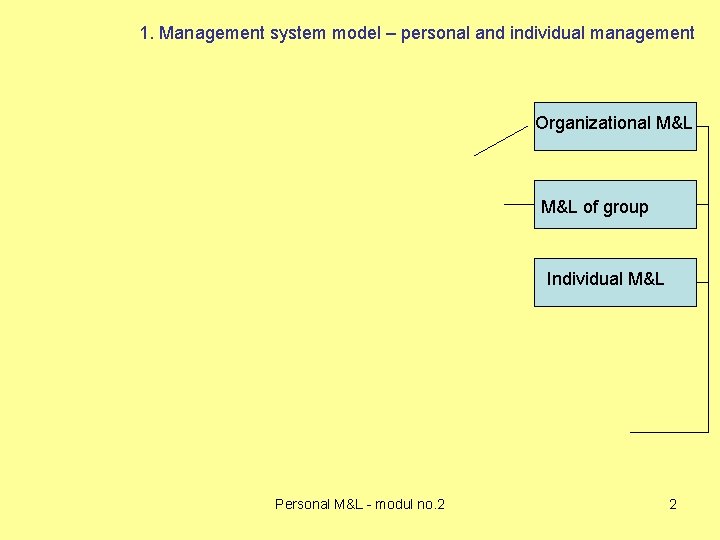
1. Management system model – personal and individual management Organizational M&L of group Individual M&L Personal M&L - modul no. 2 2
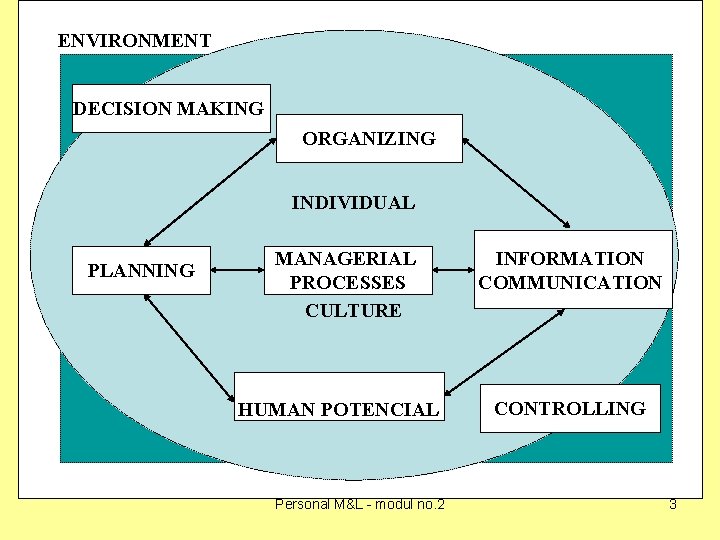
ENVIRONMENT DECISION MAKING ORGANIZING INDIVIDUAL PLANNING MANAGERIAL PROCESSES CULTURE HUMAN POTENCIAL Personal M&L - modul no. 2 INFORMATION COMMUNICATION CONTROLLING 3
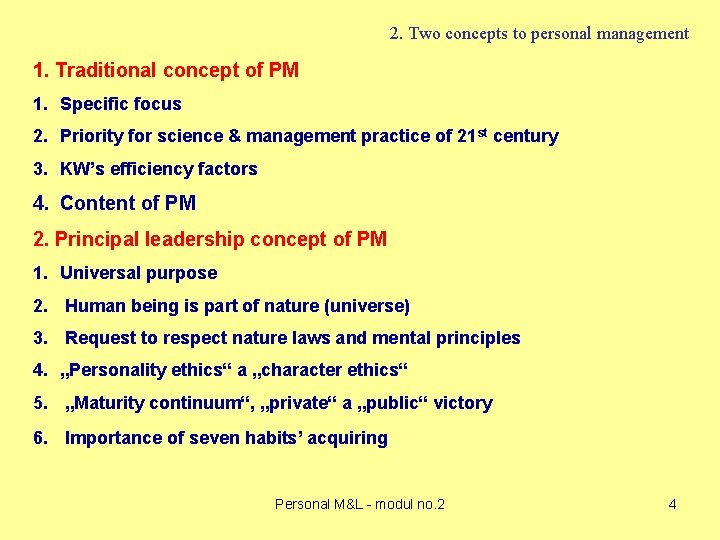
2. Two concepts to personal management 1. Traditional concept of PM 1. Specific focus 2. Priority for science & management practice of 21 st century 3. KW’s efficiency factors 4. Content of PM 2. Principal leadership concept of PM 1. Universal purpose 2. Human being is part of nature (universe) 3. Request to respect nature laws and mental principles 4. „Personality ethics“ a „character ethics“ 5. „Maturity continuum“, „private“ a „public“ victory 6. Importance of seven habits’ acquiring Personal M&L - modul no. 2 4
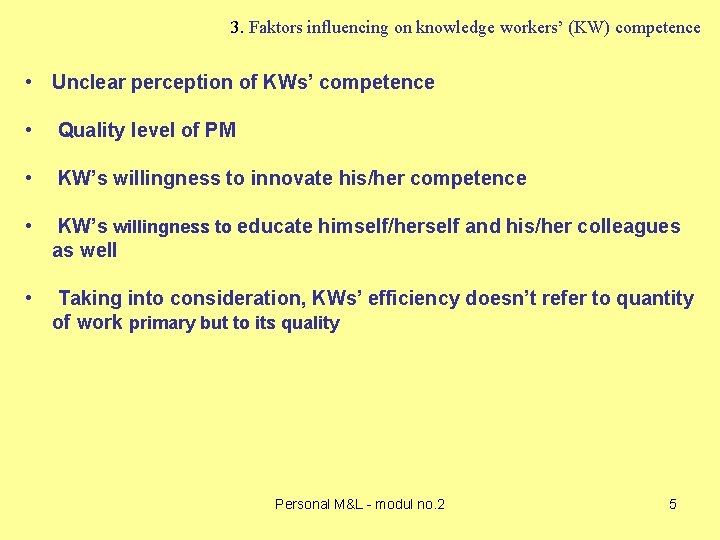
3. Faktors influencing on knowledge workers’ (KW) competence • Unclear perception of KWs’ competence • Quality level of PM • KW’s willingness to innovate his/her competence • KW’s willingness to educate himself/herself and his/her colleagues as well • Taking into consideration, KWs’ efficiency doesn’t refer to quantity of work primary but to its quality Personal M&L - modul no. 2 5
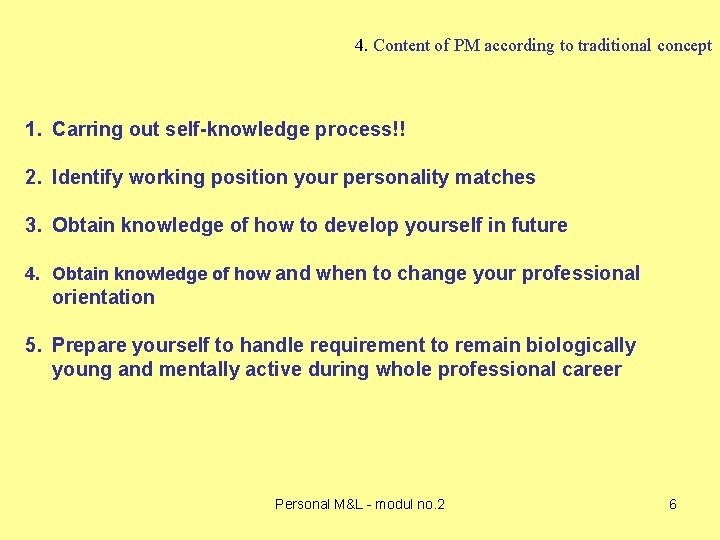
4. Content of PM according to traditional concept 1. Carring out self-knowledge process!! 2. Identify working position your personality matches 3. Obtain knowledge of how to develop yourself in future 4. Obtain knowledge of how and when to change your professional orientation 5. Prepare yourself to handle requirement to remain biologically young and mentally active during whole professional career Personal M&L - modul no. 2 6
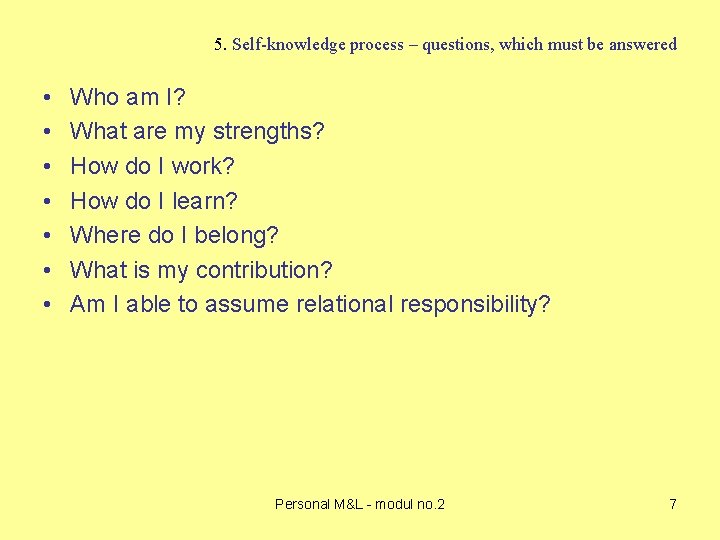
5. Self-knowledge process – questions, which must be answered • • Who am I? What are my strengths? How do I work? How do I learn? Where do I belong? What is my contribution? Am I able to assume relational responsibility? Personal M&L - modul no. 2 7
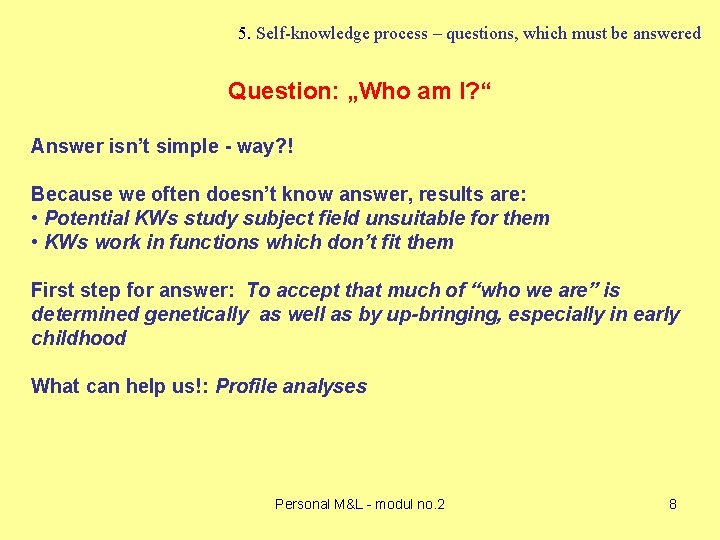
5. Self-knowledge process – questions, which must be answered Question: „Who am I? “ Answer isn’t simple - way? ! Because we often doesn’t know answer, results are: • Potential KWs study subject field unsuitable for them • KWs work in functions which don’t fit them First step for answer: To accept that much of “who we are” is determined genetically as well as by up-bringing, especially in early childhood What can help us!: Profile analyses Personal M&L - modul no. 2 8
5. Self-knowledge process – questions, which must be answered Profile analysis (1) Key examined personal characteristics: • Dominance • Influence on people • Stability needs • Willingness to adapt Comparative analyses of personal and professional profile Higher compatibility of both profiles – important assumption for successful professional competence and personal satisfaction as well Personal M&L - modul no. 2 9
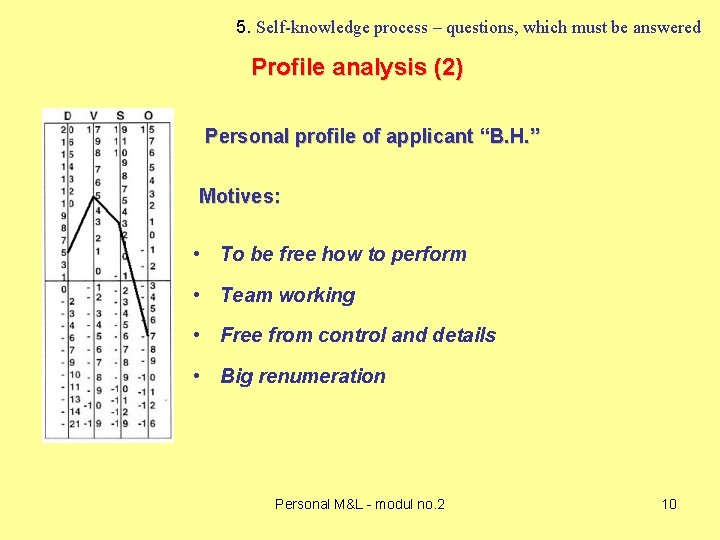
5. Self-knowledge process – questions, which must be answered Profile analysis (2) Personal profile of applicant “B. H. ” Motives: • To be free how to perform • Team working • Free from control and details • Big renumeration Personal M&L - modul no. 2 10
5. Self-knowledge process – questions, which must be answered Profile analysis (3) Personal profile applicant “J. S. ” Motives: • Using of professional knowledge • Work at home • Precise setting of job (tasks) Personal M&L - modul no. 2 11
5. Self-knowledge process – questions, which must be answered Profile analysis (4) – Comparison of personal and professional profiles Profile of B. H. Profile of judge Profile of J. S. Personal M&L - modul no. 2 Profile of notary 12
5. Self-knowledge process – questions, which must be answered Question: What of my strengths? Two myths exist: • People know their strengths and weaknesses • Efficiency can be increased due to removing of weaknesses only Method of fedback analysis: • Inform us in what our strengths are, • Bring out our activities, which causes under-utilisation of our potencial • Show, where we any strengths have Conclusions for our suitable dealing with: • Concentrate on our strengths and find matching jobs • Dealing with development of our strengths only • Identify intelectual arrogance areas Personal M&L - modul no. 2 13
5. Self-knowledge process – questions, which must be answered Question: How do I work? Suitable way of KW’s work is personal – it depends on particular KW’s personality and it’s chance to modify it only no change it! KWs have above-standard work’s results, if they work in accordance with their potencial! To answer “how I work? ” – to find answers on these subquestions: • Am I reader or listener? • How do I learn? • What are my values? Personal M&L - modul no. 2 14
5. Self-knowledge process – questions, which must be answered Question: Where do I belong? In P. Drucker’s opinion: • Most people doesn’t know what professional career’s areas are suitable for them till around 25 years of individual’s age! • Later KWs should be able to find which jobs matching their personalities and vice – versa which jobs they shouldn’t never take • Final decision making relating to career’s orientation don’t make after graduation immediately • Successful professional careers aren’t planned – It’s essential to be prepared to use of opportunities Conclusion: To know “where I belong”, it helps on average competent KWs to have outstanding efficiency!!! Personal M&L - modul no. 2 15
5. Self-knowledge process – questions, which must be answered Question: What is my contribution? Answer this question means to go from knowledge over to activity Right question should be: “What should my contribution, as KW, be? “ To correctly answer, it’s necessary to put these subquestions: • Comply required activities with my strengths? • Comply required activities with it what I want to do? • Correspond required activities to my motives? Being efficient by contributing – reactions to 3 elements (expressed by these questions): • What does situation require? • How can I contribute to what must be done, employing my strengths, way I work and my set of values? • How do I deal with to achieve changes practically? Personal M&L - modul no. 2 16
5. Self-knowledge process – questions, which must be answered Question: Am I able to assume relational responsibility? Most KWs collaborate with other KWs – Urgency for KWs to assume so -called “relational responsibility”! To assume relational responsibility means: • To understand people I cooperate with, to learn to make use of their strengths, their working methods, their sets of values! • Identify “whoever needs from me”, “who is dependent on me” and “who am I dependent on regarding goals and tasks to be achieved”! • To communicate with my colleagues in such way that sits them! Personal M&L - modul no. 2 17
6. Tasks and questions for self-study Questions: 1. Way is it advisable to increase KWs’ efficiency and way KWs’ efficiency have been lower then it should be? 2. What items does traditional personal management consist of and which of them you consider most important (why)? 3. What is essence of profile analyses and how you can use them? Tasks: 1. Try to answer all questions regarding self-knowledge process! 2. Carry out SWOT analysis refer to your future professional employability! Personal M&L - modul no. 2 18