
Personal Life Perspective Interactionism Postmodernism Evaluation of theories
- Slides: 11
Personal Life Perspective Interactionism & Postmodernism
Evaluation of theories before • 1. they all assume that the nuclear family is the dominant type • 2. they are all structural theories. Those theories assume that people in society and their behaviour is determined by the structure of society; that people have no free will.
Interactionists & Postmodernists • They believe that people in society have free will. • That they have a choice in which type of family they wish to have. • These sociologists believe to really understand a family you have to examine the meanings people in them, give about them. • This is unlike theories before because they mostly focused on what the functions of families were.
The sociology of personal life • This is taken from the Interactionist theory. • To understand families you must observe and enquire from the bottom up. • MICRO ANALYSIS
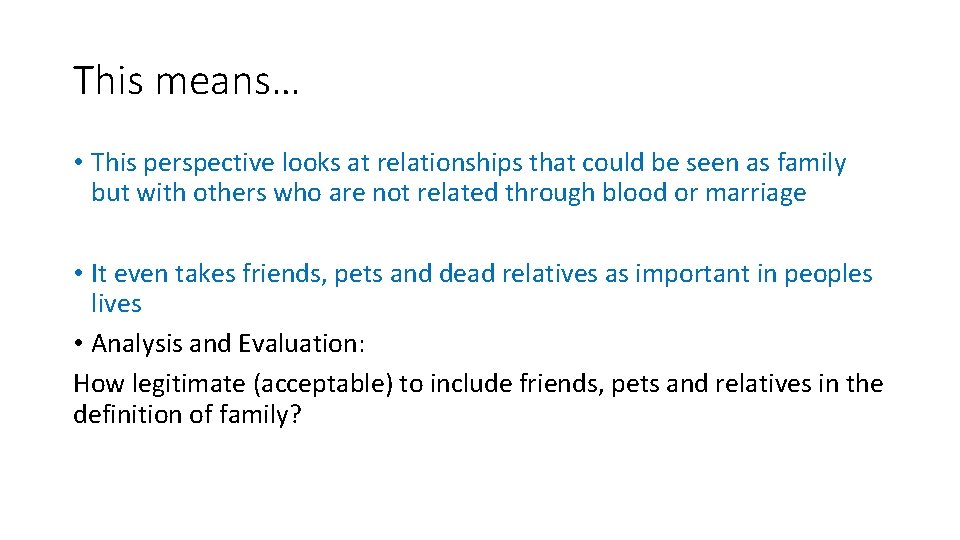
This means… • This perspective looks at relationships that could be seen as family but with others who are not related through blood or marriage • It even takes friends, pets and dead relatives as important in peoples lives • Analysis and Evaluation: How legitimate (acceptable) to include friends, pets and relatives in the definition of family?
So what about donor conceived children? Is this family? • Task: Donor conceived children • A. Having a child through egg or sperm donation can raise questions about what we mean by a family. There also legal considerations concerning donor-conceived children • Use the handout and watch each video then answer the questions below. • https: //www. youtube. com/watch? v=Tj. K 0 dbr 7 Re. M
So what about donor conceived children? Is this family? • Answers for task A
So what about donor conceived children? Is this family? • B. Professor Carol Smart discusses recent court cases involving lesbian couples who have conceived using sperm from known donors. • Use the handout and watch each video then answer the questions below. • https: //www. youtube. com/watch? v=cru 6 Qt. Qu 6 nk
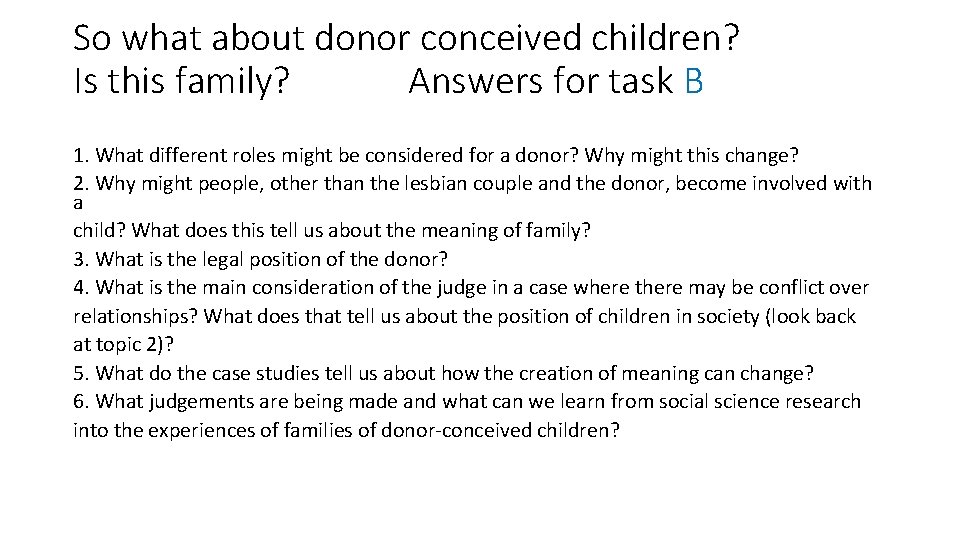
So what about donor conceived children? Is this family? Answers for task B 1. What different roles might be considered for a donor? Why might this change? 2. Why might people, other than the lesbian couple and the donor, become involved with a child? What does this tell us about the meaning of family? 3. What is the legal position of the donor? 4. What is the main consideration of the judge in a case where there may be conflict over relationships? What does that tell us about the position of children in society (look back at topic 2)? 5. What do the case studies tell us about how the creation of meaning can change? 6. What judgements are being made and what can we learn from social science research into the experiences of families of donor-conceived children?
So what about donor conceived children? Is this family? C. Write a summary paragraph on how donorconceived children highlight the personal life view of the family.
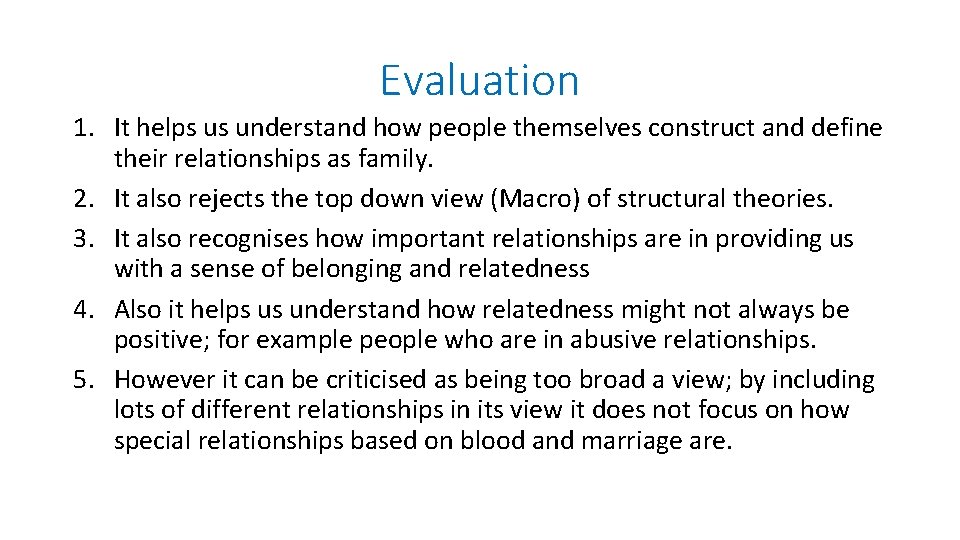
Evaluation 1. It helps us understand how people themselves construct and define their relationships as family. 2. It also rejects the top down view (Macro) of structural theories. 3. It also recognises how important relationships are in providing us with a sense of belonging and relatedness 4. Also it helps us understand how relatedness might not always be positive; for example people who are in abusive relationships. 5. However it can be criticised as being too broad a view; by including lots of different relationships in its view it does not focus on how special relationships based on blood and marriage are.