
PERSONAL LEADERSHIP PLATFORM James Graves DOVER CITY SCHOOLS

- Slides: 10
PERSONAL LEADERSHIP PLATFORM James Graves
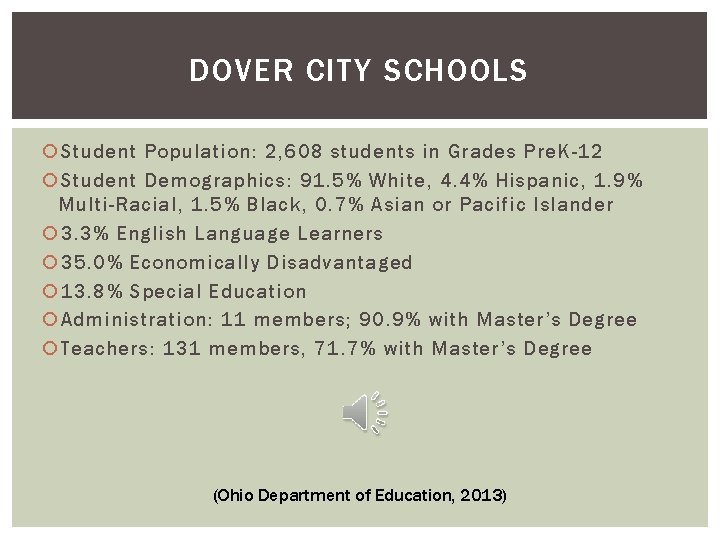
DOVER CITY SCHOOLS Student Population: 2, 608 students in Grades Pre. K-12 Student Demographics: 91. 5% White, 4. 4% Hispanic, 1. 9% Multi-Racial, 1. 5% Black, 0. 7% Asian or Pacific Islander 3. 3% English Language Learners 35. 0% Economically Disadvantaged 13. 8% Special Education Administration: 11 members; 90. 9% with Master’s Degree Teachers: 131 members, 71. 7% with Master’s Degree (Ohio Department of Education, 2013)
SCHOOL CULTURE The “Dover Way” § Tradition § Academics, Arts, Athletics Community involvement § Local Teacher Union § Dover Education Association § Dover City School Board Communication of beliefs
PERSONAL PHILOSOPHY OF LEADERSHIP Consistency and stability Professional culture § Communication § Collaboration Collective responsibility and shared decision making Clear vision and trust
MISSION AND VISION STATEMENT Mission Statement § “Educating all students to their fullest potential to become productive and responsible citizens through the coordination of parents, teachers and community” § Community-based project learning § Vocational school partnership Vision Statement § “Dover Schools…Addressing Tomorrow’s Challenges Today” § “Bring Your Own Technology” policy (Dover City Schools, 2003, pg. 25)
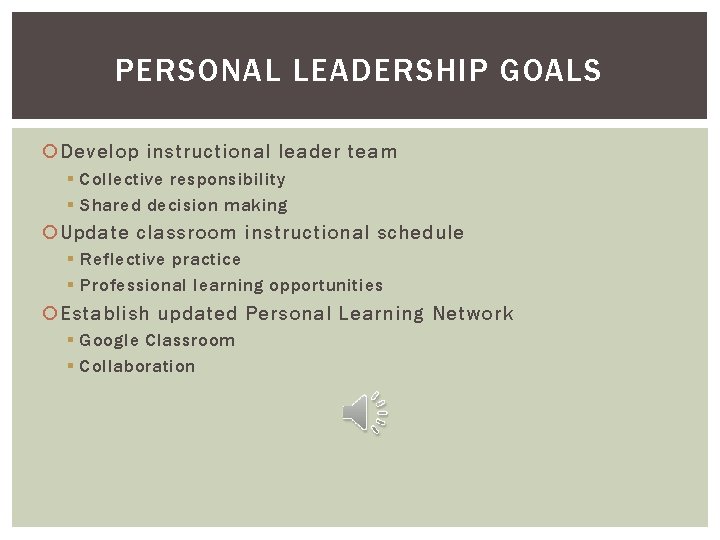
PERSONAL LEADERSHIP GOALS Develop instructional leader team § Collective responsibility § Shared decision making Update classroom instructional schedule § Reflective practice § Professional learning opportunities Establish updated Personal Learning Network § Google Classroom § Collaboration
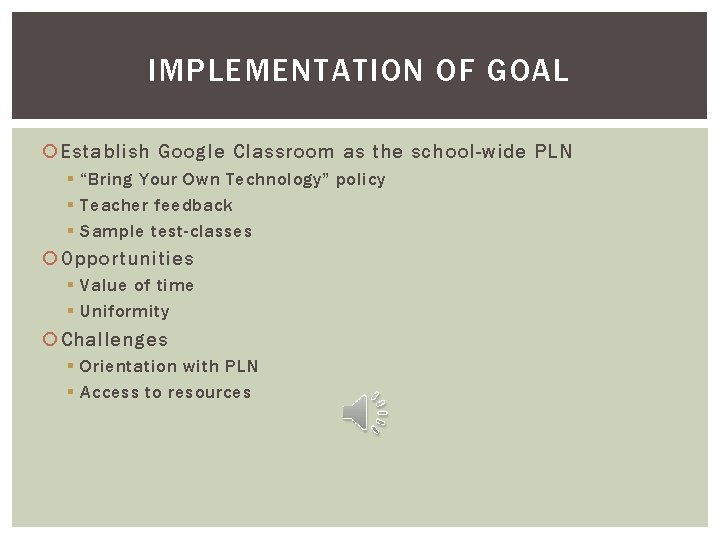
IMPLEMENTATION OF GOAL Establish Google Classroom as the school-wide PLN § “Bring Your Own Technology” policy § Teacher feedback § Sample test-classes Opportunities § Value of time § Uniformity Challenges § Orientation with PLN § Access to resources
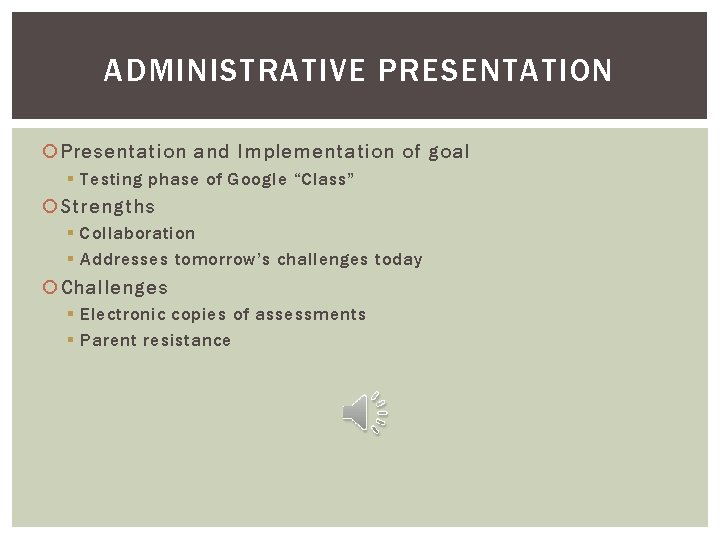
ADMINISTRATIVE PRESENTATION Presentation and Implementation of goal § Testing phase of Google “Class” Strengths § Collaboration § Addresses tomorrow’s challenges today Challenges § Electronic copies of assessments § Parent resistance
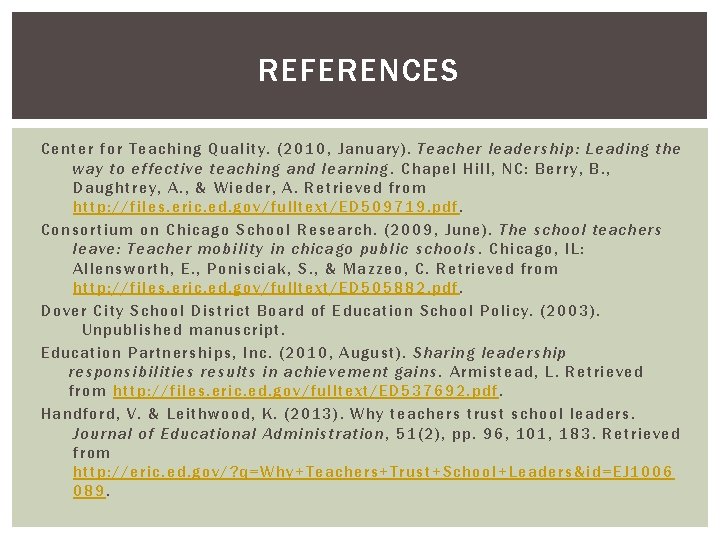
REFERENCES Center for Teaching Quality. (2010, January). Teacher leadership: Leading the way to effective teaching and learning. Chapel Hill, NC: Berry, B. , Daughtrey, A. , & Wieder, A. Retrieved from http: //files. eric. ed. gov/fulltext/ED 509719. pdf. Consortium on Chicago School Research. (2009, June). The school teachers leave: Teacher mobility in chicago public schools. Chicago, IL: Allensworth, E. , Ponisciak, S. , & Mazzeo, C. Retrieved from http: //files. eric. ed. gov/fulltext/ED 505882. pdf. Dover City School District Board of Education School Policy. (2003). Unpublished manuscript. Education Partnerships, Inc. (2010, August). Sharing leadership responsibilities results in achievement gains. Armistead, L. Retrieved from http: //files. eric. ed. gov/fulltext/ED 537692. pdf. Handford, V. & Leithwood, K. (2013). Why teachers trust school leaders. Journal of Educational Administration, 51(2), pp. 96, 101, 183. Retrieved from http: //eric. ed. gov/? q=Why+Teachers+Trust+School+Leaders&id=EJ 1006 089.
REFERENCES Hargreaves, A. , & Fullan, M. (2012). Professional capital: Transforming teaching in every school. New York: Teachers College Press. Ohio Department of Education. (2013). Retrieved from http: //reportcard. education. ohio. gov/Pages/District. Report. aspx? District. IRN=043893. Parsons, J. & Beauchamp, L. (2012). Leadership in effective elementary schools: A synthesis of five case studies. US-China Education Review, pp. 691 -711. Retrieved from http: //files. eric. ed. gov/fulltext/ED 536409. pdf. Sahin, S. (2011, Autumn). The relationship between instructional leadership style and school culture (Izmir Case). Educational Sciences : Theory and Practice, 11(4), p. 2. Retrieved from http: //files. eric. ed. gov/fulltext/EJ 962681. pdf. Val, C. & Kemp, J. (2012, Spring). Leadership styles. The Ontario Journal of Outdoor Education , 24(3), 3. Retrieved from http: //files. eric. ed. gov/fulltext/EJ 994012. pdf.