
Personal Hygiene Personal Hygiene It is the nurses


- Slides: 52
Personal Hygiene
Personal Hygiene It is the nurses responsibility to provide the patient with the opportunity for hygiene The skill may be delegated but not always, depends on facility policy.
Purpose of Bathing Cleansing the skin Removes perspiration, bacteria, which minimizes skin irritation and reduces chance of infection Stimulation of circulation Warm water and gentle strokes from distal to proximal increase circulation and promote venous return Improve self-image Promotes feeling of being refreshed, relaxed
Purpose of Bathing Reduction of body odors Especially in axillae and pubic areas Promotion of Range of Motion Movement of extremities while bathing
Nurse’s Advantage Provides opportunity to develop a meaningful nurse-patient relationship Provides opportunity for assessment of the patient including condition of patient, psychosocial and learning needs.
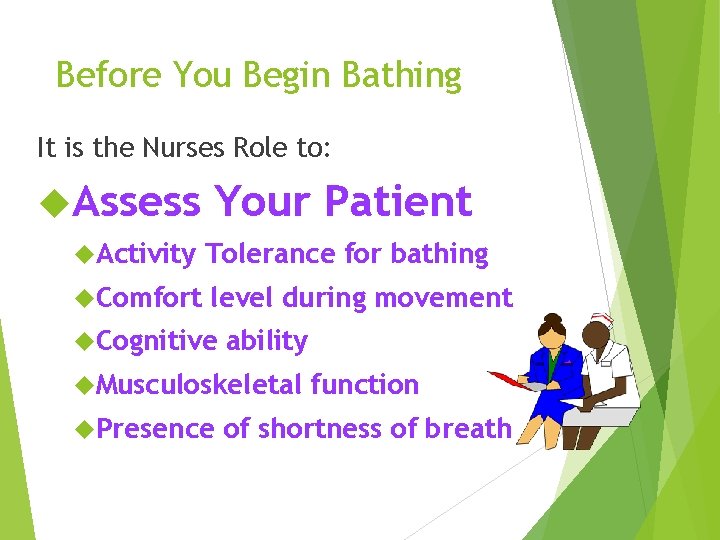
Before You Begin Bathing It is the Nurses Role to: Assess Your Patient Activity Tolerance for bathing Comfort level during movement Cognitive ability Musculoskeletal Presence function of shortness of breath
Factors Affecting Personal Hygiene 1. Cultural / Religious 2. Developmental Stage 3. Mobility 4. Emotional 5. Physical Illness 6. Personal Preference
Types of Baths Cleansing Baths Used to clean the patient
Cleansing Baths Complete Bed Bath Nurse baths entire body of dependent patient in bed Self-Help Bath Patients confined to bed are able to bathe themselves with some help Partial Bath Parts of the body are washed by the patient and some by the nurse
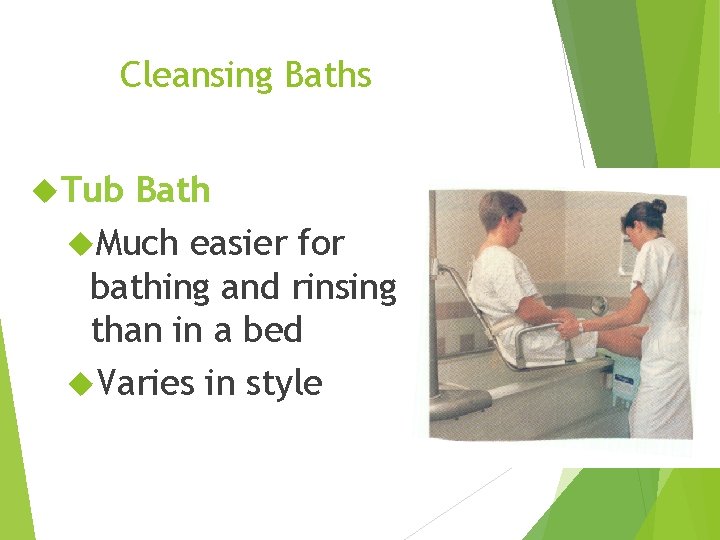
Cleansing Baths Tub Bath Much easier for bathing and rinsing than in a bed Varies in style
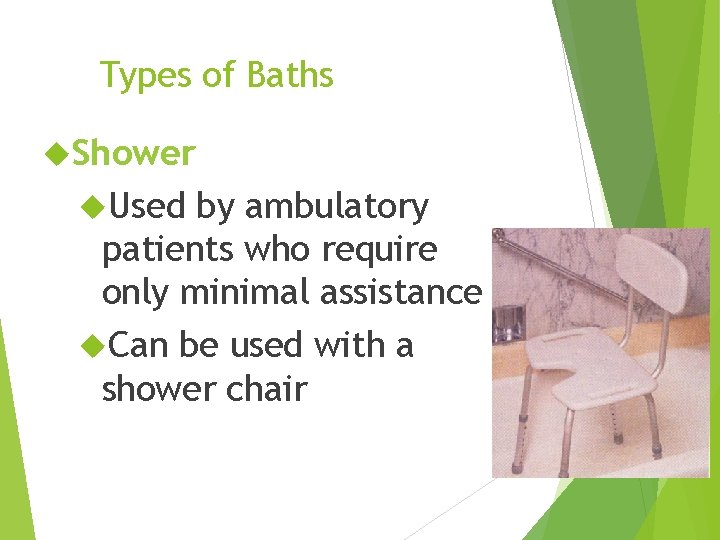
Types of Baths Shower Used by ambulatory patients who require only minimal assistance Can be used with a shower chair
Types of Baths Therapeutic Baths Bath used for treatment Usually requires a doctor’s order
Therapeutic Baths Medicated solutions may be used in bathing (Sage Baths) Range from warm water baths, cool water baths, cornstarch, oatmeal, Aveno, alcohol
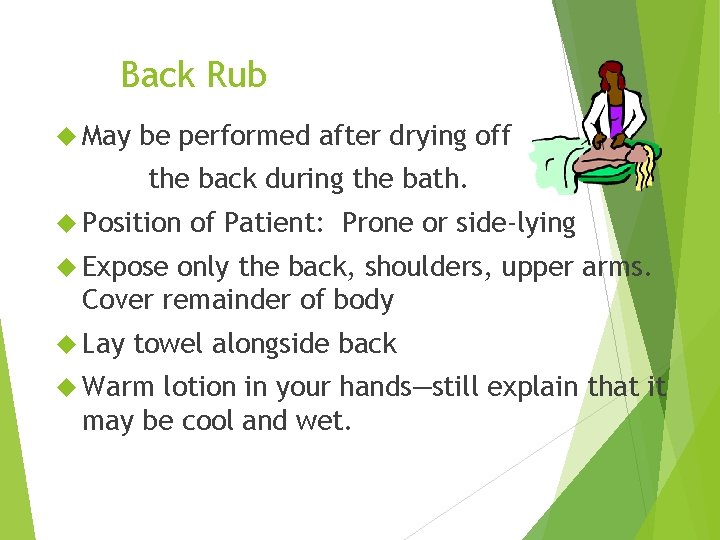
Back Rub May be performed after drying off the back during the bath. Position of Patient: Prone or side-lying Expose only the back, shoulders, upper arms. Cover remainder of body Lay towel alongside back Warm lotion in your hands—still explain that it may be cool and wet.
Back Rub Start in the sacral area, moving up the back. Massage in a circular motion over the scapula. Move upward to shoulders, massage over the scapula Continue in one smooth stroke to upper arms and laterally along side of back down to iliac crests. Do NOT allow your hands to leave the patient’s skin End by telling your patient that you are finished
Guidelines for Bathing 1. Provide Privacy 2. Maintain Safety 3. Maintain warmth 4. Promote the patient’s independence as much as possible
Procedure for Bathing Bed Bath Potter and Perry p. 797
Part B: Perineal Care Hygienic measures related to the care of the genitalia.
Perineal Care Can be embarrassing for the nurse and the patient. Should not be overlooked because of embarrassment. If the patient can do it themselves—let them. Hand them the washcloth and ask if they would like to “finish their bath. ”
Perineal Care Those patients who may need the nurses assistance: Vaginal or urethral discharge Skin irritation Catheter Surgical dressings Incontinent of urine or feces
Perineal Care Procedure Normal conditions, Discharge, Menses Women Wipe labia majora (outer) from front to back in downward motion using clean surface of wash cloth for each swipe. Wipe labia minora (inner) from front to back in downward motion using clean surface of wash cloth for each swipe Wipe down the center of the meatus from front to back. If catheter in place, clean around catheter in circular fashion, using clean surface of wash cloth for each swipe. Wash inner thighs from proximal to distal
Cont. Female Perineal Care Rinse with warm to tepid water using pour from peri-bottle if available. Pat dry using clean towel in same order as wash Remove bedpan if one is used Verbalize turning patient on side to wash anal area from front to back and dry
Perineal Care - Male Retract foreskin of penis if uncircumcised Wash around the urinary meatus in a circular motion, using clean surface of washcloth for each stroke and around the head of penis in circular motion Wash down shaft of penis toward the thighs changing washcloth position with each stroke Wash scrotum – front to back Wash inner thighs continued
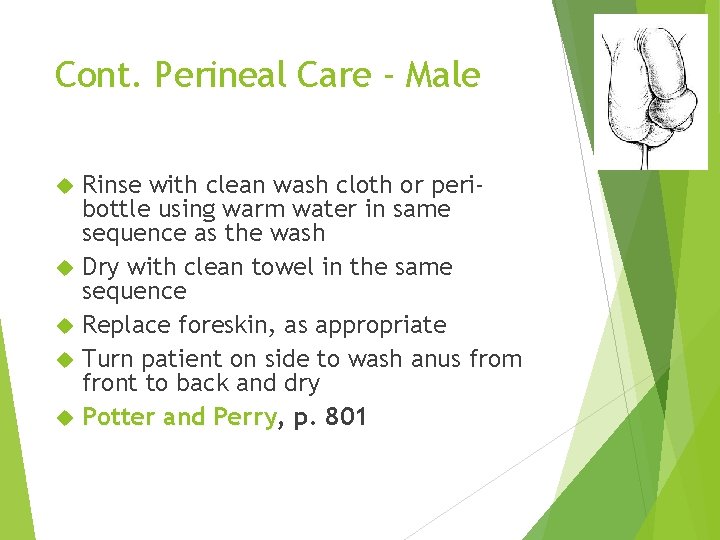
Cont. Perineal Care - Male Rinse with clean wash cloth or peribottle using warm water in same sequence as the wash Dry with clean towel in the same sequence Replace foreskin, as appropriate Turn patient on side to wash anus from front to back and dry Potter and Perry, Perry p. 801
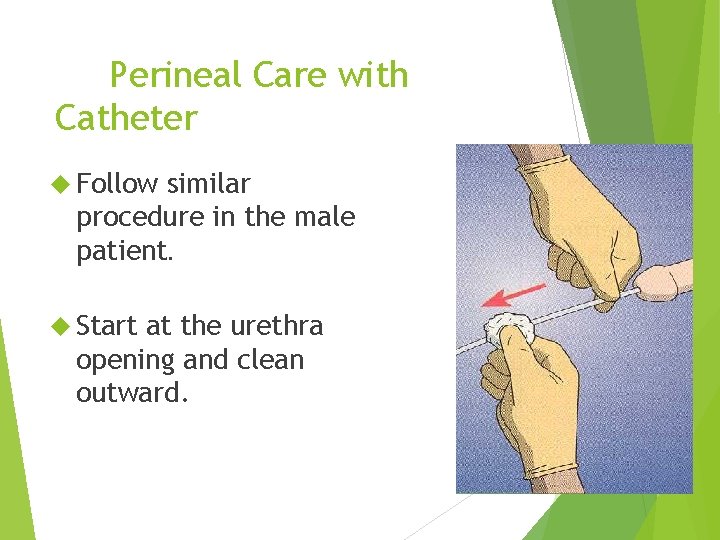
Perineal Care with Catheter Follow similar procedure in the male patient. Start at the urethra opening and clean outward.
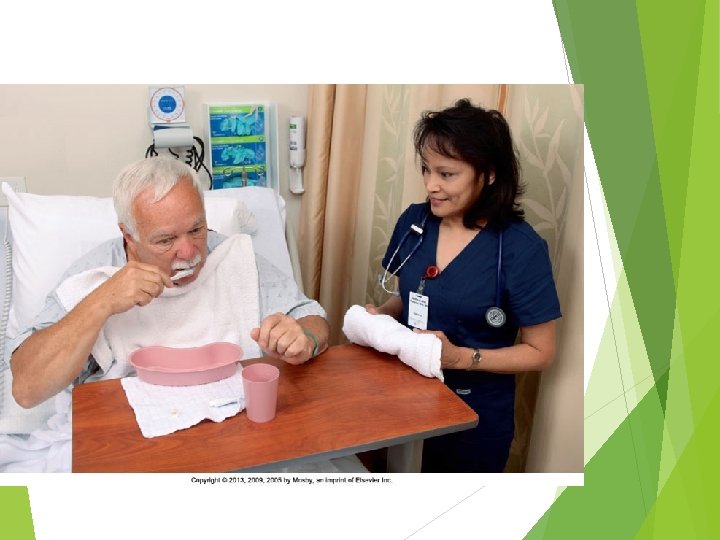
Part C: Oral Hygiene Maintains the healthy state of the mouth Cleanses teeth of food particles, plaque, and bacteria Massages the gums Relieves discomfort from unpleasant odors and tastes. Refreshes the mouth and gives a sense of well-being and thus can stimulate appetite.
Assessment: Oral Hygiene a. Frequency Depends on the condition of the patient’s mouth. Some patient’s with dry mouth or lips need care every 2 hours. Usually done twice a day or after each meal b. Assistance Needed Does the patient need assistance to do oral care *The nurse can help patients maintain good oral hygiene by: 1. Teaching them correct techniques 2. Actually performing for weakened or disabled patients.
Oral Hygiene Assessment c. Abnormalities Loose or missing teeth Swelling and bleeding of gums Unusual mouth odor Pain or stinging in mouth structures
Brushing Major concerns are: Thoroughness in cleansing Maintaining the condition of the oral mucosa. Procedure for Conscious Patient: Upright position Get out your textbook—Potter and Perry, p. 808
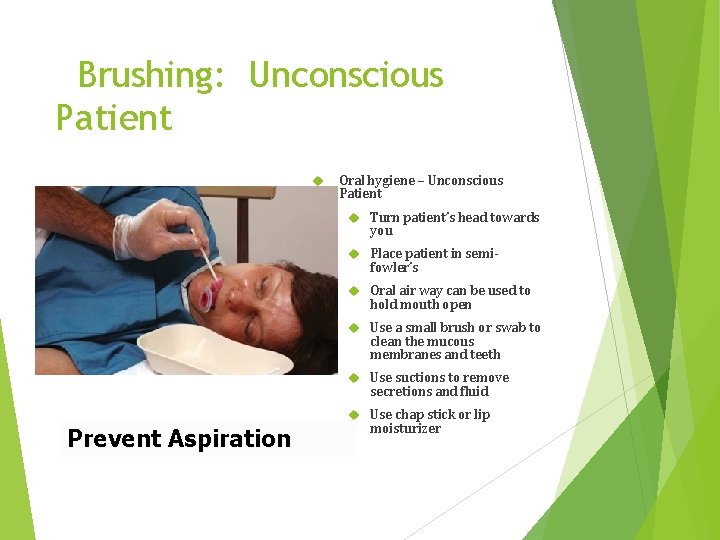
Brushing: Unconscious Patient Oral hygiene – Unconscious Patient Turn patient’s head towards you Place patient in semi- fowler’s Oral air way can be used to hold mouth open Use a small brush or swab to clean the mucous membranes and teeth Use suctions to remove secretions and fluid Use chap stick or lip Prevent Aspiration moisturizer
Oral Hygiene: Unconscious Patient Keeping the mouth open 1. Never place your hand in the patient’s mouth or open with your fingers. Oral stimulation often causes the biting –down reflex and serious injuries can occur. Potter and Perry p. 811
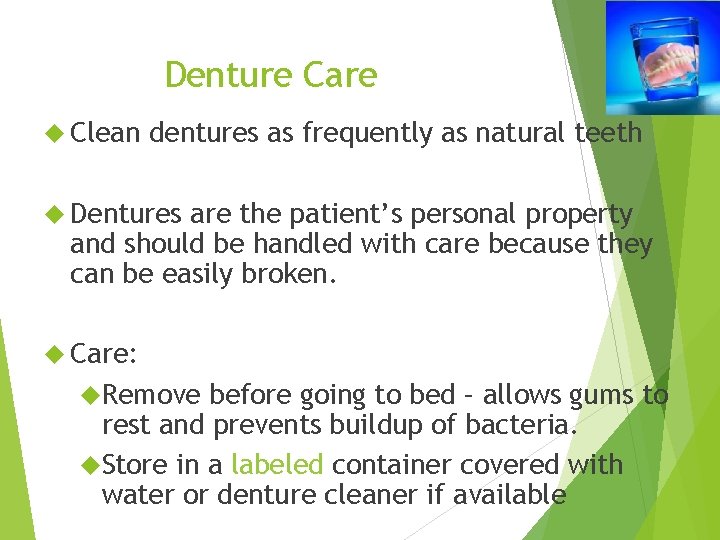
Denture Care Clean dentures as frequently as natural teeth Dentures are the patient’s personal property and should be handled with care because they can be easily broken. Care: Remove before going to bed – allows gums to rest and prevents buildup of bacteria. Store in a labeled container covered with water or denture cleaner if available
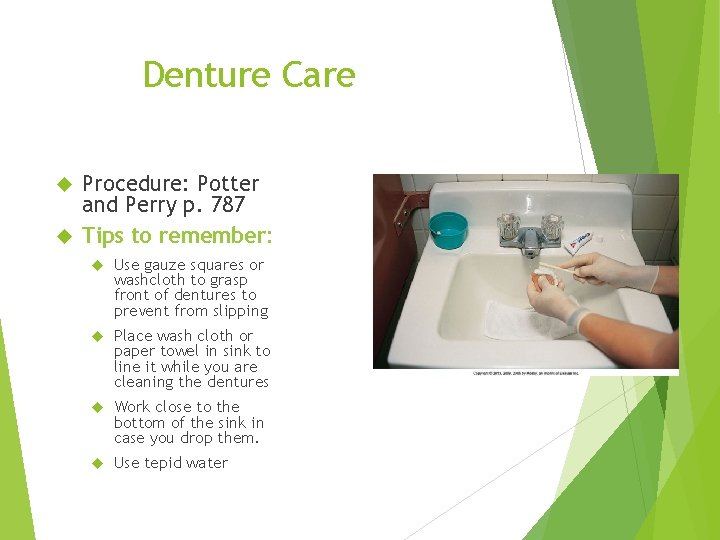
Denture Care Procedure: Potter and Perry p. 787 Tips to remember: Use gauze squares or washcloth to grasp front of dentures to prevent from slipping Place wash cloth or paper towel in sink to line it while you are cleaning the dentures Work close to the bottom of the sink in case you drop them. Use tepid water
Part D: Hair Care A person’s appearance and feeling of well-being often depends on the way their hair looks and feels
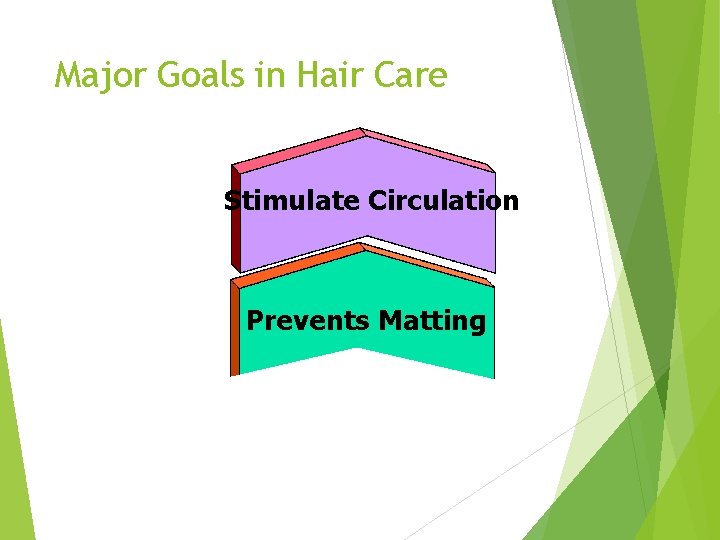
Major Goals in Hair Care Stimulate Circulation Prevents Matting
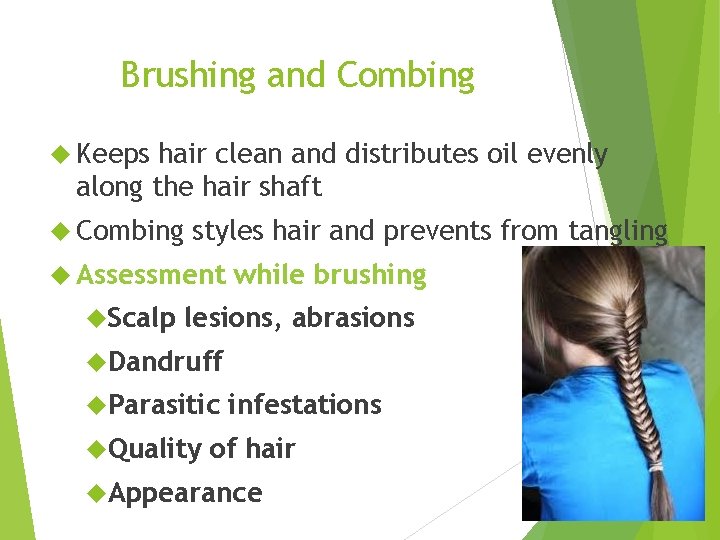
Brushing and Combing Keeps hair clean and distributes oil evenly along the hair shaft Combing styles hair and prevents from tangling Assessment Scalp while brushing lesions, abrasions Dandruff Parasitic Quality infestations of hair Appearance
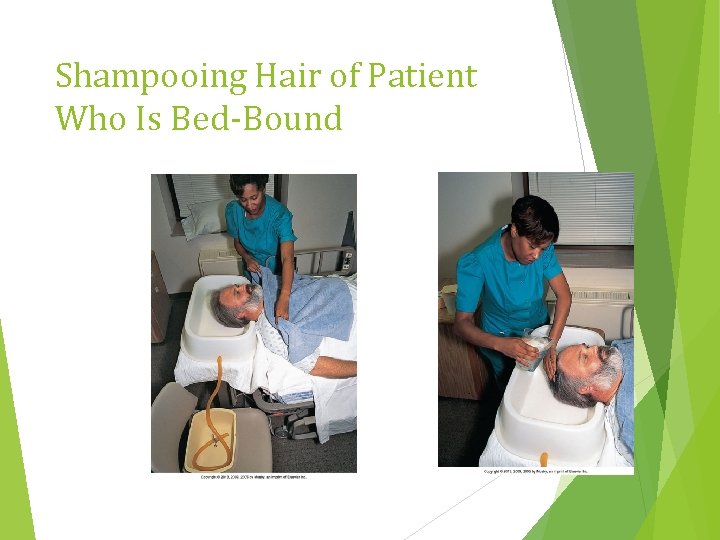
Shampooing Hair of Patient Who Is Bed-Bound
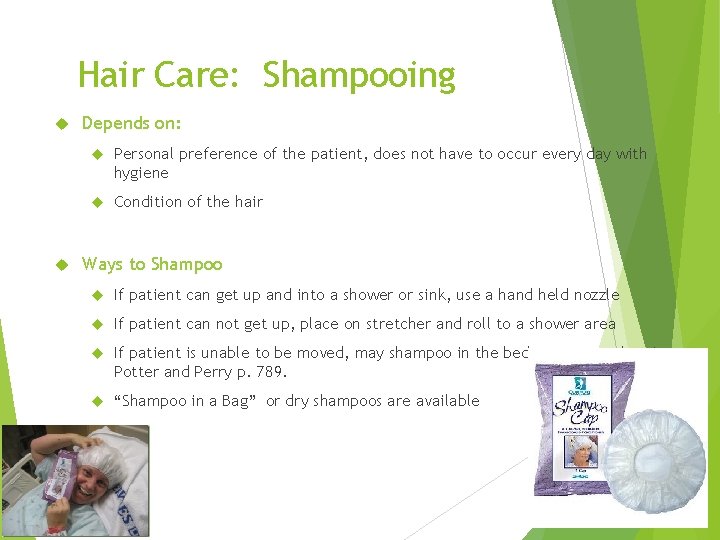
Hair Care: Shampooing Depends on: Personal preference of the patient, does not have to occur every day with hygiene Condition of the hair Ways to Shampoo If patient can get up and into a shower or sink, use a hand held nozzle If patient can not get up, place on stretcher and roll to a shower area If patient is unable to be moved, may shampoo in the bed – see procedure in Potter and Perry p. 789. “Shampoo in a Bag” or dry shampoos are available
Part E: Shaving Improves self-esteem and emotional needs of the patient Usually done after the bath or shampoo Assessment: Skin for elevated moles, warts, Rashes, patchy skin lesions, or pustules
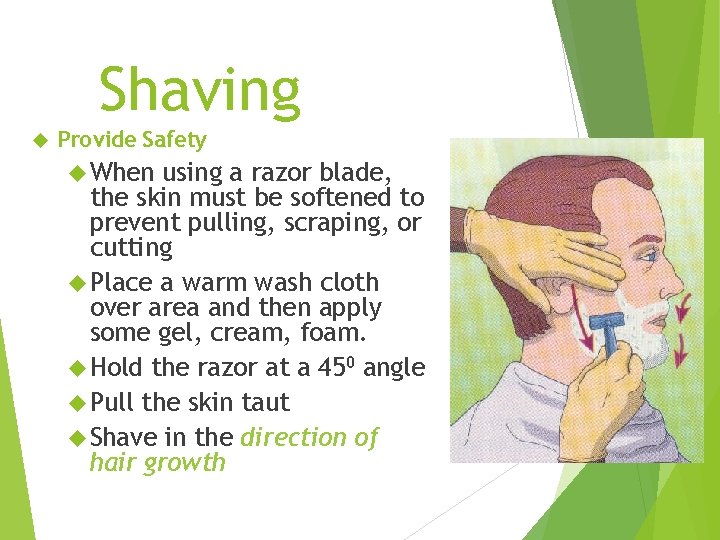
Shaving Provide Safety When using a razor blade, the skin must be softened to prevent pulling, scraping, or cutting Place a warm wash cloth over area and then apply some gel, cream, foam. Hold the razor at a 450 angle Pull the skin taut Shave in the direction of hair growth
Shaving Safety Precautions Electric razors must be used in patients who are at risk for bleeding, confused, or depressed
Part F: Foot and Nail Care Usually part of the bath Purpose: Eliminate odors sources of infection and decrease Assessment: Color, shape length, texture of nails Condition of skin around nails and between toes and fingers – swollen, inflamed, callused, lesions, temperature
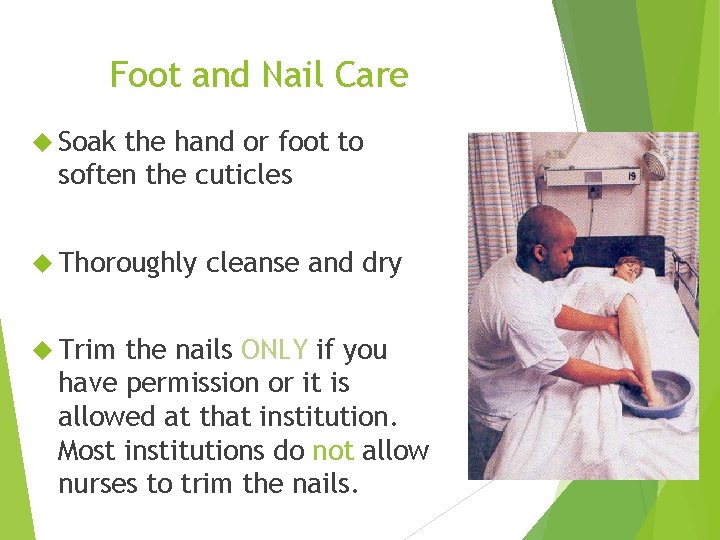
Foot and Nail Care Soak the hand or foot to soften the cuticles Thoroughly Trim cleanse and dry the nails ONLY if you have permission or it is allowed at that institution. Most institutions do not allow nurses to trim the nails.
Foot and Nail Care Teach patient and family that nails should be cut – straight across. May need to get a referral if no one available to cut nails. Show close attention to the feet and nails of the diabetic patient and the elderly ** If feet and nails are in bad condition– notify doctor so a consult can be ordered with a podiatrist
Part G: Ear Care Usually requires minimal care Cleanse the external auricle with washcloth when bathing Avoid insertion of objects into the ear
Hearing Aids a. Check that the device is functioning correctly and clean any body oils or cerumen from the hearing aid b. Make sure the hearing aid is off and volume is down before insertion c. Insert hearing aid in ear by pulling earlobe downward while pressing the hearing aid inward d. e. Turn on and adjust volume Ask the patient if comfortable and can they hear!
Part G: Eye Care Assessment: Abnormal lesions Discharge Tearing Presence of any infection Use of Visual Aids (contacts, glasses) Ask when patient needs to use these devices
Eye Care Wash around the eyes with a warm moist washcloth with warm water—NO SOAP! Clean from the inner canthus to the outer canthus of the eye. Pay special attention to the inner canthus. Provide special care for the eyes of unconscious patients. May need to tape the eye lids shut if unable to blink and protect own eyes
Nursing Process: Diagnosis Common diagnoses associated with hygiene: Activity intolerance Bathing self-care deficit Dressing self-care deficit Impaired physical mobility Impaired oral mucous membrane Ineffective health maintenance Risk for infection Use the patients’ actual alteration or the alteration for which they are at risk.
Critical Thinking Situation: The Nurse enters Mrs. G’s room to do a complete bed bath and she says “I do not want my bath now, I just want to rest”. What should the nurse do now?
Critical Thinking Situation: The nurse enters Mr. C’s room to do a complete bed bath and he says “I do not want my bath now, I just want to rest”. You notice that his bed is wet and he was incontinent of urine. Now what should the nurse do?