
Personal Financial Planning For Physicians Basics to Financial
Personal Financial Planning For Physicians Basics to Financial Wellness Michael Weis Chief Financial Officer American College of Physicians 1
Facts § 56% of physicians admit to making investment mistakes, such as real estate, stock investment, or otherwise § Over 50% of physicians believe they are behind in their retirement preparedness § Only 6% of physicians believe they are ahead on retirement savings § Many older physicians have less than $1 M in retirement assets § Doctors mainly have 25 -30 years to save for retirement 2
Why Build a Financial Foundation § You can’t afford not to! § You have something very valuable: Time § Time = the magic of compound interest 3
Save or Invest for What? § § § Emergency Cash or Rainy Day Fund Retirement Planning Insurance Protection College Education Fund Home Ownership Vacations 4
Steps to Building a Financial Foundation § Pay yourself first! • Bank 10 -20% of your monthly salary if you can. One • unexpected crisis can create havoc. Establish an “emergency fund” or financial safety in case things don’t go as planned. § Think and plan beyond debt pay back. Three quarters of physicians graduate with debt. § Understand the costs & benefits associated with your work or employment. Such as insurances & employee matching retirement vehicle. § Consider a financial advisor. 5
Topics That We Will Cover Today § § § Investment Types Education Funding (529’s) Retirement Planning Determining Risk Profile Concluding Comments Questions 6
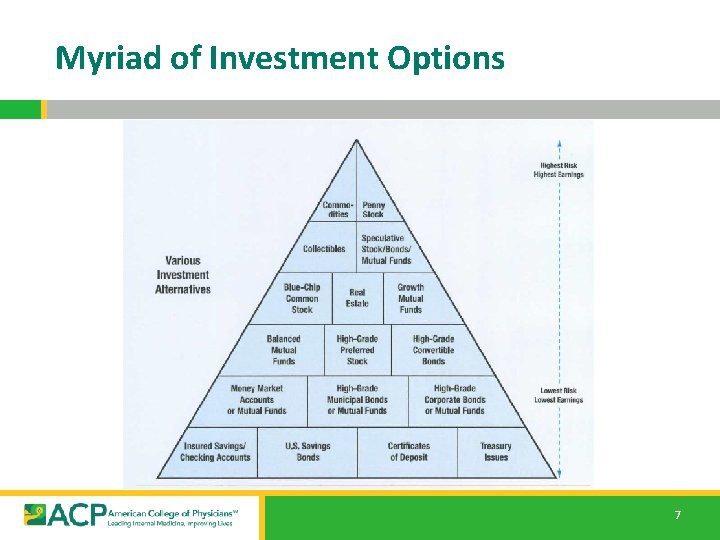
Myriad of Investment Options 7
Major Types of Investments § § Stocks Bonds Mutual Funds Cash 8
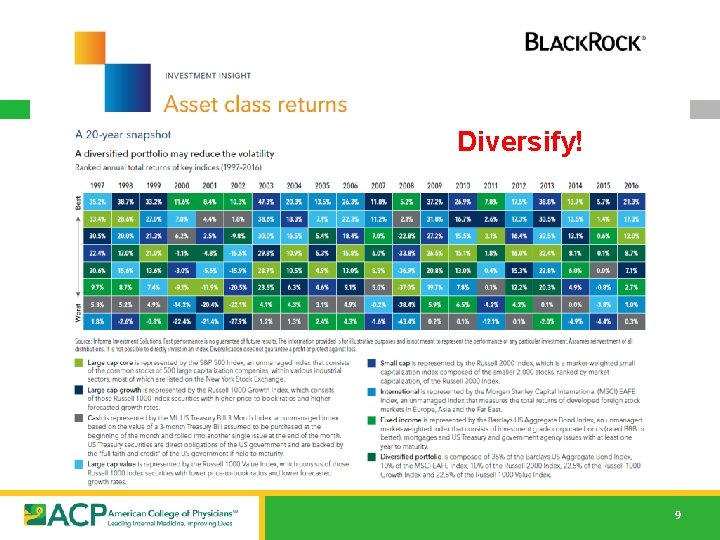
Title Diversify! 9
10
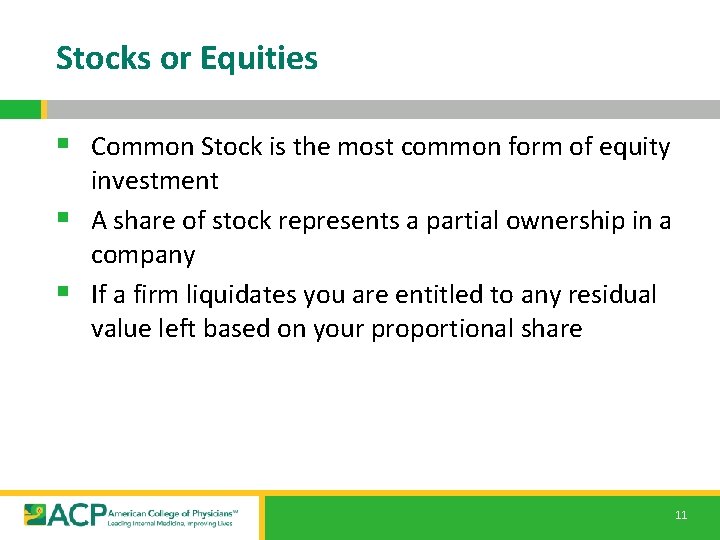
Stocks or Equities § Common Stock is the most common form of equity investment § A share of stock represents a partial ownership in a company § If a firm liquidates you are entitled to any residual value left based on your proportional share 11
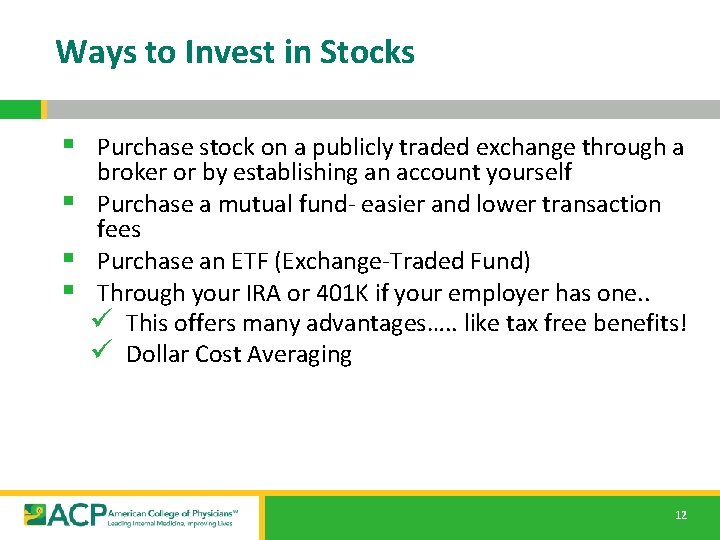
Ways to Invest in Stocks § Purchase stock on a publicly traded exchange through a broker or by establishing an account yourself § Purchase a mutual fund- easier and lower transaction fees § Purchase an ETF (Exchange-Traded Fund) § Through your IRA or 401 K if your employer has one. . ü This offers many advantages…. . like tax free benefits! ü Dollar Cost Averaging 12
Use Dollar-Cost Averaging § Save a fixed dollar amount at regular time intervals § Invest in variable price investments (stocks, mutual funds, etc. ) § By default, you buy more shares when the price is low, and fewer when the price is high § Automate it 13
Bonds § § IOU…. . Debt Security obligation of the company. Principal and interest must be paid to the bond holder Purchasing a bond makes you a creditor of the company Receive periodic payments based on the interest rate of the bond § In most cases principal is paid when bond matures § Some potential for appreciation in price § No voting rights or right to share in profits of company ** A better option now is mutual funds with a “mix of bonds” 14
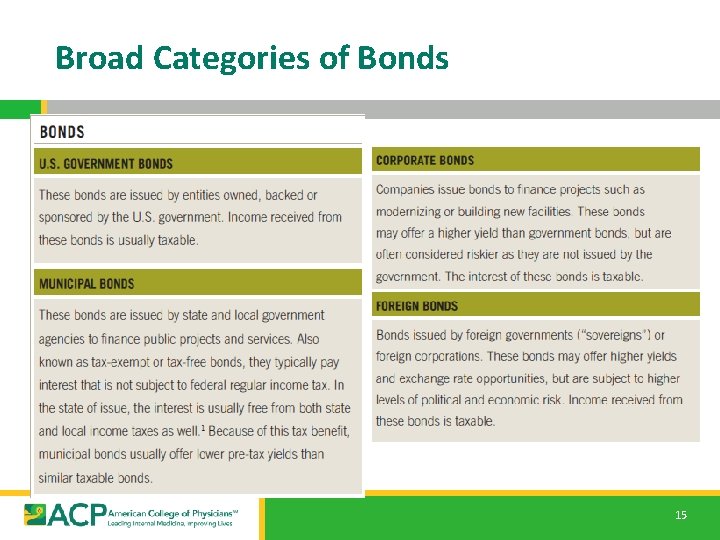
Broad Categories of Bonds 15
What is a Mutual Fund? § A mutual fund is a pool of money managed by a professional money manager or team. § The objective and the risk level are outlined in a document called a prospectus. The prospectus provides detailed guidelines for the types of investments the manager can purchase. 16
Why Purchase Mutual Funds? § Professional Management: The fund company hires skilled money managers supported by resources behind (including a team of people dedicated to researching, tracking, identifying trends, and performing analyses) § Diversification: Lowers the risk because, regardless of the size of your investment, each unit purchased is made up of many different investments. § Liquidity: Mutual funds can be sold anytime, and easily § Flexibility: Mutual funds allow you to purchase as much or as little as you want, and offer a variety of purchase plans 17
Some Mutual Fund Basics § Closed end fund (10% of funds) has limited number of shares issued initially and can only purchase shares from another investor willing to sell theirs § Open end fund (90% of funds) has no limitations on the number of shares the investment company can issue. Shares are issued and redeemed by the investment company § Load Fund - pay a commission to a sales agent when you buy shares usually 3 -8% § No Load Fund - no sales charge paid and purchased directly from the investment company 18
General Types of Mutual Funds § Money Market Funds • Liquid & secure on short term basis. Low risk and not guaranteed. Ex: treasury bills and short term notes § Bond Funds • Provides steady stream of income. Bonds are issued by government or corporation. § Balanced Funds • • Mix of investments – cash, equity and income producing. Better return than fixed and less risky than equity. Similar to “lifestyle” funds – driven by age now to age of retirement 19
General Types of Mutual Funds § Equity Funds • Main objective is long term growth through equity/stock investments. Types are: Diversified Sector specific Index International equity § Specialty Funds • Main objective is one particular sector or geographical region Ex: Health care, telecommunications, technology, financial services, Euro markets 20
Types of Cash § Certificate of Deposits § Money Market accounts § Savings Accounts 21
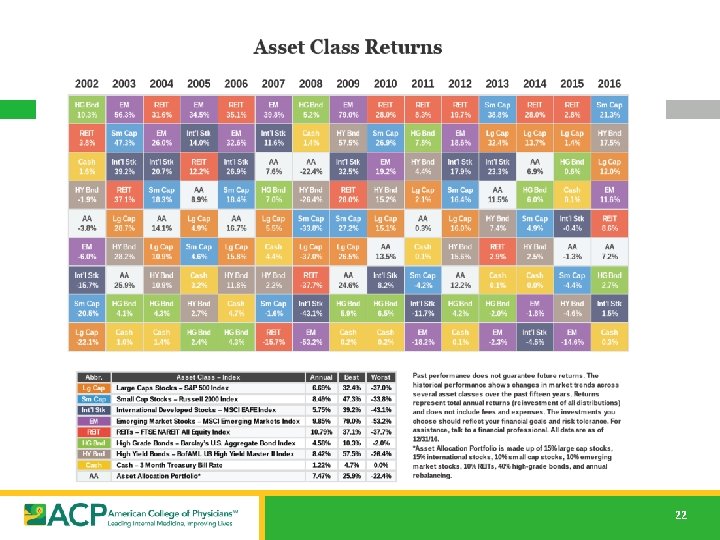
Title 22
Children’s College Education § Like retirement, but sooner § Some of you may need to start saving during residency! • Compound interest works here, too § Long-term investment focus § Various Options 23
Probably Best – 529 Savings Plans § Like Roths for college • Appreciation/gains are tax-exempt § All public/private university/college/professional schools § Tuition, fees, room, books, supplies § Can choose any state’s program • but, tax advantages often best in own state www. savingforcollege. com 24
Retirement Tips § Biggest and best advice is to begin saving today! § Consider allocating half of any future salary increase to your or your employer’s tax advantaged plan § Monitor your progress at least annually; preferably more often § Determine how much you think you’ll need at retirement 25
How Much Will I Need at Retirement? § Popular rules of thumb • Retirement annual income should equal 70% of your pre-retirement salary • You should have saved 8 times your ending salary Ø Target Age 35…. . saved one times annual salary Age 45……saved three times annual salary Age 55……saved five times annual salary Many calculators out there on Web 26
Factors Influencing Savings for Retirement § Target retirement date § Percentage of salary you defer into 401(k), 403(b), governmental 457(b) or other retirement plan § Social Security etc, § Employer provided defined benefit plan if applicable § Inheritances 27
Retirement – Basic Principles 1) Take maximum advantage of matching programs 2) Take maximum advantage of tax-advantaged programs (401 -k’s, 403 -b’s, IRA’s, Roths, etc. ) 3) Don’t count on Social Security 4) If you’re planning early retirement, budget a flexible cushion (to avoid early W/D penalties prior to age 59). Better budget for health care, too 28
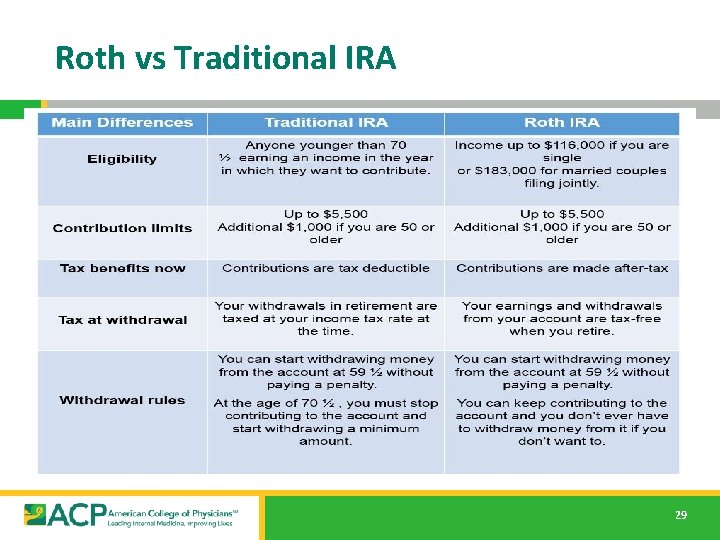
Roth vs Traditional IRA 29
A Critical Decision You Need to Make § Now that I know the most popular types of investment options, “How much risk am I willing to take? ” 30
Once you know your risk profile § Begin to develop your investment plan • Determine asset allocation-how much are you willing to invest in stocks, bonds, commodities and cash. (This is also called asset allocation or diversification) • Make periodic payments to your investment portfolio in the same percentages as your asset allocation (this is called dollar cost averaging) • Take advantage of your employer’s plan ü If they offer a tax advantaged plan and amounts are deducted each pay and then reinvested ü You are automatically doing dollar cost averaging! 31
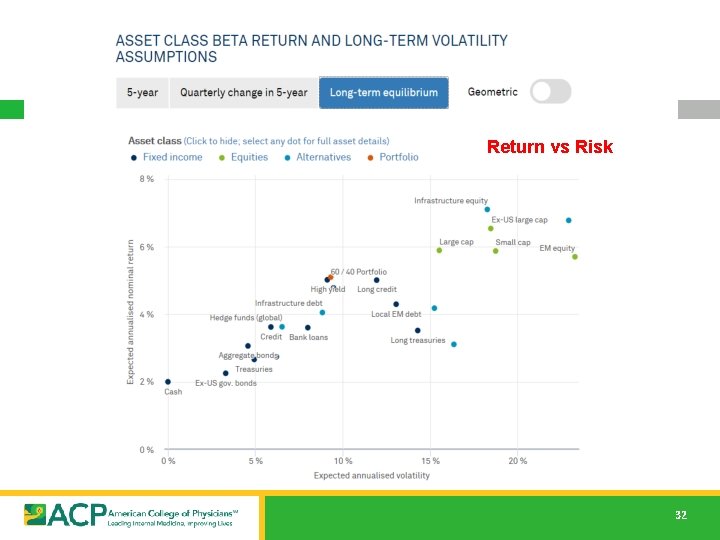
Title Return vs Risk 32
Game Plan - For Financial Health § Address Debt • Know what your student debt is: Refinance & consolidate § Create a financial plan • Comprehensive plan with an advisor is a MUST DO § Spend conservatively • The new BMW after residency can wait • Track your spending § Understand compound interest • Saving money is magnified 20 years from now 33
Thanks and Questions 34
Additional programming from the ACP Leadership Academy www. acponline. org/leadershipacademy
Upcoming Free Webinar Core Tenets of Leadership Wednesday, May 3, 2017 | 3: 00 pm ET Darilyn V. Moyer, MD, FACP Executive Vice President and Chief Executive Officer of the American College of Physicians Micah W. Beachy, DO, FACP Chair-Elect, ACP Council of Early Career Physicians 36 www. acponline. org/leadershipacademy
In partnership with the American Association for Physician Leadership Formal Leadership Training § Live meetings, faculty-led online courses, and self-study modules Fill gaps in your leadership knowledge, build your CV, and earn CME Courses count toward: § § § Certified Physician Executive (CPE) Master’s degree programs in medical management Certificate in Physician Leadership for Hospital Medicine 37 www. acponline. org/leadershipacademy
Thank you! www. acponline. org/leadershipacademy
- Slides: 38