
Personal Finance Another Perspective Health 2 Life Planning
- Slides: 64
Personal Finance: Another Perspective Health 2: Life Planning with Life Insurance Updated 2019/02/13 1 1
Objectives A. Understand the benefits of Life Insurance and the five key questions B. Understand the different types of term life insurance C. Understand the different types of permanent life insurance D. Understand which type of life insurance is best for you and the steps to buying life insurance E. Understand some life insurance strategies for different stages of your life 2
A. Benefits and Key Questions of Life Insurance • What is life insurance and why have it? • Insurance that provides compensation to your beneficiaries should you die prematurely. • This is a low frequency but high severity risk • It transfers the economic loss of death from an individual to a insurance company by way of a life insurance contract • It can help us take care of our own and extended families should we die. Death is not an excuse for disobedience (1 Tim. 5: 8) 3 3
Benefits (continued) • Are there other benefits of Life Insurance? • Estate Planning • Life insurance products can be helpful for estate tax purposes (about 90% of permanent products) • Guaranteed Insurability • Permanent life insurance products cannot be cancelled by the company • Retirement Planning (expensive!) • The cash-value portion of permanent life insurance grows tax-free, after costs and fees • Benefit 4: Forced Savings (expensive!) • For those without discipline, life insurance can be an expensive type of forced savings 4 4
5 Key Questions • 1. Why have Life Insurance? • Insurance is for emergency planning and control of your life • We have been commanded to keep adequate insurance • Death is not an excuse for not taking care of our families 5 5
Key Questions (continued) • 2. How does Life Insurance Work? • Insurance is an example of risk pooling • Individuals transfer or share their risks with others to reduce catastrophic losses from: • Health problems • Accidents • Lawsuits, or • Death 6 6
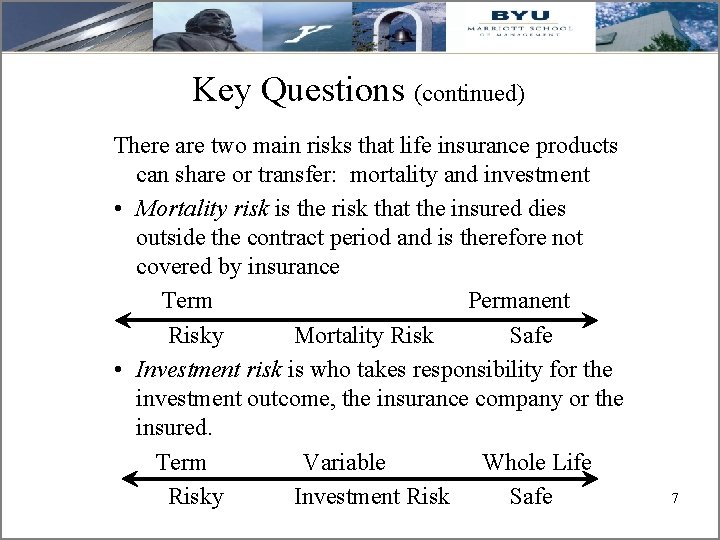
Key Questions (continued) There are two main risks that life insurance products can share or transfer: mortality and investment • Mortality risk is the risk that the insured dies outside the contract period and is therefore not covered by insurance Term Permanent Risky Mortality Risk Safe • Investment risk is who takes responsibility for the investment outcome, the insurance company or the insured. Term Variable Whole Life Risky Investment Risk Safe 7 7
Key Questions (continued) • 3. Who needs Life Insurance? • Those who need life insurance include: • Single or married with dependents or children • Married, single income couple where the spouse has insufficient work skills or savings • Business owners who wish to transfer their businesses to the next generation • Individuals whose estate exceeds the estate taxfree transfer threshold • Not everyone needs life insurance. 8 8
Key Questions (continued) 4. How much Life Insurance should I have? • How do you determine your Life Insurance needs? From the old LDS Handbook for Families it states: • Insure the family’s breadwinner first, then others, if desired, as income permits. At a minimum, get enough life insurance to pay for such things as a funeral, taxes, mortgage on the home, car payments, and other debts. The next priority should be to get enough insurance that, supplemented by any government retirement benefits the surviving spouse may be entitled to, there will be sufficient to provide for the family and to make provisions for the children’s education and missions. “Handbook for 9 9
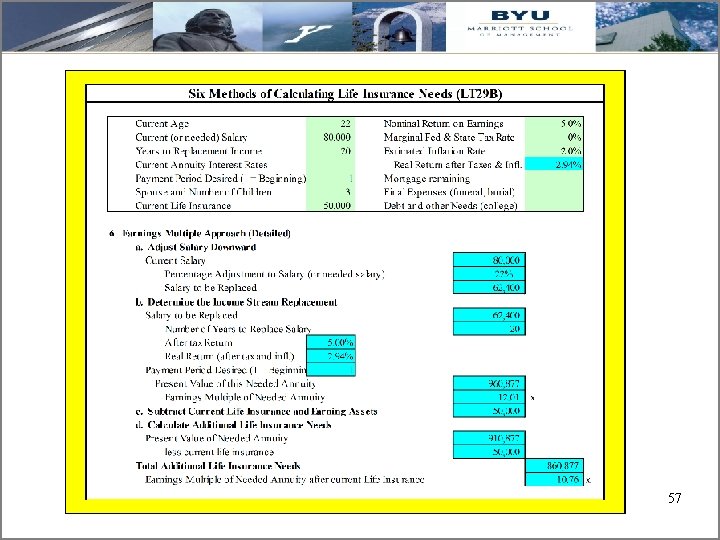
Key Questions (continued) • There are two different methods of determining how much life insurance. Calculating Life Insurance (LT 29) • a. The earnings multiple approach • It seeks to replace the annual salary stream of a bread winner for X years, normally 5 – 15 times gross salary is recommended. • How is it calculated? 1. Adjust salary down to compensate for reduced costs 2. Choose the appropriate interest rate to match the earnings on the policy settlement. 3. Determine the income replacement and annuity 4. Subtract current insurance coverage 10 10
Key Questions (continued) • b. The Needs Approach. • It calculates all the needs of the remaining household members over their lifetime • How is it calculated? 1. Adjust the salary downward 2. Add up all funding needs • This includes: immediate, debt elimination, transitional, dependency, spousal life income, education, and retirement funds 3. Subtract current coverage and other assets • This is additional coverage necessary 4. Determine the income replacement and annuity 11 11
Key Questions (continued) • 5. What Kind of Life Insurance? • What are the different types of life insurance? • Term insurance • Permanent (also called endowment or cash value) insurance • Your choice of life insurance will generally depend on four factors: • 1. Priorities and Preferences • 2. Amount of insurance needed • 3. Ability and willingness to pay premiums • 4. Duration of need 12 12
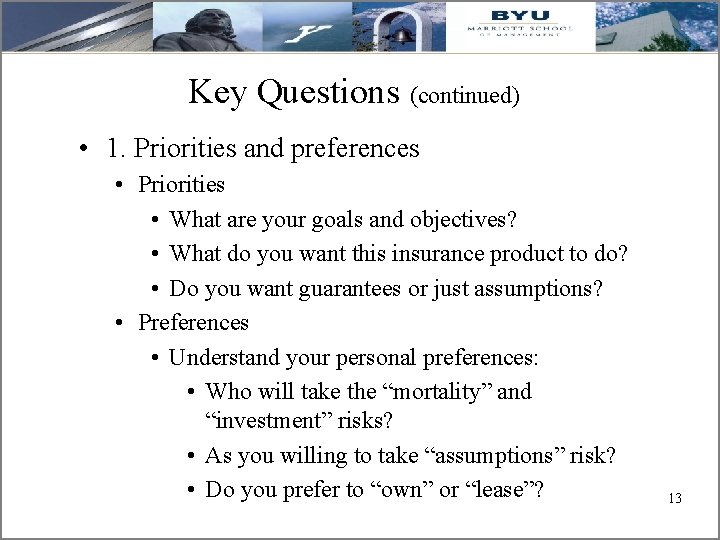
Key Questions (continued) • 1. Priorities and preferences • Priorities • What are your goals and objectives? • What do you want this insurance product to do? • Do you want guarantees or just assumptions? • Preferences • Understand your personal preferences: • Who will take the “mortality” and “investment” risks? • As you willing to take “assumptions” risk? • Do you prefer to “own” or “lease”? 13 13
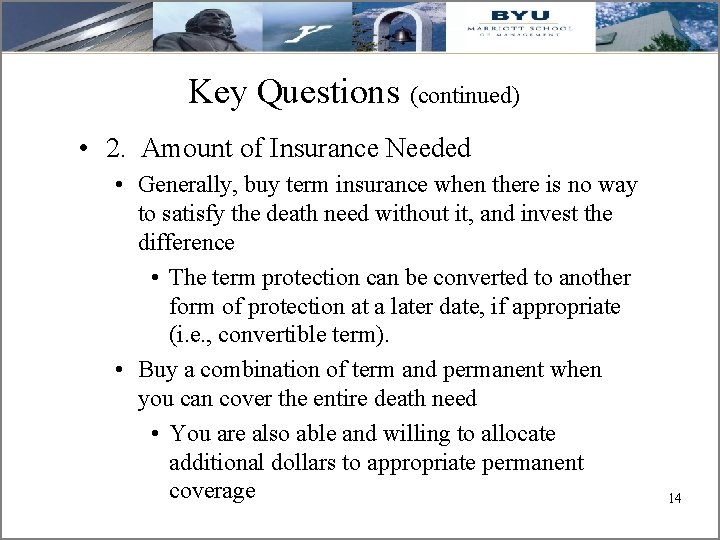
Key Questions (continued) • 2. Amount of Insurance Needed • Generally, buy term insurance when there is no way to satisfy the death need without it, and invest the difference • The term protection can be converted to another form of protection at a later date, if appropriate (i. e. , convertible term). • Buy a combination of term and permanent when you can cover the entire death need • You are also able and willing to allocate additional dollars to appropriate permanent coverage 14 14
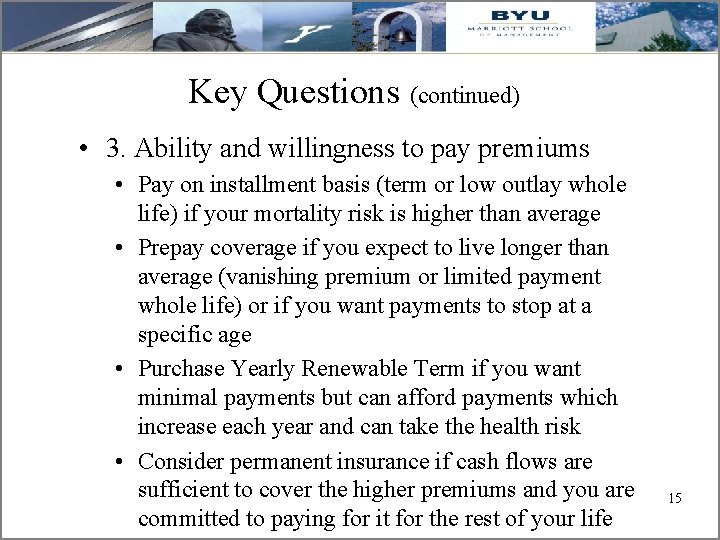
Key Questions (continued) • 3. Ability and willingness to pay premiums • Pay on installment basis (term or low outlay whole life) if your mortality risk is higher than average • Prepay coverage if you expect to live longer than average (vanishing premium or limited payment whole life) or if you want payments to stop at a specific age • Purchase Yearly Renewable Term if you want minimal payments but can afford payments which increase each year and can take the health risk • Consider permanent insurance if cash flows are sufficient to cover the higher premiums and you are committed to paying for it for the rest of your life 15 15
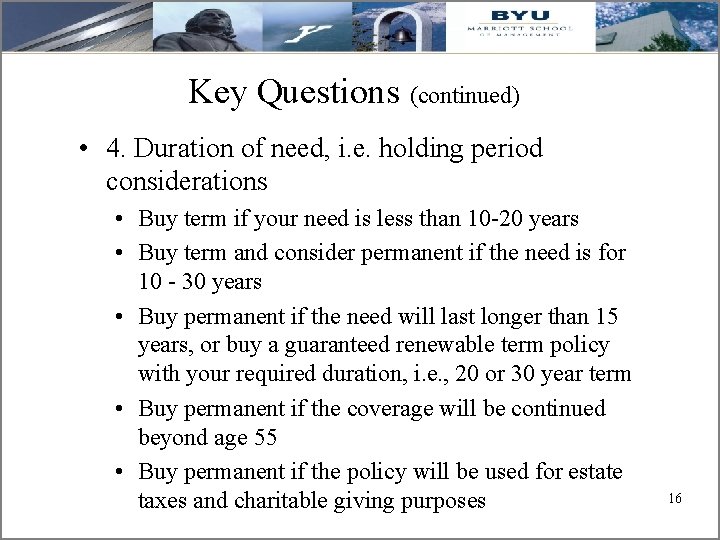
Key Questions (continued) • 4. Duration of need, i. e. holding period considerations • Buy term if your need is less than 10 -20 years • Buy term and consider permanent if the need is for 10 - 30 years • Buy permanent if the need will last longer than 15 years, or buy a guaranteed renewable term policy with your required duration, i. e. , 20 or 30 year term • Buy permanent if the coverage will be continued beyond age 55 • Buy permanent if the policy will be used for estate taxes and charitable giving purposes 16 16
C. Understand the Different Types of Term Life Insurance • What is Term Insurance? • • • Insurance protection for the insured over a specific term or time period. They may be renewable or non-renewable policies What are its advantages? • It is the least expensive form of insurance • Death benefit coverage is for a specific term • Death benefits can be much higher What are its disadvantages? • It is only valid if insured dies during the term • It may not be renewed once your term expires • Advancing age increases the cost of insurance 17 17
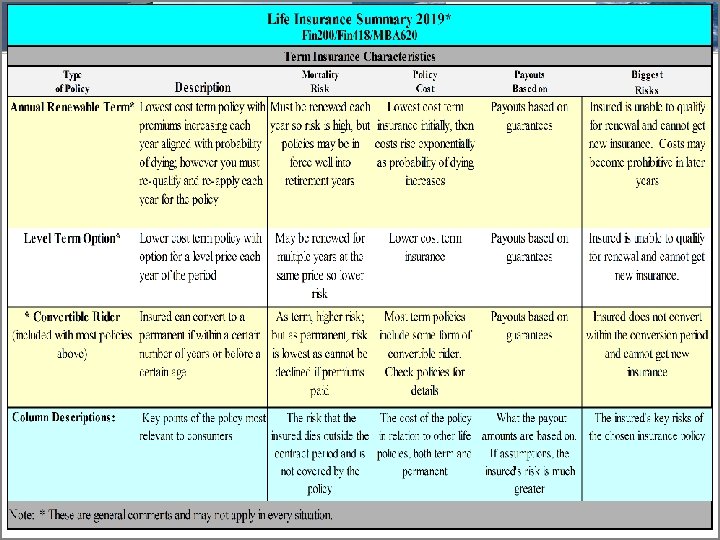
Term Insurance 18
Term Insurance (continued) • Annual term insurance • Least expensive type of coverage • The face or death benefit amount is constant through the selected term of coverage • Premiums increase each time the contract is renewed, even though the face amount remains the same • Must be renewed each period to remain in force 19 19
Term Insurance (continued) • Renewable term insurance • The policy holder may unconditionally renew the policy for successive terms at higher premiums simply by paying the indicated premiums • Premiums increase with each renewal period, and can be renewed for a specific number of years • If nonrenewable, the policy holder has no legal right to continue the insurance after the covered period 20 20
Term Insurance (continued) • Convertible term life insurance rider • Most term policies can be changed to permanent insurance within a specific number of years without evidence of insurability • Typically, it gives a contractual right to convert to some form of permanent insurance, typically whole life, within a certain number of years or before the policy holder reaches a certain age. • Conversion allows the policy holder to lock-in the premiums, although at a higher rate, and avoid the ever increasing term premiums 21 21
Term Insurance (continued) • Why are premiums for term much less than permanent insurance? • You are only paying for insurance for a specific period, i. e. risk is priced one period at a time • 98% of term policies lapse without payment • It is generally for a shorter period, i. e. 1 -10 years. • The longer the period, the more insurance companies must charge higher fees in the early years to offset the more expensive mortality charges and fees in the later years • Term is generally easier and cheaper to administer, as fees and sales charges are less and less complex 22 22
Term Insurance (continued) • Key questions when purchasing term insurance: • • How long can I keep this policy? What are the renewal terms of the contract? When will my premiums increase? Can I convert my term policy to a permanent policy? What are the details? • How strong is the insurance company financially? 23 23
D. Understand the Different Types of Permanent Insurance • What is permanent insurance? • It is an insurance contract that is purchased for your entire life with premiums divided between death protection and savings. • What are its advantages? • Provides insurance that cannot be cancelled • Can borrow against your cash value • May have other uses, especially estate planning • What are its disadvantages? • It is complex and expensive • Unless premiums are paid, it can expire worthless • Certain products can lose money 24 24
Permanent Insurance (continued) • The key is to understand why you want permanent life insurance • Understand your needs • Understand the individual polices of competing life insurance companies, i. e. , the charges and deductions of the insurance company, and fees and expenses of the mutual funds/assets invested in • Select the policy that gives you maximum benefit at the lowest possible cost to you 25 25
Permanent Insurance (continued) • Why are permanent premiums higher than term? • It is priced for your entire life • Earlier premiums must be priced higher to take into account that mortality costs increase as you age. There is a cost to eliminate mortality risk • It includes a savings component • These savings must be funded • It cannot be terminated by the insurance company • 95% of all permanent policies are paid • It is more costly to administer and sell • There are more and substantially higher up-front, operating, sales and other charges and fees 26 26
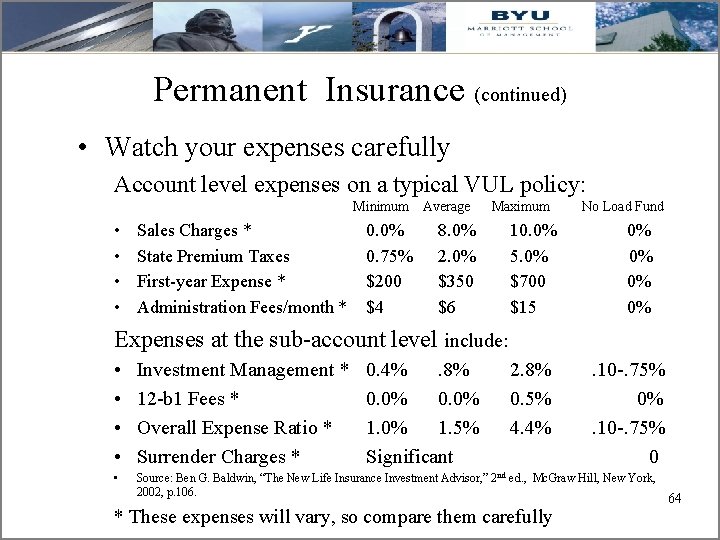
Permanent Insurance (continued) • It is not uncommon for the deductions and fees to range between 5% and 15% of every dollar you put into some types of permanent insurance. • As such, the cash-value portion of this life insurance grows slower than a term policy with the remainder invested without these fees • Permanent insurance is not for everyone, but it may be for some • Key is to understand your needs and the needs permanent insurance can fill 27 27
Permanent Insurance Important questions to ask about permanent insurance: • • • • Are the premiums within my budget? Are costs reasonable? Can I commit to these premiums over the long-term? On a variable life policy, what is the assumed interest rate in the illustration? Is the classification shown in the illustration appropriate for me (i. e. smoker/non smoker, male/female) Which figures are guaranteed and which are not? Will I be notified if the non-guaranteed amounts change? Is the death benefit guaranteed? Will the premiums always be the same, even if interest rates are lower that the illustration? Is the illustrated premium sufficient to guarantee protection for my entire life? Is the “current rate” illustrated actually the rate paid recently? What was the current rate in each of the last five years? What assumptions have been used regarding company expenses, dividends, and policy lapse rates? 28 Does all my cash value earn the current rate? Is the illustration based on the “cash surrender value” or “cash value? ” The 28 cash surrender value is usually lower and reflects what will be paid if the policy is cancelled.
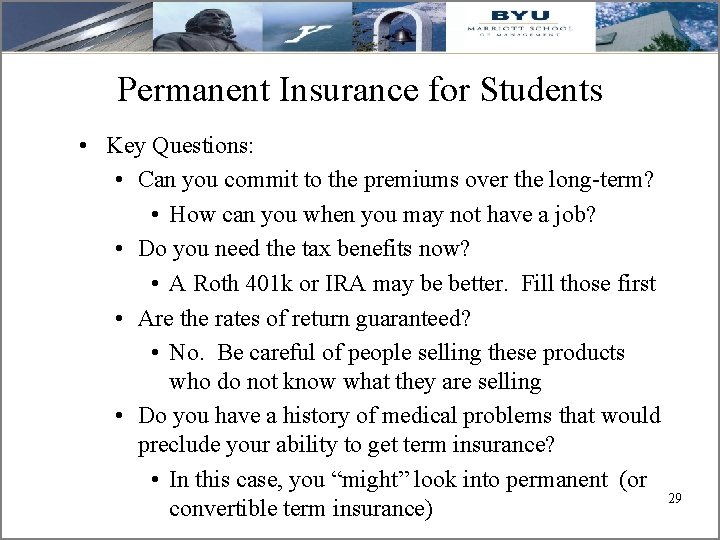
Permanent Insurance for Students • Key Questions: • Can you commit to the premiums over the long-term? • How can you when you may not have a job? • Do you need the tax benefits now? • A Roth 401 k or IRA may be better. Fill those first • Are the rates of return guaranteed? • No. Be careful of people selling these products who do not know what they are selling • Do you have a history of medical problems that would preclude your ability to get term insurance? 29 • In this case, you “might” look into permanent (or 29 convertible term insurance)
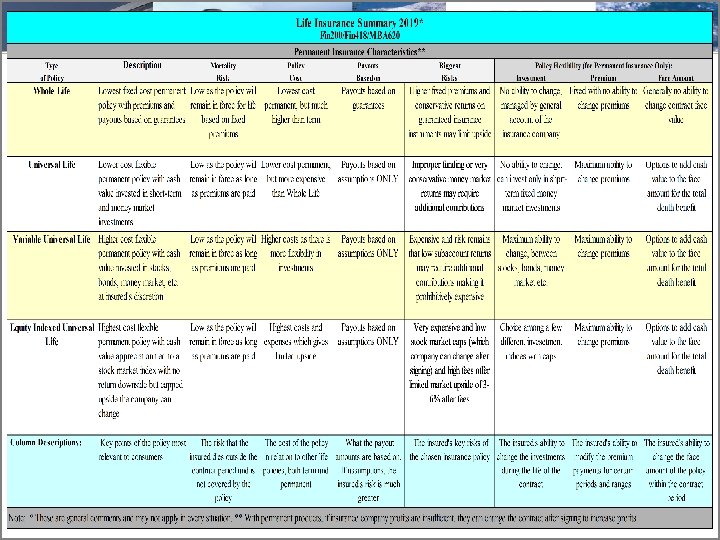
Permanent Insurance 30 30
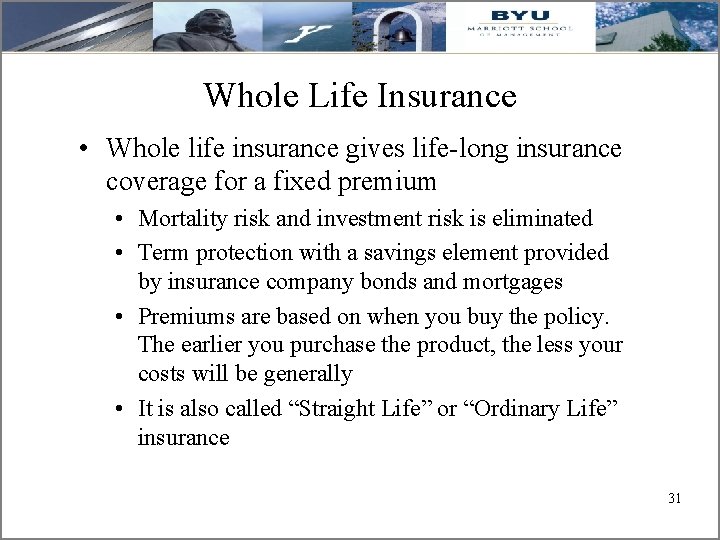
Whole Life Insurance • Whole life insurance gives life-long insurance coverage for a fixed premium • Mortality risk and investment risk is eliminated • Term protection with a savings element provided by insurance company bonds and mortgages • Premiums are based on when you buy the policy. The earlier you purchase the product, the less your costs will be generally • It is also called “Straight Life” or “Ordinary Life” insurance 31 31
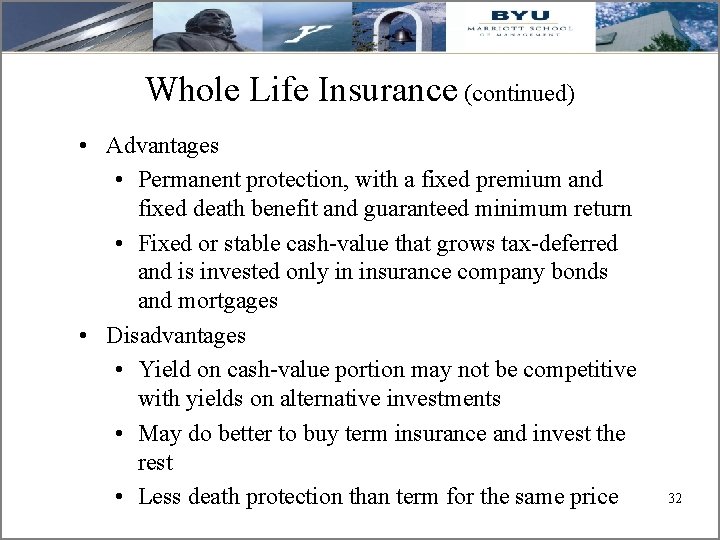
Whole Life Insurance (continued) • Advantages • Permanent protection, with a fixed premium and fixed death benefit and guaranteed minimum return • Fixed or stable cash-value that grows tax-deferred and is invested only in insurance company bonds and mortgages • Disadvantages • Yield on cash-value portion may not be competitive with yields on alternative investments • May do better to buy term insurance and invest the rest • Less death protection than term for the same price 32 32
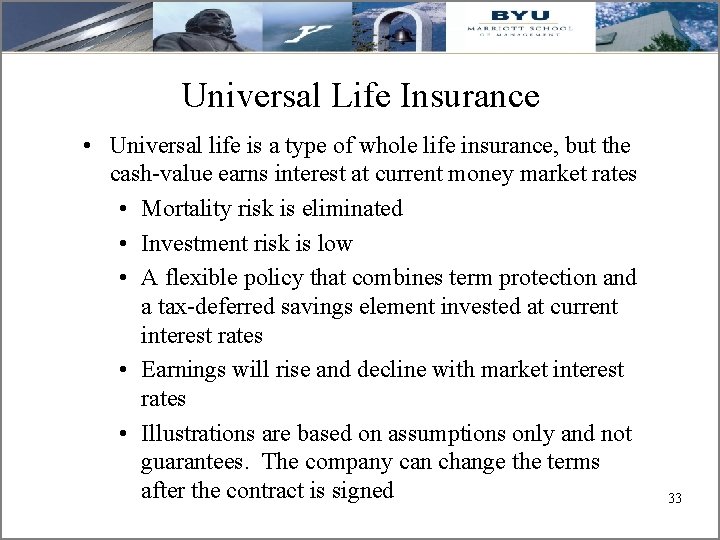
Universal Life Insurance • Universal life is a type of whole life insurance, but the cash-value earns interest at current money market rates • Mortality risk is eliminated • Investment risk is low • A flexible policy that combines term protection and a tax-deferred savings element invested at current interest rates • Earnings will rise and decline with market interest rates • Illustrations are based on assumptions only and not guarantees. The company can change the terms after the contract is signed 33 33
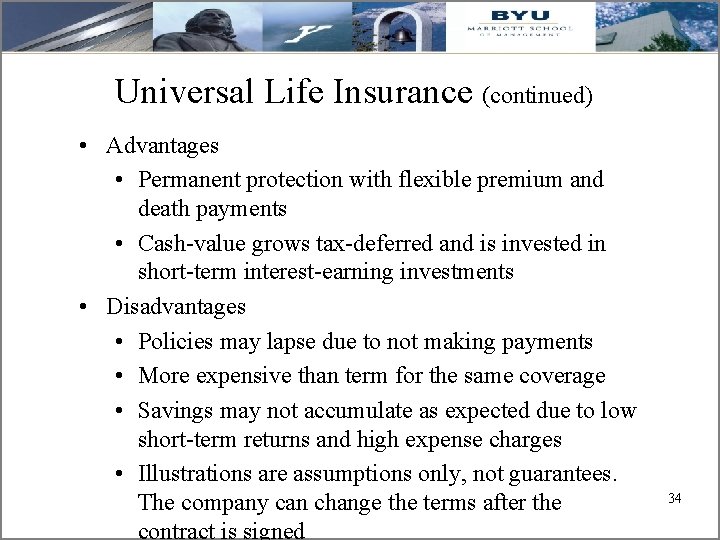
Universal Life Insurance (continued) • Advantages • Permanent protection with flexible premium and death payments • Cash-value grows tax-deferred and is invested in short-term interest-earning investments • Disadvantages • Policies may lapse due to not making payments • More expensive than term for the same coverage • Savings may not accumulate as expected due to low short-term returns and high expense charges • Illustrations are assumptions only, not guarantees. The company can change the terms after the contract is signed 34 34
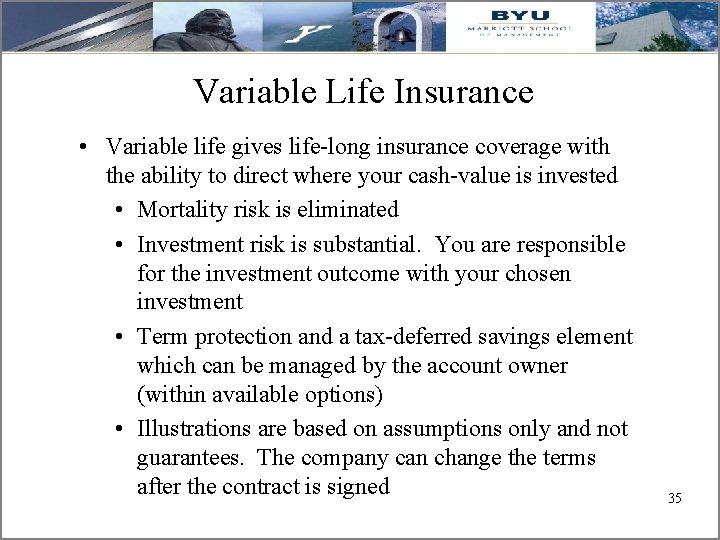
Variable Life Insurance • Variable life gives life-long insurance coverage with the ability to direct where your cash-value is invested • Mortality risk is eliminated • Investment risk is substantial. You are responsible for the investment outcome with your chosen investment • Term protection and a tax-deferred savings element which can be managed by the account owner (within available options) • Illustrations are based on assumptions only and not guarantees. The company can change the terms after the contract is signed 35 35
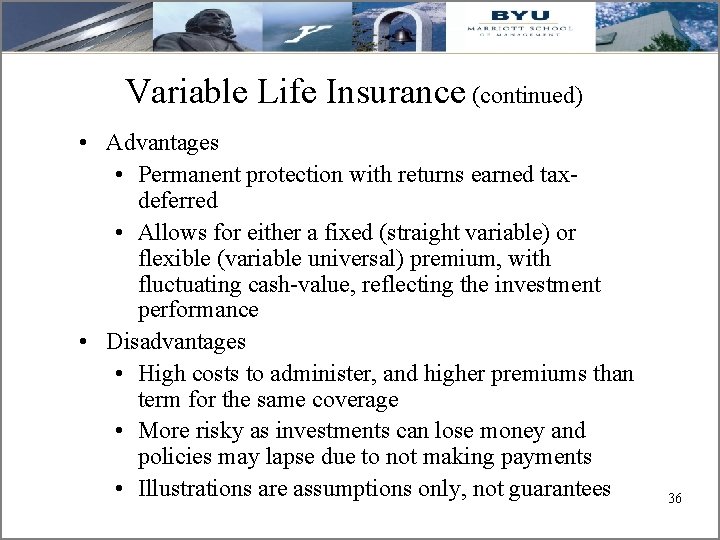
Variable Life Insurance (continued) • Advantages • Permanent protection with returns earned taxdeferred • Allows for either a fixed (straight variable) or flexible (variable universal) premium, with fluctuating cash-value, reflecting the investment performance • Disadvantages • High costs to administer, and higher premiums than term for the same coverage • More risky as investments can lose money and policies may lapse due to not making payments • Illustrations are assumptions only, not guarantees 36 36
Variable Universal Life Insurance • Variable universal life mixes the investment flexibility of variable life with the premium and face amount flexibility of universal life. • Mortality risk is eliminated • Investment risk is substantial. You are responsible for the investment outcome with the chosen investment • Term protection with full policy flexibility and which can be managed by the account owner (within available options) • Illustrations are based on assumptions only and not guarantees. The company can change the terms after the contract is signed 37 37
Variable Universal Life Insurance (continued) • Advantages • Permanent protection with returns earned on a taxdeferred basis, which allows for either a fixed or flexible premium • Flexible death benefit and fluctuating cash-value, reflecting the self-directed investment performance • Disadvantages • High costs to administer and much more expensive than term • Much more risky as investments can lose money • Policies may lapse due to not making payments • Illustrations are assumptions only, not guarantees. The company can change the terms after the contract is signed 38 38
Equity Indexed Universal Life Insurance • Equity indexed offers some of the upside of the equity market returns with the downside of insurance protection should the market returns be negative • Allocates assets to a stock market index, generally with options (and has a limited upside) • Has a minimum guaranteed rate of return component • Gives some (but limited) upside in equity returns • Gives downside protection in down equity markets • Illustrations are based on assumptions only, and the company can change contract terms even after it is signed 39 39
Equity Indexed (continued) • Advantages • Offers exposure to the equity markets • Limits downside exposure—the rate of return can’t go below zero for the cash value portion • Disadvantages • Huge commissions—very high fee structure, large surrender charges, and not transparent • Caps on returns are generally lower that historic market returns, with limited upside 6 -12% and spreads of 4 -6% resulting in actual upside of 2 -6% • Unless aggressively funded, the cash value is often insufficient to keep the policy in force later in life • Illustrations are assumptions only, not guarantees and the company can change the contract after signed 40 40
E. Determine Which Type of Life Insurance Is Best for You • For most, level convertible renewable term (convertible to a permanent policy and renewable for up to 30 years) is the cheapest and best alternative (especially for students) • Goal: Income Replacement of breadwinner • Relatively low cost • Affordable coverage when life insurance is needed the most • Can afford to carry the coverage needed for the time needed • While it becomes very expensive with age, it may be less necessary as your other assets grow so you may need less insurance in the future 41 41
Which Life Insurance Is Best (continued) • Permanent insurance may be the best choice if you meet very specific criteria. The goals are: • Estate Planning. Your assets are very large (>$22. 4 mn), and you have estate planning issues (i. e. , you need to shield some assets should you die) • Medical Insurability. You have a history of medical problems (and if you already have convertible term insurance) you can’t be denied life insurance if you convert • Retirement Savings. You have already maxed out your tax-deferred accounts (IRAs, 401 k, Roths) and want additional tax-deferred savings • Forced Savings. You can do better elsewhere! 42 42
Which Life Insurance Is Best (continued) • Still unsure of yourself? • Consider a level convertible renewable (5 -20 year) term policy • It allows the low cost of term insurance, with the ability to convert to a cash policy in the future within a specific number of years • It gives you time to re-evaluate your current situation and still retain coverage for you and your family 43
Which Life Insurance Is Best (continued) Caution 1: • Be careful if your only source of life insurance is company life insurance • If you get sick and lose your job, your insurance may terminate with your employment • It will be difficult to get new life insurance if you are sick • It is recommended that you have some additional life insurance from outside your company insurance plan • That way you will still be covered even if you lose your job due to sickness 44
Which Life Insurance Is Best (continued) Caution 2 • Because of the complexity and high setup costs for permanent/cash value life insurance, it is very expensive to change. It is of critical importance that you understand why you are buying and what you are buying before you purchase your policy • Consumers lose a significant amount of money each year because they buy policies they don’t understand then cancel them later 45 45
Steps to Buying Life Insurance 1. Understand what you want • Know yourself, your vision, goals and budget • Know how much insurance you need • Know how much money you want to spend • 2. Compare costs of competing policies • Do your homework and shop around, not just on price, but on benefits, coverage, and exclusions. Possible comparisons: • Annual Premiums: Participating or nonparticipating? If participating, the 5 year dividend history? This year? 46 46
Steps to Buying Life Insurance (continued) • 3. Select only a high-quality insurance company based on company ratings • Price is not the only criteria. You also want the company to be around to pay the benefits. • Ratings Companies include A. M. Best, Moody’s Standard & Poor’s and Weiss Research • 4. Select an insurance agent with whom you feel comfortable and are not pressured • • Ask for a point-by-point explanation if there are items you don’t understand Understand how the agent is getting compensated. Know the agent’s commission on each product 47 47
Steps to Buying Life Insurance (continued) • 5. Use wisdom in your decisions • Make sure you check out the insurance company and read your policy when you receive it to ensure it is correct. It must all be in writing! • Consider alternative approaches: the net or an advisor • Make sure you feel good about the decision before you sign anything or send money. Don’t rush into a decision. • Make your check payable to the insurance company, not the agent, and be sure you are given a receipt for all money’s given. 48 48
Questions • Do you have any questions on buying life insurance? 49 49
F. Understand Life Insurance Strategies for your Different Stages • Following are a few ideas of life insurance strategies over different time periods • Students and young marrieds • If married, buy a $250 - $500 k 20 year annual renewable term product with the convertibility option. In case of health reversal, you can convert to a (generally) whole life policy without a medical exam in the first 10 years • Once children come, ladder on additional renewable convertible term products, extending out the life to the time that children leave home • If term insurance rates have decreased, you can purchase a new product then cancel the old 50 50
Life Insurance Strategies (continued) • Married with families • Make sure you have sufficient term policies consistent with LT 29 to protect those you love • Continue to ladder in additional policies and keeping their maturities longer consistent with the time children leave home • If you have filled your Roth/traditional 401 k and Roth/traditional IRA investments and are looking for additional tax-deferred investments, you may want to look into permanent products. Be careful • If term insurance rates have decreased, you can purchase a new product then cancel the old 51 51
Life Insurance Strategies (continued) • Empty nesters • As your investment assets increase and children leave the home, you can allow some of the policies to terminate without renewing as the need for income replacement is diminished • If you would like to leave money to your heirs, think to maximize your contribution to Roth products, as these are wonderful assets to leave to heirs (the taxes have already been paid) • If your desire and plans for estate planning materialize, you can utilize permanent insurance for some of those options. Be careful of costs 52 52
Review of Objectives A. Do you understand the benefits of Life Insurance? B. Do you understand the five key questions about Life Insurance? C. Do you understand the different types of term life insurance? D. Do you understand the different types of permanent life insurance? E. Do you understand which type of insurance is best for you and the steps to buying life insurance? 53
Case Study #1 Data • Bill is 45 and is concerned for his family’s welfare should he die. He is currently making $80, 000 per year, has two children, and his company gives him $50, 000 in life insurance coverage as a benefit. If he died, his wife could invest the insurance settlement and make a 5. 0% return with 2% inflation each year for 20 years until the kids finish school. • Calculations • What is the process for determining needs? (Assume a 22% drop in living expenses after death) • How much insurance should Bill have? 54 54
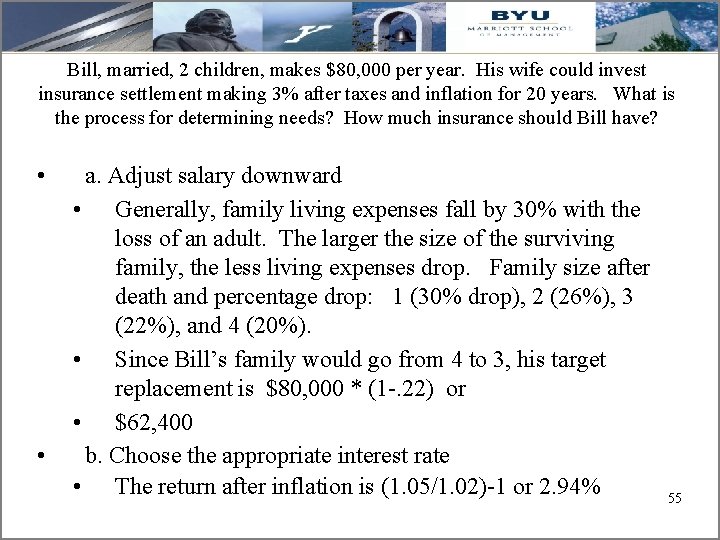
Bill, married, 2 children, makes $80, 000 per year. His wife could invest insurance settlement making 3% after taxes and inflation for 20 years. What is the process for determining needs? How much insurance should Bill have? • • a. Adjust salary downward • Generally, family living expenses fall by 30% with the loss of an adult. The larger the size of the surviving family, the less living expenses drop. Family size after death and percentage drop: 1 (30% drop), 2 (26%), 3 (22%), and 4 (20%). • Since Bill’s family would go from 4 to 3, his target replacement is $80, 000 * (1 -. 22) or • $62, 400 b. Choose the appropriate interest rate • The return after inflation is (1. 05/1. 02)-1 or 2. 94% 55 55
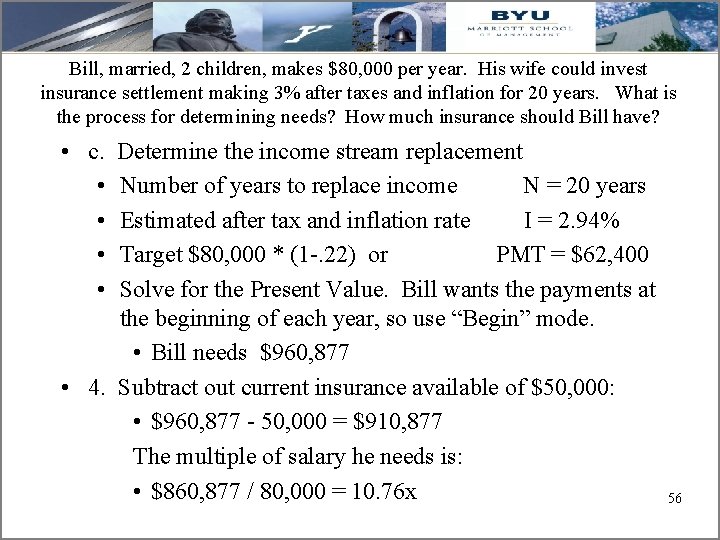
Bill, married, 2 children, makes $80, 000 per year. His wife could invest insurance settlement making 3% after taxes and inflation for 20 years. What is the process for determining needs? How much insurance should Bill have? • c. • • Determine the income stream replacement Number of years to replace income N = 20 years Estimated after tax and inflation rate I = 2. 94% Target $80, 000 * (1 -. 22) or PMT = $62, 400 Solve for the Present Value. Bill wants the payments at the beginning of each year, so use “Begin” mode. • Bill needs $960, 877 • 4. Subtract out current insurance available of $50, 000: • $960, 877 - 50, 000 = $910, 877 The multiple of salary he needs is: • $860, 877 / 80, 000 = 10. 76 x 56 56
57 57
Case #2 • Bob has been dogged by an insurance agent trying to sell him cash value insurance as an investment product. Bob is living on a budget, out of debt, has adequate insurance and has an existing investment program. What questions could Bob ask the insurance agent to help get more information on why he is pushing so hard? 58 58
Permanent Insurance Thoughts • What are your first year and later commissions? If permanent insurance is such a good product, why do I have to pay such high commissions for sales (first year commissions to agents can be 50 -120% of first year sales). What are your commissions if I purchase this product (and the company pays me is not an answer) • What are my annual fees and expenses? What are the fees on investment sub-accounts? These are not complex products. Why can’t they use low-cost index funds with lower fees? • What are your assumptions for benefits? Why are payments on cash value products (except whole life) based on assumptions which the company is not liable for? Why not use real values? • Why is it so hard to find performance data on these products? I can find data on mutual funds, why not these insurance products? 59 59
Permanent Insurance (continued) • Why are there two different sets of expenses? Why does the company have two sets of expenses, one with current and one with maximum charges. Why can the company change the contract and extract maximum charges after the contract is signed? • If this is for retirement, why do I need a medical exam? If permanent is such a good investment product, why require a medical exam before the contract? If I fail the exam, I must pay more for insurance • Why does the insurance company have the right to reject me? Why after I have signed up for insurance, is the company is not required to accept me as a client? They can me you at their discretion • What have been the actual returns on these products? Why is anecdotal return evidence so poor, which shows that 20 year returns on permanent products have generally been only slightly above inflation? 60 60
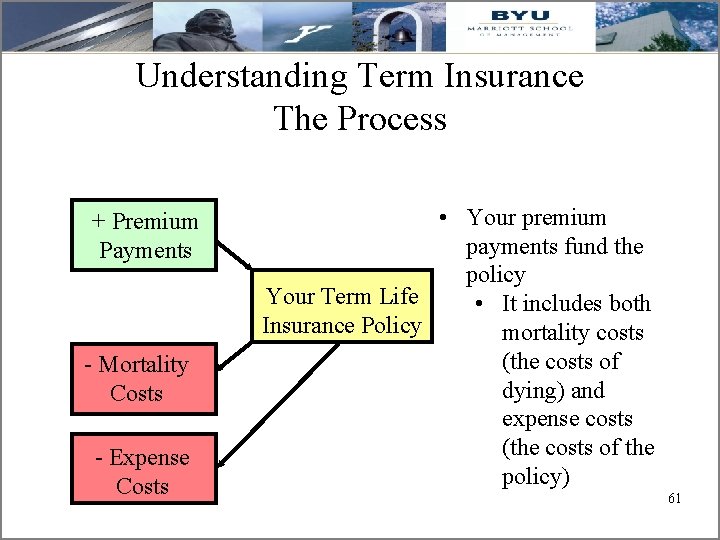
Understanding Term Insurance The Process + Premium Payments - Mortality Costs - Expense Costs • Your premium payments fund the policy Your Term Life • It includes both Insurance Policy mortality costs (the costs of dying) and expense costs (the costs of the policy) 61 61
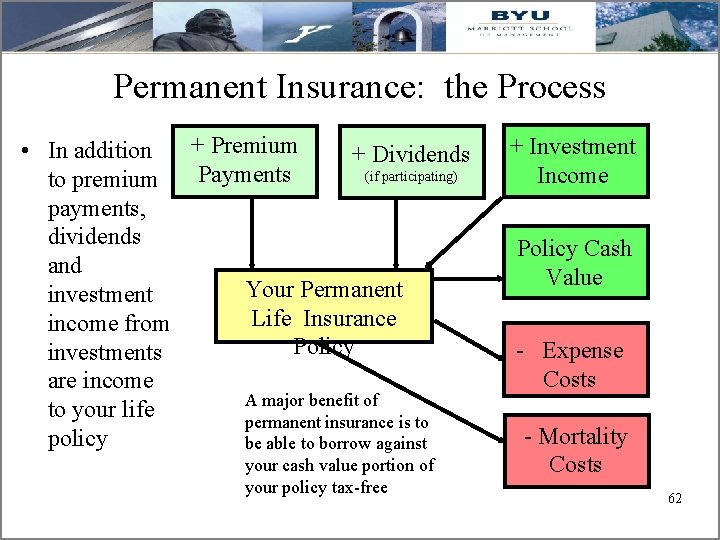
Permanent Insurance: the Process + Premium • In addition + Dividends (if participating) Payments to premium payments, dividends and Your Permanent investment Life Insurance income from Policy investments are income A major benefit of to your life permanent insurance is to policy be able to borrow against your cash value portion of your policy tax-free + Investment Income Policy Cash Value - Expense Costs - Mortality Costs 62 62
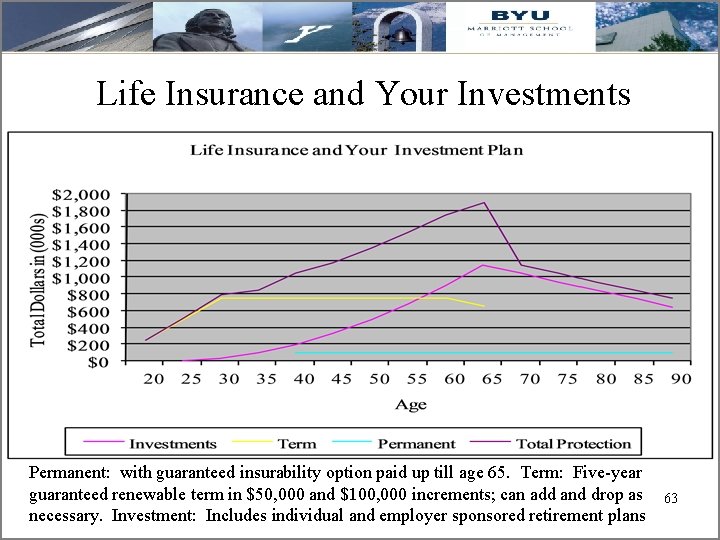
Life Insurance and Your Investments Permanent: with guaranteed insurability option paid up till age 65. Term: Five-year guaranteed renewable term in $50, 000 and $100, 000 increments; can add and drop as necessary. Investment: Includes individual and employer sponsored retirement plans 63
Permanent Insurance (continued) • Watch your expenses carefully Account level expenses on a typical VUL policy: Minimum • • Sales Charges * State Premium Taxes First-year Expense * Administration Fees/month * 0. 0% 0. 75% $200 $4 Average Maximum 8. 0% 2. 0% $350 $6 No Load Fund 10. 0% 5. 0% $700 $15 0% 0% 2. 8% 0. 5% 4. 4% . 10 -. 75% 0%. 10 -. 75% 0 64 Expenses at the sub-account level include: • • Investment Management * 12 -b 1 Fees * Overall Expense Ratio * Surrender Charges * • Source: Ben G. Baldwin, “The New Life Insurance Investment Advisor, ” 2 nd ed. , Mc. Graw Hill, New York, 2002, p. 106. 0. 4%. 8% 0. 0% 1. 5% Significant * These expenses will vary, so compare them carefully 64