
Personal Dosimetry in a RIB Facility External Exposure
Personal Dosimetry in a RIB Facility • External Exposure • Internal Exposure • Biokinetic Models • Dosimetry • Threshold Measurements • Particularities of a RIB facility Thomas Otto, CERN, TIS-RP T. Otto, TIS-RP 1
Dosimetry: basic concept • Absorbed dose: • together with suitable weighting or quality factors: dose equivalent H • radiation detriment is assumed to be proportional to dose equivalent in the low dose, low doserate regime • dose equivalent H key quantity for radiological risk assessment Th. Otto TIS-RP Personal Dosimetry in RIB facilities 2

External vs. Internal Exposure Th. Otto TIS-RP Personal Dosimetry in RIB facilities 3
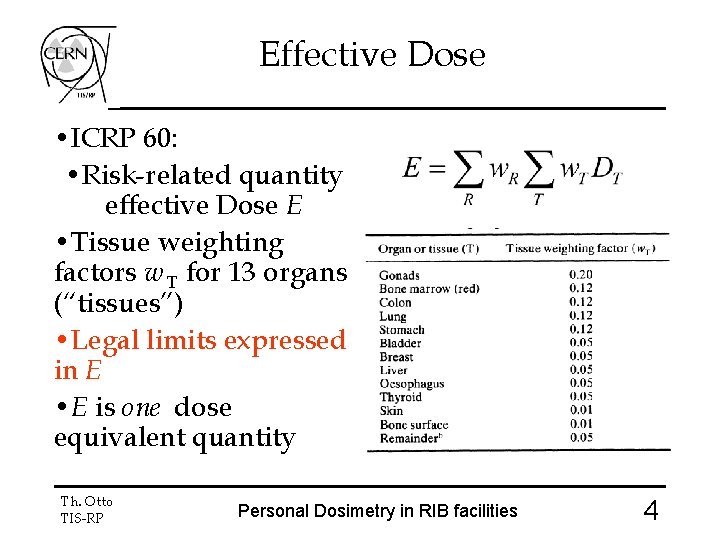
Effective Dose • ICRP 60: • Risk-related quantity effective Dose E • Tissue weighting factors w T for 13 organs (“tissues”) • Legal limits expressed in E • E is one dose equivalent quantity Th. Otto TIS-RP Personal Dosimetry in RIB facilities 4
Dosimetry of External Exposure • “Dose measurement” • Organs inaccessible for measurement • Effective Dose cannot be measured directly • Operational quantity “Personal dose equivalent” for protection purposes • H > E Th. Otto TIS-RP • Measure H with calibrated dosimeter on representative part of body Personal Dosimetry in RIB facilities 5

Personal Dosimeters • Gamma/Beta: • mature technology • TLD or OSL • Neutrons: • Wide range of relevant energies • Dosimeters only for partial energy range • Albedo, Track-etch Th. Otto TIS-RP Personal Dosimetry in RIB facilities 6

Internal Exposure • Penetration of radioisotopes into the body • inhalation via respiratory tract • ingestion via Gastro. Intestinal tract • by wounds • description by biokinetic models Th. Otto TIS-RP Personal Dosimetry in RIB facilities 7
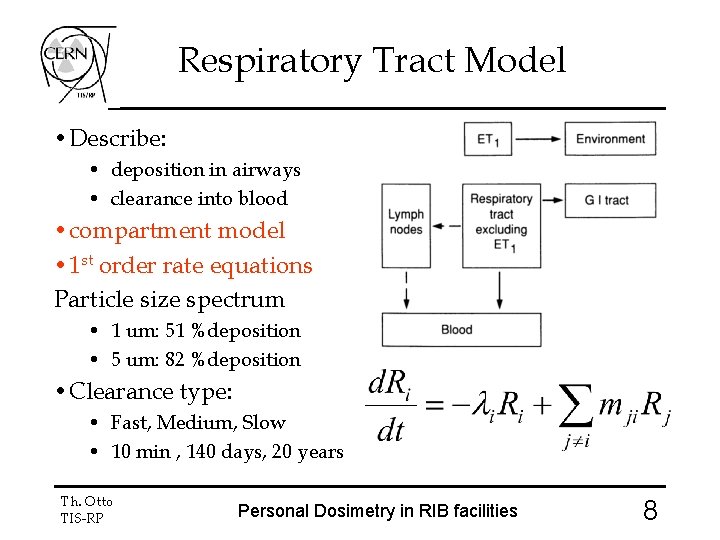
Respiratory Tract Model • Describe: • deposition in airways • clearance into blood • compartment model • 1 st order rate equations Particle size spectrum • 1 um: 51 %deposition • 5 um: 82 %deposition • Clearance type: • Fast, Medium, Slow • 10 min , 140 days, 20 years Th. Otto TIS-RP Personal Dosimetry in RIB facilities 8
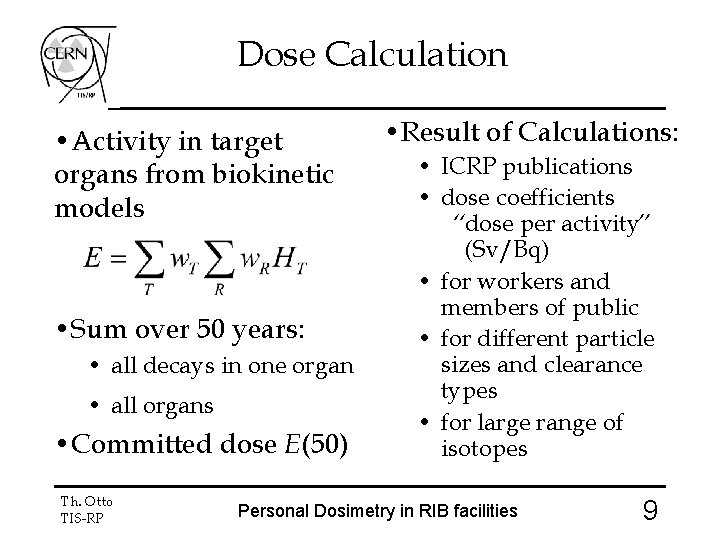
Dose Calculation • Activity in target organs from biokinetic models • Sum over 50 years: • all decays in one organ • all organs • Committed dose E(50) Th. Otto TIS-RP • Result of Calculations: • ICRP publications • dose coefficients “dose per activity” (Sv/Bq) • for workers and members of public • for different particle sizes and clearance types • for large range of isotopes Personal Dosimetry in RIB facilities 9
Dosimetry • “Dose measurement” • Need to estimate incorporated activity • Organs inaccessible for measurement • Effective Dose cannot be measured directly • Calculation of dose from incorporated activity Th. Otto TIS-RP Personal Dosimetry in RIB facilities 10
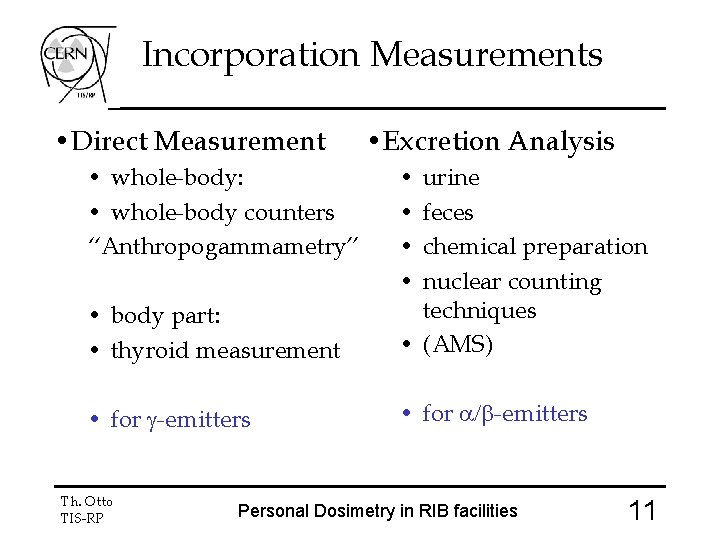
Incorporation Measurements • Direct Measurement • whole-body: • whole-body counters “Anthropogammametry” • Excretion Analysis • • • body part: • thyroid measurement urine feces chemical preparation nuclear counting techniques • (AMS) • for g-emitters • for a/b-emitters Th. Otto TIS-RP Personal Dosimetry in RIB facilities 11
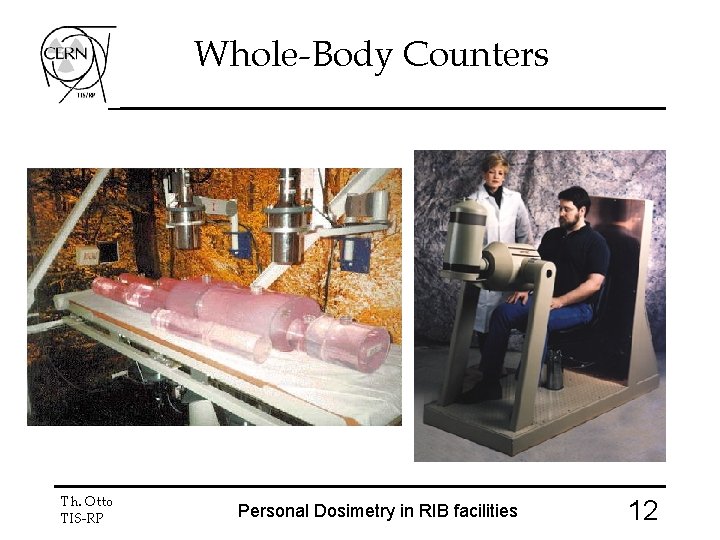
Whole-Body Counters Th. Otto TIS-RP Personal Dosimetry in RIB facilities 12
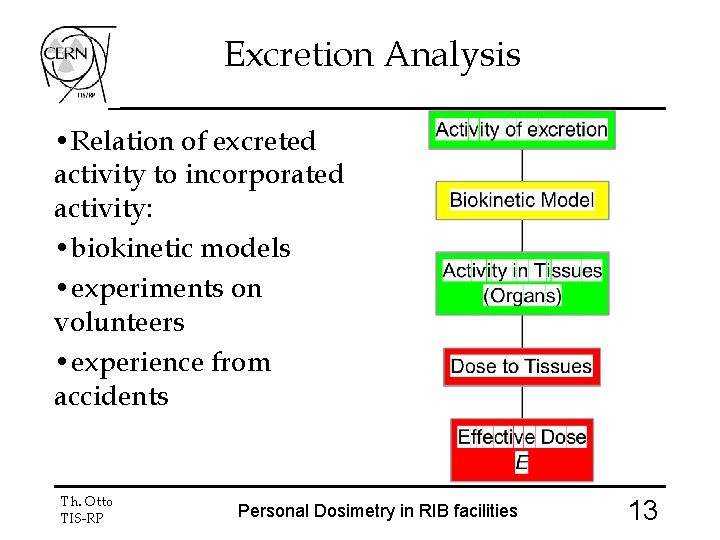
Excretion Analysis • Relation of excreted activity to incorporated activity: • biokinetic models • experiments on volunteers • experience from accidents Th. Otto TIS-RP Personal Dosimetry in RIB facilities 13
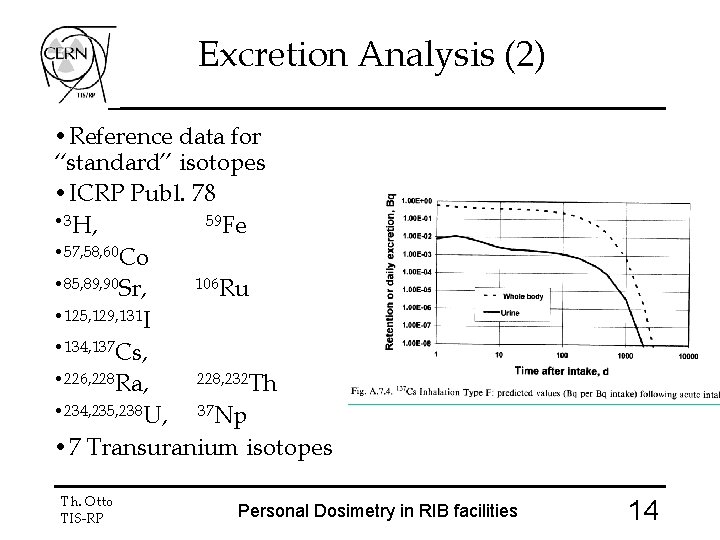
Excretion Analysis (2) • Reference data for “standard” isotopes • ICRP Publ. 78 • 3 H, 59 Fe • 57, 58, 60 Co • 85, 89, 90 Sr, 106 Ru • 125, 129, 131 I • 134, 137 Cs, • 226, 228 Ra, 228, 232 Th • 234, 235, 238 U, 37 Np • 7 Transuranium isotopes Th. Otto TIS-RP Personal Dosimetry in RIB facilities 14
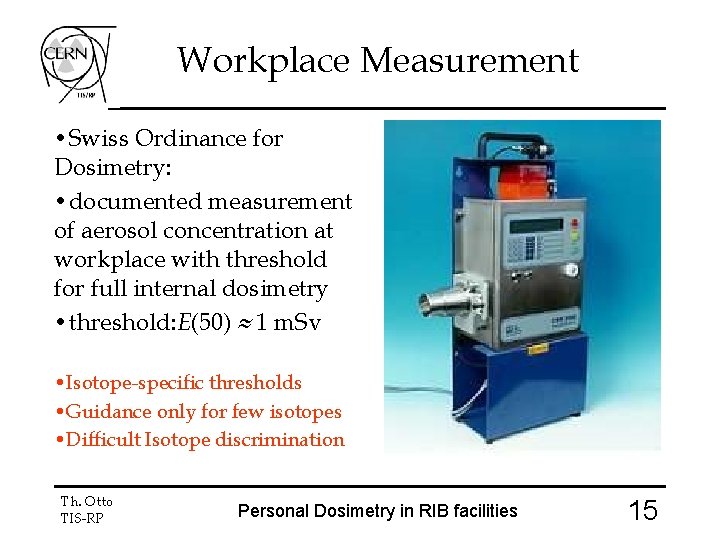
Workplace Measurement • Swiss Ordinance for Dosimetry: • documented measurement of aerosol concentration at workplace with threshold for full internal dosimetry • threshold: E(50) 1 m. Sv • Isotope-specific thresholds • Guidance only for few isotopes • Difficult Isotope discrimination Th. Otto TIS-RP Personal Dosimetry in RIB facilities 15
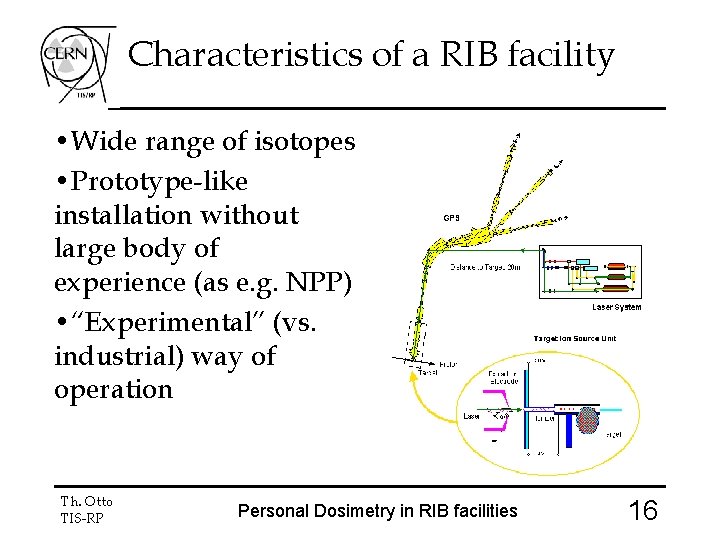
Characteristics of a RIB facility • Wide range of isotopes • Prototype-like installation without large body of experience (as e. g. NPP) • “Experimental” (vs. industrial) way of operation Th. Otto TIS-RP Personal Dosimetry in RIB facilities 16
External Dosimetry in RIB Facility • Full-body gamma dosimeters • Electronic dosimeter upon access to activated area (front-end, separator, reactor, storage) for immediate dose control • Extremity g/b –dosimeters for specific work • during operation, neutron dosimeter (type depending on driver: reactor vs. accelerator) Th. Otto TIS-RP Personal Dosimetry in RIB facilities 17
Workplace Monitoring in RIB Facility • Regular checks for volatile contamination • Activity-in–air measurements • Look for representative “tracer” nuclides and estimate total contamination from their concentration • Identify such tracers • Determine best measurement practice (Instrument sensitivities, sample preparation…) Th. Otto TIS-RP Personal Dosimetry in RIB facilities 18
Internal Dosimetry in RIB Facilities • Periodic whole-body scans for gamma emitters are simple, low-cost and reassuring for emplyer and staff • Periodicity has to be reviewed • Extra-scans after incidents • Excretion analysis needs identification of “tracers “ and development of specific sample preparation/detection methods • Use of automated equipment and personal protective equipment to raise threshold for “real” internal dosimetry Th. Otto TIS-RP Personal Dosimetry in RIB facilities 19
Summary • Personal dosimetry key element of radiological protection programme • External vs. internal dosimetry • Specific challenges of RIB-facilities: • non-standard character of installation • range of isotopes • Development work for implementation of full dosimetry programme is still necessary Th. Otto TIS-RP Personal Dosimetry in RIB facilities 20
- Slides: 20