
Personal Decision Making Styles 2006 by SouthWestern a
Personal Decision Making Styles © 2006 by South-Western, a division of Thomson Learning. All rights reserved. 1
Personal Decision Making Styles o Directive 1. Used for Quick Decisions 2. May Only Consider a few Alternatives 3. Generally Efficiency Based Managers © 2006 by South-Western, a division of Thomson Learning. All rights reserved. 2
Personal Decision Making Styles o Analytical 1. Acquires as Much Data as Possible 2. Carefully Considers all Alternatives 3. Rational, Objective Decisions © 2006 by South-Western, a division of Thomson Learning. All rights reserved. 3
Personal Decision Making Styles o Conceptual 1. More Socially Oriented 2. Seeks Group Consensus 3. Rely on Information from People and Systems © 2006 by South-Western, a division of Thomson Learning. All rights reserved. 4
Personal Decision Making Styles o Behavioral 1. Deep Concern for Others 2. Understands Feelings of Those Involved 3. Concerned with Personal Development Affected by Decisions © 2006 by South-Western, a division of Thomson Learning. All rights reserved. 5
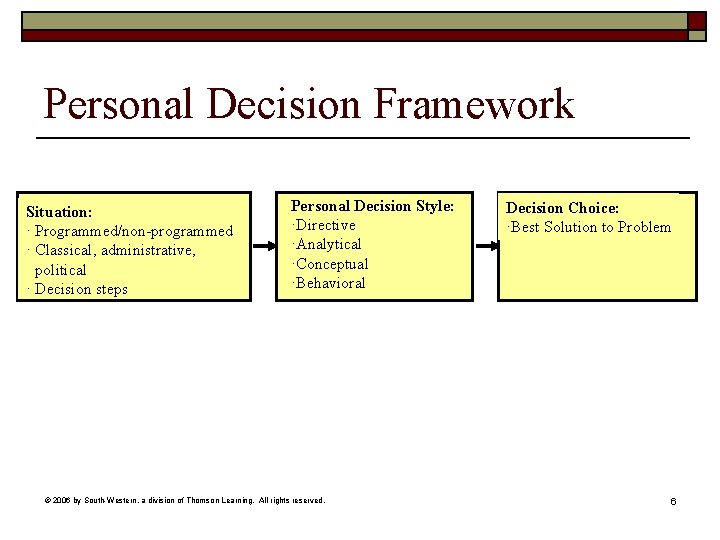
Personal Decision Framework Situation: · Programmed/non-programmed · Classical, administrative, political · Decision steps Personal Decision Style: ·Directive ·Analytical ·Conceptual ·Behavioral © 2006 by South-Western, a division of Thomson Learning. All rights reserved. Decision Choice: ·Best Solution to Problem 6
Common Decision Making Biases © 2006 by South-Western, a division of Thomson Learning. All rights reserved. 7
Common Decision Making Biases o Availability Bias – Making Decision from Past Experiences Only © 2006 by South-Western, a division of Thomson Learning. All rights reserved. 8
Common Decision Making Biases o o Availability Bias Representative Bias – Generalizing From a Small Sample or Single Event © 2006 by South-Western, a division of Thomson Learning. All rights reserved. 9
Common Decision Making Biases o o o Availability Bias Representative Bias Anchoring and Adjusting Bias – Making Decisions on the Initial Figure © 2006 by South-Western, a division of Thomson Learning. All rights reserved. 10
Common Decision Making Biases o o Availability Bias Representative Bias Anchoring and Adjusting Bias Escalation of Commitment Bias – Committing to a Project Despite Negative Information © 2006 by South-Western, a division of Thomson Learning. All rights reserved. 11
Resistance to Decision Making © 2006 by South-Western, a division of Thomson Learning. All rights reserved. 12
Resistance to Decision Making o Relaxed Avoidance – Managers Fail to See Risk and Don’t Take any Action © 2006 by South-Western, a division of Thomson Learning. All rights reserved. 13
Resistance to Decision Making o o Relaxed Avoidance Relaxed Change – Managers Look for Easiest Way Out © 2006 by South-Western, a division of Thomson Learning. All rights reserved. 14
Resistance to Decision Making o o o Relaxed Avoidance Relaxed Change Defensive Avoidance – Manager is Unable to Find Good Alternatives so He/She Denies Any Risk, Procrastinates or Passes the Buck © 2006 by South-Western, a division of Thomson Learning. All rights reserved. 15
Resistance to Decision Making o o Relaxed Avoidance Relaxed Change Defensive Avoidance Panic – Manager Makes Irrational Decisions or is Unable to Make Any Decision © 2006 by South-Western, a division of Thomson Learning. All rights reserved. 16
Group Decision Making Questions to Determine Group Participation in Decision Making Decision significance Importance of commitment Leader expertise Likelihood of commitment Group support for goals Group expertise Team competence © 2006 by South-Western, a division of Thomson Learning. All rights reserved. 17
Group Decision Making Advantages 1. Greater Pool of Knowledge 2. Different Perspectives 3. Intellectual Stimulation 4. Better Understanding by Employees 5. Deeper Commitment to the Decision © 2006 by South-Western, a division of Thomson Learning. All rights reserved. 18
Group Decision Making Disadvantages 1. A Few people May Dominate 2. Groupthink 3. Satisficing 4. Goal Displacement © 2006 by South-Western, a division of Thomson Learning. All rights reserved. 19
Group Decision Making Concerns for Managers 1. Less Efficient 2. Size Affects Quality Inversely 3. Group May Be Too Confident 4. Knowledge Counts © 2006 by South-Western, a division of Thomson Learning. All rights reserved. 20
Group Decision Making Best Times to Utilize Groups 1. When It Can Increase Quality 2. When It Can Increase Acceptance 3. When It Can Increase Development © 2006 by South-Western, a division of Thomson Learning. All rights reserved. 21
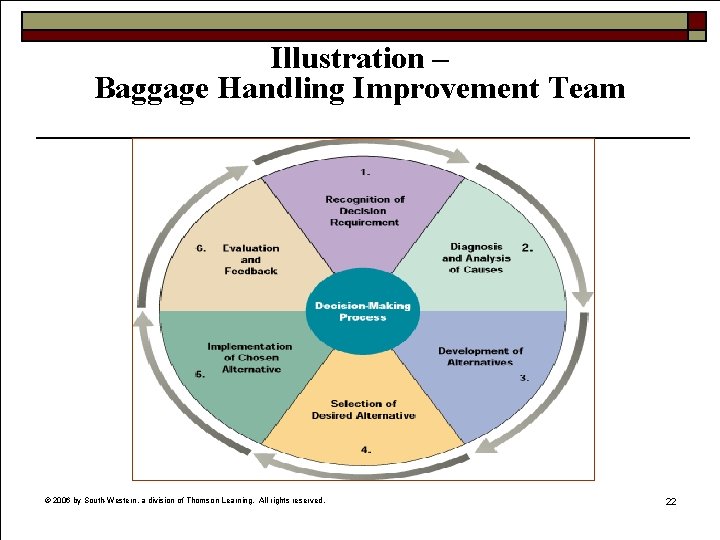
Illustration – Baggage Handling Improvement Team © 2006 by South-Western, a division of Thomson Learning. All rights reserved. 22
Management Hot-Seat Case © 2006 by South-Western, a division of Thomson Learning. All rights reserved. 23
- Slides: 23