
Personal Care Skills Chapter 13 1 Explain personal
- Slides: 37
Personal Care Skills Chapter 13
1. Explain personal care of residents • NAs provide the following care in the morning (a. m. care): • Assisting with toileting • Helping wash face and hands • Assisting with hair care, dressing, and shaving • Assisting with mouth care
NAs provide the following care in the evening (p. m. care): • Assisting with elimination • Helping wash face and hands • Giving a snack • Assisting with mouth care • Assisting with changing into nightclothes • Giving a back rub
Assisting with Personal Care • Help the resident be as independent as possible. • Be aware of resident preferences and routines. • Always explain what you will be doing. • Always provide privacy. • Observe the resident during care. • Note and report signs and symptoms. • Observe resident’s mental and emotional state. • Report any changes. • Leave the resident’s room clean and tidy. • Leave call light within resident’s reach.
1. Explain personal care of residents Think about these questions and Journal your answers: Why do you think that performing the personal care task is only half the NA’s job? What else do you think can be accomplished while providing personal care?
1. Explain personal care of residents Journal to Remember: While providing personal care an NA can obtain important information about the resident by asking questions and making observations.
It is important for NAs to observe and report changes in the following areas during personal care: • Skin color, temperature, or reddened areas • Mobility • Flexibility • Comfort or pain level • Strength and ability to perform ADLs • Mental and emotional state • Complaints
1. Explain personal care of residents Journal to Remember: NAs must report any complaints a resident might express during personal care.
2. Identify guidelines for providing skin care and preventing pressure injuries Journal to Remember: Pressure injuries are painful and difficult to heal. They can lead to lifethreatening infections. Prevention is very important and is the key to skin health.
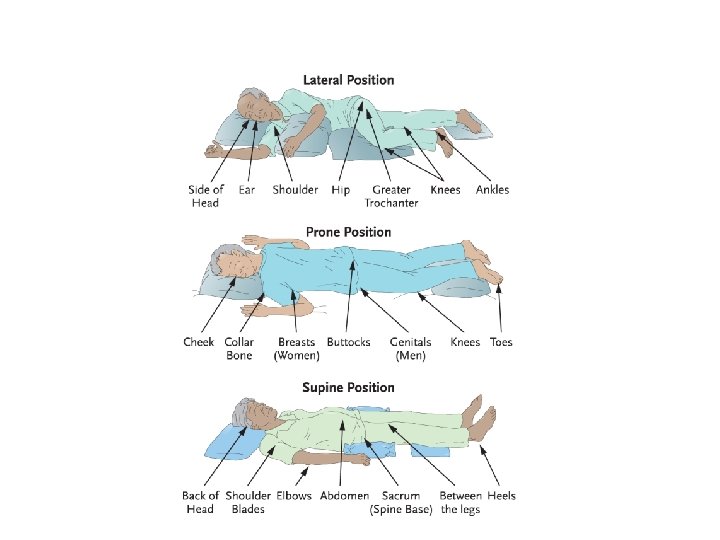
Transparency 13 -2: Pressure Injury Danger Zones
2. Identify guidelines for providing skin care and preventing pressure injuries Journal to Remember: Observation is very important in the prevention of pressure injuries.
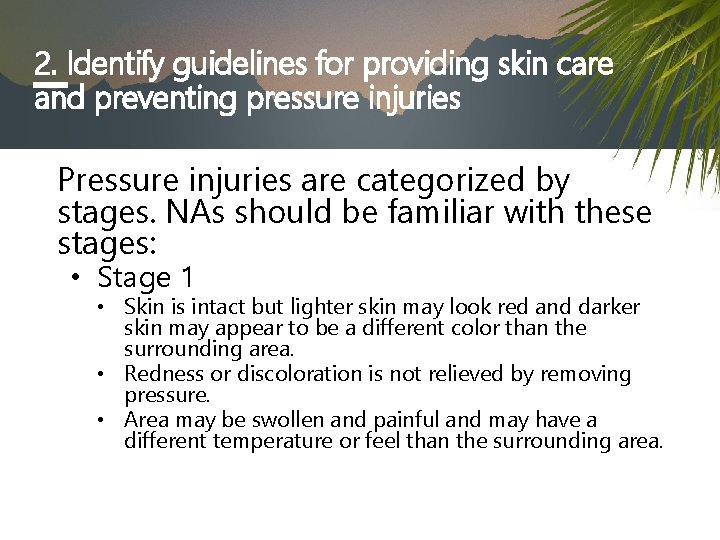
2. Identify guidelines for providing skin care and preventing pressure injuries Pressure injuries are categorized by stages. NAs should be familiar with these stages: • Stage 1 • Skin is intact but lighter skin may look red and darker skin may appear to be a different color than the surrounding area. • Redness or discoloration is not relieved by removing pressure. • Area may be swollen and painful and may have a different temperature or feel than the surrounding area.
Pressure injury stages (cont’d): • Stage 2 • There is partial-thickness skin loss involving the outer and/or inner layers of skin. • The injury is pink or red and moist. • It may look like a blister. • Stage 3 • There is full-thickness skin loss in which fat is visible in the ulcer. • Dead tissue may be present. • The damage may extend down to, but not through, the tissue that covers muscle.
Pressure injury stages (cont’d): • Stage 4 • There is full-thickness skin loss extending through all layers of the skin, tissue, muscle, bone, and other structures (such as tendons). • It will look like a deep crater. • Dead tissue may be visible.
Observing the Skin • Pale, white, reddened, gray, or purple skin • Blisters, bruises, or wounds on the skin • Differences in temperature of the skin when compared to the area around it • Complaints of tingling, warmth, or burning of the skin • Dry, cracked, or flaking skin • Itching or scratching • Rash or any skin discoloration • Swelling • Fluid or blood draining from the skin • Broken skin anywhere on the body, including between the toes or around the toenails • Changes in existing injury, including size, depth, drainage, color, or odor
Observing the Skin (cont’d) Darker skin may not look red, but may appear • A different color than the surrounding area • Swollen, painful, firm, or soft • Warmer or cooler when compared to the area around it
NAs should follow these guidelines for skin care: • Report changes in residents’ skin. • Provide regular skin care. • Reposition immobile residents frequently, at least every two hours. • Give frequent, thorough skin care for incontinent residents. Change clothing and linen often. • Avoid scratching or irritating skin; report blisters or sores on feet. • Massage skin often. Do not massage white, red, or purple areas.
Guidelines for skin care (cont’d): • Be gentle during transfers. Avoid pulling or tearing skin. • In overweight residents, pay special attention to skin under folds. • Encourage residents to eat well-balanced meals. • Keep plastic or rubber materials from coming into contact with skin. • Follow the care plan and nurse’s instructions on special skin care for dry, closed wounds or other conditions.
NAs may be assigned to apply ointments, lotions, or powders to a resident’s skin. Not all NAs are allowed to do this, so it is important for an NA to know the rules in his facility. If he is assigned to do this task and permitted to do it, an NA should follow guidelines: • Read the directions. • Know exactly where it is to be applied. • Know if it should be rubbed in or left on the top of the skin. • Wash hands before and after application. • Wear gloves • Avoid getting any on clothing, as it may stain. • Ask questions if anything is unclear.
When caring for residents who are at a high risk for pressure injuries (bed bound) NAs should remember these guidelines: • Keep bottom sheet tight and wrinkle-free. • Avoid shearing. • Place sheepskin, chamois skin, or bed pad under back and buttocks. • Relieve pressure under bony prominences. • Make bed or chair softer with flotation pads. • Use bed cradle to keep top sheets from rubbing skin. • Reposition residents seated in chairs or wheelchairs every 15 minutes if they cannot easily change positions themselves.
NAs should be familiar with the following positioning devices: • Backrests • Bed cradles • Draw sheets • Footboards • Hand rolls • Orthotic devices • Trochanter rolls • Abduction pillows/wedges/splits/pads
1. NAs 3. Explain guidelines for assisting with bathing Journal to Remember: must carefully check the temperature of water used for bathing a resident, and must change the water when it becomes too cool, soapy, or dirty. 2. When performing perineal care for a female resident it is important to clean from front to back. 3. During bed baths NAs must carefully keep residents covered with towels and bath blankets for privacy and warmth.
3. Explain guidelines for assisting with bathing NAs should remember these guidelines when assisting with showers or tub baths: • Clean tub or shower before and after use. • Be sure floor is dry. • Be familiar with and use assistive devices as necessary. • Have resident use safety bars to get into or out of tub or shower. • Place items within reach. • Do not leave resident alone. • Do not use bath oils, lotions, or powders. • Test water temperature to make sure it is safe and comfortable.
Giving a shower • Equipment: bath blanket, soap, shampoo, 2 -4 washcloths, 2 -4 bath towels, clean clothes, nonskid footwear, 2 pairs of gloves, lotion, deodorant, hair dryer 1. 2. 3. 4. 5. 6. 7. Wash your hands. Place equipment in the shower or tub room. Put on gloves. Clean the shower or tub area and shower chair. Place a bucket under shower chair (in case resident has a bowel movement). Turn on the heat lamp to warm the room, if available. Remove and discard gloves. Wash your hands. Go to the resident’s room. Identify yourself by name. Identify the resident by name. Wash your hands. Explain procedure to the resident. Speak clearly, slowly, and directly. Maintain face-to-face contact whenever possible. Provide for resident’s privacy with curtain, screen, or door.
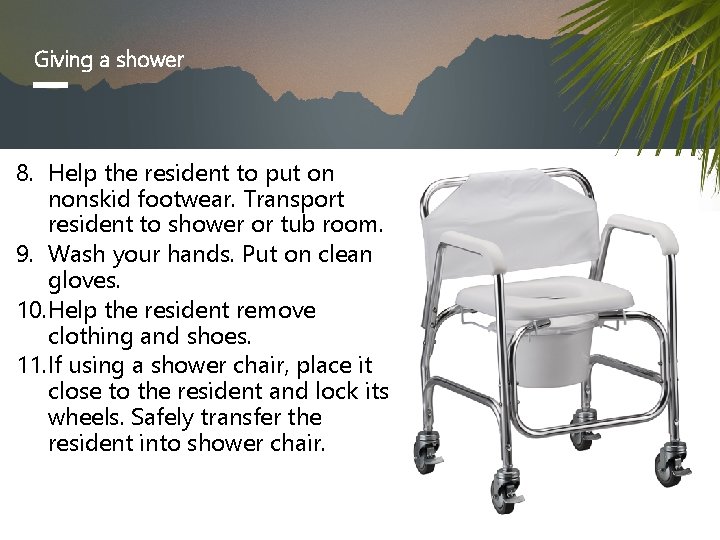
Giving a shower 8. Help the resident to put on nonskid footwear. Transport resident to shower or tub room. 9. Wash your hands. Put on clean gloves. 10. Help the resident remove clothing and shoes. 11. If using a shower chair, place it close to the resident and lock its wheels. Safely transfer the resident into shower chair.
Giving a shower 12. Turn on water. Test water temperature against the inside of your wrist. Water temperature should be no higher than 105°F. Have resident check water temperature. Adjust if necessary. Check temperature throughout the shower. 13. Unlock the shower chair and move it into the shower stall. Lock the wheels. 14. Stay with the resident during the procedure. 15. Let the resident wash as much as possible. Help to wash his or her face. 16. Help the resident shampoo and rinse hair. 17. Using soap, help to wash and rinse the entire body. Move from head to (clean to dirty). 18. Turn off water. Unlock shower chair wheels. Roll the resident out of the shower.
Giving a shower 19. Give resident towel(s) and help to pat dry. Pat dry under the breasts, between skin folds, in the perineal area, and between toes. 20. Apply lotion and deodorant as needed. 21. Place soiled clothing and linens in proper containers. 22. Remove and discard gloves. 24. Wash your hands. Help the resident dress and comb hair before leaving shower or tub room. Put on nonskid footwear. Return resident to room. 25. Make sure resident is comfortable. 26. Place call light within resident’s reach. 27. Report any changes in resident to nurse. 28. Document procedure using facility guidelines.
4. Explain guidelines for assisting with grooming NAs should observe and report the following during foot care: • • • Dry, flaking skin Non-intact or broken skin Discoloration of the feet Blisters Bruises Blood or drainage Long, ragged toenails Ingrown toenails Swelling Soft, fragile, or reddened heels Differences in temperature of the feet
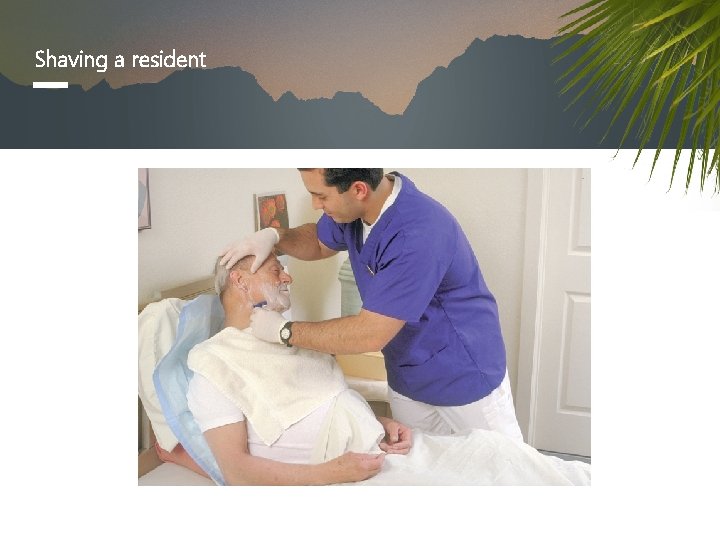
4. Explain guidelines for assisting with grooming NAs should remember these points about assisting a resident with shaving: • Respect personal preferences regarding shaving. • Wear gloves. • Soften hair on face first if using disposable or safety razor. • Shave in direction of hair growth. • Use aftershave if desired. • Discard disposable shaving products properly. Do not attempt to recap a disposable razor. • Do not use electric razors near water or oxygen.
Shaving a resident
4. Explain guidelines for assisting with grooming NAs should remember these points about combing or brushing a resident’s hair: Let residents choose their own hairstyles. Do not style residents’ hair in a childish manner. Handle hair gently. Equipment: comb, brush, towel, mirror, hair care items requested by resident. • Use hair care products that the resident prefers for his or her type of hair. • •
Assisting with Dressing • Refer to affected side as weaker or involved. • Preferences should be followed. • Allow resident to choose clothing. • Encourage residents to dress in regular clothes in the daytime. • Residents should do as much as possible to dress themselves. • Provide privacy. • Roll or fold down socks before putting them on. • Front-fastening bras are easier for residents to fasten by themselves. • Put back-fastening bras on waist and fasten in front first before rotating around. • When dressing, start with the weaker arm or leg first. When undressing, start with the stronger side.
5. List guidelines for assisting with dressing Journal to Remember: Several types of adaptive aids are available to make dressing easier for residents.
6. Identify guidelines for proper oral care NAs should observe and report the following when providing oral care: • Irritation • Raised areas • Coated or swollen tongue • Ulcers • Flaky, white spots • Dry, cracked, bleeding, or chapped lips • Loose, chipped, broken, or decayed teeth • Swollen, irritated, bleeding, or whitish gums • Bad or fruity breath • Reports of mouth pain
6. Identify guidelines for proper oral care NAs must remember the following points about oral care for an unconscious resident: • Regular oral care keeps the mouth clean and moist. • Use as little liquid as possible and turn residents on their sides to avoid aspiration.
7. Define dentures and explain how to care for dentures It is important to remember the following about denture care: • Dentures are expensive. • Handle them carefully. • Notify the nurse if dentures do not fit properly, are chipped, or are missing. • Wear gloves when cleaning dentures. • Store dentures in solution or clean, moderate/cool water (not hot water) so they do not dry out and warp. • Place them in a labeled cup.
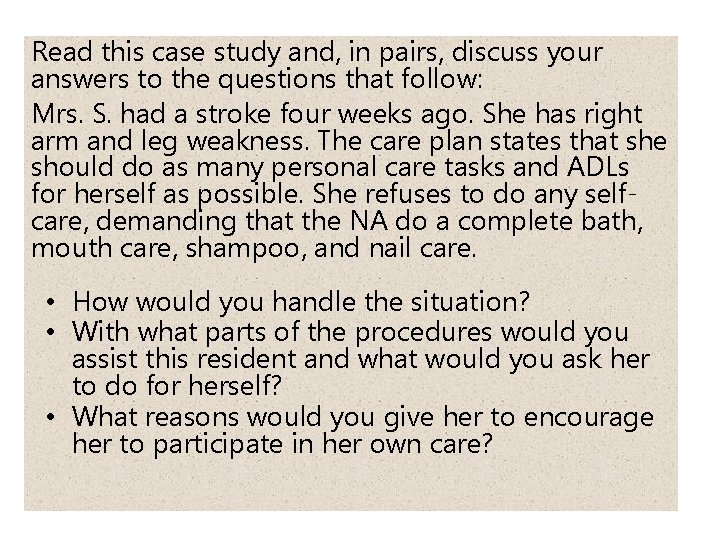
Read this case study and, in pairs, discuss your answers to the questions that follow: Mrs. had a stroke four weeks ago. She has right Case S. study activity arm and leg weakness. The care plan states that she should do as many personal care tasks and ADLs for herself as possible. She refuses to do any selfcare, demanding that the NA do a complete bath, mouth care, shampoo, and nail care. • How would you handle the situation? • With what parts of the procedures would you assist this resident and what would you ask her to do for herself? • What reasons would you give her to encourage her to participate in her own care?