
Personal and Family Preparedness Personal and Family Preparedness
- Slides: 49
Personal and Family Preparedness
Personal and Family Preparedness I. II. IV. V. 12/14/2021 Prevent a ‘Personal’ Disaster ARES/RACES Communications Plans Good Amateur Radio Operating Practice Individual Equipment Recommendations “Go Kit” Personal and Family Preparedness 1
Objectives At the end of this course you will be able to: v v v Explain what is most important in disaster preparation List the steps in family preparedness List the ARES/RACES preparedness steps Explain why frequency planning is important List the equipment recommendations for ARES/RACES operation 12/14/2021 Personal and Family Preparedness 2
I. Prevent a ‘Personal’ Disaster n n Any community can be affected by a disaster – don’t let it become ‘your’ disaster Family comes FIRST n Your family must be self-reliant n n n 12/14/2021 You can’t adequately perform your ARES/RACES duties unless you KNOW your family will be safe Develop a plan with your family Then, you can concentrate on your task Personal and Family Preparedness 3
I. Prevent a ‘Personal’ Disaster (cont. ) n Step One - Determine hazards your community faces n Natural: Floods, tornadoes, fires, earthquakes n Technological: HAZMAT releases, pipeline breaks, power failures n Resource Shortages: Drought, water of fuel shortages n Other Consequences: Of criminal acts, civil unrest, terrorism 12/14/2021 Personal and Family Preparedness 4
I. Prevent a ‘Personal’ Disaster (cont. ) n Step Two - Obtain knowledge of how to cope with known hazards n What are the recommended evacuation routes? n n Shelter locations and directions will be determined at the time of evacuation Whom would you call? Where would family members meet if they become separated? How would you and your family members get together? 12/14/2021 Personal and Family Preparedness 5
I. Prevent a ‘Personal’ Disaster (cont. ) n Step Three – Develop a family disaster plan n Neighborhood Refuge n n Farther Away Friend n n 12/14/2021 Neighbor within walking distance Safe for children when you aren’t home Meet and account for everyone after a fire Use as alternative to public shelter “Out of Area Contact” - If family becomes separated, this party agrees to accept collect calls from everyone to assure they are save Personal and Family Preparedness 6
I. Prevent a ‘Personal’ Disaster (cont. ) n Ensure that family knows how to shut off Electricity n Gas n Water at the main sources, should they need to evacuate n 12/14/2021 Personal and Family Preparedness 7
II. ARES/RACES Communications Plans n ROUTINE Simplex Operations n n n 12/14/2021 Repeaters are for backup Not for use as the primary incident working frequency Reserve repeaters for traffic requiring wide area coverage Personal and Family Preparedness 8
II. ARES/RACES Communications Plans (cont. ) n Establish Local Plans n n Contingency plans for operations After disaster-related loss of repeaters Test regularly in exercises Frequency Reference Card n Pre-program rigs to a standard list n 12/14/2021 Channels 1 – n will be the same on all rigs Personal and Family Preparedness 9
II. ARES/RACES Communications Plans (cont. ) v YAVAPAI COUNTY ARES/RACES FREQUENCY PLAN (Preferred) v YAVAPAI COUNTY ARES/RACES FREQUENCY PLAN (Alternate) Refer to Handout 12/14/2021 Personal and Family Preparedness 10
II. ARES/RACES Communications Plans (cont. ) n Why Do We Need Simplex? n Essential for local ARES/RACES operations n n n 12/14/2021 Reduces congestion – keeps repeaters available for high priority messages Repeater non-availability due to disaster damage AC failures deplete battery backup after outage Personal and Family Preparedness 11
II. ARES/RACES Communications Plans (cont. ) n Why Do We Need Simplex? (cont. ) n Don’t tie up a repeater for local area activities n n Use drills to hone skills n n 12/14/2021 Use only when wide-area coverage is needed Practice in simulated emergency conditions Ideal for localized events and activities Personal and Family Preparedness 12
II. ARES/RACES Communications Plans (cont. ) n Teach Simplex Awareness n n Where is the `reverse’ button? Don’t hog the repeater for local rag chews Use repeater to make initial contact Then… Listen to the repeater input n n n 12/14/2021 IF both stations have good copy… THEN change to to simplex, but… PLEASE… respect the band plan! Personal and Family Preparedness 13
II. ARES/RACES Communications Plans (cont. ) n Become Familiar With Appropriate Simplex Frequencies n Not “coordinated, ” – “gentlemen’s agreement” n n 12/14/2021 Reduces interference during local operations Relinquish during ARES/RACES operations Normal amateur usage encouraged at other times Encourage routine monitoring for preparedness Personal and Family Preparedness 14
II. ARES/RACES Communications Plans (cont. ) n Become Familiar With Appropriate Simplex Frequencies (cont. ) n 12/14/2021 Observe band plans n Use standard channelization! n Doing so reduces adjacent channel interference n All routine use, drills, non-emergency operations n Use pre-assigned freqs for local ops Personal and Family Preparedness 15
III. Good Amateur Radio Operating Practice n LISTEN before keying up n n Monitor so you don’t “step on” other users Avoid unnecessary output power n n Appropriate use of cross-band repeat n 12/14/2021 Splattering and over-deviation Routine use of CTCSS (Continuous Tone Coded Squelch System) to reduce interference Personal and Family Preparedness 16
III. Good Amateur Radio Operating Practice (cont. ) n Portable/Temporary repeaters n n Use the Shared-Non-Protected pair w/CTCCS Regional tone/’splinter channel’ plans n 12/14/2021 Enables multi-jurisdictional sharing of limited UHF frequencies for local incident area ‘talk-around’ Personal and Family Preparedness 17
III. Good Amateur Radio Operating Practice (cont. ) n Don’t Expect Repeaters to “Always Be There” n DON’T depend on an HT as your only rig! n n Inadequate as a ‘primary’ rig for emergencies Limits you mostly to nearby repeaters Severely limits your useful simplex range Typical “rubber duck” is -5 d. B! n 12/14/2021 Average HT simplex range is 1 – 2 miles Personal and Family Preparedness 18
III. Good Amateur Radio Operating Practice (cont. ) n Don’t Expect Repeaters to “Always Be There” (cont. ) n n 12/14/2021 EVERYONE still needs an HT for “walk & talk” And also as a spare or backup! Personal and Family Preparedness 19
III. Good Amateur Radio Operating Practice (cont. ) n Local Nets Are Training Opportunities n n n 12/14/2021 Do more than just collect names on a roster! Teach and routinely use directed net procedures Rotate NCS (Net Control Station) operators so everyone learns how Generate and handle some formal written traffic Encourage operators to use emergency power Personal and Family Preparedness 20
III. Good Amateur Radio Operating Practice (cont. ) n Local Nets Are Training Opportunities (cont. ) n n 12/14/2021 Practice setting up in field/mobile locations Leave breaks so others can make contacts Encourage “weak signal” capability and LISTEN! Test limits of coverage, teach operators to call for and relay outlying stations as a matter of routine Personal and Family Preparedness 21
IV. Individual Equipment Recommendations n n n Emphasis on RELIABILITY 24 hours minimum battery power 2 M or dual-band recommended Mobile/portable base capability 25 watts minimum RF output 12/14/2021 Personal and Family Preparedness 22
IV. Individual Equipment Recommendations (cont. ) n Recommend a Mobile Rig Because n n n 12/14/2021 Reliable simplex capability Is less dependent upon the repeater infrastructure Has higher power capability Personal and Family Preparedness 23
IV. Individual Equipment Recommendations (cont. ) n Basic Rig Should Be Capable of n n n n 12/14/2021 Operating on 12 -15 V DC power (battery capable) “Low” (~5 W battery conserve) and “High” (25 W min. RF output for reliable simplex) Frequency agile, field programmable, w/CTCSS Cross-band repeat not essential, but desirable Minimum 10 field-programmable memories Portable/mobile HF desirable Packet capability & “appliance operator’s” skill highly desirable Personal and Family Preparedness 24
IV. Individual Equipment Recommendations (cont. ) n When a Portable Unit (HT) is Best n n n 12/14/2021 When taking public transportation You are a minor who doesn’t drive You have impaired mobility or depend on others to conduct basic life activities You are to act as a “shadow” for some person or official Logistics inhibit transport/use of a mobile rig Personal and Family Preparedness 25
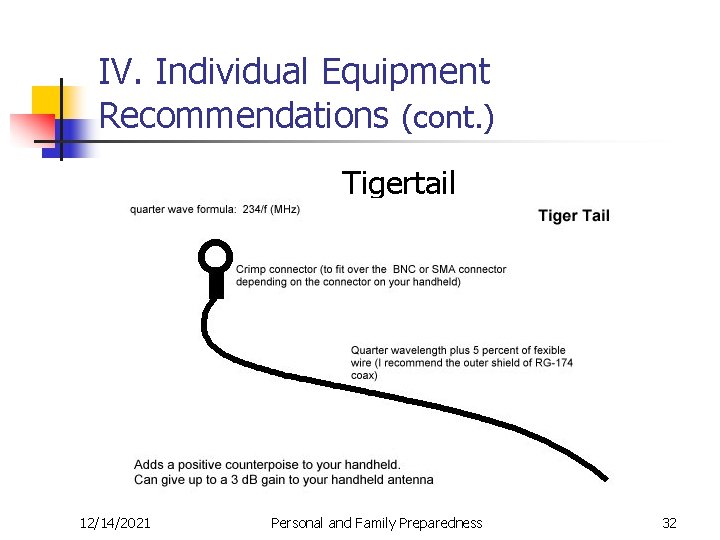
IV. Individual Equipment Recommendations (cont. ) n HT User’s Supplemental Equipment n ½ wave ‘no-ground-plane’ ant. , unity gain n n Equal to a ¼ wave ant. with ground plane 2. 15 d. B gain if used with ground plane Single or dual-band mobile antenna + mag. Mount Telescoping ½ wave whip, or… n n 12/14/2021 Roll-up 300 Ohm twin-lead, or copper J-pole (works well in tree or on bike or wheelchair) “Tigertail” HT counterpoise Personal and Family Preparedness 26
IV. Individual Equipment Recommendations (cont. ) n HT User’s Supplemental Equipment (cont. ) n n And/or 5/8 wave mobile ant. + mag. mount, 3 d. B gain, with mast clamp & radial kit If no ground plane, improvise n n n Metal vehicle, file cabinet, trash can, railing, etc. Radial kit and mast clamp for your mobile ant. TV tripod and 15’ of mast + mallet, stakes, and guys 12/14/2021 Personal and Family Preparedness 27
IV. Individual Equipment Recommendations (cont. ) n ARES/RACES Hints & Kinks Web Site http: //www. qsl. net/ccares/hints. html Has good information on connectors, adapters, and antennas 12/14/2021 Personal and Family Preparedness 28
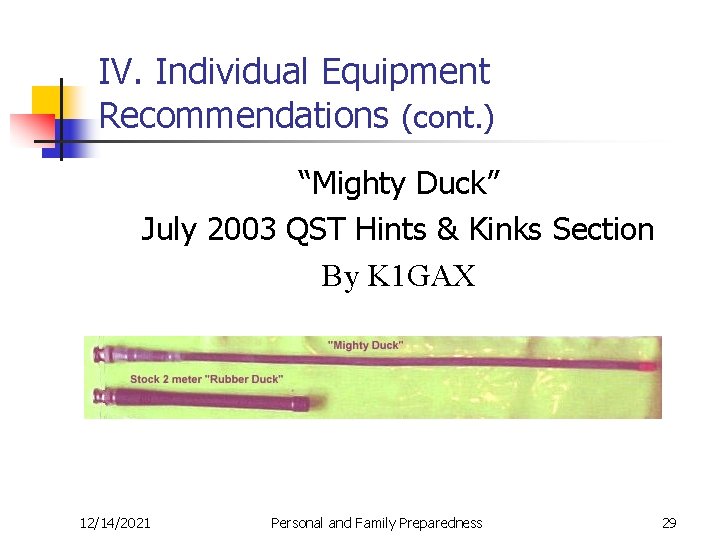
IV. Individual Equipment Recommendations (cont. ) “Mighty Duck” July 2003 QST Hints & Kinks Section By K 1 GAX 12/14/2021 Personal and Family Preparedness 29
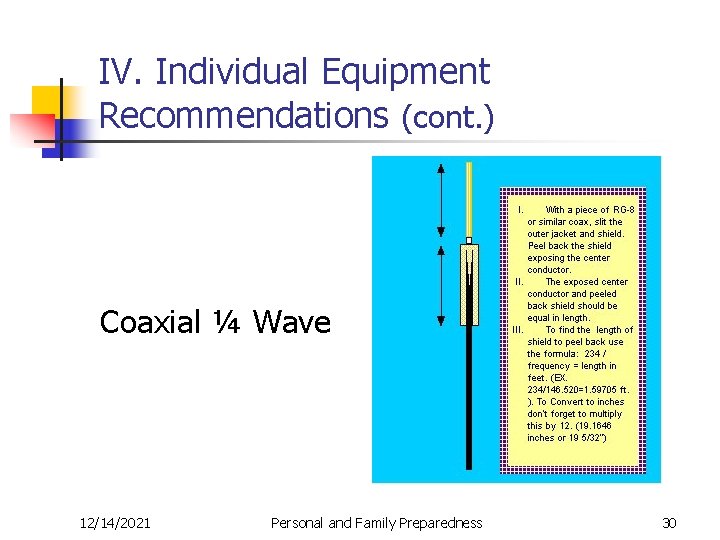
IV. Individual Equipment Recommendations (cont. ) Coaxial ¼ Wave 12/14/2021 Personal and Family Preparedness 30
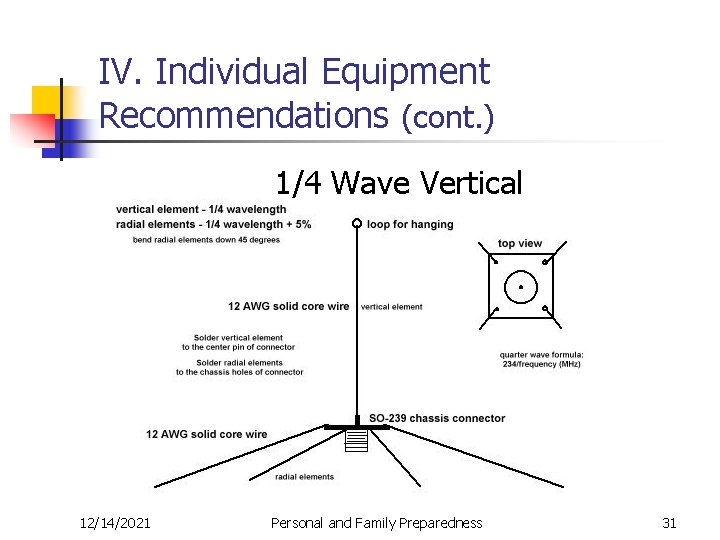
IV. Individual Equipment Recommendations (cont. ) 1/4 Wave Vertical 12/14/2021 Personal and Family Preparedness 31
IV. Individual Equipment Recommendations (cont. ) Tigertail 12/14/2021 Personal and Family Preparedness 32
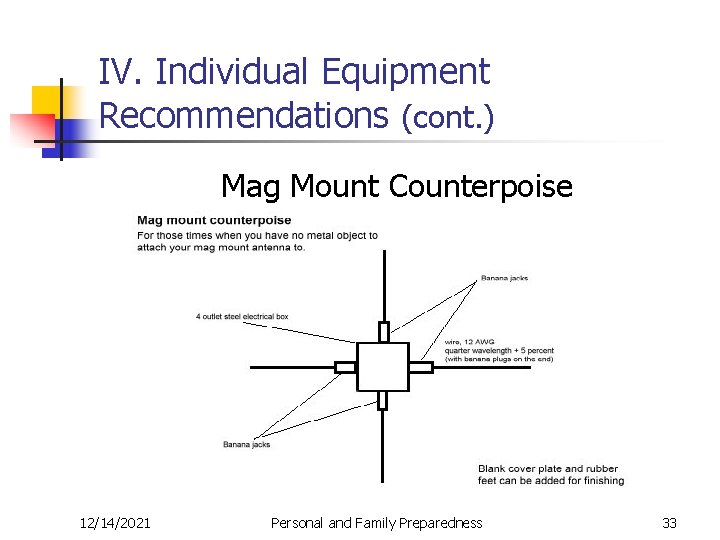
IV. Individual Equipment Recommendations (cont. ) Mag Mount Counterpoise 12/14/2021 Personal and Family Preparedness 33
IV. Individual Equipment Recommendations (cont. ) n For 146. 5 MHz, TV Twin-Lead J-Pole and 2 M Omnidirectional ½ Wave Colinear Antennas, see antenna handout 12/14/2021 Personal and Family Preparedness 34
IV. Individual Equipment Recommendations (cont. ) n HT User’s Supplemental Equipment (cont. ) n n n 25’ of RG 8 -X + adaptors for HT and antenna Auxiliary power cord – power rig from vehicle battery or external gel cell battery Gel cell or AGM battery able to power rig at 5 W for 24 hours 12/14/2021 Personal and Family Preparedness 35
IV. Individual Equipment Recommendations (cont. ) n “Walking and Talking” – Portable HT Battery Recommendations n Minimum: Ni. Cd/Ni. MH + AA auxiliary power source n n 12/14/2021 Large capacity (1000 m. Ah) Ni. Cd/Ni. MH packs – two minimum + AA case TWO spare sets of AA alkaline batteries Consider using AA battery power initially Personal and Family Preparedness 36
IV. Individual Equipment Recommendations (cont. ) n “Walking and Talking” – Portable HT Battery Recommendations (cont. ) n Highly Recommended: Auxiliary power source in addition to above, such as n n SLA (Sealed Lead Acid) battery/batteries – total of 4 Ah capacity External adaptor cord to run HT from battery or auto cigarette lighter/auxiliary plug 12/14/2021 Personal and Family Preparedness 37
IV. Individual Equipment Recommendations (cont. ) n How do we Keep Going? n CONSERVE batteries by using: n n Do NOT run car engine to charge batteries n n 12/14/2021 MINIMUM reliable transmit power SHORTEST run of low loss feed line Most EFFICIENT practical antenna Wastes gasoline in real emergency Equip vehicle with dual batteries n Isolator diodes or solenoid and means of external charging, entirely “off the grid” Personal and Family Preparedness 38
IV. Individual Equipment Recommendations (cont. ) n What is “Emergency Power? ” n “The ability to sustain continuous communications for as long as required, fully independent of AC mains” n Batteries are “auxiliary” – not “emergency power n n 12/14/2021 Finite capacity, limited depth of discharge Require regular load testing & recharging Personal and Family Preparedness 39
IV. Individual Equipment Recommendations (cont. ) n What is “Emergency Power? ” (cont. ) n n All ARES/RACES operators should be ready for 24 hours MINIMUM, 48+ hours for certain personnel How would you operate for a week? 12/14/2021 Personal and Family Preparedness 40
IV. Individual Equipment Recommendations (cont. ) n Summing Up n 24 hrs. of battery capacity for EVERYONE n n One Ah for each watt of transmitter output Inspect/test batteries and equipment weekly Use local simplex nets for equipment checks Do regular operator training “on the air” 12/14/2021 Personal and Family Preparedness 41
IV. Individual Equipment Recommendations (cont. ) n Summing Up (cont. ) n Gain antennas, outside whenever possible n n 12/14/2021 As high up as you can get them Low loss feed line High place to operate, away from power lines Stress highest ERP (Effective Radiated Power), station efficiency Personal and Family Preparedness 42
IV. Individual Equipment Recommendations (cont. ) n Summing Up (cont. ) n Get your message through the first time n n When everyone is adequately trained and equipped n 12/14/2021 Don’t waste others’ batteries repeating fills and relays because you have a weak station ARES/RACES can provide effective and efficient emergency communications independent of repeater infrastructure Personal and Family Preparedness 43
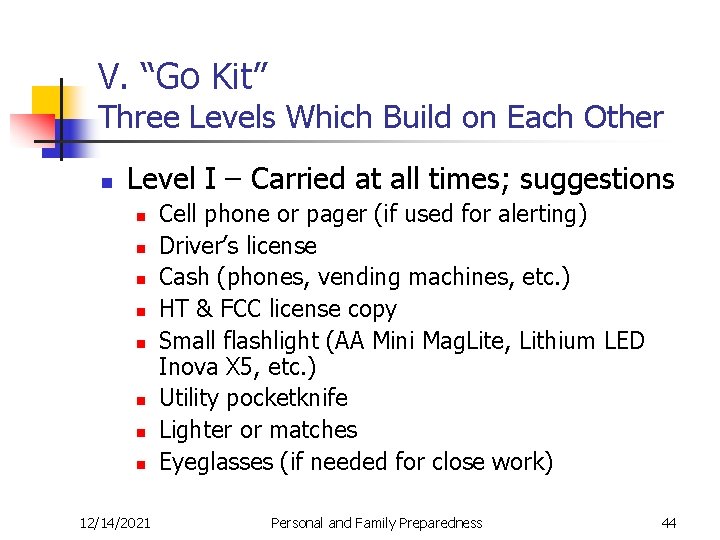
V. “Go Kit” Three Levels Which Build on Each Other n Level I – Carried at all times; suggestions n n n n 12/14/2021 Cell phone or pager (if used for alerting) Driver’s license Cash (phones, vending machines, etc. ) HT & FCC license copy Small flashlight (AA Mini Mag. Lite, Lithium LED Inova X 5, etc. ) Utility pocketknife Lighter or matches Eyeglasses (if needed for close work) Personal and Family Preparedness 44
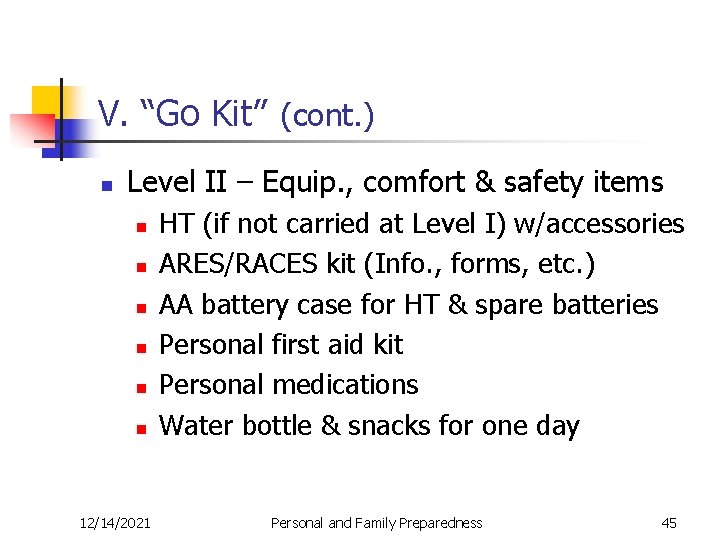
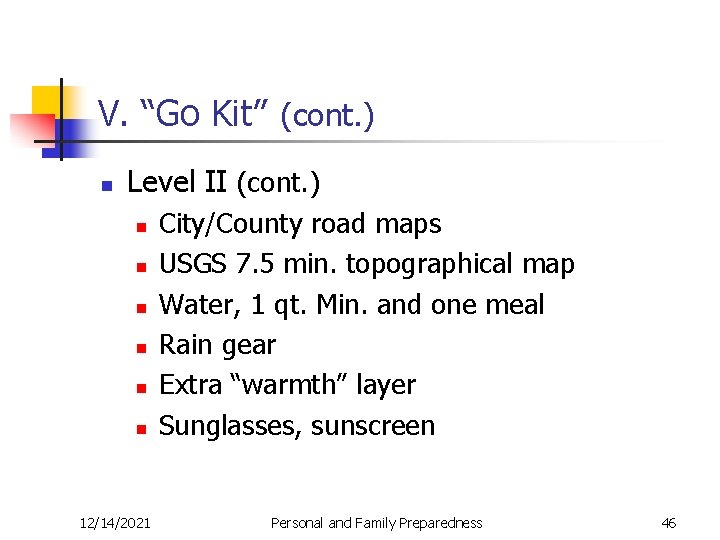
V. “Go Kit” (cont. ) n Level II – Equip. , comfort & safety items n n n 12/14/2021 HT (if not carried at Level I) w/accessories ARES/RACES kit (Info. , forms, etc. ) AA battery case for HT & spare batteries Personal first aid kit Personal medications Water bottle & snacks for one day Personal and Family Preparedness 45
V. “Go Kit” (cont. ) n Level II (cont. ) n n n 12/14/2021 City/County road maps USGS 7. 5 min. topographical map Water, 1 qt. Min. and one meal Rain gear Extra “warmth” layer Sunglasses, sunscreen Personal and Family Preparedness 46
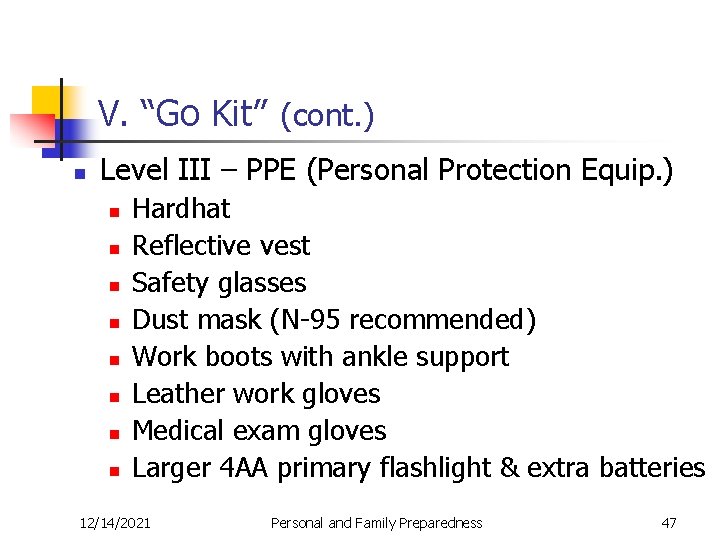
V. “Go Kit” (cont. ) n Level III – PPE (Personal Protection Equip. ) n n n n Hardhat Reflective vest Safety glasses Dust mask (N-95 recommended) Work boots with ankle support Leather work gloves Medical exam gloves Larger 4 AA primary flashlight & extra batteries 12/14/2021 Personal and Family Preparedness 47
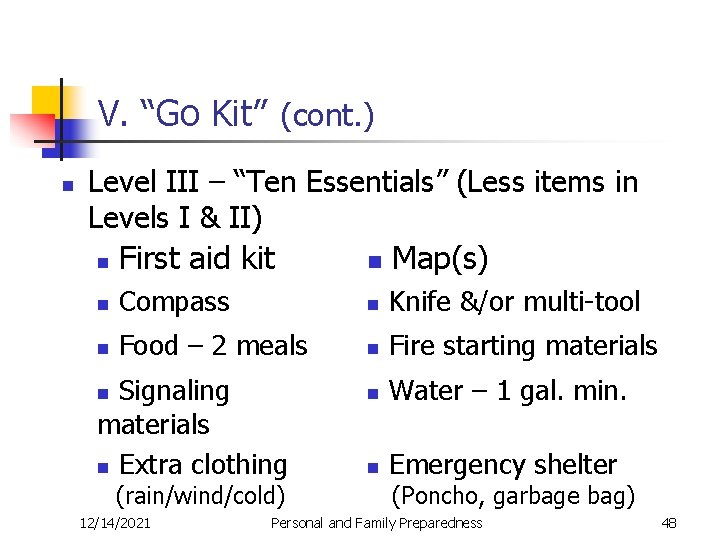
V. “Go Kit” (cont. ) n Level III – “Ten Essentials” (Less items in Levels I & II) n First aid kit n Map(s) n Compass n Knife &/or multi-tool n Food – 2 meals n Fire starting materials n Water – 1 gal. min. n Emergency shelter Signaling materials n Extra clothing n (rain/wind/cold) 12/14/2021 (Poncho, garbage bag) Personal and Family Preparedness 48