
PERSONA AND SHADOW By Courtney Lynn Weixel PERSONA
PERSONA AND SHADOW By Courtney Lynn Weixel
PERSONA AND SHADOW • Review of the concepts • Viewing shadow and persona through the lens of a prominent issue – bullying • (Fictional) case study • Short film
CASE STUDY • Four high school students; Sabrina, Charlotte, Michelle, and Kayla were involved in a bullying incident against a fellow student – Amelia. • The girls engaged in several cyber-bullying attacks against Amelia, and the police were involved when her social media profile was hacked. • Police, school personnel and parents were disturbed to find that Sabrina had participated in the attack, for she had previously been friends with Amelia.
CASE STUDY • The police asked a team of psychologists to evaluate the girls and their actions; the psychological team specialized in a depth-oriented approach to their evaluations and treatment approaches. • Throughout the course of the evaluation, the psychologists were struck to find that each girl’s shadow and persona – especially Sabrina’s – played a large part in the way that the events took place.

SHADOW Inferior and unpleasant qualities (Samuels, Shorter, & Plaut, 1986). Parts of our being and personality which are incompatible with our ego and persona (Stein, 1998). Suppressed or undeveloped personality traits (Stein, 1998). The negative side of the personality (Samuels, Shorter, & Plaut, 1986).
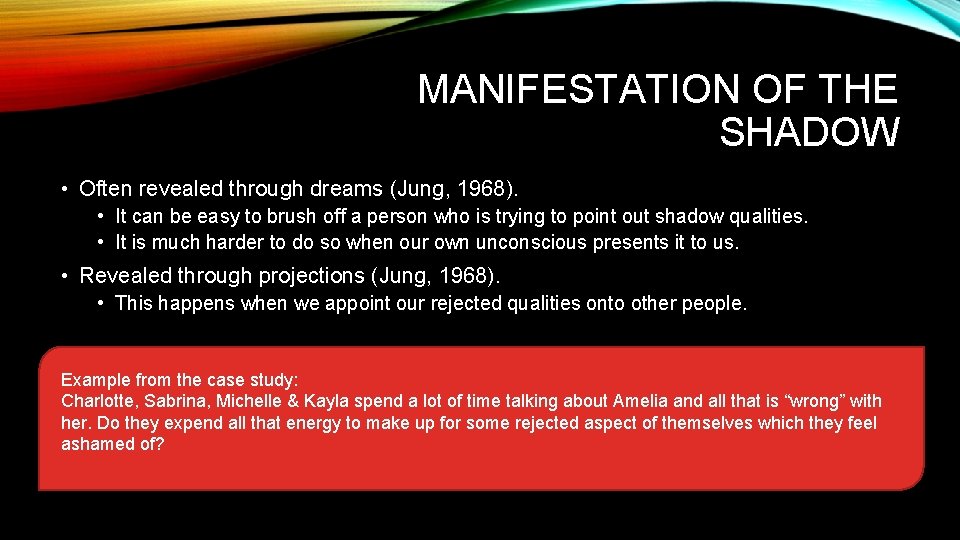
MANIFESTATION OF THE SHADOW • Often revealed through dreams (Jung, 1968). • It can be easy to brush off a person who is trying to point out shadow qualities. • It is much harder to do so when our own unconscious presents it to us. • Revealed through projections (Jung, 1968). • This happens when we appoint our rejected qualities onto other people. Example from the case study: Charlotte, Sabrina, Michelle & Kayla spend a lot of time talking about Amelia and all that is “wrong” with her. Do they expend all that energy to make up for some rejected aspect of themselves which they feel ashamed of?
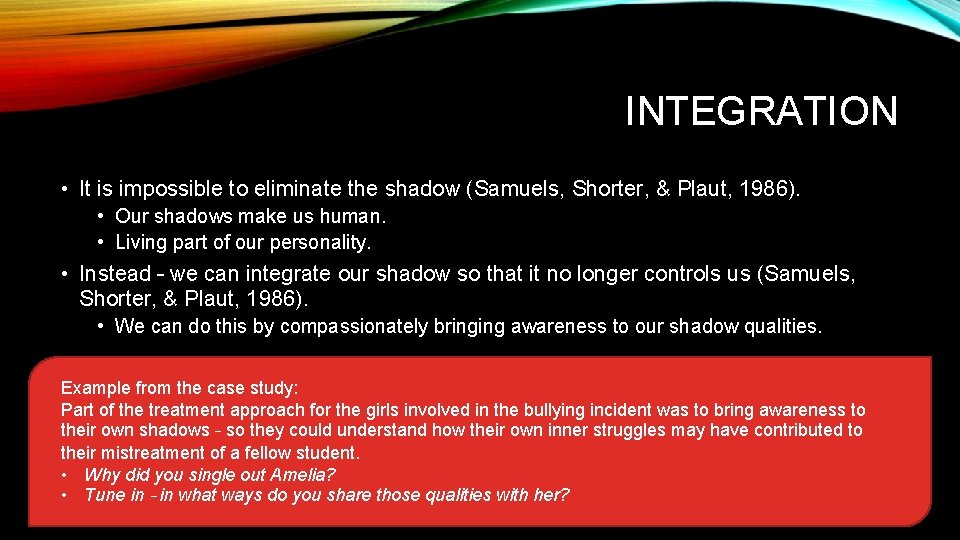
INTEGRATION • It is impossible to eliminate the shadow (Samuels, Shorter, & Plaut, 1986). • Our shadows make us human. • Living part of our personality. • Instead – we can integrate our shadow so that it no longer controls us (Samuels, Shorter, & Plaut, 1986). • We can do this by compassionately bringing awareness to our shadow qualities. Example from the case study: Part of the treatment approach for the girls involved in the bullying incident was to bring awareness to their own shadows – so they could understand how their own inner struggles may have contributed to their mistreatment of a fellow student. • Why did you single out Amelia? • Tune in – in what ways do you share those qualities with her?
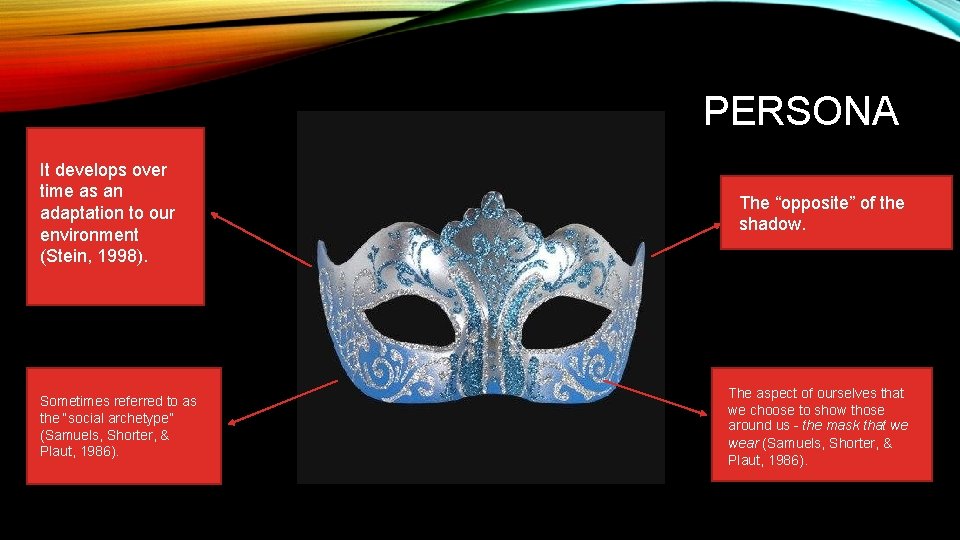
PERSONA It develops over time as an adaptation to our environment (Stein, 1998). Sometimes referred to as the “social archetype” (Samuels, Shorter, & Plaut, 1986). The “opposite” of the shadow. The aspect of ourselves that we choose to show those around us – the mask that we wear (Samuels, Shorter, & Plaut, 1986).

SHADOW & PERSONA Shadow NEGATIVE POSITIVE Persona

POSITIVE ASPECTS OF THE SHADOW • The repressed or rejected shadow qualities can include undeveloped positive qualities. Example from the case study: There were several instances where Sabrina had the opportunity to stand up for either herself or Amelia. When she realized that behavior was incompatible with the persona she was developing as a member of the popular group – she repressed it – and it became a part of her shadow.
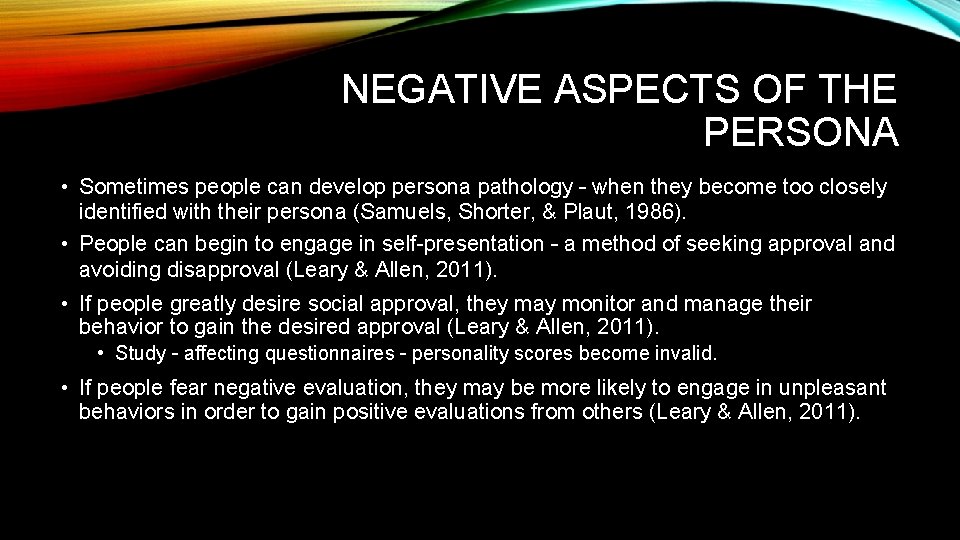
NEGATIVE ASPECTS OF THE PERSONA • Sometimes people can develop persona pathology – when they become too closely identified with their persona (Samuels, Shorter, & Plaut, 1986). • People can begin to engage in self-presentation – a method of seeking approval and avoiding disapproval (Leary & Allen, 2011). • If people greatly desire social approval, they may monitor and manage their behavior to gain the desired approval (Leary & Allen, 2011). • Study – affecting questionnaires – personality scores become invalid. • If people fear negative evaluation, they may be more likely to engage in unpleasant behaviors in order to gain positive evaluations from others (Leary & Allen, 2011).

NEGATIVE ASPECTS OF THE PERSONA Example from the case study: Sabrina shifted her opinions and behavior to meet the expectations of the group and gain approval. This led to the development of a false personality, self-betrayal, and the betrayal of a friend.
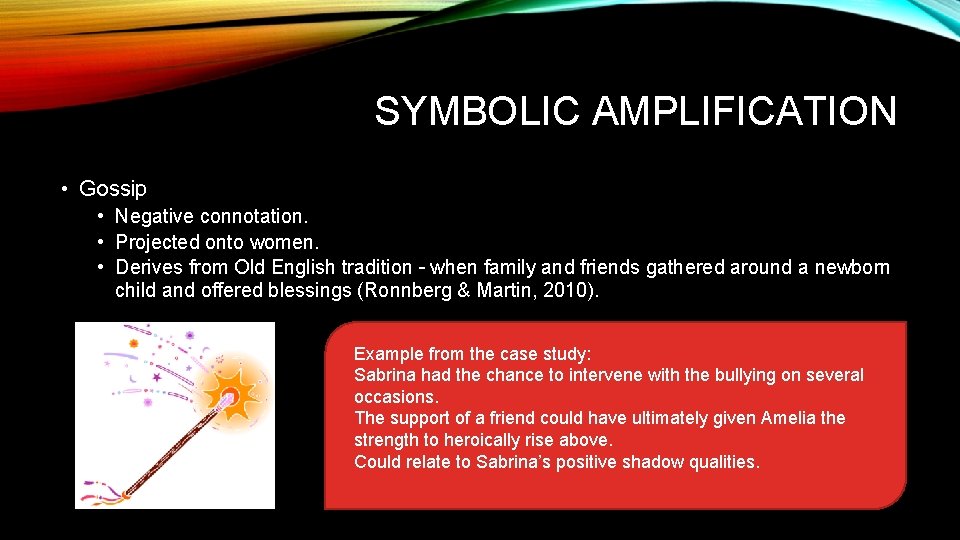
SYMBOLIC AMPLIFICATION • Gossip • Negative connotation. • Projected onto women. • Derives from Old English tradition – when family and friends gathered around a newborn child and offered blessings (Ronnberg & Martin, 2010). Example from the case study: Sabrina had the chance to intervene with the bullying on several occasions. The support of a friend could have ultimately given Amelia the strength to heroically rise above. Could relate to Sabrina’s positive shadow qualities.
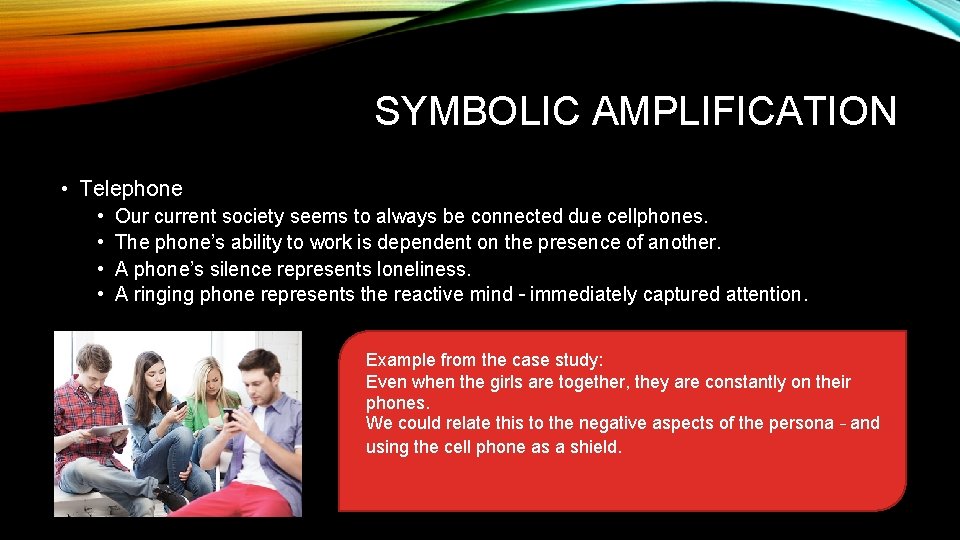
SYMBOLIC AMPLIFICATION • Telephone • • Our current society seems to always be connected due cellphones. The phone’s ability to work is dependent on the presence of another. A phone’s silence represents loneliness. A ringing phone represents the reactive mind – immediately captured attention. Example from the case study: Even when the girls are together, they are constantly on their phones. We could relate this to the negative aspects of the persona – and using the cell phone as a shield.
PSYCHOLOGICAL IMPACT OF THE INTERNET • Changing our expectations for relationships. • Constant connection to devices – • Interfering with autonomy. • Causing the need for constant feedback (Kirmayer, Raikhel, & Rahimi, 2013). • Case study – giving bullies the ability to harass people like never before. • All of this interferes with healthy persona development.
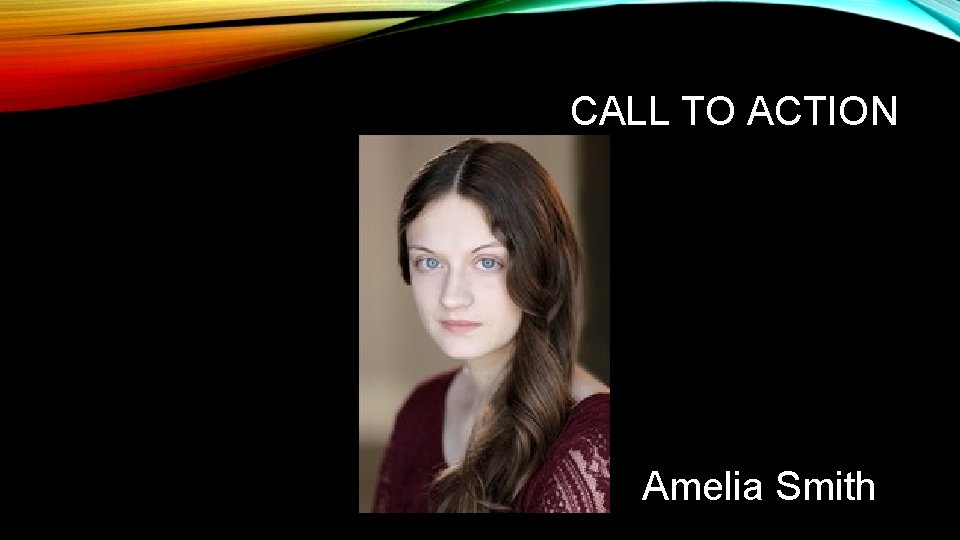
CALL TO ACTION Amelia Smith
REFERENCES Allen, A. B. & Leary, M. R. (2011). Personality and persona: Personality processes in selfpresentation. Journal of Personality, 79(6), 889 -916. doi: 10. 1111/j. 1467 -6494. 2010. 00704. x. Duke Ellington School of the Arts. (2014). Theatre masks [Graphic]. Retrieved from: http: //www. ellingtonschool. org/? attachment_id=11874. Free. Images. (n. d. ). Shadow girl image [Photograph]. Retrieved from: https: //www. freeimages. com/search/shadow-girl. Jung, C. G. (Ed. ). (1968). Man and his symbols. New York, NY: Dell.
REFERENCES Kirmayer, L. J. , Raikhel, E. , Rahimi, S. (2013). Cultures of the internet: Identity, community and mental health. Transcultural Psychiatry, 50(2), 165 -191. doi: 10. 1177/1363461513490626. Pin. Art. (2017). Fairy tale clip art wand [Clip Art]. Retrieved from: http: //moziru. com/explore/Fairy%20 Tale%20 clipart%20 wand/. Psych. Guides. (2017). Cell phone addiction [Photograph]. Retrieved from: https: //www. psychguides. com/guides/cell-phone-addiction/. Ronnberg, A. , & Martin, K. (Eds. ). (2010). The book of symbols: Reflections on archetypal images. Cologne, GE: Taschen.
REFERENCES Samuels, A. , Shorter, B. , & Plaut, F. (1986). A critical dictionary of Jungian analysis. New York, NY: Routledge. Stein, M. (1998). Jung’s map of the soul: An introduction. Chicago, IL: Open Court. Vivo Masks. (2016). Colombina stella silver sky blue [Photograph]. Retrieved from: https: //www. vivomasks. com/products/colombina-stella-silver-sky-blue.
- Slides: 19