
Person Society Week 6 Topic Social Class Global
Person & Society Week 6 Topic: Social Class & Global Stratification
Last week… balan ce be tween struct ure-ag ency • What makes us who we are? • What happens when we are not socialised properly? • What are the over-arching belief systems which contribute to meanings about identity? • Ethnocentrism • Cultural Relativism
This week. . . • In what ways does ‘class’ impact on our own identities? on i t a loc • What is identity? r u o by. d e enc ucture u l f • What is social class? l in ass str l a are ial cl e. W e soc • Theories of social class – Marx h in t & Weber • What is global stratification? • Global poverty • Impact of economic globalisation
In what ways does ‘social class’ impact on our identities?
What is ‘identity’? • Identity ‘refers to the way we relate to and understand ourselves and how other people understand us and relate to us’ (Bessant & Watts 2007: 153) • The self as ‘individual’ • Indicated by names such as ‘girl’, ‘doctor’, ‘student’, ‘white’, ‘Muslim’ • Features of our self, such as physical demeanour and skin colour, carry meanings. • This signal particular stories about who we are supposed to be on the inside and help shape the ways the outside world responds to us. But there are discrepancies between how we feel and identify ourselves and how certain other people see and behave towards us.
• How would you describe your identity? • Write down some descriptive words to describe you – based on your gender, religion, ethnicity and any other aspects that are important to you….
Problematising ‘Identity’ • Is there only one identity? • Each have numerous identities… which stem from our social relationships. Each of our identity markers indicates or requires the existence of someone who is the same or who is different and it is that similarity or differences that is used to help say who we are or are not. We are not like…the Other
Who is the Other? Woman is the other of man, animal is the other of human, stranger is the other of native, abnormality the other of norm, deviation the other of law-abiding, illness the other of health, insanity the other of reason, lay public the other of the expert, foreigner the other of state subject, enemy the other of friend (Bauman 1991: 8).
Problematising ‘Identity’ (cont. ) • Identity is fragmented or divided • E. g. , Gender: men and women: same or different? A white, middle class woman may share some experiences with a white working class woman, but not all as the social class marker will mean that perhaps they will live in different suburbs; shop at different stores; do different types of jobs. • Issues with essentialism • Thinking that all people who belong to a particular identity marker have a common existence is called essentialism. One makes generalisations or assumptions that all people with that marker will have the same kind of beliefs; needs and desires; and behave in the same way.
Problematising ‘Identity’ (cont. ) • These esentialised dichotomies are so often taken for granted and presumed to be natural. • But social identities are not natural – they represent an established social order – a hierarchy where certain groups are established as being superior to other groups. • Individuals have the choice (or agency) to create their identities according to their own beliefs about the world. However the negotiation of identity equally depends upon the negotiation of power relations. • Lets examine these in the context of social class.
What is social class? Social Stratification: is a system in which groups of people are divided into layers according to their relative property, prestige and power. It is a way of ranking large groups of people into a hierarchy according to their relative privileges (Henslin 2010: 226).
What is social class? • Hence, when we are talking about social classes, we are talking about the way that people are placed into a hierarchy based on their wealth, status, employment and often their access to things such as education, health, housing and so on.
What does social class look like in other industrialised nations? • https: //www. youtube. com/watch? v=n. U 5 M t. VM_z. Fs • Lets watch this clip to find out!
Discussion • In pairs, write down as many aspects of the two main theories of social class that you remember from your reading: • -Karl Marx • -Max Weber
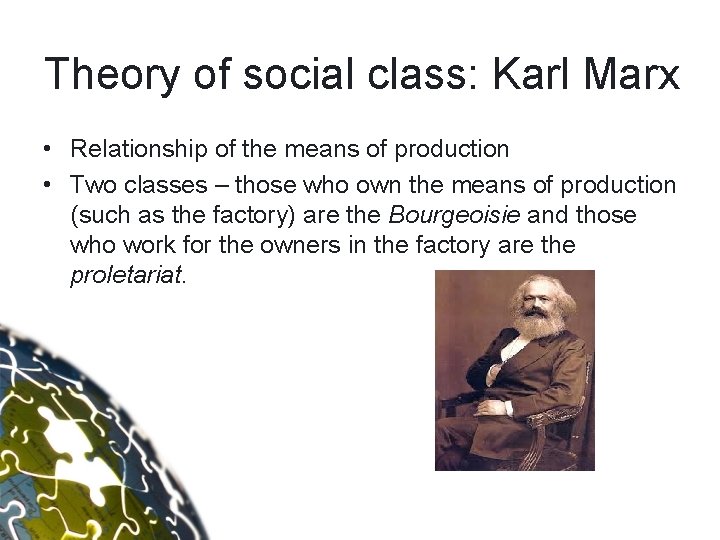
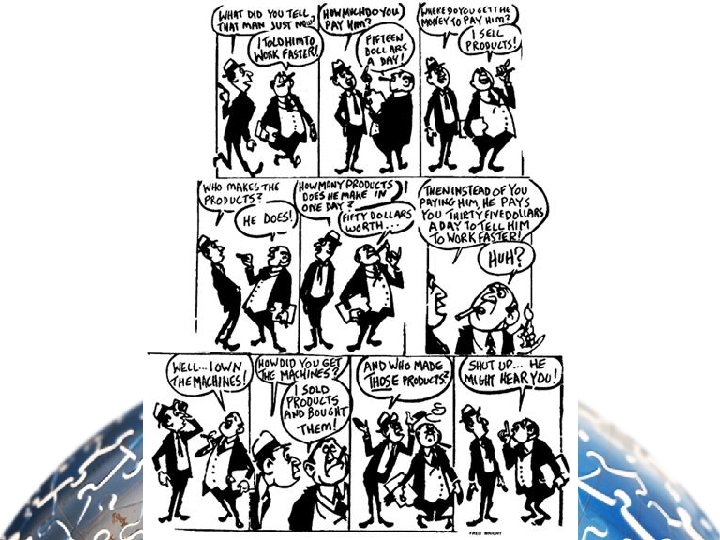
Theory of social class: Karl Marx • Relationship of the means of production • Two classes – those who own the means of production (such as the factory) are the Bourgeoisie and those who work for the owners in the factory are the proletariat.
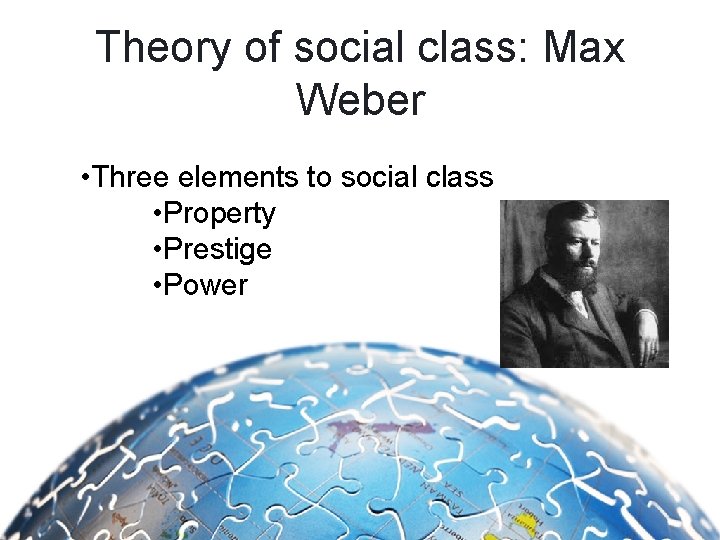
Theory of social class: Max Weber • Three elements to social class • Property • Prestige • Power
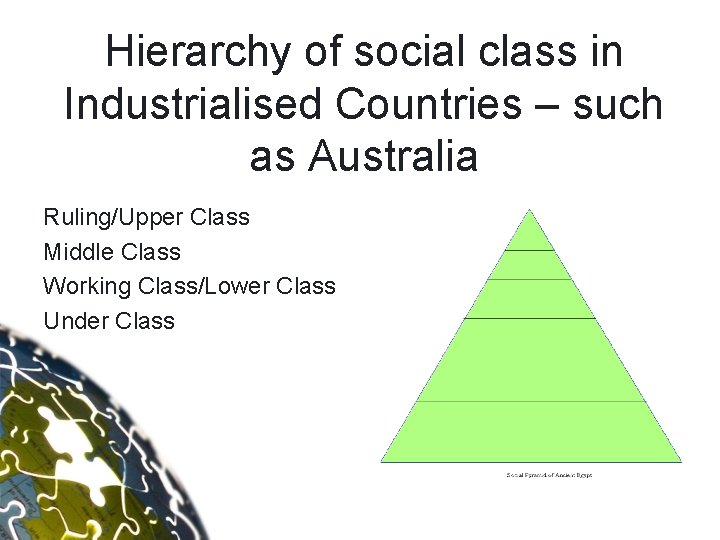
Hierarchy of social class in Industrialised Countries – such as Australia Ruling/Upper Class Middle Class Working Class/Lower Class Under Class
What are the characteristics of the ruling/upper class? • 15 % of the population • Owns 60% of the nations wealth • Examples: Packer and Murdoch families • Political influence & ‘shape the consciousness of the nation’ (Henslin 2010: 235). • Inquiry into media ownership • Plus the nouveau riche – new money
What are the characteristics of the middle-class? • 47% of population is middle-class • Often defined by tertiary qualifications – but not always • Consumer culture – cars, houses, holidays • White collar: lawyers, teachers, small business owners; non-manual workers
What are the characteristics of the working/lower class • 38% population makes up the working class • Less educational qualifications • Blue-collar work – manual labour • This is the group which has no ownership of the means of production and Marx would call the proletariat – little bargaining power over wages.
Social mobility • The movement up or down the class strata you are born into is known as social mobility • Education is often key to social mobility up the class strata (but keep in mind that one’s culture influences the experiences one has within educational institutions).
What is global stratification? • Three worlds? • Industrialisation: process whereby manufacturing industries develop within a society which had been based on agriculture as its main form of sustenance. • The most industrialised nations • 16% worlds people • 31% earth’s land • The industrialising nations • 16% worlds people • 20% earth’s land • The least industrialised nations • 68% world’s people • 49% earth’s land
Monopoly over Global Wealth • Why do the same countries remain rich year after year while the rest stay poor? • https: //www. youtube. com/watch? v=u. WSxzjy. MNp U
How did the worlds nations become stratified? • Lack of resources? • Colonialism: • Is the process whereby one nation takes over another nation – use labour/resources leaving a trail of instability between cultures and neighbouring countries.
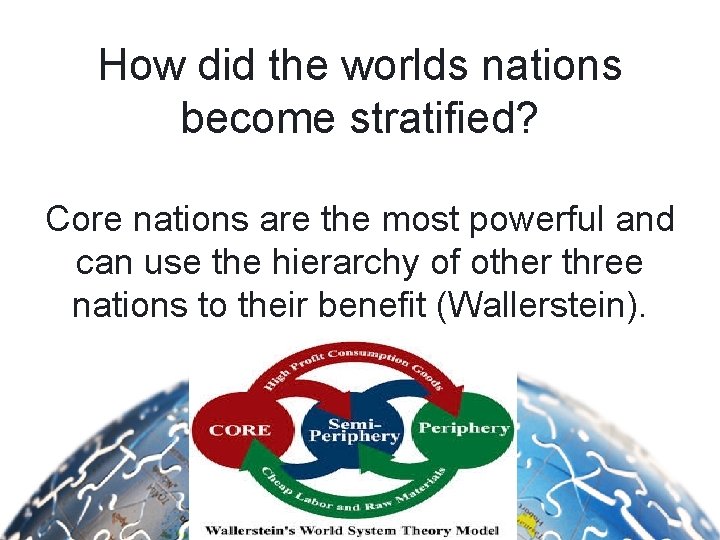
How did the worlds nations become stratified? Core nations are the most powerful and can use the hierarchy of other three nations to their benefit (Wallerstein).
Maintaining Global Stratification • Why do the same countries remain rich year after year while the rest stay poor? • Neocolonialism • Industrialised nations turned to international markets as a way of controlling the least industrialised • By selling them goods on credit the most industrialised nations entrap the poor nations with a circle of debt. • Keeping these nations in debt forces them to submit to trading terms dictated by the neocolonialists.
Impact of economic globalisation • Global stratification is produced by economic globalisation, which is inherent to the globalising of the economy and the power of the transnational corporations. • What is the global economy? – Is where production, finance and trade – facilitated by the internet and other information technologies is organised at a global level (Carl et al 2011).
Impact of economic globalisation • How is that TNC’s are able to negotiate these cheap labour costs? • Global regulation • Who are the global regulators & what do they do? – World Bank – International Monetary Fund (IMF) – World Trade Organisation (WTO)
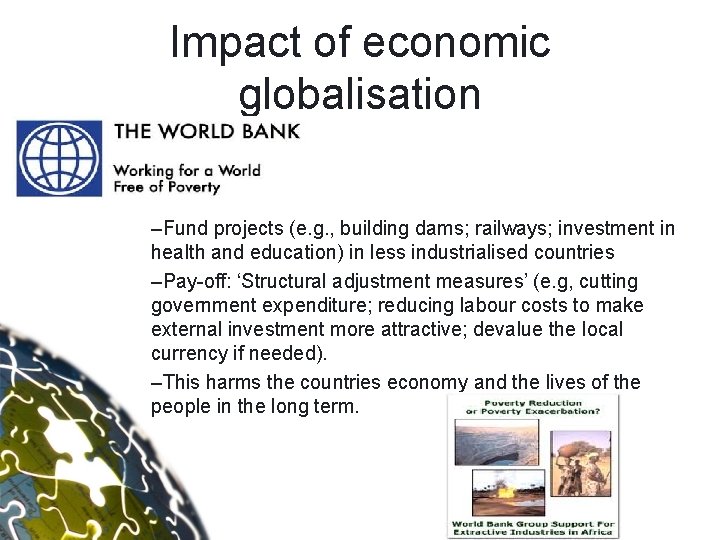
Impact of economic globalisation The World Bank –Fund projects (e. g. , building dams; railways; investment in health and education) in less industrialised countries –Pay-off: ‘Structural adjustment measures’ (e. g, cutting government expenditure; reducing labour costs to make external investment more attractive; devalue the local currency if needed). –This harms the countries economy and the lives of the people in the long term.
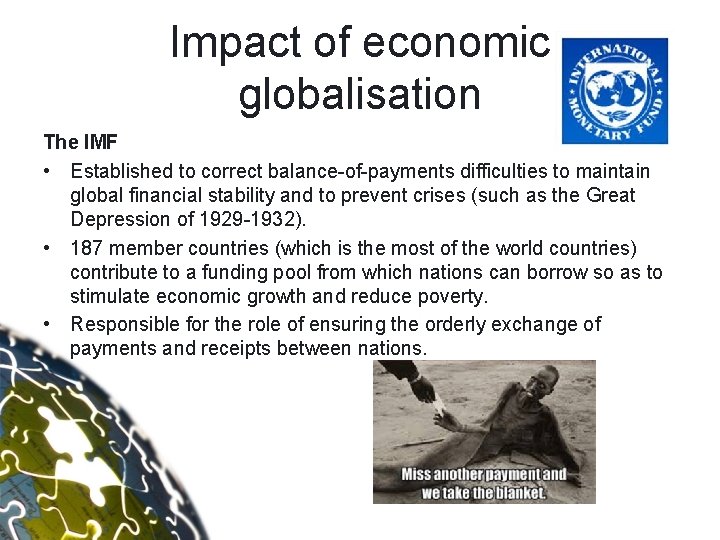
Impact of economic globalisation The IMF • Established to correct balance-of-payments difficulties to maintain global financial stability and to prevent crises (such as the Great Depression of 1929 -1932). • 187 member countries (which is the most of the world countries) contribute to a funding pool from which nations can borrow so as to stimulate economic growth and reduce poverty. • Responsible for the role of ensuring the orderly exchange of payments and receipts between nations.
Impact of economic globalisation The World Trade Organization vcomprises 153 nations which together account for 97 % of world trade. v. Its main objective is to promote global trade by looking after the trade agreements, settling trade disputes, reviewing national policies, and establishing ways of removing barriers to trade. v. Is it contributing to global wealth and the global economy in a positive way, or are the main winner from the workings of these three origanisations is the TNCs?
Impact of economic globalisation • The underlying theory that these organisations promote is that of ‘economic growth’ and ‘free-markets’ as the only means of generating wealth for development and poverty reduction. • This neoliberal ideology now dominates the global economy and has proven to be extremely profitable for corporations. • So what actually happens to the least industrialised countries?
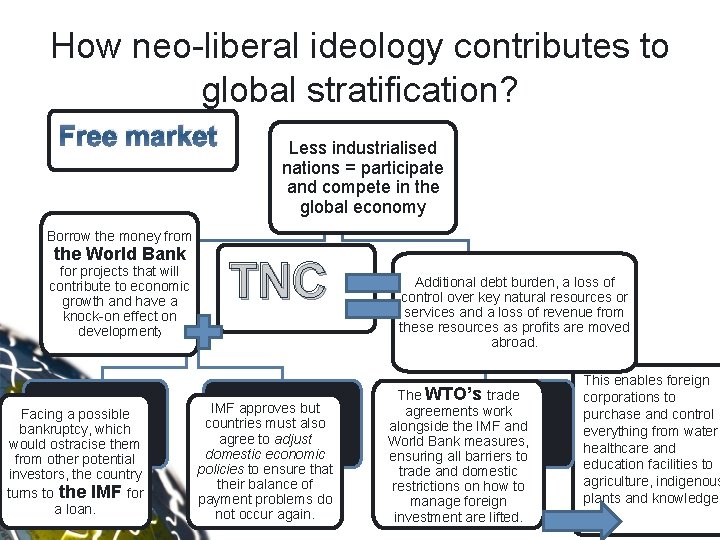
How neo-liberal ideology contributes to global stratification? Free market Less industrialised nations = participate and compete in the global economy Borrow the money from the World Bank for projects that will contribute to economic growth and have a knock-on effect on development) Facing a possible bankruptcy, which would ostracise them from other potential investors, the country turns to the IMF for a loan. TNC IMF approves but countries must also agree to adjust domestic economic policies to ensure that their balance of payment problems do not occur again. Additional debt burden, a loss of control over key natural resources or services and a loss of revenue from these resources as profits are moved abroad. The WTO’s trade agreements work alongside the IMF and World Bank measures, ensuring all barriers to trade and domestic restrictions on how to manage foreign investment are lifted. This enables foreign corporations to purchase and control everything from water, healthcare and education facilities to agriculture, indigenous plants and knowledge.
Would you like to see an example of how these organisations have worked to undermine developing nations? Luckiest nut in the world – Case study of Senegal http: //www. globalissues. org/video/778/luckiest-nut-in -the-world How did the global regulators contribute to the downfall of Senegal’s economy? Who is the luckiest nut in the world and why?
Impact of economic globalisation • Power of Transnational Corporations (TNC’s) – Involved in economic activities in two or more countries – Seek to profit from establishing the best combination of labour skills, wage rates, government subsidies, taxation regimes, market opportunities and political conditions that exist in and between nations. – Use geographical flexibility by shifting resources between locations on a regular basis to take advantage of price differentials and changing conditions – Powerful within nations as well as at a global level – Cheapest labour in the least industrialised countries
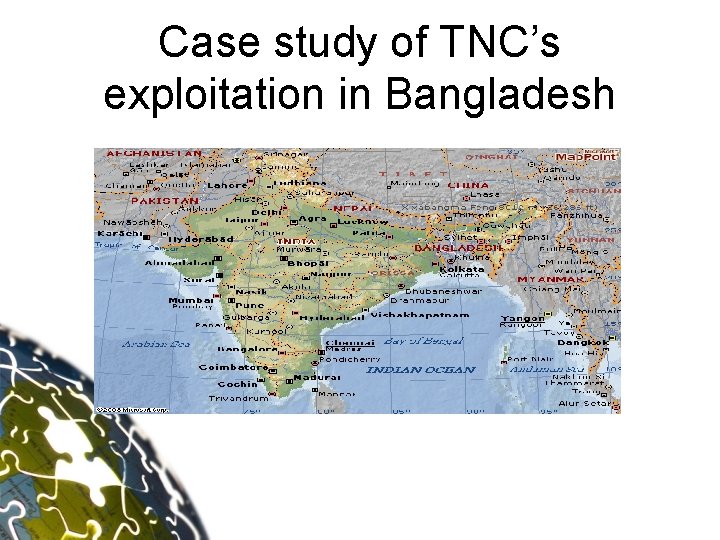
Case study of TNC’s exploitation in Bangladesh
Activity 3: Watch the video ‘Fashion Victims’ and attend to following questions: http: //www. abc. net. au/4 corners/stories/2013/06/25/3785918. htm 1. What are significant causes of poverty in Bangladesh which implicate the global community? 2. How is gender implicated in issues of global poverty? 3. What do you think could be done by the international community to put pressure on global companies to accept responsibility over safety and fairer pay-rates of their workers?
- Slides: 38