
Person Detection and Tracking using Binocular LucasKanade Feature

Person Detection and Tracking using Binocular Lucas-Kanade Feature Tracking and K-means Clustering Chris Dunkel Committee: Dr. Stanley Birchfield, Committee Chair Dr. Adam Hoover Dr. Richard Brooks
The Importance of Person Detection • Critical technology for machine/human interaction • Basis for future research into machine/human interaction • Many applications: – Person avoidance by robots in a factory – Following of people with heavy equipment or tools – Autonomous patrolling of secure areas
![Other Approaches • Color Based [1, 2, 3, 4] – Simple, fast – Can](http://slidetodoc.com/presentation_image_h2/a5211b817ca3656d3760cd3236f99f95/image-3.jpg "Other Approaches • Color Based [1, 2, 3, 4] – Simple, fast – Can")
Other Approaches • Color Based [1, 2, 3, 4] – Simple, fast – Can be confused by similar-color environments • Optical Flow/Motion Based[5, 6] – Robust to color or lighting changes – Person must move relative to background • Dense Stereo Matching[7] – Constructs accurate 3 D models of the environment – Slow, may have difficulty with people near the background • Pattern Based[8] – Low false positive rate. Works well on low-resolution images in adverse conditions – Slow (4 fps). Requires stationary camera.
![Our Approach • Inspired by the work of Chen and Birchfield [12] • Stereo](http://slidetodoc.com/presentation_image_h2/a5211b817ca3656d3760cd3236f99f95/image-4.jpg "Our Approach • Inspired by the work of Chen and Birchfield [12] • Stereo")
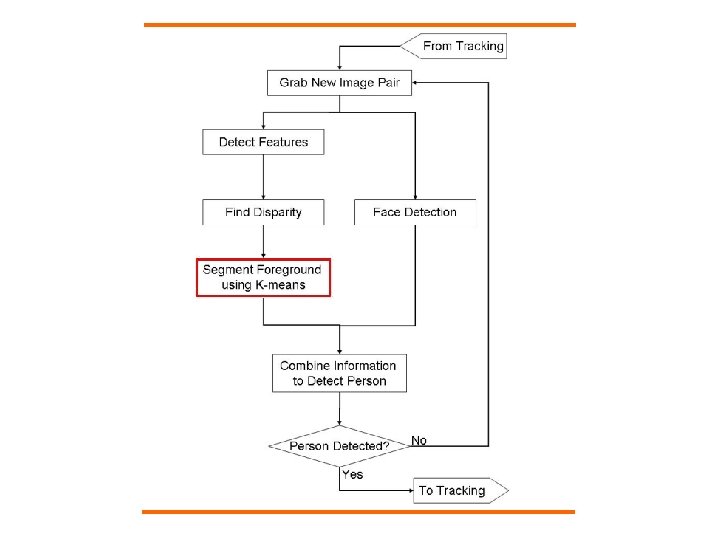
Our Approach • Inspired by the work of Chen and Birchfield [12] • Stereo based Lucas-Kanade [9, 10] – Detect and track feature points – Calculate sparse disparity map • Segment scene using k-means Clustering • Detect faces using Viola-Jones detector [11] • Detect Person using results of k-means and Viola-Jones • Track Person using modified detection procedure

Person Detection
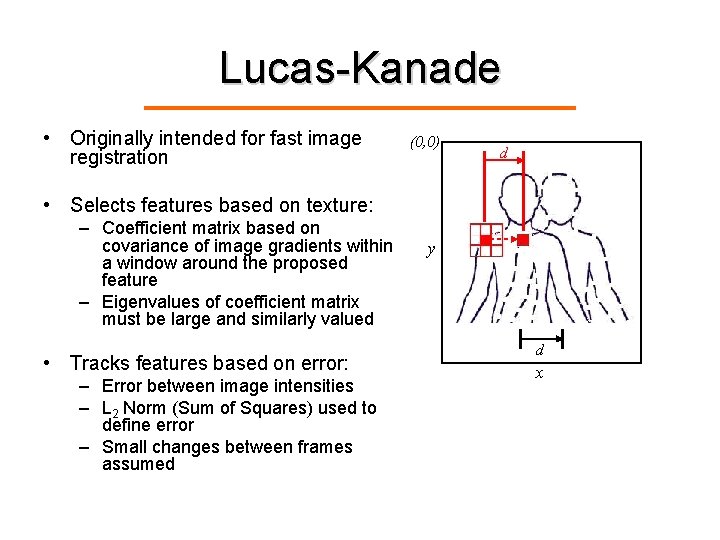
Lucas-Kanade • Originally intended for fast image registration (0, 0) d • Selects features based on texture: – Coefficient matrix based on covariance of image gradients within a window around the proposed feature – Eigenvalues of coefficient matrix must be large and similarly valued • Tracks features based on error: – Error between image intensities – L 2 Norm (Sum of Squares) used to define error – Small changes between frames assumed y d x
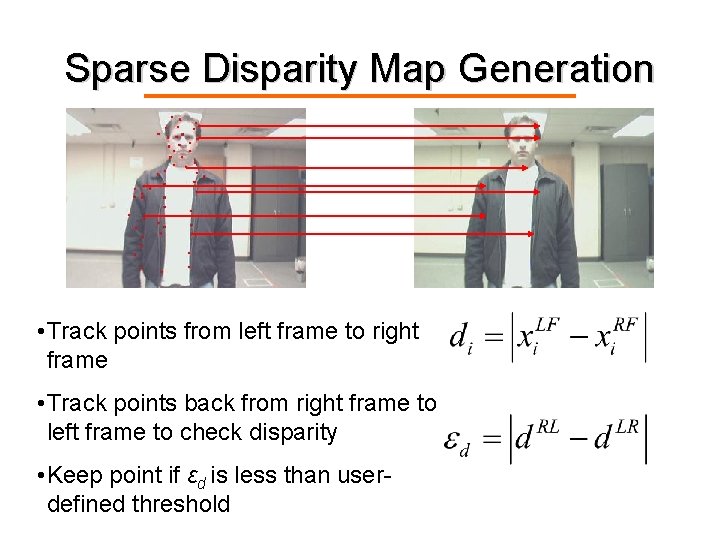
Sparse Disparity Map Generation • Track points from left frame to right frame • Track points back from right frame to left frame to check disparity • Keep point if εd is less than userdefined threshold
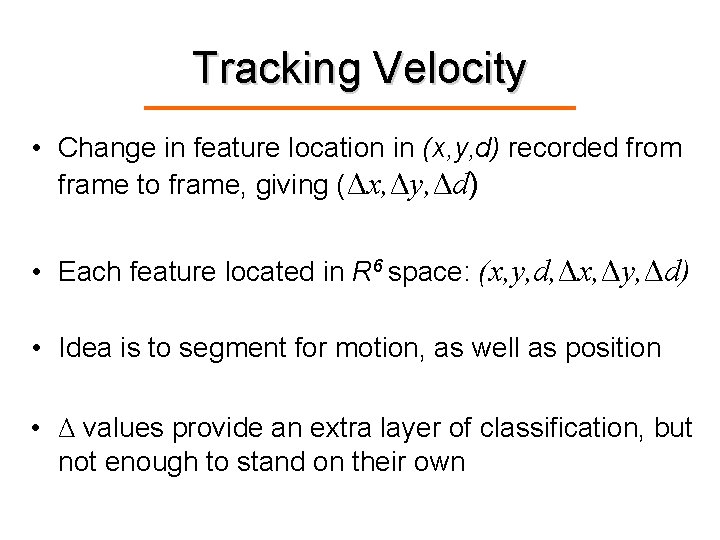
Tracking Velocity • Change in feature location in (x, y, d) recorded from frame to frame, giving (Δx, Δy, Δd) • Each feature located in R 6 space: (x, y, d, Δx, Δy, Δd) • Idea is to segment for motion, as well as position • Δ values provide an extra layer of classification, but not enough to stand on their own
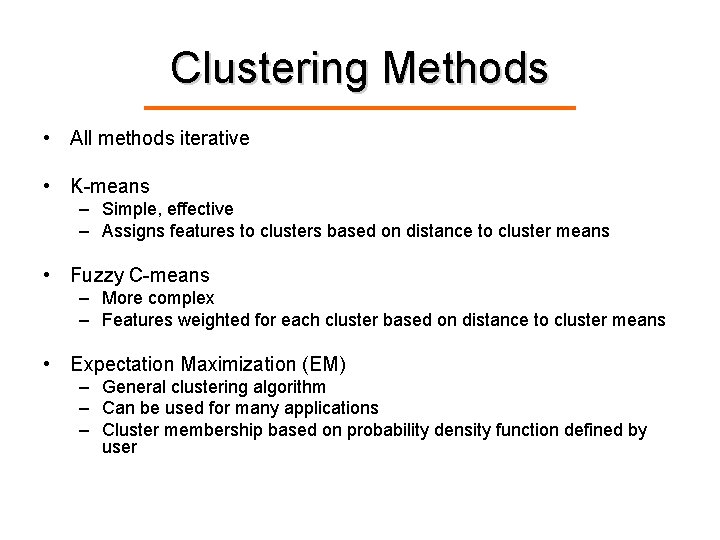
Clustering Methods • All methods iterative • K-means – Simple, effective – Assigns features to clusters based on distance to cluster means • Fuzzy C-means – More complex – Features weighted for each cluster based on distance to cluster means • Expectation Maximization (EM) – General clustering algorithm – Can be used for many applications – Cluster membership based on probability density function defined by user
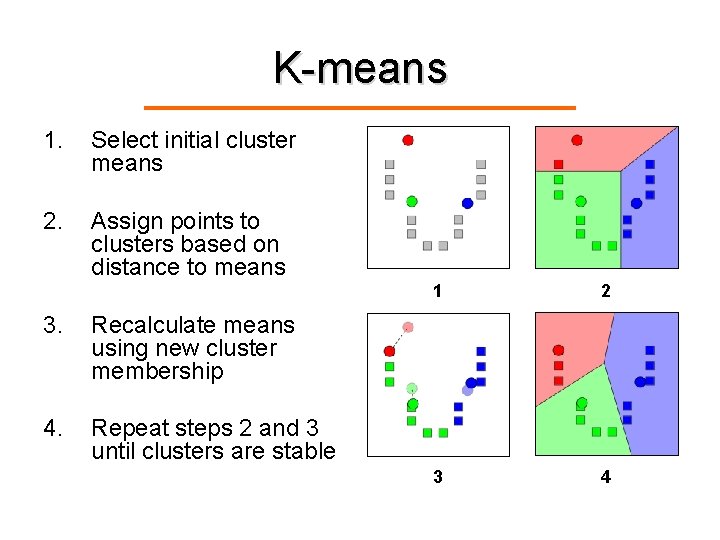
K-means 1. Select initial cluster means 2. Assign points to clusters based on distance to means 3. Recalculate means using new cluster membership 4. Repeat steps 2 and 3 until clusters are stable 1 2 3 4
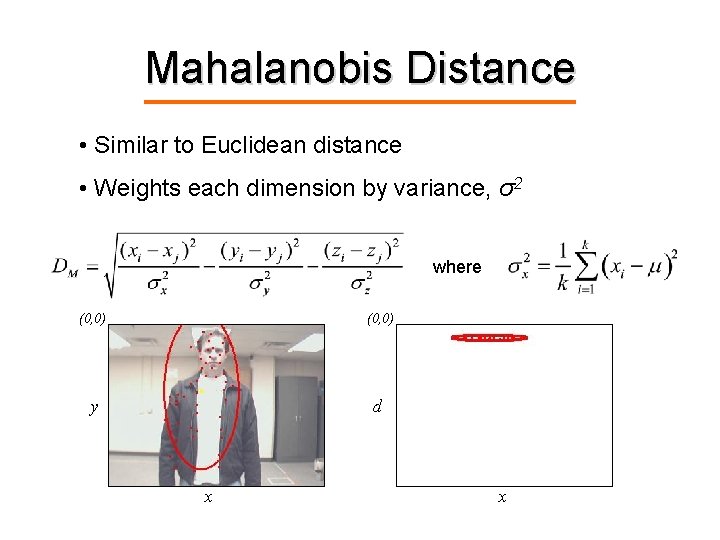
Mahalanobis Distance • Similar to Euclidean distance • Weights each dimension by variance, σ2 where (0, 0) y d x x
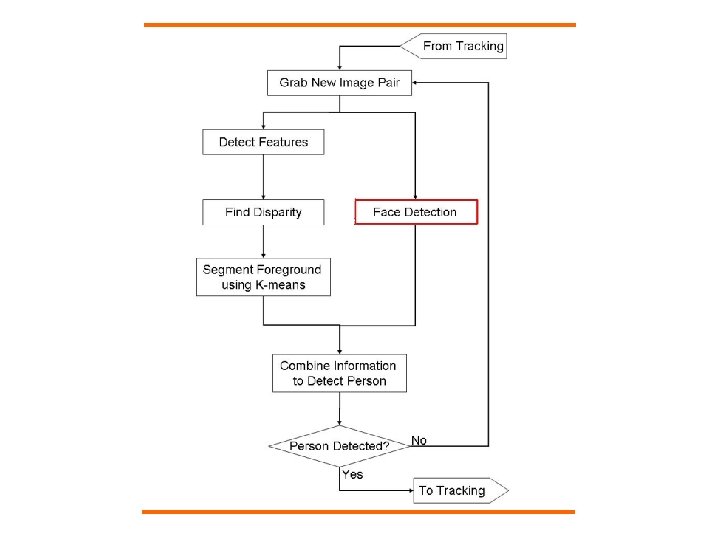
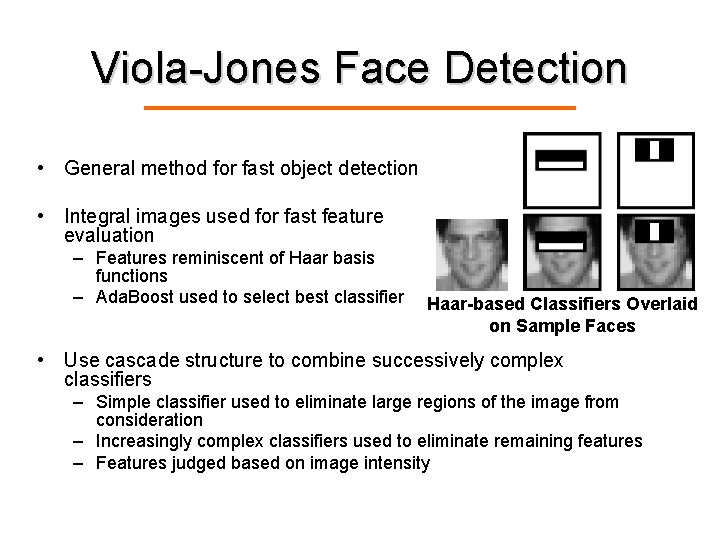
Viola-Jones Face Detection • General method for fast object detection • Integral images used for fast feature evaluation – Features reminiscent of Haar basis functions – Ada. Boost used to select best classifier Haar-based Classifiers Overlaid on Sample Faces • Use cascade structure to combine successively complex classifiers – Simple classifier used to eliminate large regions of the image from consideration – Increasingly complex classifiers used to eliminate remaining features – Features judged based on image intensity
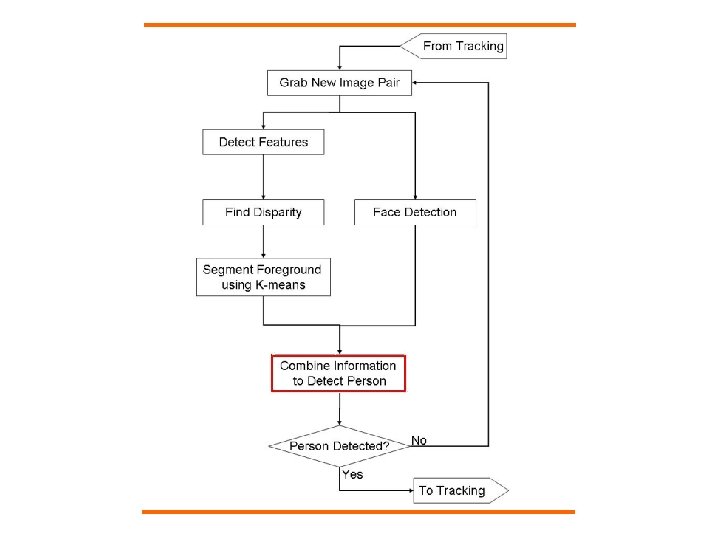
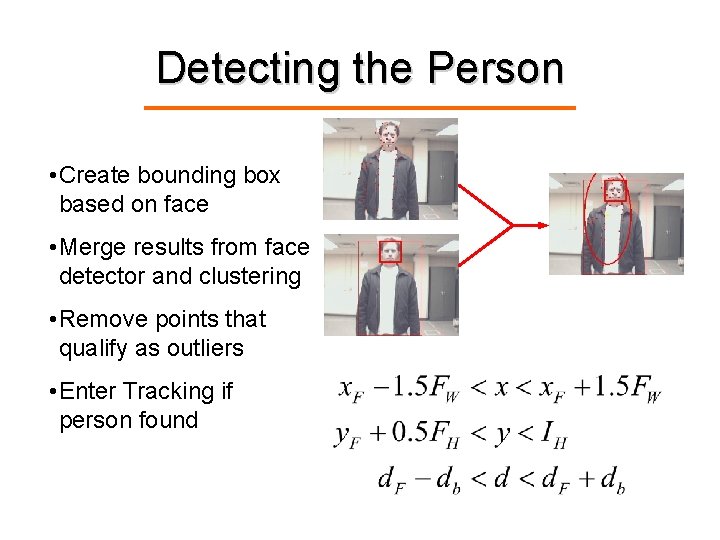
Detecting the Person • Create bounding box based on face • Merge results from face detector and clustering • Remove points that qualify as outliers • Enter Tracking if person found
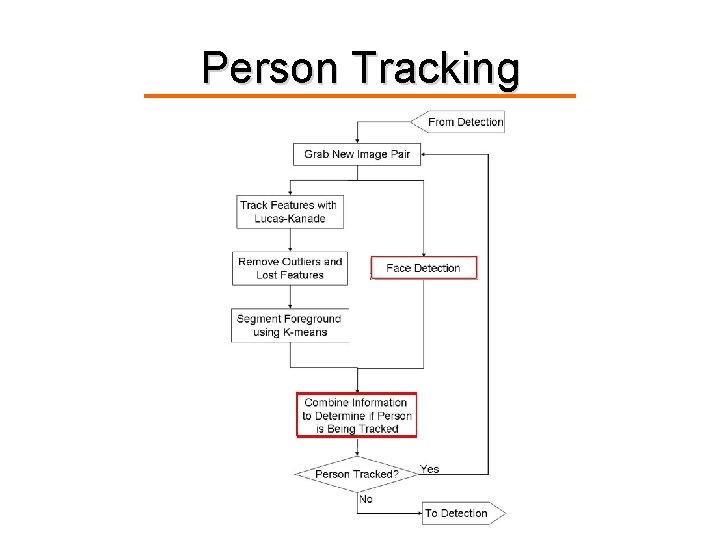
Person Tracking
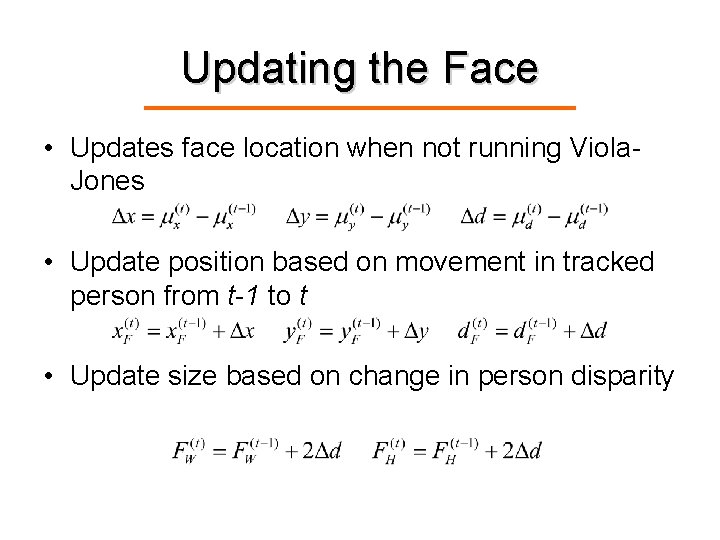
Updating the Face • Updates face location when not running Viola. Jones • Update position based on movement in tracked person from t-1 to t • Update size based on change in person disparity
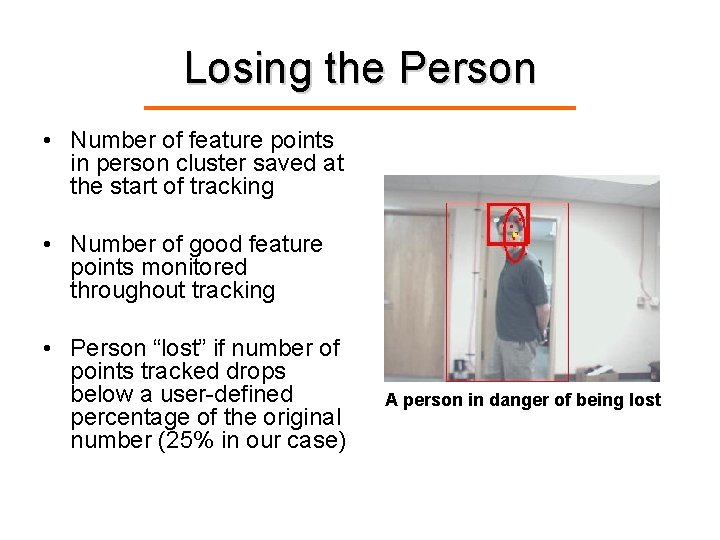
Losing the Person • Number of feature points in person cluster saved at the start of tracking • Number of good feature points monitored throughout tracking • Person “lost” if number of points tracked drops below a user-defined percentage of the original number (25% in our case) A person in danger of being lost
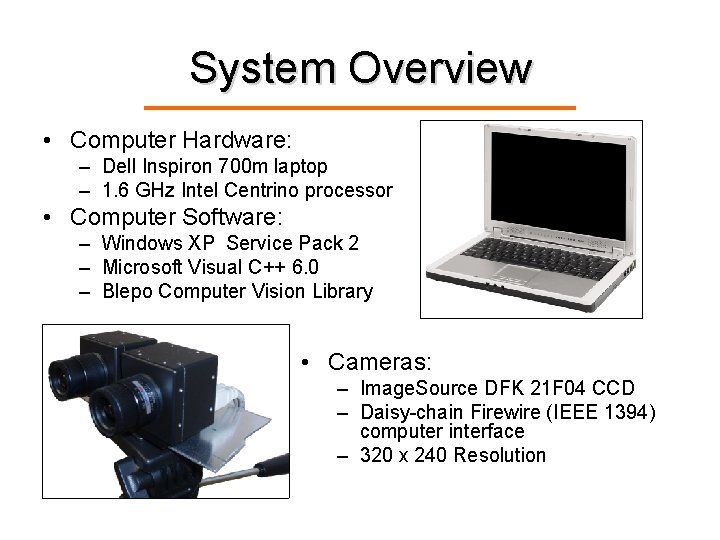
System Overview • Computer Hardware: – Dell Inspiron 700 m laptop – 1. 6 GHz Intel Centrino processor • Computer Software: – Windows XP Service Pack 2 – Microsoft Visual C++ 6. 0 – Blepo Computer Vision Library • Cameras: – Image. Source DFK 21 F 04 CCD – Daisy-chain Firewire (IEEE 1394) computer interface – 320 x 240 Resolution
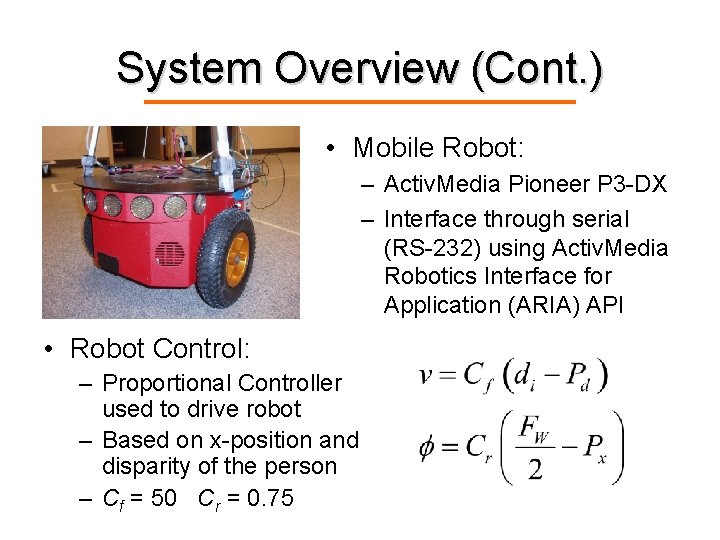
System Overview (Cont. ) • Mobile Robot: – Activ. Media Pioneer P 3 -DX – Interface through serial (RS-232) using Activ. Media Robotics Interface for Application (ARIA) API • Robot Control: – Proportional Controller used to drive robot – Based on x-position and disparity of the person – Cf = 50 Cr = 0. 75
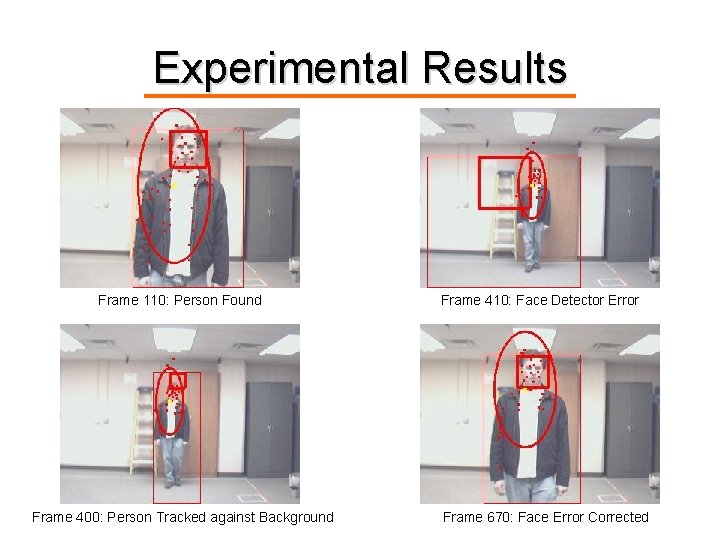
Experimental Results Frame 110: Person Found Frame 400: Person Tracked against Background Frame 410: Face Detector Error Frame 670: Face Error Corrected
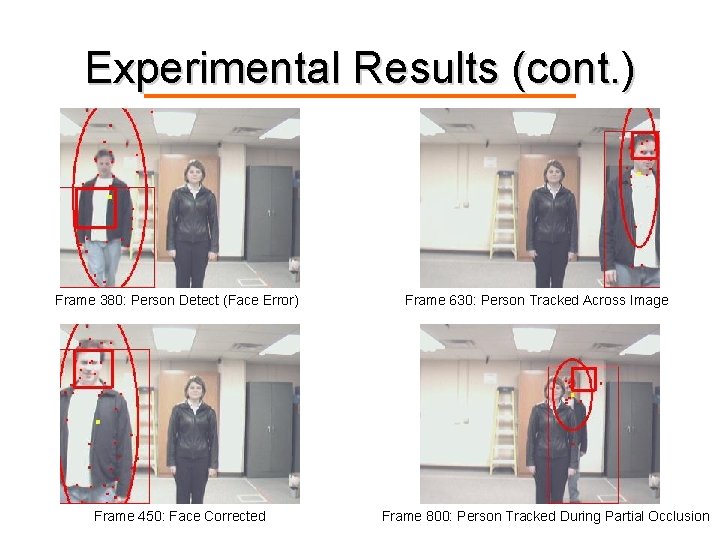
Experimental Results (cont. ) Frame 380: Person Detect (Face Error) Frame 450: Face Corrected Frame 630: Person Tracked Across Image Frame 800: Person Tracked During Partial Occlusion
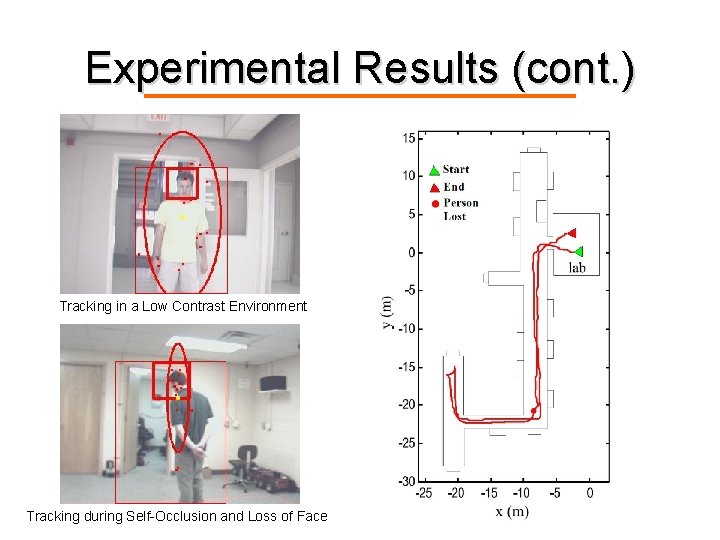
Experimental Results (cont. ) Tracking in a Low Contrast Environment Tracking during Self-Occlusion and Loss of Face
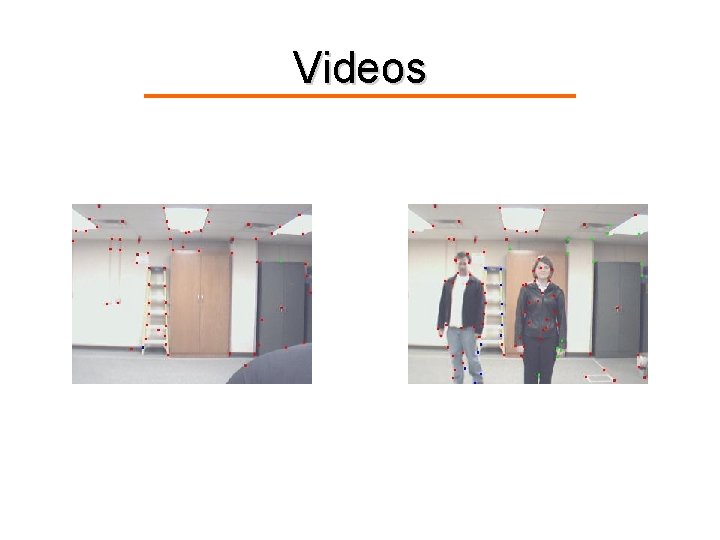
Videos
Algorithm Comparison • Color Based – Works in low-contrast environments – Robust to lighting changes • Optical Flow/Motion Based – Person does not need to move relative to camera • Dense Stereo Matching – Real time • Pattern Based – Real time – Does not require stationary camera
Conclusions & Future Work • Advantages: – Does not need color – Can detect person with no relative motion – Robust to partial and self occlusion • Future Work: – Less reliance on face, and addition of person qualifiers such as motion estimation – Testing to determine optimal thresholds – Application of other clustering methods – Person classification / recognition
![References [1] Sidenbladh et al. , A Person Following Behavior for a Mobile Robot,](http://slidetodoc.com/presentation_image_h2/a5211b817ca3656d3760cd3236f99f95/image-28.jpg "References [1] Sidenbladh et al. , A Person Following Behavior for a Mobile Robot,")
References [1] Sidenbladh et al. , A Person Following Behavior for a Mobile Robot, 1999 [2] Tarokh and Ferrari, Robotic Person Following Using Fuzzy Control for Image Segmentation, 2003 [3] Kwon et al. , Person Tracking with a Mobile Robot Using Two Uncalibrated Independently Moving Cameras, 2005 [4] Schlegel et al. , Vision Based Person Tracking with a Mobile Robot, 1998 [5] Paggio et al. , An Optical-Flow Person Following Behaviour, 1998 [6] Chivilo et al. , Follow-the-leader Behavior through Optical Flow Minimization, 2004 [7] Beymer and Konolige, Tracking People from a Mobile Platform, 2001 [8] Viola et al. , Detecting Pedestrians Using Patterns of Motion and Appearance, 2003 [9] Lucas and Kanade, An Iterative Image Registration Technique with an Application to Stereo Vision, 1981 [10] Tomasi and Kanade, Detection and Tracking of Point Features, 1991 [11] Viola and Jones, Rapid Object Detection Using a Boosted Cascade of Simple Features, 2001 [12] Chen and Birchfield, Person Following with a Mobile Robot Using Binocular Feature-Based Tracking, 2007
Questions?
- Slides: 29