
Persistent Identifiers Discoverability and Open Science Fiona Murphy
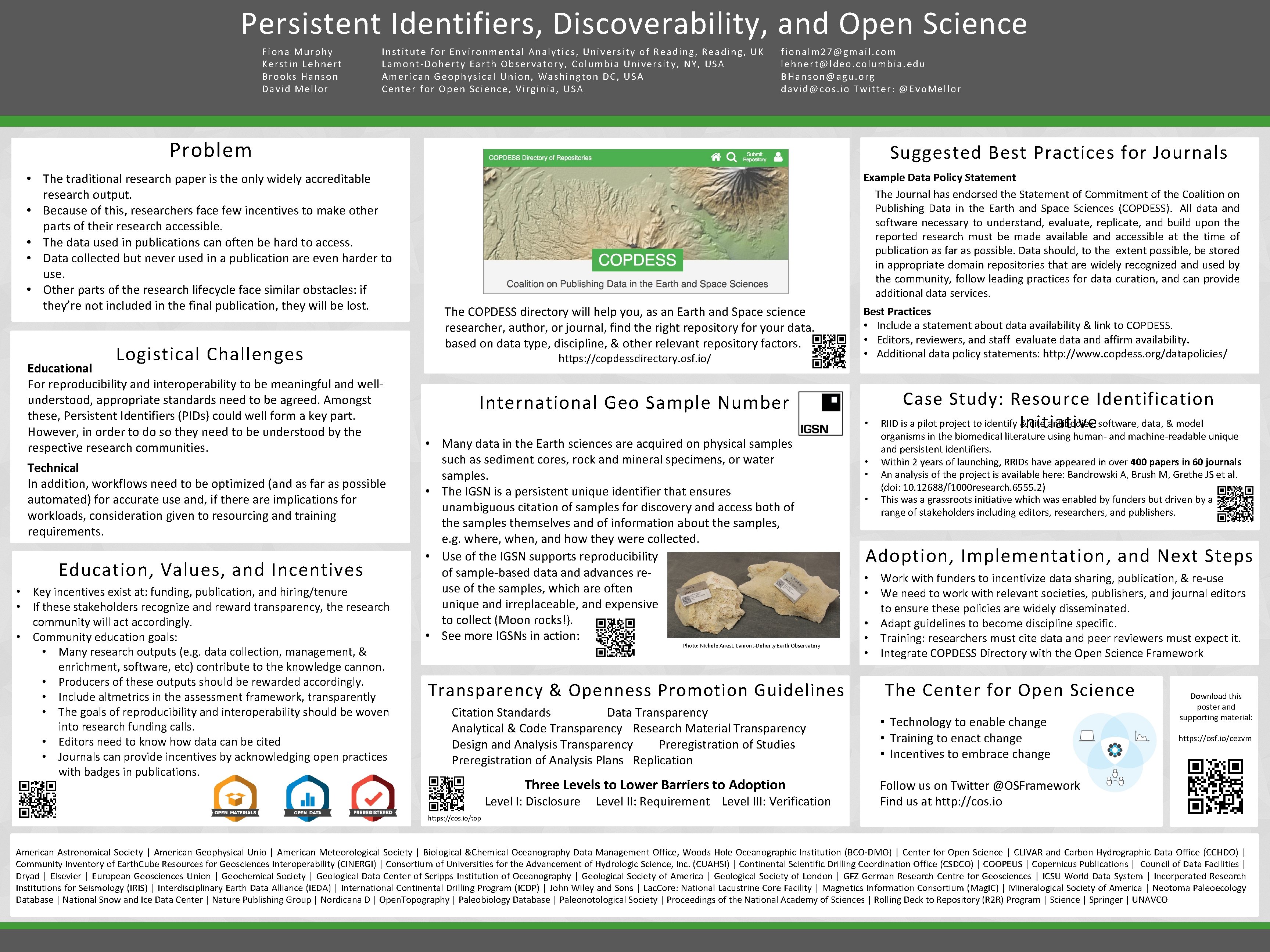
Persistent Identifiers, Discoverability, and Open Science Fiona Murphy Kerstin Lehnert Brooks Hanson David Mellor fionalm 27@gmail. com Institute for Environmental Analytics, University of Reading, UK Lamont-Doherty Earth Observatory, Columbia University, NY, USA lehnert@ldeo. columbia. edu BHanson@agu. org American Geophysical Union, Washington DC, USA david@cos. io Twitter: @Evo. Mellor Center for Open Science, Virginia, USA Problem • The traditional research paper is the only widely accreditable research output. • Because of this, researchers face few incentives to make other parts of their research accessible. • The data used in publications can often be hard to access. • Data collected but never used in a publication are even harder to use. • Other parts of the research lifecycle face similar obstacles: if they’re not included in the final publication, they will be lost. Logistical Challenges Educational For reproducibility and interoperability to be meaningful and wellunderstood, appropriate standards need to be agreed. Amongst these, Persistent Identifiers (PIDs) could well form a key part. However, in order to do so they need to be understood by the respective research communities. Technical In addition, workflows need to be optimized (and as far as possible automated) for accurate use and, if there are implications for workloads, consideration given to resourcing and training requirements. Education, Values, and Incentives • Key incentives exist at: funding, publication, and hiring/tenure • If these stakeholders recognize and reward transparency, the research community will act accordingly. • Community education goals: • Many research outputs (e. g. data collection, management, & enrichment, software, etc) contribute to the knowledge cannon. • Producers of these outputs should be rewarded accordingly. • Include altmetrics in the assessment framework, transparently • The goals of reproducibility and interoperability should be woven into research funding calls. • Editors need to know how data can be cited • Journals can provide incentives by acknowledging open practices with badges in publications. Suggested Best Practices for Journals Example Data Policy Statement The Journal has endorsed the Statement of Commitment of the Coalition on Publishing Data in the Earth and Space Sciences (COPDESS). All data and software necessary to understand, evaluate, replicate, and build upon the reported research must be made available and accessible at the time of • publication as far as possible. Data should, to the extent possible, be stored At the end of each trial, the correct category was revealed and the subjects recorded the accuracy of their category guess. in appropriate domain repositories that are widely recognized and used by the community, follow leading practices for data curation, and can provide additional data services. The COPDESS directory will help you, as an Earth and Space science researcher, author, or journal, find the right repository for your data, based on data type, discipline, & other relevant repository factors. https: //copdessdirectory. osf. io/ Best Practices • Include a statement about data availability & link to COPDESS. • Editors, reviewers, and staff evaluate data and affirm availability. • Additional data policy statements: http: //www. copdess. org/datapolicies/ International Geo Sample Number • • Many data in the Earth sciences are acquired on physical samples such as sediment cores, rock and mineral specimens, or water samples. • The IGSN is a persistent unique identifier that ensures unambiguous citation of samples for discovery and access both of the samples themselves and of information about the samples, e. g. where, when, and how they were collected. • Use of the IGSN supports reproducibility of sample-based data and advances reuse of the samples, which are often unique and irreplaceable, and expensive to collect (Moon rocks!). • See more IGSNs in action: Photo: Nichole Anest, Lamont-Doherty Earth Observatory Transparency & Openness Promotion Guidelines Citation Standards Data Transparency Analytical & Code Transparency Research Material Transparency Design and Analysis Transparency Preregistration of Studies Preregistration of Analysis Plans Replication Three Levels to Lower Barriers to Adoption Level I: Disclosure Level II: Requirement Level III: Verification • • • Case Study: Resource Identification RIID is a pilot project to identify & cite antibodies, software, data, & model Initiative organisms in the biomedical literature using human- and machine-readable unique and persistent identifiers. Within 2 years of launching, RRIDs have appeared in over 400 papers in 60 journals An analysis of the project is available here: Bandrowski A, Brush M, Grethe JS et al. (doi: 10. 12688/f 1000 research. 6555. 2) This was a grassroots initiative which was enabled by funders but driven by a range of stakeholders including editors, researchers, and publishers. Adoption, Implementation, and Next Steps • Work with funders to incentivize data sharing, publication, & re-use • We need to work with relevant societies, publishers, and journal editors to ensure these policies are widely disseminated. • Adapt guidelines to become discipline specific. • Training: researchers must cite data and peer reviewers must expect it. • Integrate COPDESS Directory with the Open Science Framework The Center for Open Science • Technology to enable change • Training to enact change • Incentives to embrace change Download this poster and supporting material: https: //osf. io/cezvm Follow us on Twitter @OSFramework Find us at http: //cos. io https: //cos. io/top American Astronomical Society | American Geophysical Unio | American Meteorological Society | Biological &Chemical Oceanography Data Management Office, Woods Hole Oceanographic Institution (BCO-DMO) | Center for Open Science | CLIVAR and Carbon Hydrographic Data Office (CCHDO) | Community Inventory of Earth. Cube Resources for Geosciences Interoperability (CINERGI) | Consortium of Universities for the Advancement of Hydrologic Science, Inc. (CUAHSI) | Continental Scientific Drilling Coordination Office (CSDCO) | COOPEUS | Copernicus Publications | Council of Data Facilities | Dryad | Elsevier | European Geosciences Union | Geochemical Society | Geological Data Center of Scripps Institution of Oceanography | Geological Society of America | Geological Society of London | GFZ German Research Centre for Geosciences | ICSU World Data System | Incorporated Research Institutions for Seismology (IRIS) | Interdisciplinary Earth Data Alliance (IEDA) | International Continental Drilling Program (ICDP) | John Wiley and Sons | Lac. Core: National Lacustrine Core Facility | Magnetics Information Consortium (Mag. IC) | Mineralogical Society of America | Neotoma Paleoecology Database | National Snow and Ice Data Center | Nature Publishing Group | Nordicana D | Open. Topography | Paleobiology Database | Paleonotological Society | Proceedings of the National Academy of Sciences | Rolling Deck to Repository (R 2 R) Program | Science | Springer | UNAVCO
- Slides: 1