
Permutations Combinations Selected Exercises Preliminaries Denote the of

Permutations & Combinations: Selected Exercises
Preliminaries Denote the # of arrangements of some k elements of a set of n elements as P( n, k ). Use the product rule to derive a formula for P( n, k ). Let C( n, k ) be the # of subsets of k elements drawn from a set of n elements. Use the product rule to derive a formula for C( n, k ) in terms of P( n, k ) & P( k, k ). Copyright © Peter Cappello 2
10 There are 6 different candidates for governor. In how many different orders can the names of the candidates be printed on a ballot? Copyright © Peter Cappello 3
10 Solution The # of different orders that the candidate names can be printed on a ballot is described by the following procedure: 1. Pick the candidate that appears on top (6) 2. Pick the candidate that appears below that (5) 3. Pick the candidate that appears below that (4) 4. Pick the candidate that appears below that (3) 5. Pick the candidate that appears below that (2) 6. Pick the candidate that appears below that (1) The composite number is 6! = 6. 5. 4. 3. 2. 1 = 720. This also is known as P(6, 6). Copyright © Peter Cappello 4
20 (a) How many bit strings of length 10 have exactly 3 0 s? Copyright © Peter Cappello 5
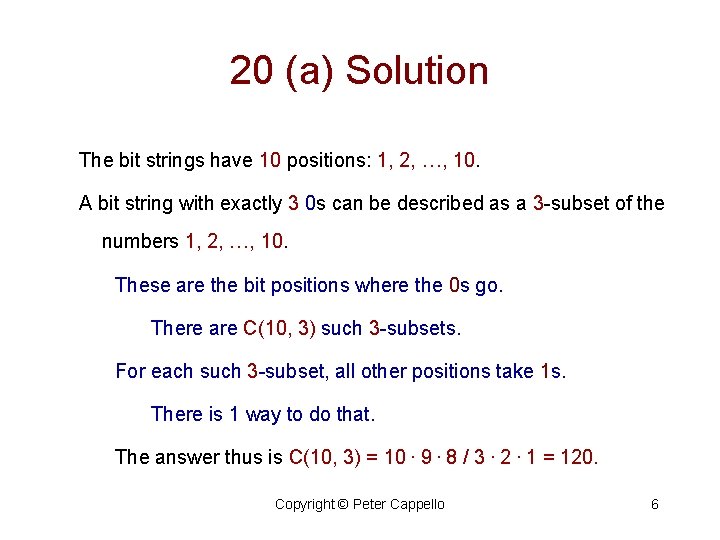
20 (a) Solution The bit strings have 10 positions: 1, 2, …, 10. A bit string with exactly 3 0 s can be described as a 3 -subset of the numbers 1, 2, …, 10. These are the bit positions where the 0 s go. There are C(10, 3) such 3 -subsets. For each such 3 -subset, all other positions take 1 s. There is 1 way to do that. The answer thus is C(10, 3) = 10. 9. 8 / 3. 2. 1 = 120. Copyright © Peter Cappello 6
20 (b) How many bit strings of length 10 have more 0 s than 1 s? Copyright © Peter Cappello 7
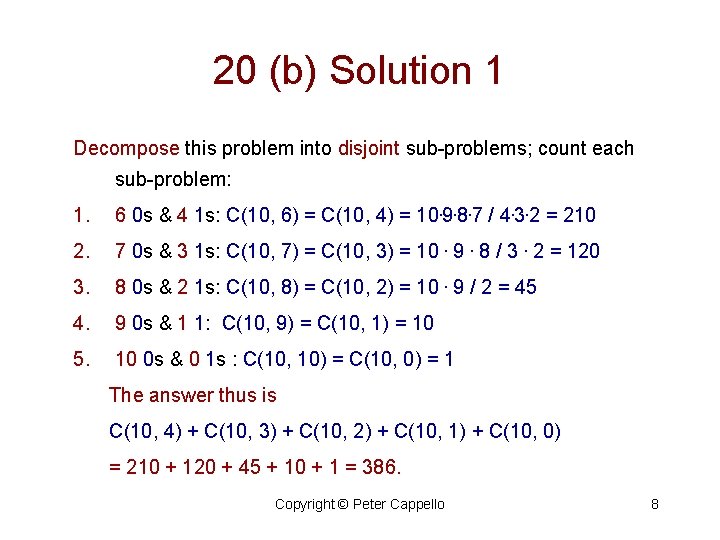
20 (b) Solution 1 Decompose this problem into disjoint sub-problems; count each sub-problem: 1. 6 0 s & 4 1 s: C(10, 6) = C(10, 4) = 10. 9. 8. 7 / 4. 3. 2 = 210 2. 7 0 s & 3 1 s: C(10, 7) = C(10, 3) = 10. 9. 8 / 3. 2 = 120 3. 8 0 s & 2 1 s: C(10, 8) = C(10, 2) = 10. 9 / 2 = 45 4. 9 0 s & 1 1: C(10, 9) = C(10, 1) = 10 5. 10 0 s & 0 1 s : C(10, 10) = C(10, 0) = 1 The answer thus is C(10, 4) + C(10, 3) + C(10, 2) + C(10, 1) + C(10, 0) = 210 + 120 + 45 + 10 + 1 = 386. Copyright © Peter Cappello 8
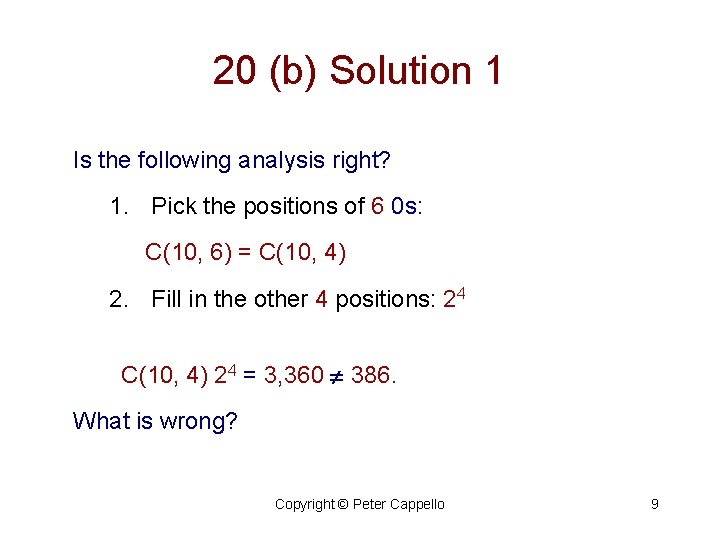
20 (b) Solution 1 Is the following analysis right? 1. Pick the positions of 6 0 s: C(10, 6) = C(10, 4) 2. Fill in the other 4 positions: 24 C(10, 4) 24 = 3, 360 386. What is wrong? Copyright © Peter Cappello 9
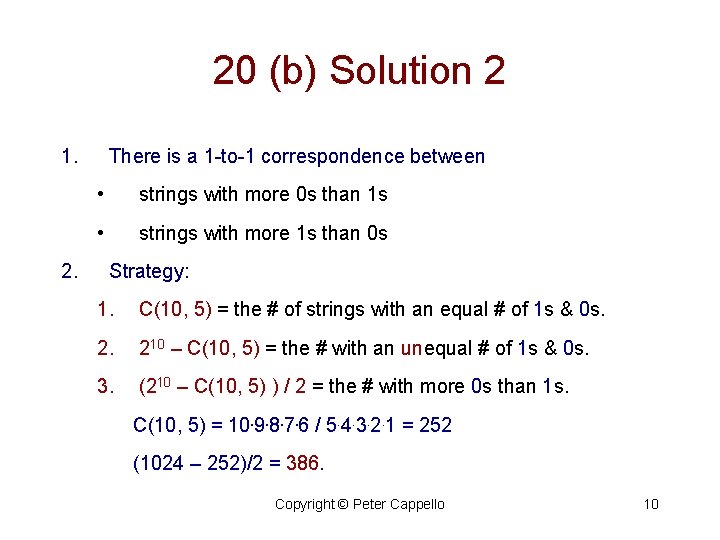
20 (b) Solution 2 1. 2. There is a 1 -to-1 correspondence between • strings with more 0 s than 1 s • strings with more 1 s than 0 s Strategy: 1. C(10, 5) = the # of strings with an equal # of 1 s & 0 s. 210 – C(10, 5) = the # with an unequal # of 1 s & 0 s. 3. (210 – C(10, 5) ) / 2 = the # with more 0 s than 1 s. C(10, 5) = 10. 9. 8. 7. 6 / 5. 4. 3. 2. 1 = 252 (1024 – 252)/2 = 386. Copyright © Peter Cappello 10
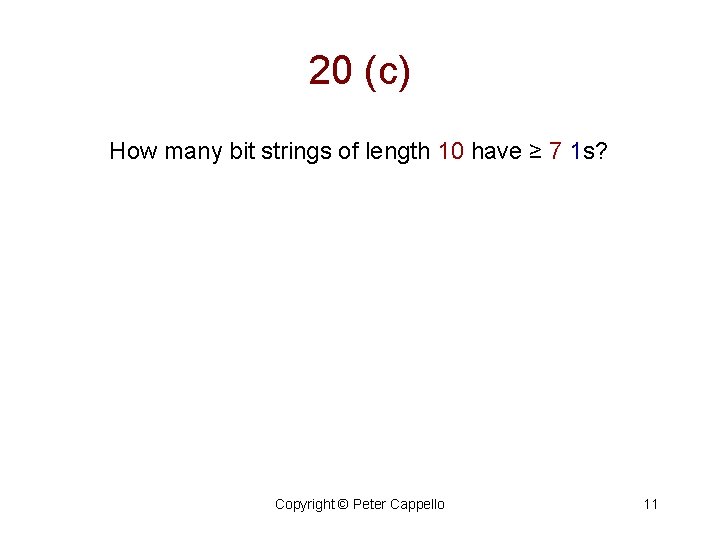
20 (c) How many bit strings of length 10 have ≥ 7 1 s? Copyright © Peter Cappello 11
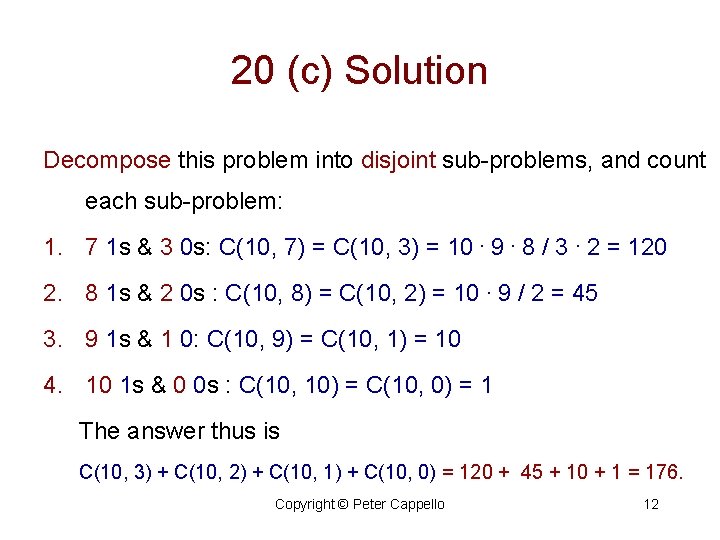
20 (c) Solution Decompose this problem into disjoint sub-problems, and count each sub-problem: 1. 7 1 s & 3 0 s: C(10, 7) = C(10, 3) = 10. 9. 8 / 3. 2 = 120 2. 8 1 s & 2 0 s : C(10, 8) = C(10, 2) = 10. 9 / 2 = 45 3. 9 1 s & 1 0: C(10, 9) = C(10, 1) = 10 4. 10 1 s & 0 0 s : C(10, 10) = C(10, 0) = 1 The answer thus is C(10, 3) + C(10, 2) + C(10, 1) + C(10, 0) = 120 + 45 + 10 + 1 = 176. Copyright © Peter Cappello 12
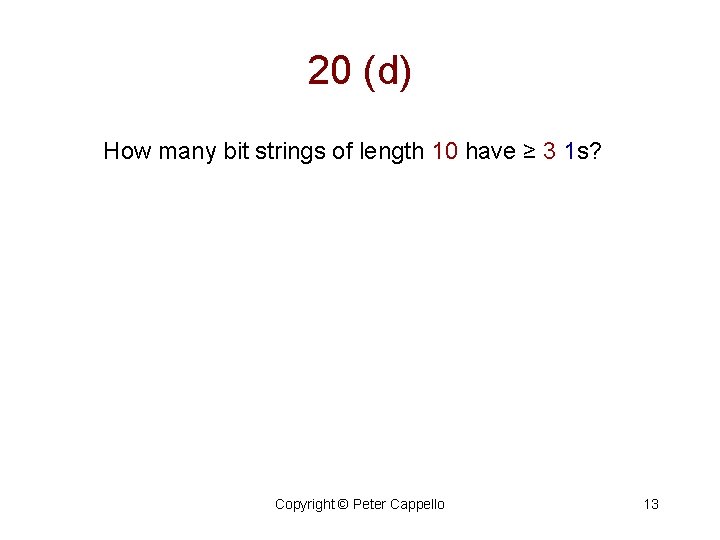
20 (d) How many bit strings of length 10 have ≥ 3 1 s? Copyright © Peter Cappello 13
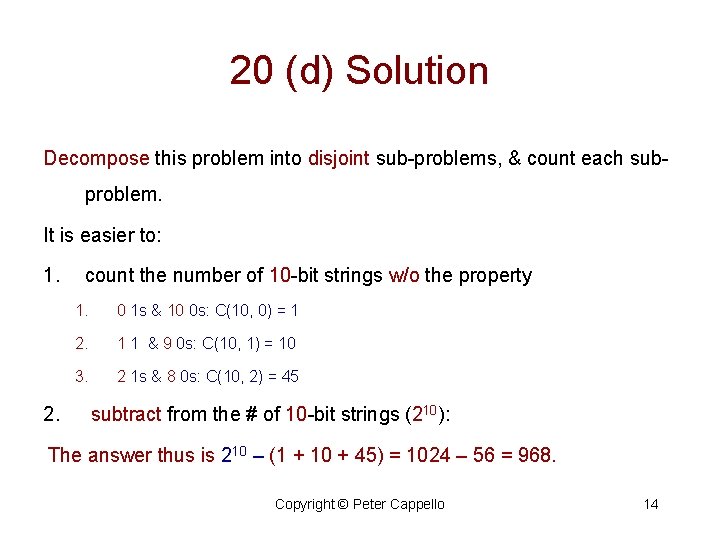
20 (d) Solution Decompose this problem into disjoint sub-problems, & count each subproblem. It is easier to: 1. 2. count the number of 10 -bit strings w/o the property 1. 0 1 s & 10 0 s: C(10, 0) = 1 2. 1 1 & 9 0 s: C(10, 1) = 10 3. 2 1 s & 8 0 s: C(10, 2) = 45 subtract from the # of 10 -bit strings (210): The answer thus is 210 – (1 + 10 + 45) = 1024 – 56 = 968. Copyright © Peter Cappello 14
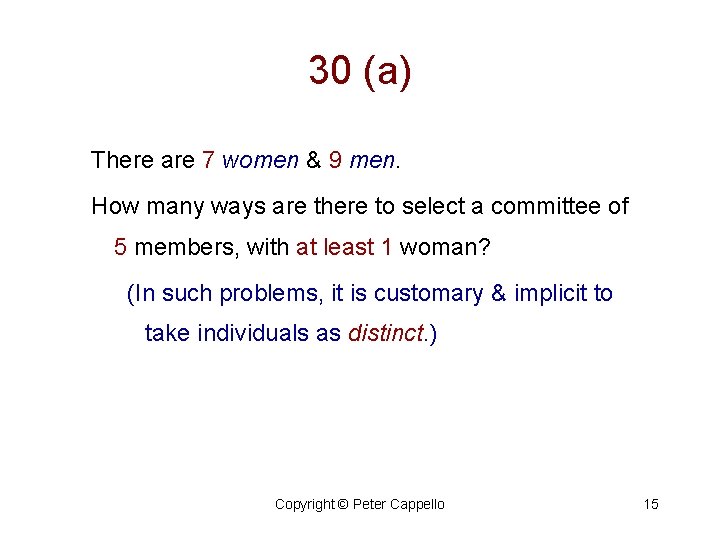
30 (a) There are 7 women & 9 men. How many ways are there to select a committee of 5 members, with at least 1 woman? (In such problems, it is customary & implicit to take individuals as distinct. ) Copyright © Peter Cappello 15
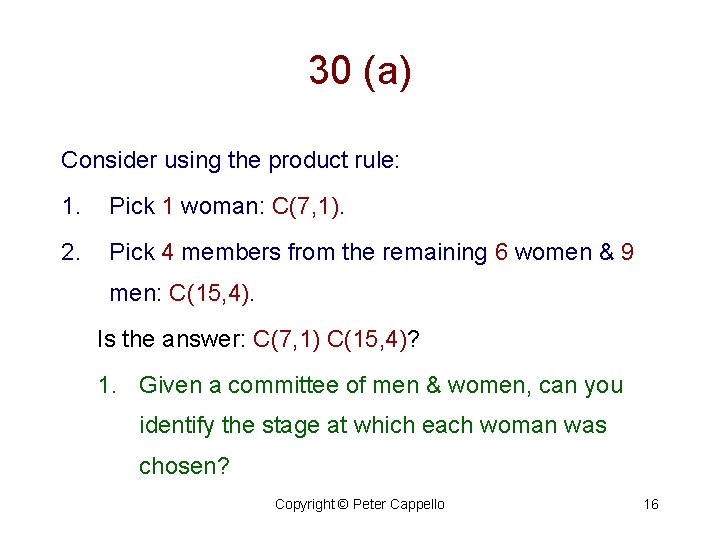
30 (a) Consider using the product rule: 1. Pick 1 woman: C(7, 1). 2. Pick 4 members from the remaining 6 women & 9 men: C(15, 4). Is the answer: C(7, 1) C(15, 4)? 1. Given a committee of men & women, can you identify the stage at which each woman was chosen? Copyright © Peter Cappello 16
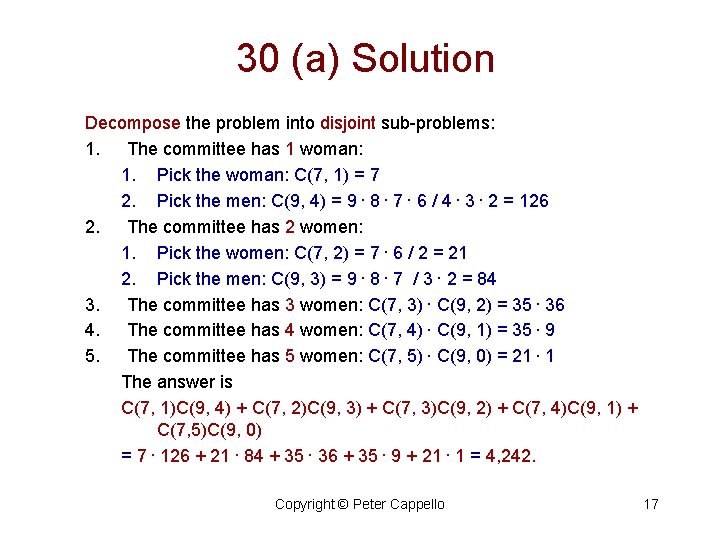
30 (a) Solution Decompose the problem into disjoint sub-problems: 1. The committee has 1 woman: 1. Pick the woman: C(7, 1) = 7 2. Pick the men: C(9, 4) = 9. 8. 7. 6 / 4. 3. 2 = 126 2. The committee has 2 women: 1. Pick the women: C(7, 2) = 7. 6 / 2 = 21 2. Pick the men: C(9, 3) = 9. 8. 7 / 3. 2 = 84 3. The committee has 3 women: C(7, 3). C(9, 2) = 35. 36 4. The committee has 4 women: C(7, 4). C(9, 1) = 35. 9 5. The committee has 5 women: C(7, 5). C(9, 0) = 21. 1 The answer is C(7, 1)C(9, 4) + C(7, 2)C(9, 3) + C(7, 3)C(9, 2) + C(7, 4)C(9, 1) + C(7, 5)C(9, 0) = 7. 126 + 21. 84 + 35. 36 + 35. 9 + 21. 1 = 4, 242. Copyright © Peter Cappello 17
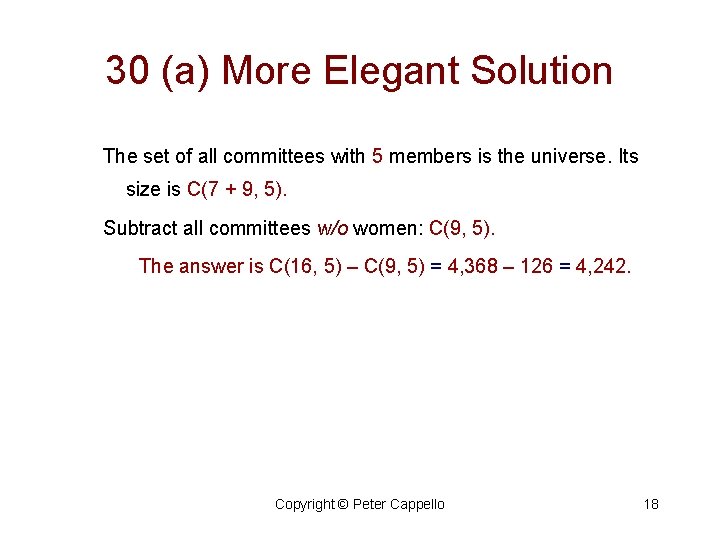
30 (a) More Elegant Solution The set of all committees with 5 members is the universe. Its size is C(7 + 9, 5). Subtract all committees w/o women: C(9, 5). The answer is C(16, 5) – C(9, 5) = 4, 368 – 126 = 4, 242. Copyright © Peter Cappello 18
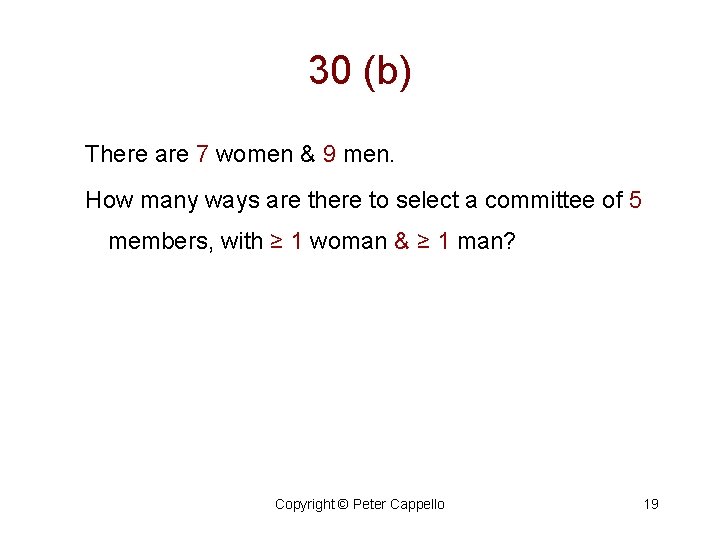
30 (b) There are 7 women & 9 men. How many ways are there to select a committee of 5 members, with ≥ 1 woman & ≥ 1 man? Copyright © Peter Cappello 19
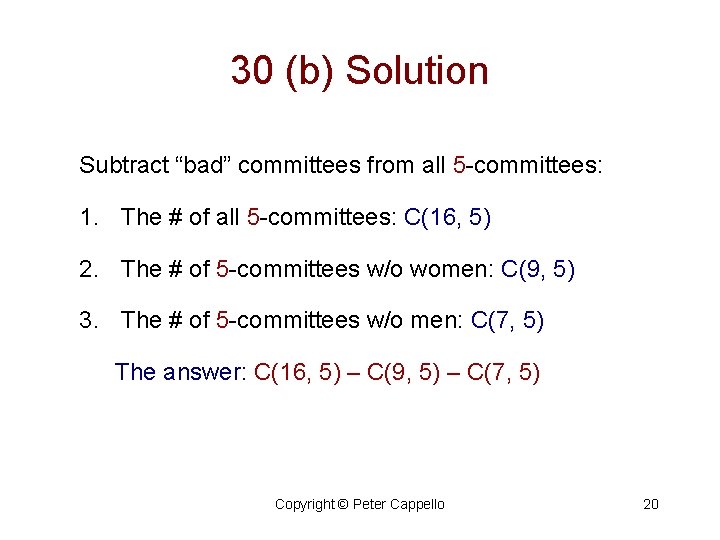
30 (b) Solution Subtract “bad” committees from all 5 -committees: 1. The # of all 5 -committees: C(16, 5) 2. The # of 5 -committees w/o women: C(9, 5) 3. The # of 5 -committees w/o men: C(7, 5) The answer: C(16, 5) – C(9, 5) – C(7, 5) Copyright © Peter Cappello 20
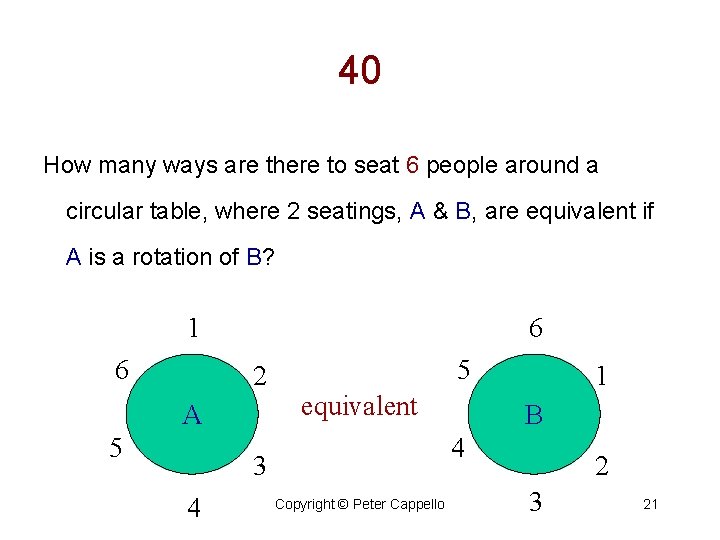
40 How many ways are there to seat 6 people around a circular table, where 2 seatings, A & B, are equivalent if A is a rotation of B? 1 6 6 2 A 5 5 equivalent B 4 3 4 1 Copyright © Peter Cappello 2 3 21
40 Solution If the people sat in a line the answer is 6! If we drag the line seating into a circle, 6 rotations (permutations) of that “line seating” are equivalent. The answer is 6!/6 = 5! The equivalence relation has 5! equivalence classes, each with 6 elements. Alternatively: 1. Fix person 1 at the head of the table: 1 2. Arrange the other 5 people at the table: 5! Copyright © Peter Cappello 22
Computing C(n, k) How many ways are there to select a team of k players from a set of n players, with a particular player named as captain? 1. Pick the k players: C(n, k) 2. Pick the captain: C(k, 1) = k Equivalently, 1. Pick the captain: C(n, 1) = n 2. Pick the remainder of the team: C(n-1, k-1) Copyright © Peter Cappello 23
Computing C( n, k )k = n C( n-1, k-1 ) C( n, k ) = n/k C( n-1, k-1 ). Apply the above recursively: C(n, 1) = n, for k = 1 C( n, k ) = n(n-1). . . (n - k +1) /k! , for k > 1. For example, C(1000, 4) = 1000. 999. 998. 997 / 4. 3. 2. 1 Why does each factor in the denominator divide some factor in the numerator? Copyright © Peter Cappello 24
- Slides: 24