
PERMITTING IN THE CRITICAL AREA St Marys County

- Slides: 24
PERMITTING IN THE CRITICAL AREA St. Mary’s County Department of Land Use and Growth Management
Outline • Basic Critical Area Background Info • Critical Area Zones • Application Requirements • Plan Review Process • Variance Process • Shoreline Permitting • Buffer Management Plans
Critical Area vs. 100 -foot Buffer • CRITICAL AREA • All waters of the Chesapeake Bay, the Atlantic Coastal Bays, and their tributaries to the head of tide • All land under these waters • All land within 1, 000 feet of the landward edge of tidal waters and tidal wetlands • Critical Area Law and Criteria regulates development within this 1, 000 feet Slide borrowed from Critical Area Commission presentation: Building in the Critical Area • 100 -FOOT BUFFER : • Exists or may be established in natural vegetation • Immediately landward from mean high water of tidal waters, the edge of a bank of a tributary stream or the edge of a tidal wetland • Can be expanded for steep slopes, hydric soils, and/or highly erodible soils • In general, no new development permitted without a variance.
Critical Area Overlays • Resource Conservation Area (RCA) • Limited Development Area (LDA) • Intensely Developed Area (IDA)
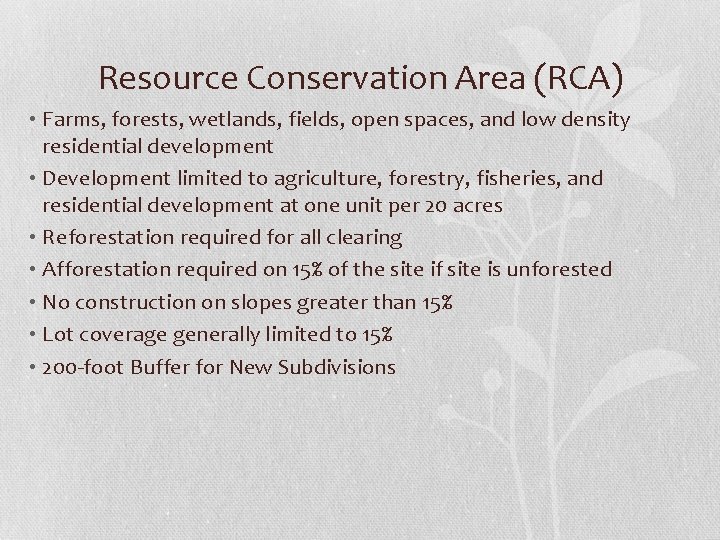
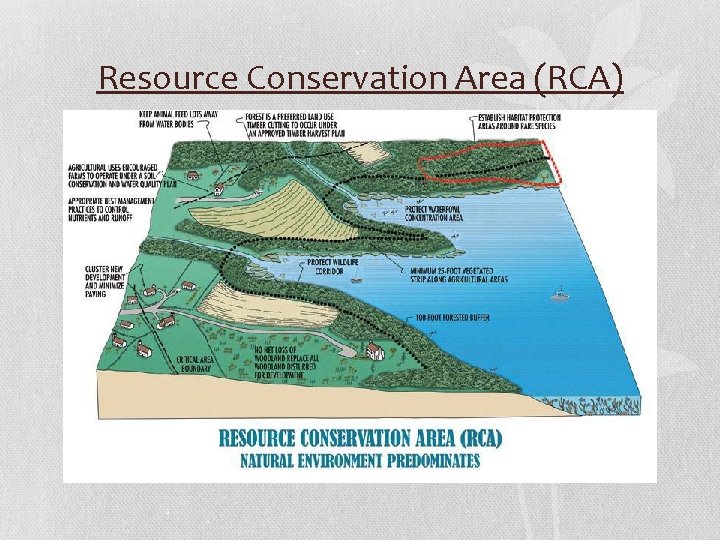
Resource Conservation Area (RCA) • Farms, forests, wetlands, fields, open spaces, and low density residential development • Development limited to agriculture, forestry, fisheries, and residential development at one unit per 20 acres • Reforestation required for all clearing • Afforestation required on 15% of the site if site is unforested • No construction on slopes greater than 15% • Lot coverage generally limited to 15% • 200 -foot Buffer for New Subdivisions
Resource Conservation Area (RCA)
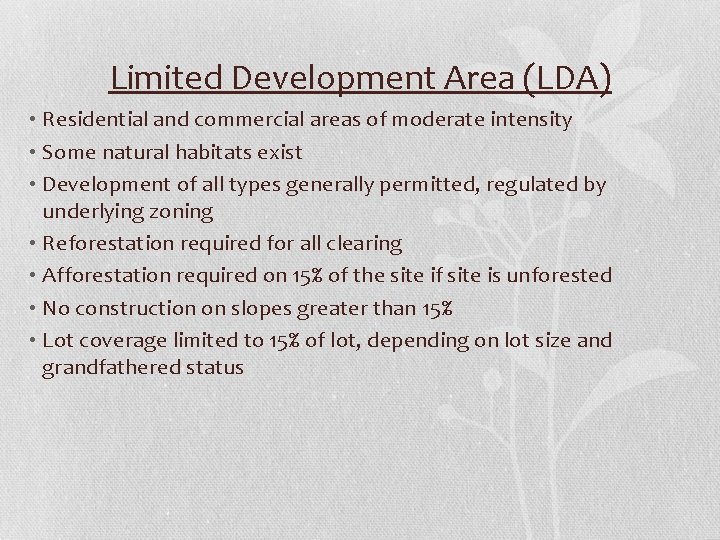
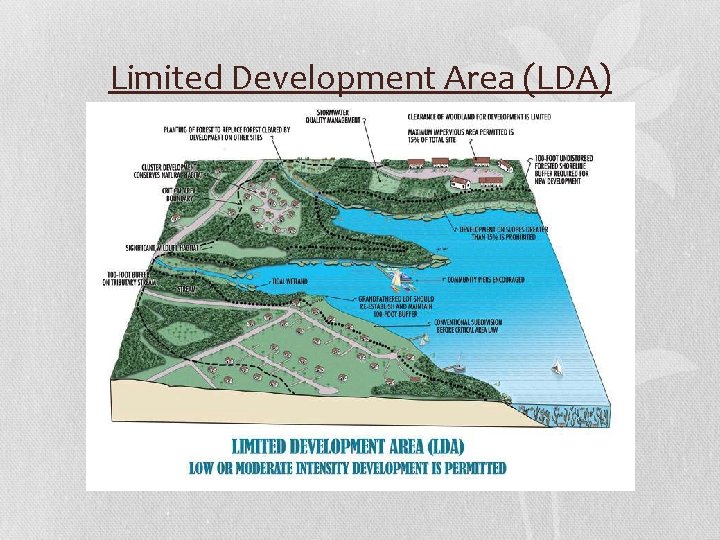
Limited Development Area (LDA) • Residential and commercial areas of moderate intensity • Some natural habitats exist • Development of all types generally permitted, regulated by underlying zoning • Reforestation required for all clearing • Afforestation required on 15% of the site if site is unforested • No construction on slopes greater than 15% • Lot coverage limited to 15% of lot, depending on lot size and grandfathered status
Limited Development Area (LDA)
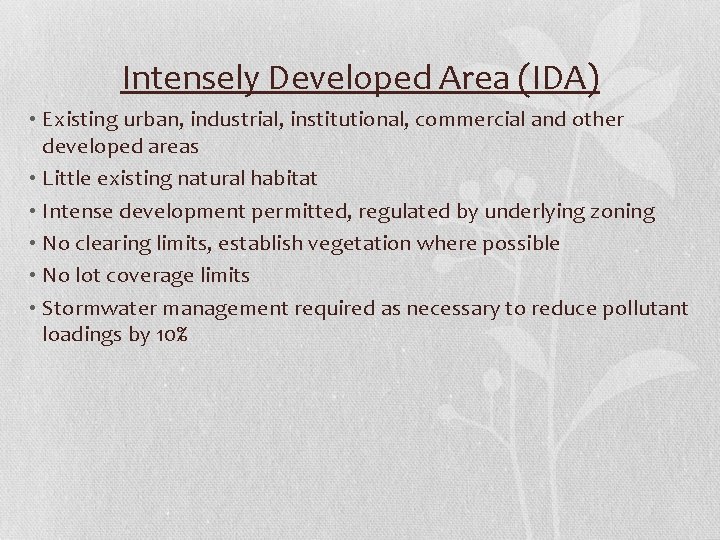
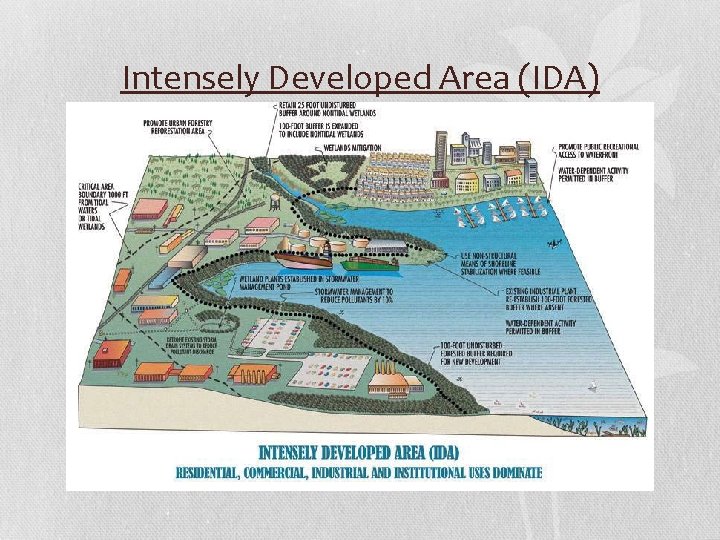
Intensely Developed Area (IDA) • Existing urban, industrial, institutional, commercial and other developed areas • Little existing natural habitat • Intense development permitted, regulated by underlying zoning • No clearing limits, establish vegetation where possible • No lot coverage limits • Stormwater management required as necessary to reduce pollutant loadings by 10%
Intensely Developed Area (IDA)
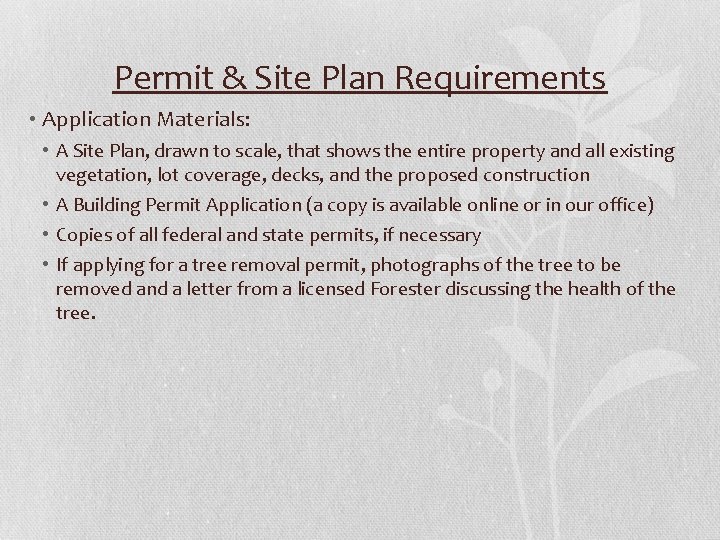
Permit & Site Plan Requirements • Application Materials: • A Site Plan, drawn to scale, that shows the entire property and all existing vegetation, lot coverage, decks, and the proposed construction • A Building Permit Application (a copy is available online or in our office) • Copies of all federal and state permits, if necessary • If applying for a tree removal permit, photographs of the tree to be removed and a letter from a licensed Forester discussing the health of the tree.
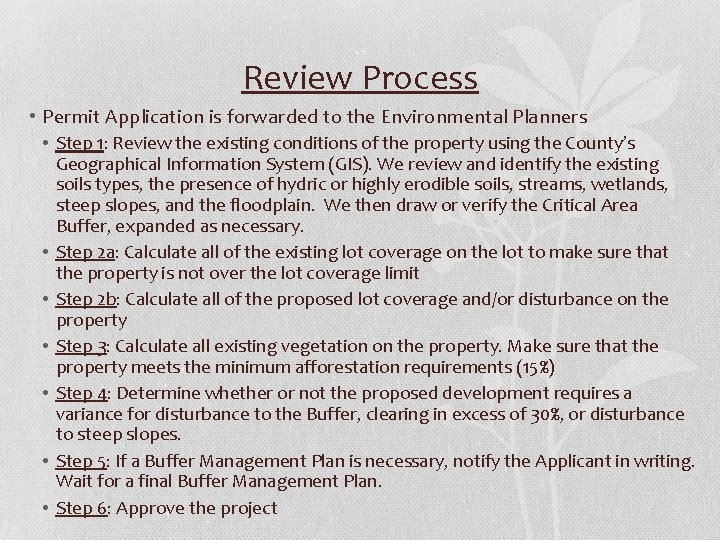
Review Process • Permit Application is forwarded to the Environmental Planners • Step 1: Review the existing conditions of the property using the County’s • • • Geographical Information System (GIS). We review and identify the existing soils types, the presence of hydric or highly erodible soils, streams, wetlands, steep slopes, and the floodplain. We then draw or verify the Critical Area Buffer, expanded as necessary. Step 2 a: Calculate all of the existing lot coverage on the lot to make sure that the property is not over the lot coverage limit Step 2 b: Calculate all of the proposed lot coverage and/or disturbance on the property Step 3: Calculate all existing vegetation on the property. Make sure that the property meets the minimum afforestation requirements (15%) Step 4: Determine whether or not the proposed development requires a variance for disturbance to the Buffer, clearing in excess of 30%, or disturbance to steep slopes. Step 5: If a Buffer Management Plan is necessary, notify the Applicant in writing. Wait for a final Buffer Management Plan. Step 6: Approve the project
Variance Process • All Critical Area Variances are heard by the St. Mary’s County Board of Appeals. The Board is made up of 5 members of the public that are appointed by the Commissioners of St. Mary’s County. • Hearings are held on the 2 nd Thursday of every month in the Commissioner’s meeting room. • Applicants must address the standards for granting a variance in the Critical Area • The Board must find that the Applicants have met all of the required standards in order to grant the requested variance. • There is a 30 day appeal period from the date of the signed order • The Critical Area Commission comments on all variances • A Buffer Management Plan is required for all variances that propose clearing or disturbance in the Critical Area Buffer or on a property that is impacted by the Critical Area Buffer. • If granted, variances remain valid for 1 year from the date of the signed order. As long as construction begins and the permit remains valid, the variance is valid.
What is Lot Coverage? • Lot Coverage: The percentage of a total lot or parcel that is: Occupied by a principal structure, accessory structure, parking area, driveway, walkway, or roadway; or • Covered with gravel, stone, shell, impermeable decking, a paver, permeable pavement, or any manmade material. • Lot coverage includes the ground area covered or occupied by a stairway or impermeable deck. • In general, limited to 15% in LDA and RCA • Lot Coverage does not include: • A fence or wall that is less than one foot in width that has not been constructed with a footer; • A walkway in the Buffer or expanded Buffer, including a stairway, that provides direct access to a community or private pier; • A wood mulch pathway; or • A deck with gaps to allow water to pass freely (SMC requires ¼ inch gaps between boards)
Shoreline Permitting
Application Requirements • A site plan, drawn to scale, that shows the entire property, all existing lot coverage, vegetation, the proposed work, and any proposed disturbance • The access path, if needed, must also be shown • A copy of the Maryland Department of the Environment (MDE) and Army Corps of Engineers (ACOE) Joint Tidal Wetlands License • Photographs of the existing shoreline, if available
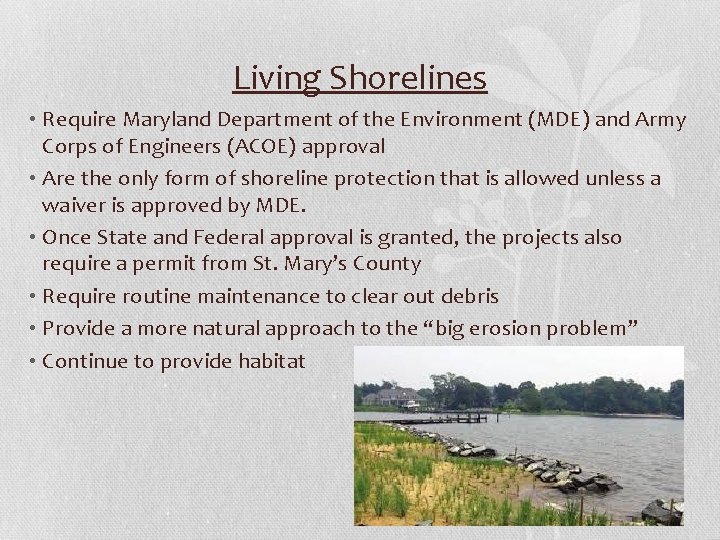
Living Shorelines • Require Maryland Department of the Environment (MDE) and Army Corps of Engineers (ACOE) approval • Are the only form of shoreline protection that is allowed unless a waiver is approved by MDE. • Once State and Federal approval is granted, the projects also require a permit from St. Mary’s County • Require routine maintenance to clear out debris • Provide a more natural approach to the “big erosion problem” • Continue to provide habitat
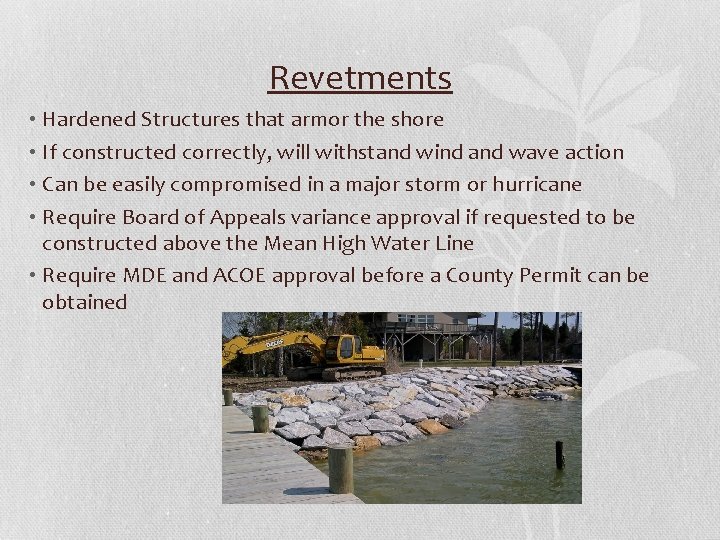
Revetments • Hardened Structures that armor the shore • If constructed correctly, will withstand wind and wave action • Can be easily compromised in a major storm or hurricane • Require Board of Appeals variance approval if requested to be constructed above the Mean High Water Line • Require MDE and ACOE approval before a County Permit can be obtained
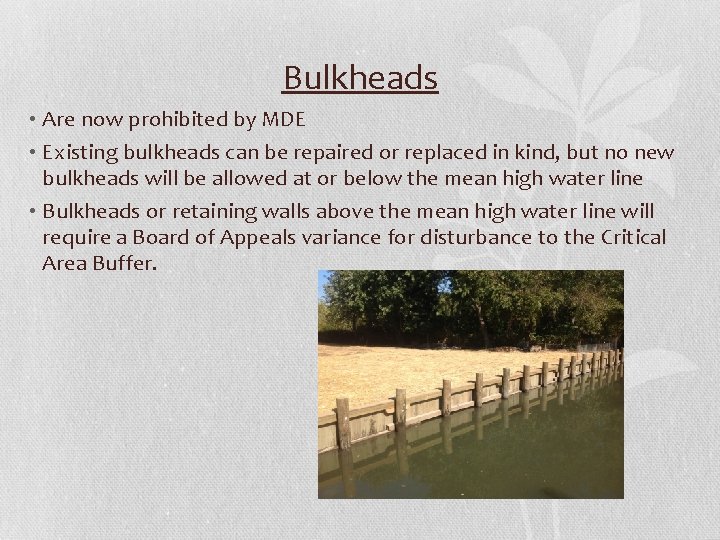
Bulkheads • Are now prohibited by MDE • Existing bulkheads can be repaired or replaced in kind, but no new bulkheads will be allowed at or below the mean high water line • Bulkheads or retaining walls above the mean high water line will require a Board of Appeals variance for disturbance to the Critical Area Buffer.
Piers • Require MDE and ACOE review and approval through a Joint Tidal Wetlands License • Require County Permits • Only 1 pier is allowed per property • St. Mary’s County requires property owners to adhere to Lateral Lines and Lateral Line setbacks. • A 25 foot Buffer is required from lateral lines for navigation purposes • This Buffer may be reduced if the adjoining property owners will sign a Lateral Line Setback Agreement or an Agreement to cross a Lateral Line. These documents must be signed, notarized, and recorded among the land records of St. Mary’s County.
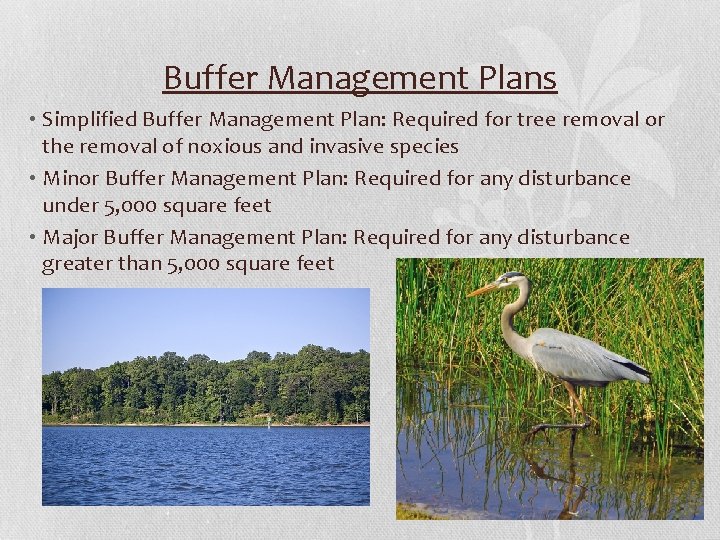
Buffer Management Plans • Simplified Buffer Management Plan: Required for tree removal or the removal of noxious and invasive species • Minor Buffer Management Plan: Required for any disturbance under 5, 000 square feet • Major Buffer Management Plan: Required for any disturbance greater than 5, 000 square feet
Violations in the Critical Area • Any work performed without first obtaining a permit is considered a violation. Ex’s: Clearing, construction, grading • Conducting work outside of the approved permit is also considered a violation. • Violations carry a fine of $500 per day, per violation in the Critical Area • If you suspect a violation, you can contact our Inspections Division at 301 -475 -4200 x*1580.
Helpful Resources • St. Mary’s County Government’s Website http: //www. stmarysmd. com/ • The Green Book for the Buffer http: //dnr. maryland. gov/criticalarea/Documents/PDF/Home/Gr een. Book_Buffer. pdf (produced by the Critical Area Commission) • Native Plants for Habitat and Wildlife Conservation Landscaping, Chesapeake Bay Watershed (produced by U. S. Fish & Wildlife) http: //dnr. maryland. gov/criticalarea/Documents/PDF/Home/ch esapeakenatives. pdf • The Critical Area Commission’s Website http: //dnr. maryland. gov/criticalarea/Pages/default. aspx • The Maryland Department of the Environment’s Website: http: //www. mde. state. md. us/Pages/Home. aspx
Kelly Palmer, CFM Environmental Planner III St. Mary’s County Department of Land Use and Growth Management 301 -475 -4200 x*1528 Kelly. Palmer@stmarysmd. com