
Perl Arrays Functions References Etc Arrays Slices splices
- Slides: 20
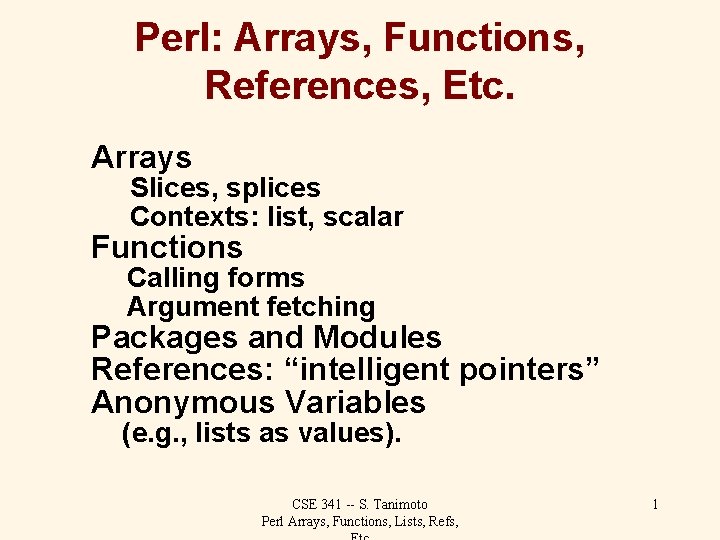
Perl: Arrays, Functions, References, Etc. Arrays Slices, splices Contexts: list, scalar Functions Calling forms Argument fetching Packages and Modules References: “intelligent pointers” Anonymous Variables (e. g. , lists as values). CSE 341 -- S. Tanimoto Perl Arrays, Functions, Lists, Refs, 1
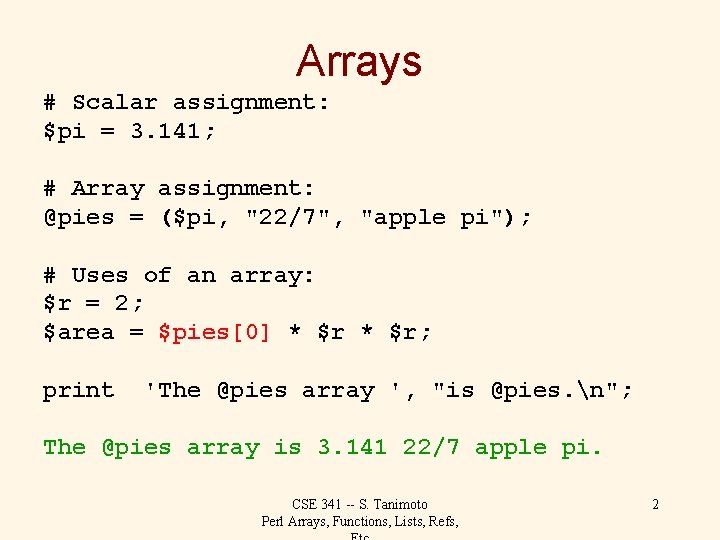
Arrays # Scalar assignment: $pi = 3. 141; # Array assignment: @pies = ($pi, "22/7", "apple pi"); # Uses of an array: $r = 2; $area = $pies[0] * $r; print 'The @pies array ', "is @pies. n"; The @pies array is 3. 141 22/7 apple pi. CSE 341 -- S. Tanimoto Perl Arrays, Functions, Lists, Refs, 2
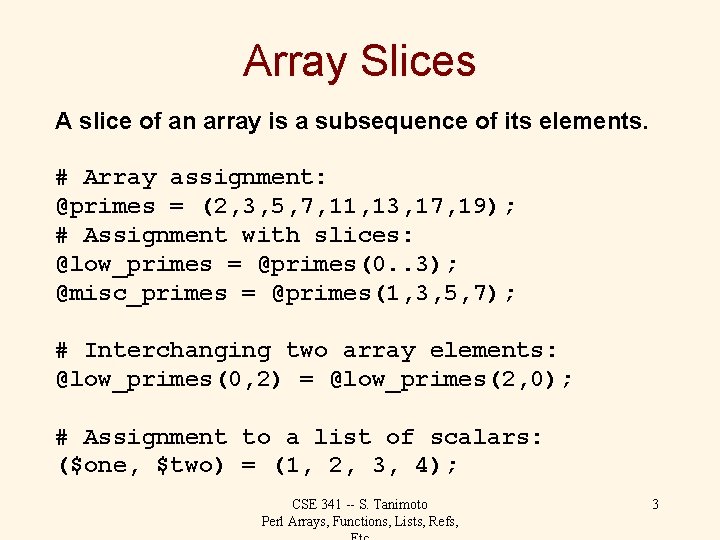
Array Slices A slice of an array is a subsequence of its elements. # Array assignment: @primes = (2, 3, 5, 7, 11, 13, 17, 19); # Assignment with slices: @low_primes = @primes(0. . 3); @misc_primes = @primes(1, 3, 5, 7); # Interchanging two array elements: @low_primes(0, 2) = @low_primes(2, 0); # Assignment to a list of scalars: ($one, $two) = (1, 2, 3, 4); CSE 341 -- S. Tanimoto Perl Arrays, Functions, Lists, Refs, 3
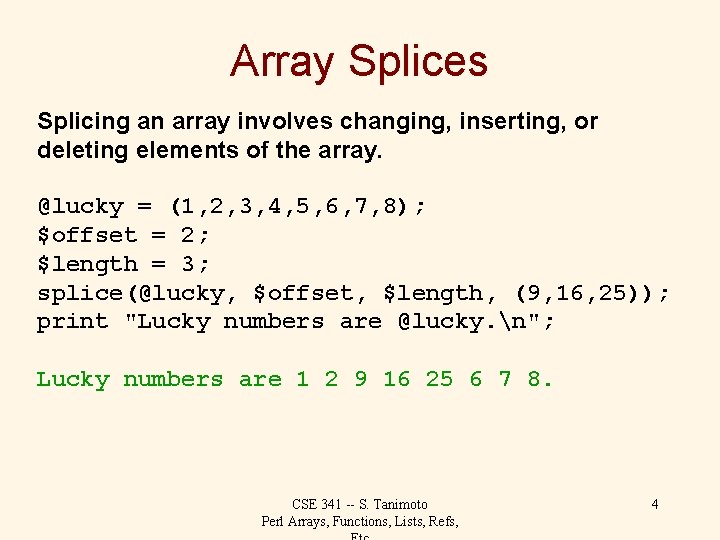
Array Splices Splicing an array involves changing, inserting, or deleting elements of the array. @lucky = (1, 2, 3, 4, 5, 6, 7, 8); $offset = 2; $length = 3; splice(@lucky, $offset, $length, (9, 16, 25)); print "Lucky numbers are @lucky. n"; Lucky numbers are 1 2 9 16 25 6 7 8. CSE 341 -- S. Tanimoto Perl Arrays, Functions, Lists, Refs, 4
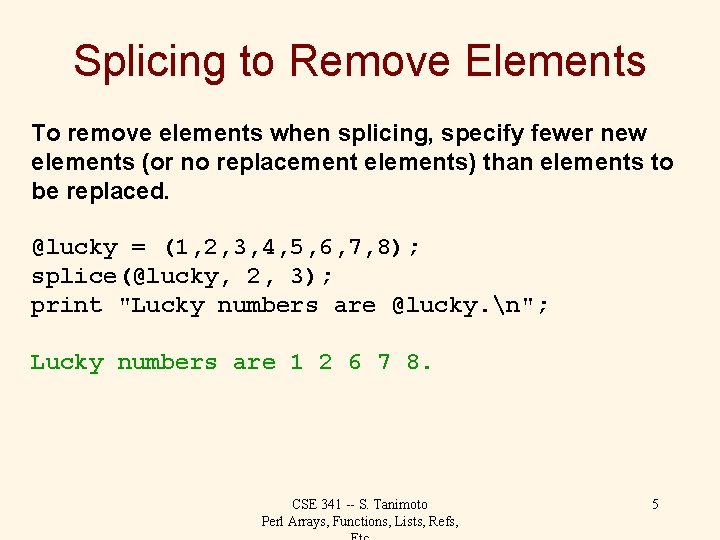
Splicing to Remove Elements To remove elements when splicing, specify fewer new elements (or no replacement elements) than elements to be replaced. @lucky = (1, 2, 3, 4, 5, 6, 7, 8); splice(@lucky, 2, 3); print "Lucky numbers are @lucky. n"; Lucky numbers are 1 2 6 7 8. CSE 341 -- S. Tanimoto Perl Arrays, Functions, Lists, Refs, 5
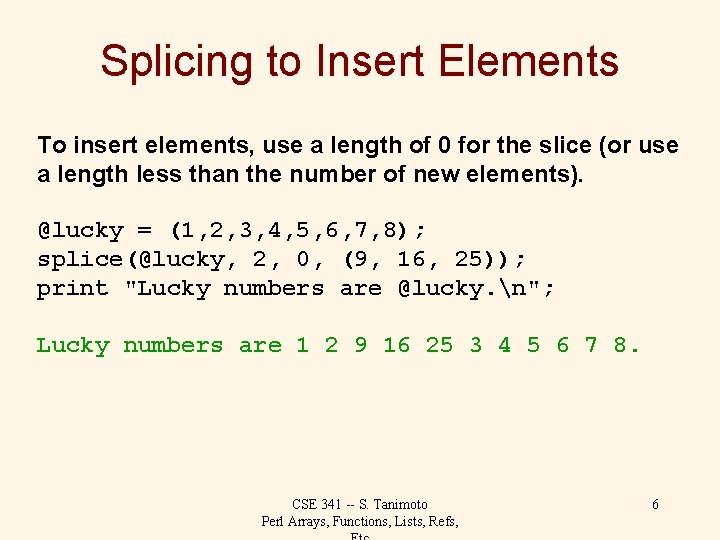
Splicing to Insert Elements To insert elements, use a length of 0 for the slice (or use a length less than the number of new elements). @lucky = (1, 2, 3, 4, 5, 6, 7, 8); splice(@lucky, 2, 0, (9, 16, 25)); print "Lucky numbers are @lucky. n"; Lucky numbers are 1 2 9 16 25 3 4 5 6 7 8. CSE 341 -- S. Tanimoto Perl Arrays, Functions, Lists, Refs, 6
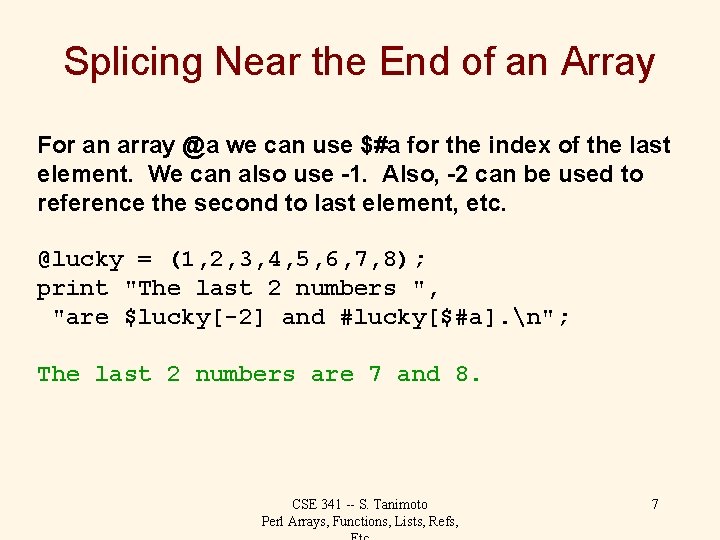
Splicing Near the End of an Array For an array @a we can use $#a for the index of the last element. We can also use -1. Also, -2 can be used to reference the second to last element, etc. @lucky = (1, 2, 3, 4, 5, 6, 7, 8); print "The last 2 numbers ", "are $lucky[-2] and #lucky[$#a]. n"; The last 2 numbers are 7 and 8. CSE 341 -- S. Tanimoto Perl Arrays, Functions, Lists, Refs, 7
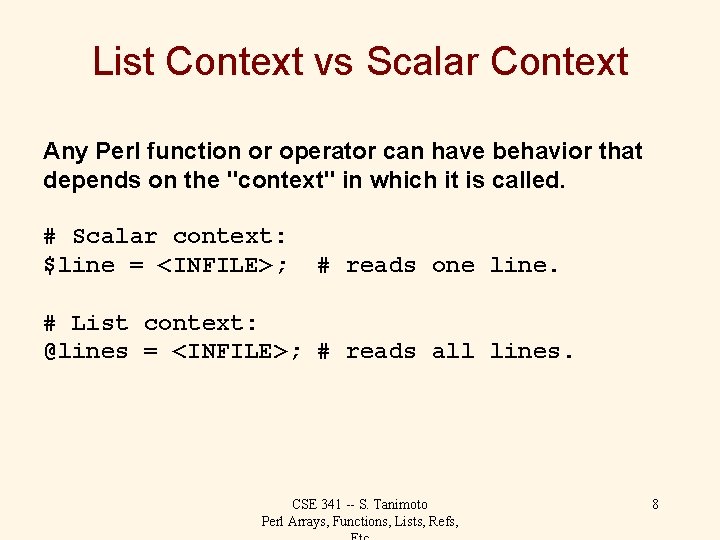
List Context vs Scalar Context Any Perl function or operator can have behavior that depends on the "context" in which it is called. # Scalar context: $line = <INFILE>; # reads one line. # List context: @lines = <INFILE>; # reads all lines. CSE 341 -- S. Tanimoto Perl Arrays, Functions, Lists, Refs, 8
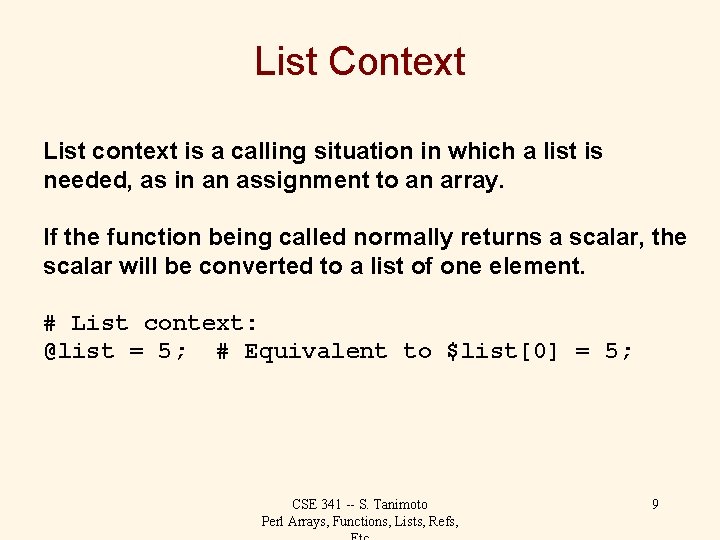
List Context List context is a calling situation in which a list is needed, as in an assignment to an array. If the function being called normally returns a scalar, the scalar will be converted to a list of one element. # List context: @list = 5; # Equivalent to $list[0] = 5; CSE 341 -- S. Tanimoto Perl Arrays, Functions, Lists, Refs, 9
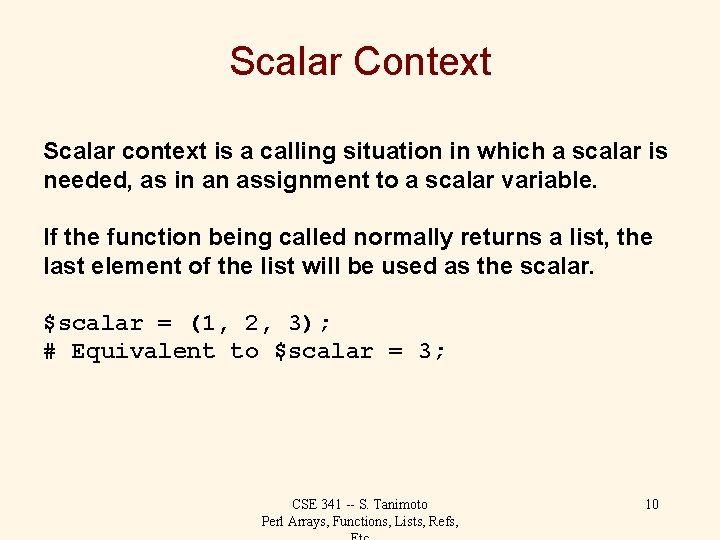
Scalar Context Scalar context is a calling situation in which a scalar is needed, as in an assignment to a scalar variable. If the function being called normally returns a list, the last element of the list will be used as the scalar. $scalar = (1, 2, 3); # Equivalent to $scalar = 3; CSE 341 -- S. Tanimoto Perl Arrays, Functions, Lists, Refs, 10
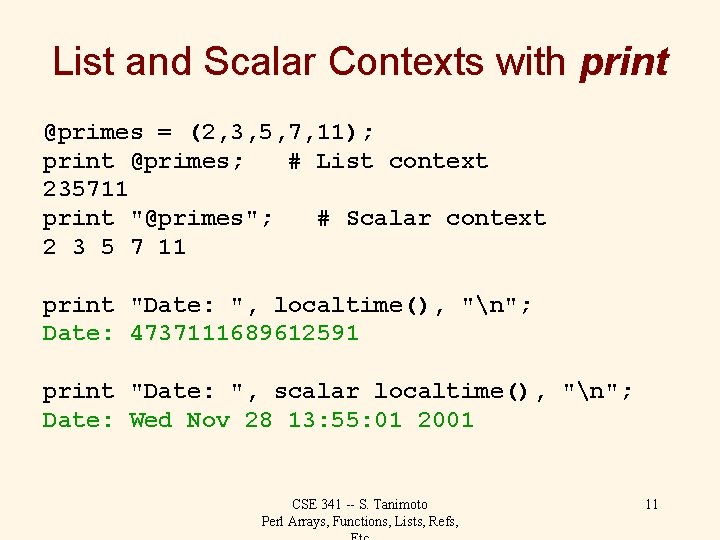
List and Scalar Contexts with print @primes = (2, 3, 5, 7, 11); print @primes; # List context 235711 print "@primes"; # Scalar context 2 3 5 7 11 print "Date: ", localtime(), "n"; Date: 4737111689612591 print "Date: ", scalar localtime(), "n"; Date: Wed Nov 28 13: 55: 01 2001 CSE 341 -- S. Tanimoto Perl Arrays, Functions, Lists, Refs, 11
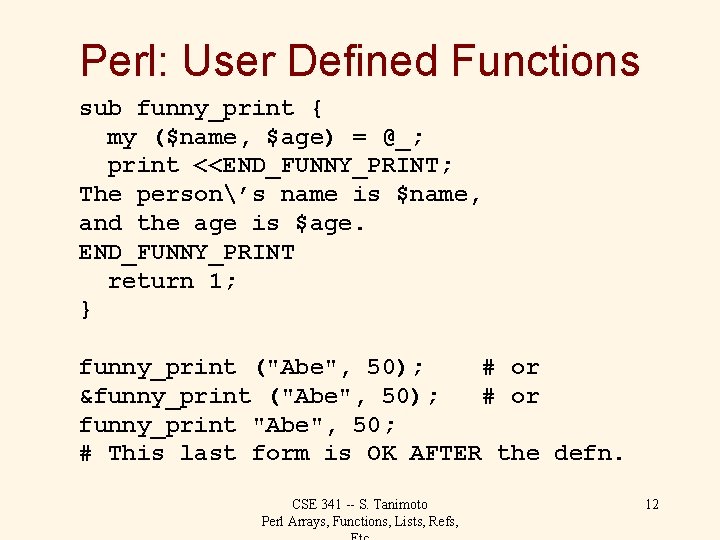
Perl: User Defined Functions sub funny_print { my ($name, $age) = @_; print <<END_FUNNY_PRINT; The person’s name is $name, and the age is $age. END_FUNNY_PRINT return 1; } funny_print ("Abe", 50); # or &funny_print ("Abe", 50); # or funny_print "Abe", 50; # This last form is OK AFTER the defn. CSE 341 -- S. Tanimoto Perl Arrays, Functions, Lists, Refs, 12
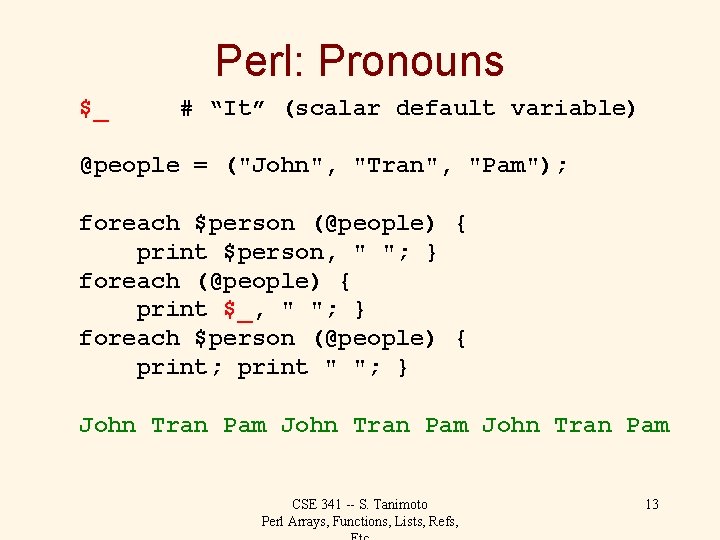
Perl: Pronouns $_ # “It” (scalar default variable) @people = ("John", "Tran", "Pam"); foreach $person (@people) { print $person, " "; } foreach (@people) { print $_, " "; } foreach $person (@people) { print; print " "; } John Tran Pam CSE 341 -- S. Tanimoto Perl Arrays, Functions, Lists, Refs, 13
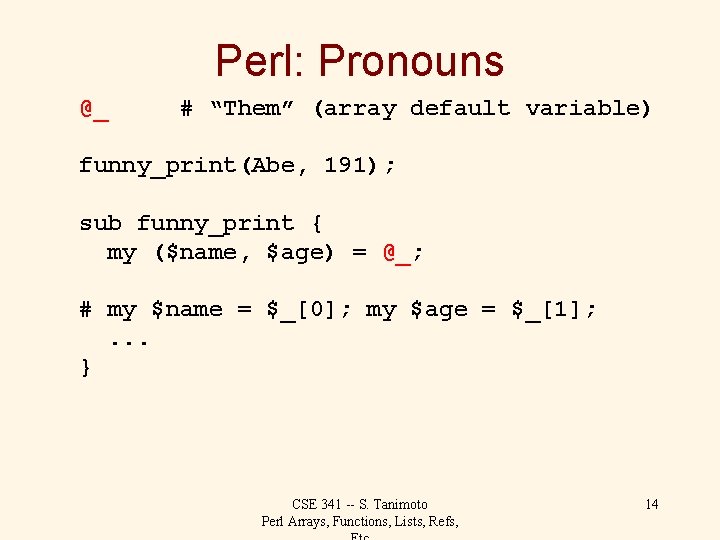
Perl: Pronouns @_ # “Them” (array default variable) funny_print(Abe, 191); sub funny_print { my ($name, $age) = @_; # my $name = $_[0]; my $age = $_[1]; . . . } CSE 341 -- S. Tanimoto Perl Arrays, Functions, Lists, Refs, 14
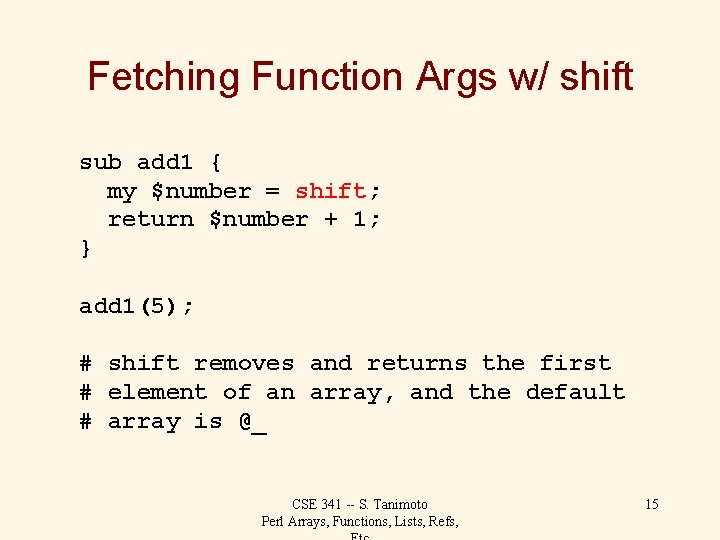
Fetching Function Args w/ shift sub add 1 { my $number = shift; return $number + 1; } add 1(5); # shift removes and returns the first # element of an array, and the default # array is @_ CSE 341 -- S. Tanimoto Perl Arrays, Functions, Lists, Refs, 15
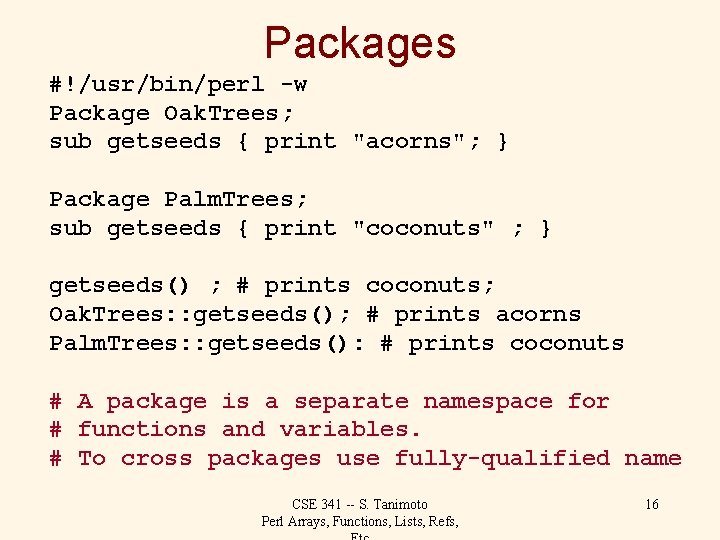
Packages #!/usr/bin/perl -w Package Oak. Trees; sub getseeds { print "acorns"; } Package Palm. Trees; sub getseeds { print "coconuts" ; } getseeds() ; # prints coconuts; Oak. Trees: : getseeds(); # prints acorns Palm. Trees: : getseeds(): # prints coconuts # A package is a separate namespace for # functions and variables. # To cross packages use fully-qualified name CSE 341 -- S. Tanimoto Perl Arrays, Functions, Lists, Refs, 16
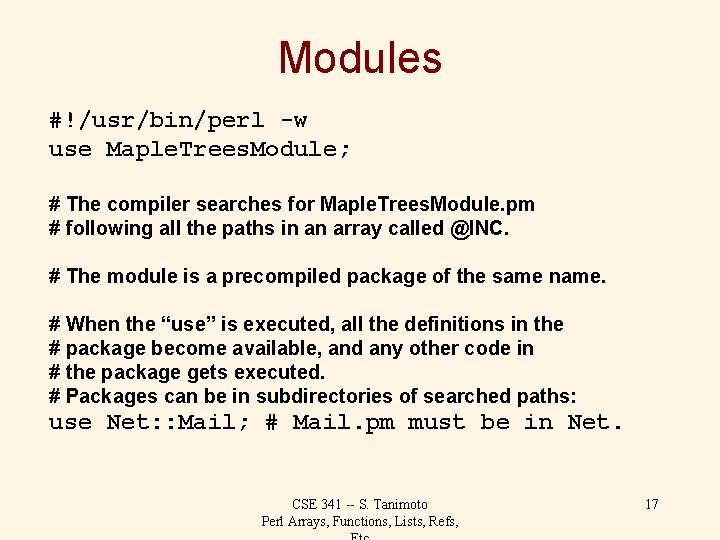
Modules #!/usr/bin/perl -w use Maple. Trees. Module; # The compiler searches for Maple. Trees. Module. pm # following all the paths in an array called @INC. # The module is a precompiled package of the same name. # When the “use” is executed, all the definitions in the # package become available, and any other code in # the package gets executed. # Packages can be in subdirectories of searched paths: use Net: : Mail; # Mail. pm must be in Net. CSE 341 -- S. Tanimoto Perl Arrays, Functions, Lists, Refs, 17
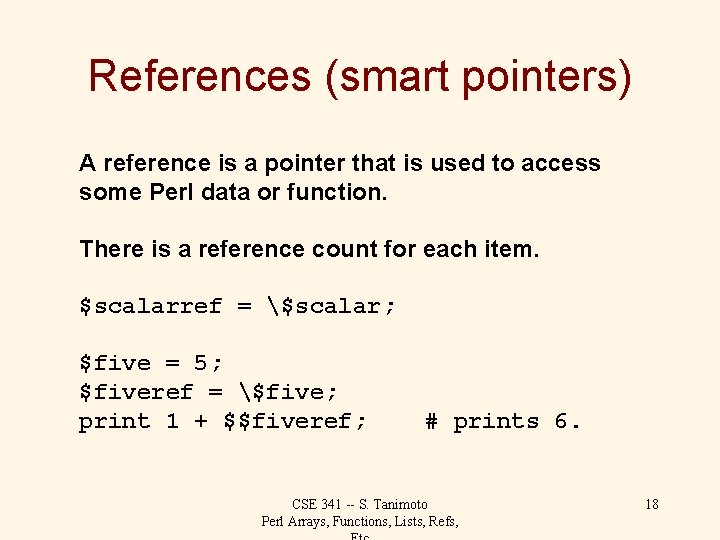
References (smart pointers) A reference is a pointer that is used to access some Perl data or function. There is a reference count for each item. $scalarref = $scalar; $five = 5; $fiveref = $five; print 1 + $$fiveref; # prints 6. CSE 341 -- S. Tanimoto Perl Arrays, Functions, Lists, Refs, 18
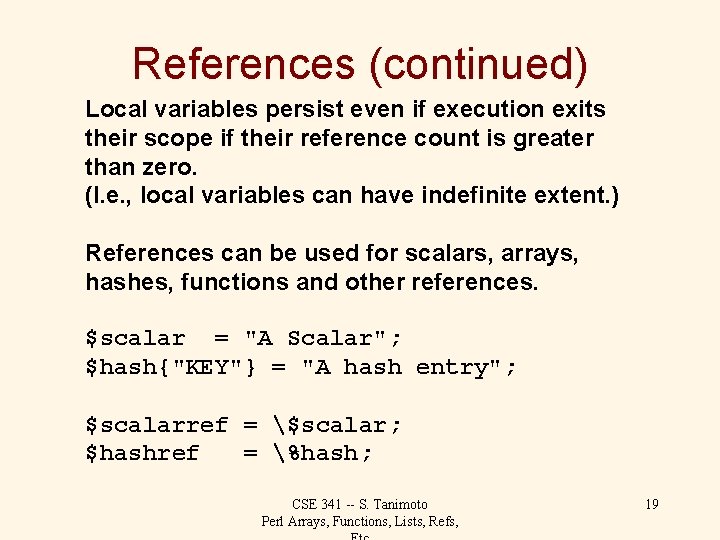
References (continued) Local variables persist even if execution exits their scope if their reference count is greater than zero. (I. e. , local variables can have indefinite extent. ) References can be used for scalars, arrays, hashes, functions and other references. $scalar = "A Scalar"; $hash{"KEY"} = "A hash entry"; $scalarref = $scalar; $hashref = %hash; CSE 341 -- S. Tanimoto Perl Arrays, Functions, Lists, Refs, 19
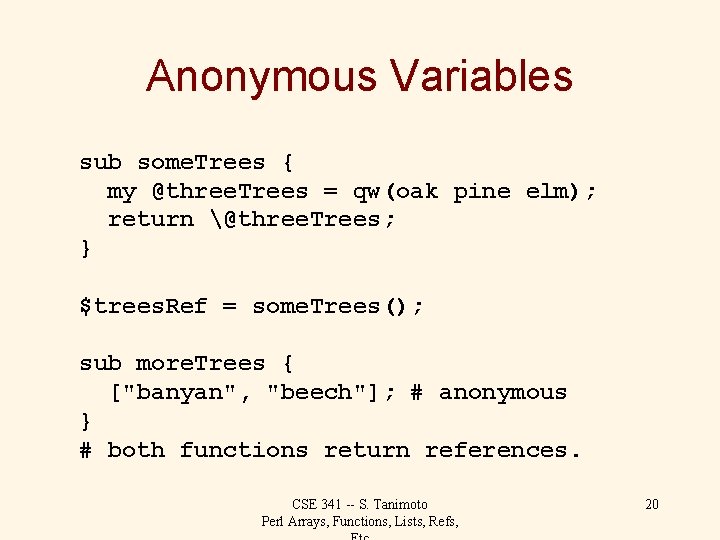
Anonymous Variables sub some. Trees { my @three. Trees = qw(oak pine elm); return @three. Trees; } $trees. Ref = some. Trees(); sub more. Trees { ["banyan", "beech"]; # anonymous } # both functions return references. CSE 341 -- S. Tanimoto Perl Arrays, Functions, Lists, Refs, 20