
Perkins CTE Distribution and Uses of Funds Perkins
Perkins CTE Distribution and Uses of Funds Perkins Fiscal Training Part II-October 15, 2012

Goals l Explain the distribution of Perkins funds to local consortia l Review required and permissive uses of funds l Provide guidelines for using the funds {Part I-Governance, 2012 -2013 funding, and requirements www. cte. mnscu. edu/professionaldevelopment }

Distribution of Perkins Funds to Local Consortia
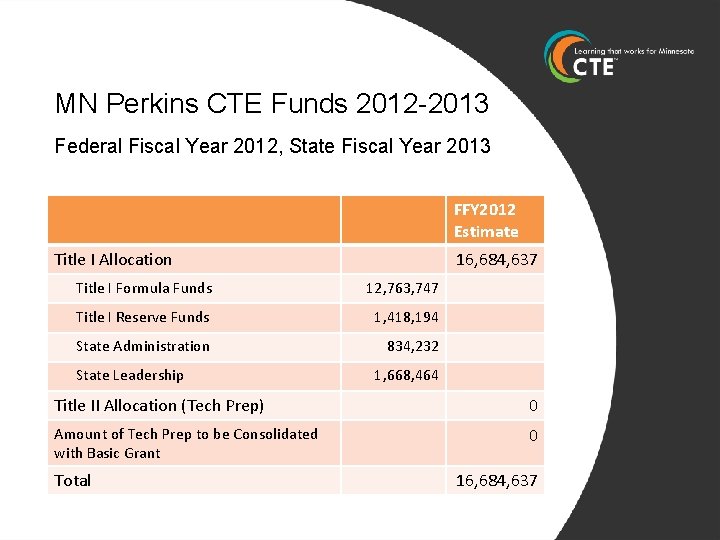
MN Perkins CTE Funds 2012 -2013 Federal Fiscal Year 2012, State Fiscal Year 2013 FFY 2012 Estimate Title I Allocation 16, 684, 637 Title I Formula Funds 12, 763, 747 Title I Reserve Funds 1, 418, 194 State Administration 834, 232 State Leadership 1, 668, 464 Title II Allocation (Tech Prep) 0 Amount of Tech Prep to be Consolidated with Basic Grant 0 Total 16, 684, 637
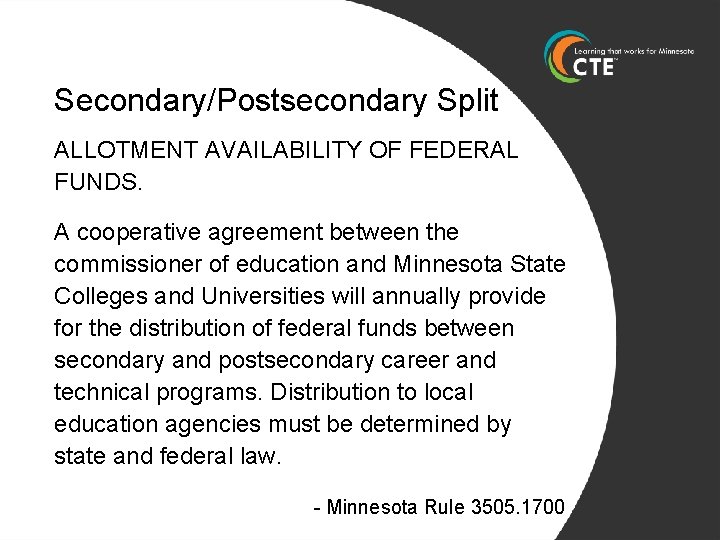
Secondary/Postsecondary Split ALLOTMENT AVAILABILITY OF FEDERAL FUNDS. A cooperative agreement between the commissioner of education and Minnesota State Colleges and Universities will annually provide for the distribution of federal funds between secondary and postsecondary career and technical programs. Distribution to local education agencies must be determined by state and federal law. - Minnesota Rule 3505. 1700
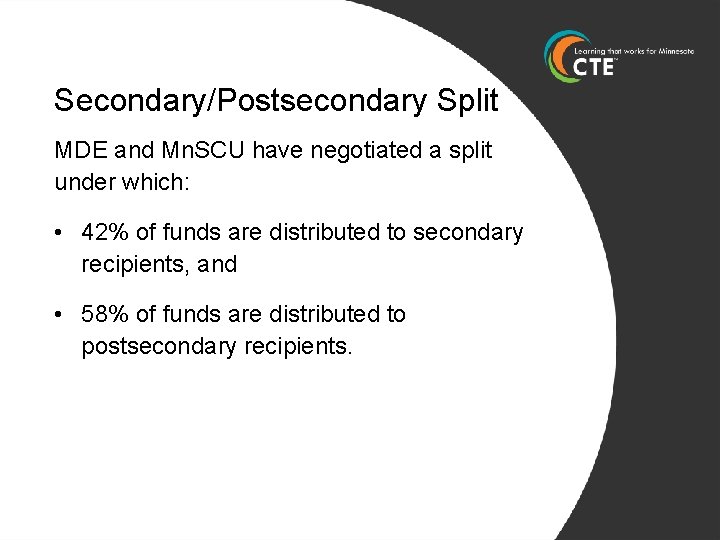
Secondary/Postsecondary Split MDE and Mn. SCU have negotiated a split under which: • 42% of funds are distributed to secondary recipients, and • 58% of funds are distributed to postsecondary recipients.
Secondary Distribution The Perkins Act specifies that once the split is determined, funds will be distributed to secondary recipients on the following basis: • 30% will be distributed on the basis of individuals between the ages of 5 and 17 inclusive using the most recent US Census data available • 70% will be distributed on the basis of individuals between the ages of 5 and 17 inclusive in households of poverty using the most recent US Census data available
Postsecondary Distribution The Perkins Act specifies that once the split is determined, funds will be distributed to postsecondary recipients on the following basis: • 100% will be distributed on the basis of individuals in career and technical education programs receiving PELL or Bureau of Indian Affairs assistance
Reserve Distribution The Perkins Act allows states to utilize an alternate method to distribute up to 10% of Perkins funds to address any of three factors: 1. rural areas; 2. areas with high percentages of career and technical education students; and 3. areas with high numbers of career and technical education students.
Reserve Distribution Minnesota opted to address two of these three factors for the distribution of reserve funds to local recipients: 1. rural areas; 2. areas with high numbers of career and technical education students.
Reserve Distribution The state distributes • half of the reserve on the basis of the geographic area of the consortium • half of the reserve on the basis of the number of CTE participants in secondary and postsecondary programs, weighted 3: 1 toward secondary participation to reflect programming formerly conducted under tech prep

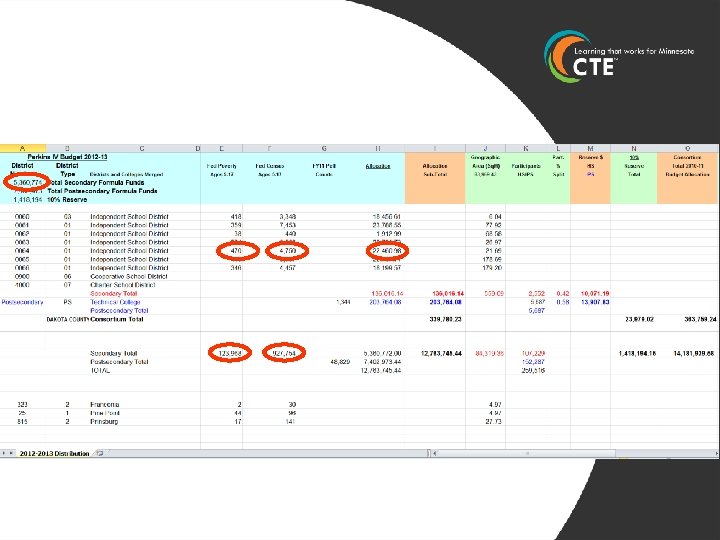
To better understand the process for distributing funds to Perkins consortia, please refer to the spreadsheet posted with the presentation documents.
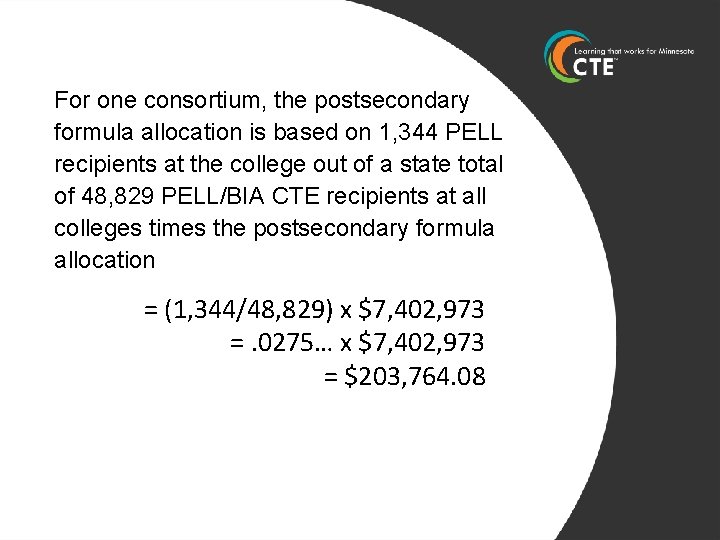
For one consortium, the postsecondary formula allocation is based on 1, 344 PELL recipients at the college out of a state total of 48, 829 PELL/BIA CTE recipients at all colleges times the postsecondary formula allocation = (1, 344/48, 829) x $7, 402, 973 =. 0275… x $7, 402, 973 = $203, 764. 08
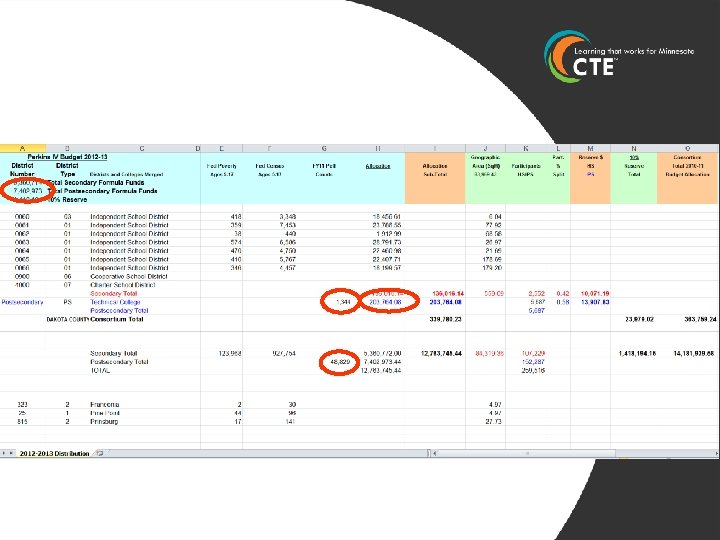
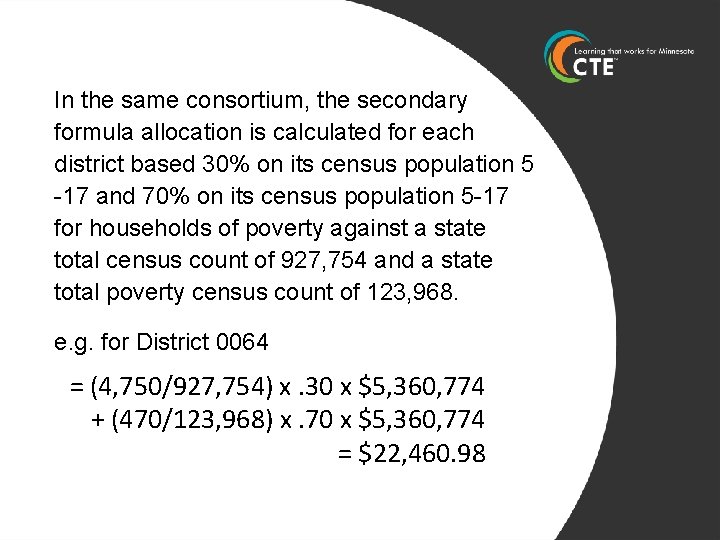
In the same consortium, the secondary formula allocation is calculated for each district based 30% on its census population 5 -17 and 70% on its census population 5 -17 for households of poverty against a state total census count of 927, 754 and a state total poverty census count of 123, 968. e. g. for District 0064 = (4, 750/927, 754) x. 30 x $5, 360, 774 + (470/123, 968) x. 70 x $5, 360, 774 = $22, 460. 98
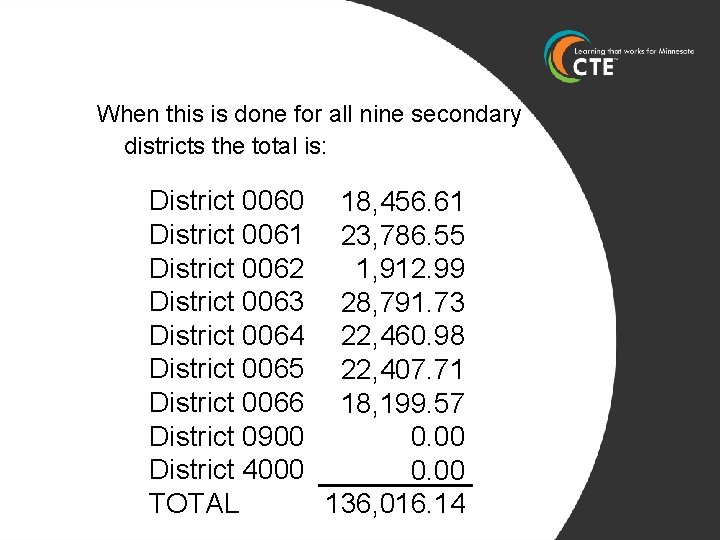
When this is done for all nine secondary districts the total is: District 0060 18, 456. 61 District 0061 23, 786. 55 District 0062 1, 912. 99 District 0063 28, 791. 73 District 0064 22, 460. 98 District 0065 22, 407. 71 District 0066 18, 199. 57 District 0900 0. 00 District 4000 0. 00 TOTAL 136, 016. 14
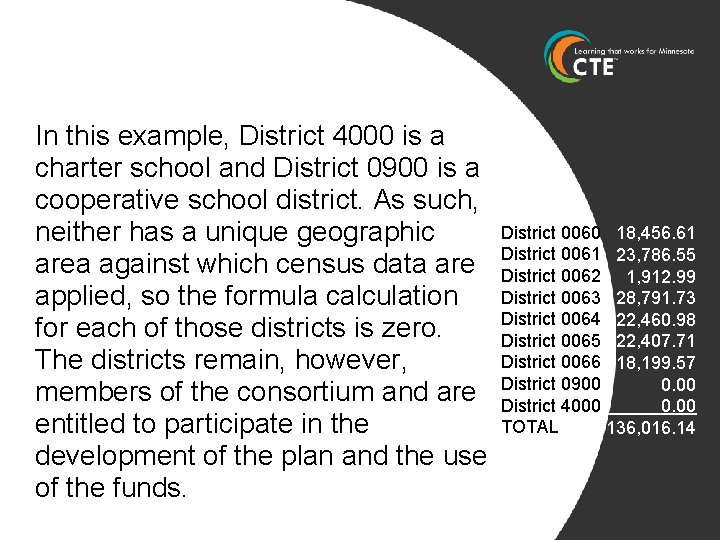
In this example, District 4000 is a charter school and District 0900 is a cooperative school district. As such, neither has a unique geographic area against which census data are applied, so the formula calculation for each of those districts is zero. The districts remain, however, members of the consortium and are entitled to participate in the development of the plan and the use of the funds. District 0060 District 0061 District 0062 District 0063 District 0064 District 0065 District 0066 District 0900 District 4000 TOTAL 18, 456. 61 23, 786. 55 1, 912. 99 28, 791. 73 22, 460. 98 22, 407. 71 18, 199. 57 0. 00 136, 016. 14
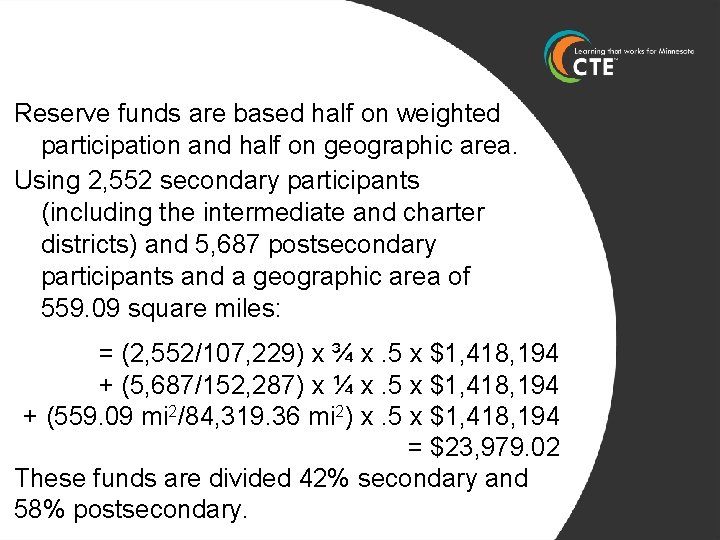
Reserve funds are based half on weighted participation and half on geographic area. Using 2, 552 secondary participants (including the intermediate and charter districts) and 5, 687 postsecondary participants and a geographic area of 559. 09 square miles: = (2, 552/107, 229) x ¾ x. 5 x $1, 418, 194 + (5, 687/152, 287) x ¼ x. 5 x $1, 418, 194 + (559. 09 mi 2/84, 319. 36 mi 2) x. 5 x $1, 418, 194 = $23, 979. 02 These funds are divided 42% secondary and 58% postsecondary.
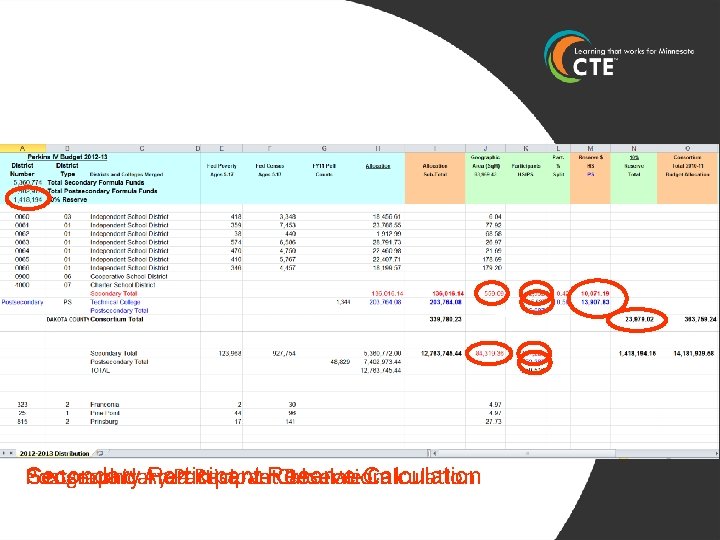
Postsecondary Geographic Area Participant Reserve Calculation Secondary Participant
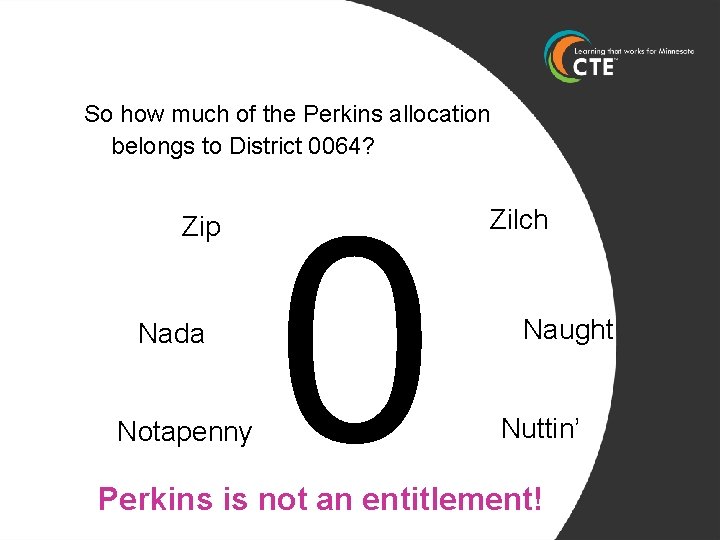
So how much of the Perkins allocation belongs to District 0064? Zip Nada Notapenny 0 Zilch Naught Nuttin’ Perkins is not an entitlement!
Minnesota relies on the language from Section 131(f)(2) of the Perkins Act which states: "Funds allocated to a consortium. . . shall be used only for purposes and programs that are mutually beneficial to all members of the consortium. . Such funds may not be reallocated to individual members of the consortium for purposes or programs benefitting only 1 member of the consortium. "

Reallocation: Funds are received by the local consortium for the period of the state fiscal year only (July 1 through June 30). At the end of this period, unused funds are returned to the state.
The state will combine funds returned from both the secondary and postsecondary levels into a single pot and will redistribute those funds to all local consortia on the basis of the distribution formula without using the reserve calculation. We hope to generally do this as early in the Fall as possible.
• Redistributed funds will be handled as a separate award and accounts will reflect the federal fiscal year under which the funds were first granted (prior to redistribution). • Funds will be used in accordance with the current year’s local plan – any changes must be approved by state staff. • Once allocated, redistributed funds should be used before the current year funds – First In/First Out.
Uses of Perkins Funds
General Authority Each eligible recipient that receives funds under this part shall use such funds to improve career and technical education programs. - Carl D. Perkins Career and Technical Education Act, Section 135
Required Activities The Act requires that certain activities be conducted within career and technical education programs if supported with federal funds. The Act does not require locals to use federal funds for these activities, but all required activities must be addressed in the local plan if Perkins funds are received.
1. Integration of academics (or liberal arts and sciences) with career and technical education programs 2. Link CTE at the secondary and postsecondary levels through at least one program of study (MN State Plan requires at least seven/consortium) 3. Provide students with understanding of all aspects of an industry 4. Develop, improve or expand the use of technology in CTE
5. Provide in-service and pre-service professional development 6. Develop and implement CTE program evaluations 7. Initiate, improve, expand modernize quality CTE programs 8. Provide services that are of sufficient size, scope and quality to be effective
9. Provide activities to prepare special populations for high-skill, high-wage, or high-demand occupations that will lead to self-sufficiency Minnesota has two additional required activities: 10. Collaboration/Brokering of Service/Continuum of Services 11. Articulation, PSEO, Concurrent Enrollment, or other recognized strategies
Permissible Activities The Act allows certain activities to be conducted within career and technical education programs IF required activities have been addressed.
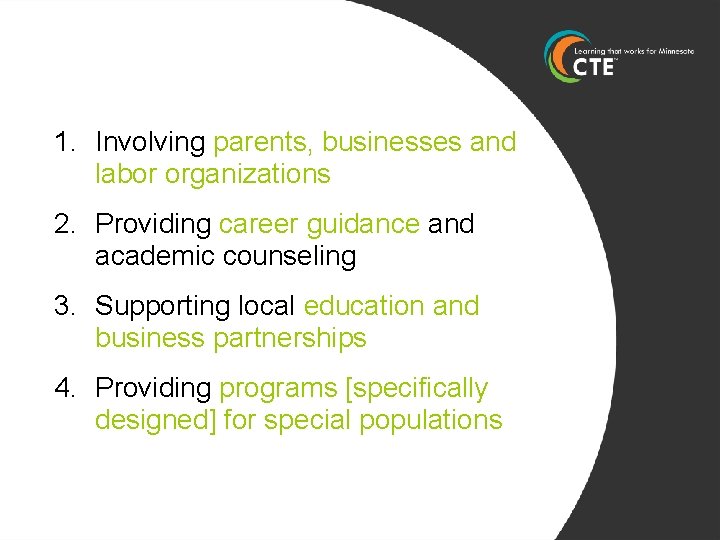
1. Involving parents, businesses and labor organizations 2. Providing career guidance and academic counseling 3. Supporting local education and business partnerships 4. Providing programs [specifically designed] for special populations
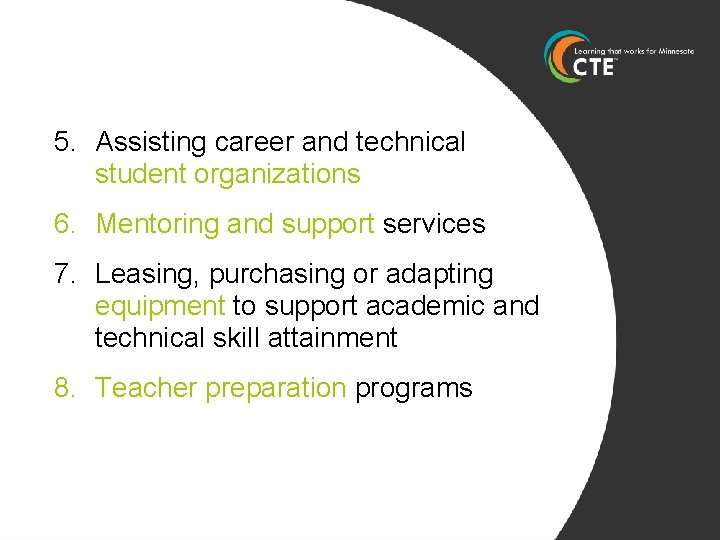
5. Assisting career and technical student organizations 6. Mentoring and support services 7. Leasing, purchasing or adapting equipment to support academic and technical skill attainment 8. Teacher preparation programs
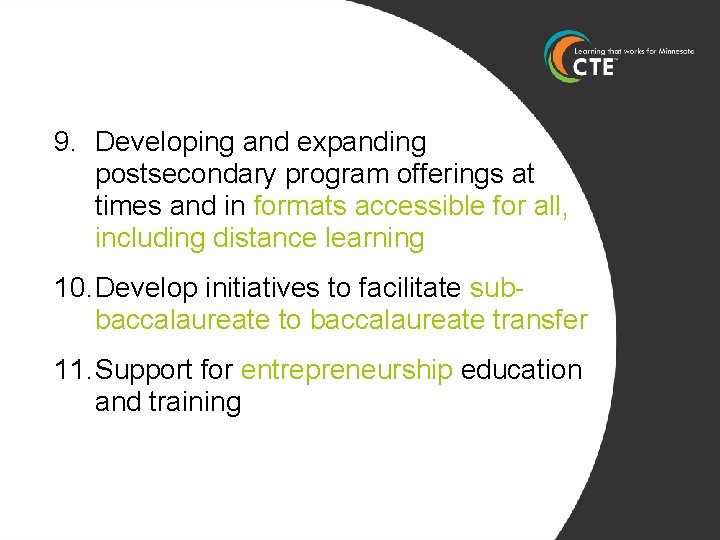
9. Developing and expanding postsecondary program offerings at times and in formats accessible for all, including distance learning 10. Develop initiatives to facilitate subbaccalaureate to baccalaureate transfer 11. Support for entrepreneurship education and training
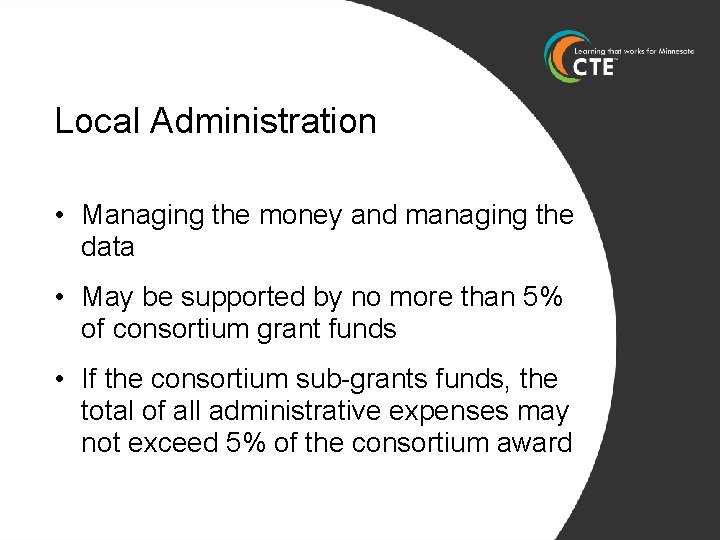
Local Administration • Managing the money and managing the data • May be supported by no more than 5% of consortium grant funds • If the consortium sub-grants funds, the total of all administrative expenses may not exceed 5% of the consortium award
Guidelines for Using Funds
Fiscal Host Responsibility • Receive and safeguard grant funds on behalf of the consortium in accordance with state and federal requirements • Maintain separate disbursement records and receipts, make financial records/documentation available • Disburse funds in accordance with the grant
Funds allocated to a consortium shall be used only for the purposes and programs mutually beneficial and agreed to by all members of the consortium and may not be reallocated to individual members for programs benefitting only one member.
Administrative costs are for those activities necessary for proper and efficient performance of eligible agency duties, i. e. fiscal support, supervision of activities, records retention, etc. The 5% administration cap includes indirect costs and costs for staff not directly related to a specific goal/objective of the grant.
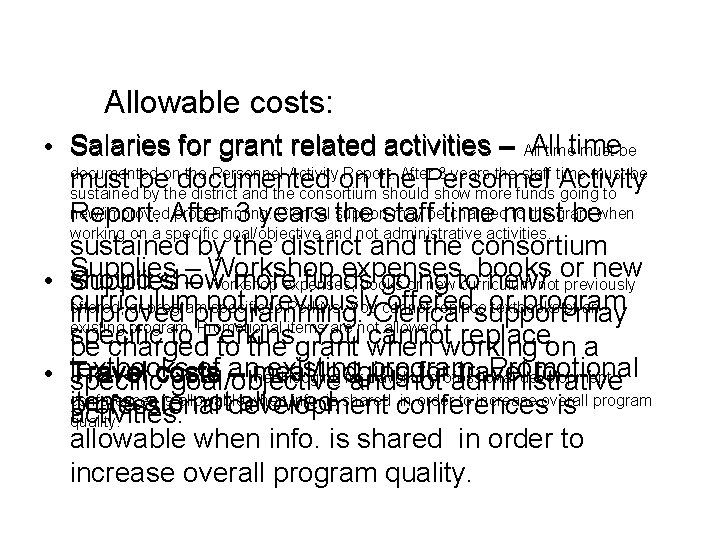
Allowable costs: • Salaries for grant related activities – All time must be documented on the Personnel Activity Report. After 3 years the staff time must be documented on the Personnel Activity sustained by the district and the consortium should show more funds going to new/improved. After programming. Clerical support may betime chargedmust to the grant Report. 3 years the staff bewhen working on a specific goal/objective and not administrative activities. sustained by the district and the consortium Workshop expenses, books new – should show more funds going new/notor • Supplies – Workshop expenses, books or new to curriculum previously offered, program offered, or programnot specific to Perkins. You cannot replace or textbooks of an improved programming. Clerical support may existing program. Promotional items are not allowed. specific to Perkins. You cannot replace be charged to the grant when working on a of an existing program. Promotional Travel costs – meal/lodging travel to • textbooks for travel tofor professional development specific goal/objective and not administrative conferences is allowable when info. is shared conferences in order to increase overall program items are not allowed. professional development is activities. quality. allowable when info. is shared in order to increase overall program quality.
Sub-distributions • Consortia may sub-distribute funds on a competitive or other basis that supports the consortium as a whole • The consortium may NOT sub-distribute funds on a formula basis • Authority for spending decisions of the consortium must remain at the level of the consortium
Sub-awards – funds distributed by fiscal host to a member district, college or outside entity in order to carry out a goal/objective on behalf of the consortium. • MDE grant – UFARS – FIN 428/628 and FIN 475/675, OBJ codes 303/304 • Mn. SCU—fiscal host college expends funds from Basic GL 384131, Reserve GL 384132 or Reallocated GL 384135 and a subrecipient college receipts and expends funds from Subgrant GL 384134
Supplement, Not Supplanting is the unlawful use of federal funds to displace state or local funds.
Supplement, Not Supplanting is determined on a case-bycase basis. Federal funds cannot displace state or local funds, but a local entity may (in rare cases) use federal funds to support an activity if the local entity can prove that the activity would not have occurred without the federal expenditure.
Supplement not Supplant – Federal funds may not be used to pay for services, staff, programs or materials that would otherwise be paid with state/ local funds. State/local funds must be used for all activities that are the district/organization responsibility. • Test #1 – Was the activity paid for in the prior year with non-federal funds? • Test #2 – Was the activity required by state/local law or policy? If the district can prove in the absence of federal funds it would have eliminated the activity, it may use the federal funds to support the activity, if allowable under Perkins.
Example 1 – The Legislature reduced state funding by 6% resulting in a reduction in force that includes 3 CTE instructors. The district may use federal funds to support those positions. The district must retain evidence (e. g. legislation and school board minutes) to support its action.
Example 2 – The school district needs to replace mathematics textbooks and decides to shift state/local funds from CTE to mathematics to make this purchase and to maintain the CTE program with federal funds. Since in absence of federal funds the mathematics expenditure shift would not be made, this is unlawful supplanting.
ALWAYS check with the state before entertaining any spending decision that may be construed as supplanting!
Equipment Inventories All equipment must be labeled as Perkins and listed on an Equipment Record An equipment inventory has been provided to secondary fiscal agents and must be updated and submitted annually For postsecondary fiscal agents, the ISRS inventory must be updated annually
Indirect Costs Indirect costs are the assignable costs of items such as heat and light to an academic program, and those expenses that benefit the entire entity and, therefore, cannot be directly charged to a specific cost category or project activity. Indirect costs are allowable, but must be included as part of the 5% administrative set-aside.
Perkins CTE Financial Questions • Please input your questions on the chat function.
Perkins CTE Financial Resources: MN CTE Website www. cte. mnscu. edu/ – Perkins IV Operational Handbook Section III p. 24 Financial Requirements www. cte. mnscu. edu/consortium_resources/index. – FY 12 Local Application Section III Resources www. cte. mnscu. edu/forms/index. html – Home page-FAQs www. cte. mnscu. edu/index. html
Perkins CTE Financial Training Webinars • Perkins Fiscal Procedures and Requirements– Postsecondary Wednesday, October 17, 2012, 1: 00 – 2: 00 pm • Perkins Fiscal Procedures and Requirements – Secondary Wednesday, October 24 , 2012, 10: 00 -11: 00 am www. cte. mnscu. edu
Upcoming events: • Annual Perkins Consortium Coordinators Meeting November 14, 2012 Minnesota Department of Education, Roseville, MN • CTE Works! Career & Technical Education Conference November 15, 2012 Crowne Plaza West, Plymouth, MN • http: //www. cte. mnscu. edu/events/index. html
Thanks for joining us today! We value your feedback about today’s session. Please click on the link in the chat window now to complete the session evaluation form or go to: http: //www. cte. mnscu. edu/professionaldevelopmnindex. html and find the “Evaluation” link for this webinar. REMINDER: For secondary participants, Continuing Education Units (CEU’s) will be made available for teachers for this series of webinars. In order to get the necessary certificates you MUST complete the session evaluation. Slide 26
Presenters Jo. Ann Simser, State CTE Director, joann. simser@so. mnscu. edu 651 -201 -1650 Shannon Kohlman, Grant Accountant, shannon. kohlman@so. mnscu. edu 612 -548 -2067 Minnesota State Colleges and Universities Dan Smith, Supervisor, Center for Postsecondary Success, dan. smith@state. mn. us 651 -582 -8339 Minnesota Department of Education
Thank you for all you do for CTE in Minnesota…
- Slides: 58