
Peritoneum and Peritoneal Cavity 2 ND YEAR MBBS
Peritoneum and Peritoneal Cavity 2 ND YEAR MBBS ANATOMY LECTURE DR ABEERA/DR MOHAMMED ZUBAIR
Introduction: The peritoneum is a thin serous membrane that line the walls of the abdominal and pelvic cavities and cover the organs within these cavities Parietal peritoneum -lines the walls of the abdominal and pelvic cavities Visceral peritoneum -covers the organs Peritoneal cavity -the potential space between the parietal and visceral layer of peritoneum, in the male, is a closed sac, but in the female, there is a communication with the exterior through the uterine tubes, the uterus, and the vagina. When the peritoneum folds while following the lining of the organs, it forms pouches (recesses) which can be filled with fluid if there is an ongoing inflammation of adjacent organs. Examples of such recesses are the inferior recess of the lesser sac formed by the folding of the greater omentum, and the recto-uterine pouch (of Douglas) found between the uterus and rectum in females.
Function: Secretes a lubricating serous fluid that continuously moistens the associated organs Absorb Support viscera
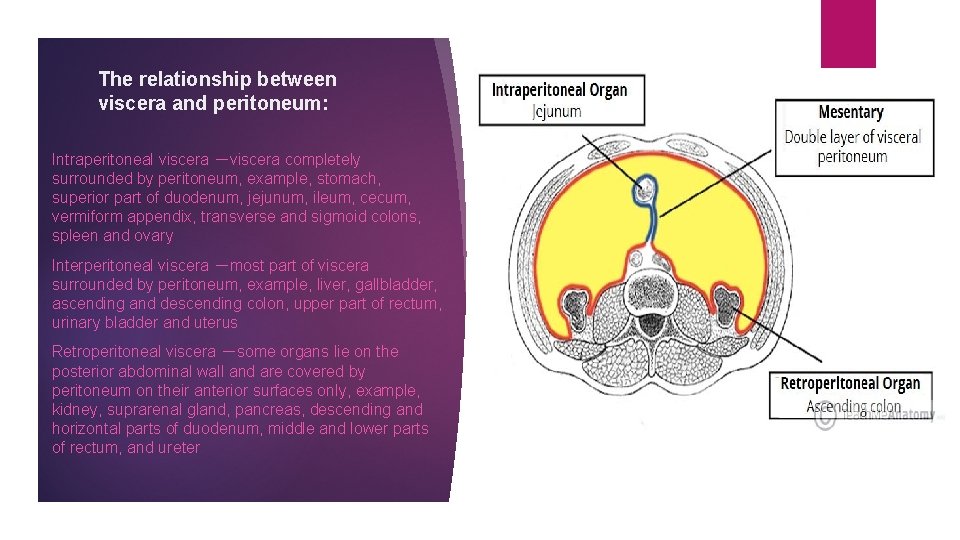
The relationship between viscera and peritoneum: Intraperitoneal viscera -viscera completely surrounded by peritoneum, example, stomach, superior part of duodenum, jejunum, ileum, cecum, vermiform appendix, transverse and sigmoid colons, spleen and ovary Interperitoneal viscera -most part of viscera surrounded by peritoneum, example, liver, gallbladder, ascending and descending colon, upper part of rectum, urinary bladder and uterus Retroperitoneal viscera -some organs lie on the posterior abdominal wall and are covered by peritoneum on their anterior surfaces only, example, kidney, suprarenal gland, pancreas, descending and horizontal parts of duodenum, middle and lower parts of rectum, and ureter
A useful mnemonic to help in recalling which abdominal viscera are retroperitoneal is SAD PUCKER: • S = Suprarenal (adrenal) Glands • A = Aorta/IVC • D =Duodenum (except the proximal 2 cm, the duodenal cap) • P = Pancreas (except the tail) • U = Ureters • C = Colon (ascending and descending parts) • K = Kidneys • E = (O)esophagus • R = Rectum
Structures which are formed by peritoneum: Mesentery: mesentery proper, transverse mesocolon, sigmoid mesocolon, mesoappendix Omenta: greater omentum, lesser omentum Peritoneal ligaments: hepatogastric, hepatoduodenal, gastrophrenic, gastrosplenic, splenorenal, gastrocolic ligament
OMENTUM: Two-layered fold of peritoneum that extends from stomach to adjacent organs Lesser omentum: two-layered fold of peritoneum which extends from porta hepatis to lesser curvature of stomach and superior part of duodenum. It consists of two parts: the hepatogastric ligament (the flat, broad sheet) and the hepatoduodenal ligament (the free edge, containing the portal triad). Hepatogastric ligament -extends from porta hepatis to lesser curvature of stomach Hepatoduodenal ligament - Extends from porta hepatis to superior part of duodenum.
Greater Omentum: four-layered fold of peritoneum, the anterior two layers descend from the greater curvature of stomach and superior part of duodenum and hangs down like an apron in front of coils of small intestine, and then turns upward and attaches to the transverse colon. It has a role in immunity and is sometimes referred to as the ‘abdominal policeman’ because it can migrate to infected viscera or to the site of surgical disturbance. If an infection occurs in the intestine, plasma cells formed in the lymph nodes combat the infection and help prevent it from spreading to the peritoneum.
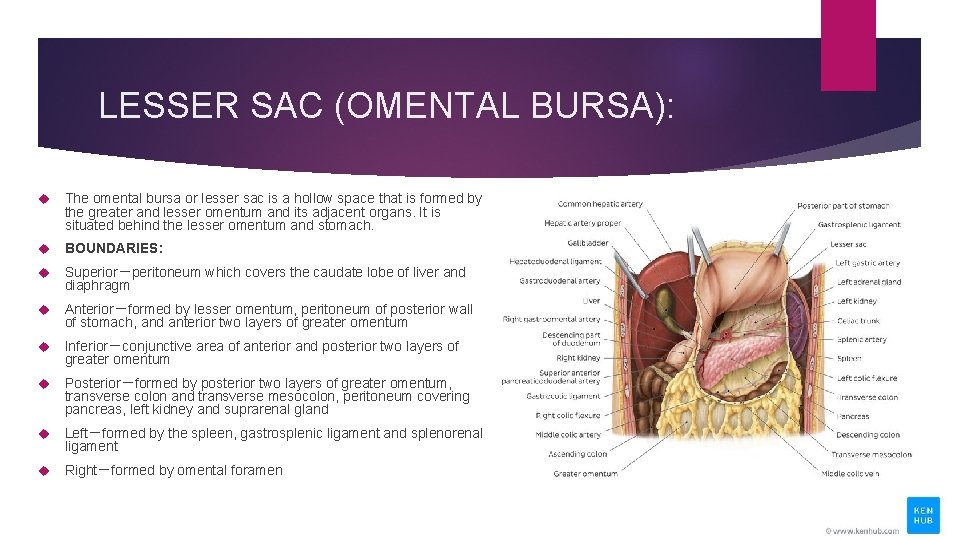
LESSER SAC (OMENTAL BURSA): The omental bursa or lesser sac is a hollow space that is formed by the greater and lesser omentum and its adjacent organs. It is situated behind the lesser omentum and stomach. BOUNDARIES: Superior-peritoneum which covers the caudate lobe of liver and diaphragm Anterior-formed by lesser omentum, peritoneum of posterior wall of stomach, and anterior two layers of greater omentum Inferior-conjunctive area of anterior and posterior two layers of greater omentum Posterior-formed by posterior two layers of greater omentum, transverse colon and transverse mesocolon, peritoneum covering pancreas, left kidney and suprarenal gland Left-formed by the spleen, gastrosplenic ligament and splenorenal ligament Right-formed by omental foramen
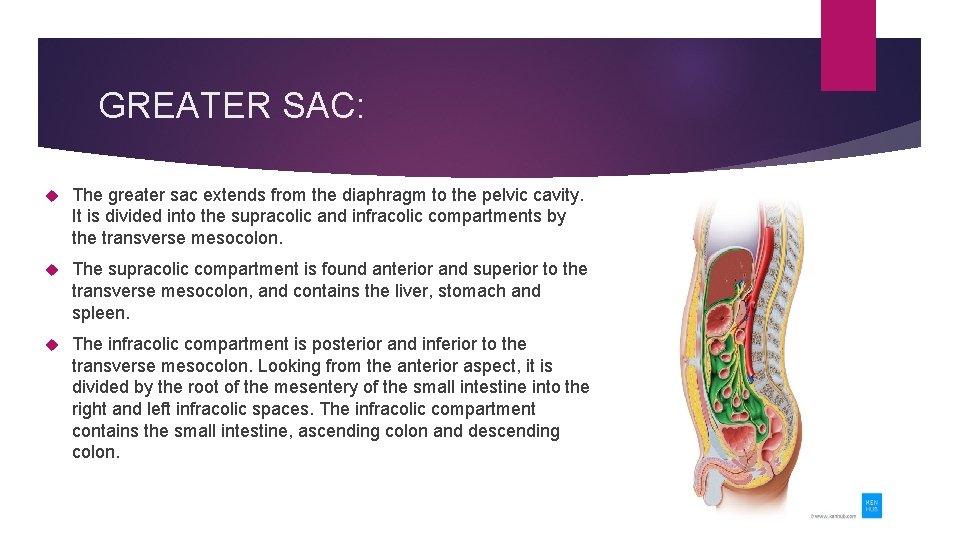
GREATER SAC: The greater sac extends from the diaphragm to the pelvic cavity. It is divided into the supracolic and infracolic compartments by the transverse mesocolon. The supracolic compartment is found anterior and superior to the transverse mesocolon, and contains the liver, stomach and spleen. The infracolic compartment is posterior and inferior to the transverse mesocolon. Looking from the anterior aspect, it is divided by the root of the mesentery of the small intestine into the right and left infracolic spaces. The infracolic compartment contains the small intestine, ascending colon and descending colon.
OMENTAL FORAMEN: The Omental bursa (lesser sac) communicates with the greater sac through the omental foramen or EPIPLOIC FORAMEN OF WINSLOW. Present behind the right border of hepatoduodenal ligament BOUNDARIES: Superior-caudate lobe of liver Inferior-superior part of duodenum Anterior-hepatodudenal ligament Posterior-peritoneum covering the inferior vena cava
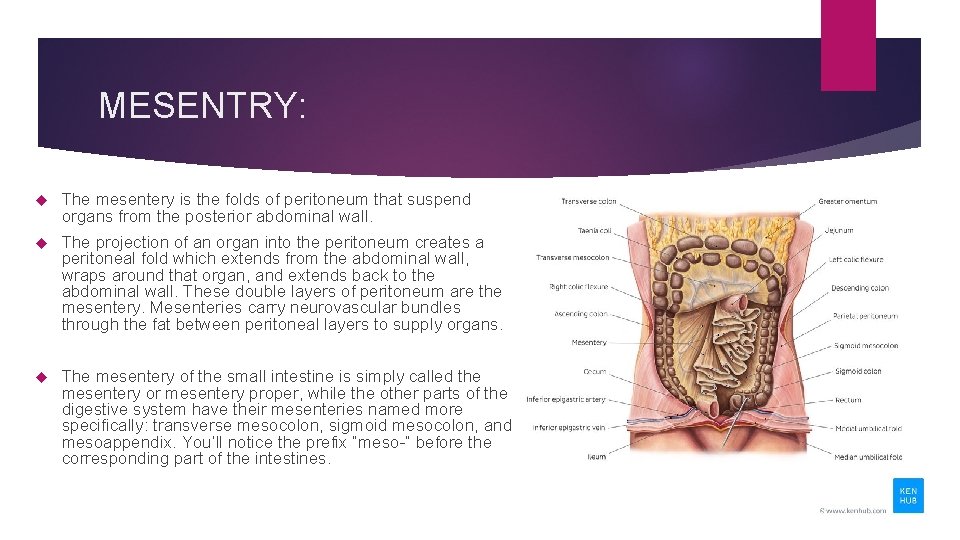
MESENTRY: The mesentery is the folds of peritoneum that suspend organs from the posterior abdominal wall. The projection of an organ into the peritoneum creates a peritoneal fold which extends from the abdominal wall, wraps around that organ, and extends back to the abdominal wall. These double layers of peritoneum are the mesentery. Mesenteries carry neurovascular bundles through the fat between peritoneal layers to supply organs. The mesentery of the small intestine is simply called the mesentery or mesentery proper, while the other parts of the digestive system have their mesenteries named more specifically: transverse mesocolon, sigmoid mesocolon, and mesoappendix. You’ll notice the prefix “meso-” before the corresponding part of the intestines.
PERITONEAL LIGAMENTS: Peritoneal ligaments are duplicatures of the peritoneum and can make up parts of the omenta. They have two main functions: To attach organs to the abdominal wall and/or to other abdominal organs and hold them in position To carry neurovascular structures which supply abdominal organs Based on from which they originate, peritoneal ligaments are classified as splenic, gastric or hepatic ligaments. Notable ligaments include the hepatogastric ligament and hepatoduodenal ligament which make up the lesser omentum. The hepatoduodenal ligament carries the portal triad – hepatic portal vein, hepatic artery proper, common bile duct. The gastrophrenic ligament, gastrosplenic ligament, gastrocolic ligament and splenorenal ligament form part of the greater omentum.

Peritoneal ligaments Splenic ligaments Phrenicocolic ligament (sustentaculum lienis) Gastrosplenic ligament Splenorenal (lienorenal) ligament Gastric ligaments Gastrophrenic ligament Gastrocolic ligament Hepatic ligaments Falciform ligament Gastrohepatic ligament Hepatoduodenal ligament
Folds and recesses of posterior abdominal wall: Superior duodenal fold and recess Inferior duodenal fold and recess Intersigmoid recess -formed by the inverted V attachment of sigmoid mesocolon Retrocecal recess -in which the appendix frequenty lies Hepatorenal recess -lies between the right lobe of liver, right kidney, and right colic flexure, and is the lowest parts of the peritoneal cavity when the subject is supine
Folds and fossas of anterior abdominal wall: Medial umbilical fold -contain the remnant of urachus (median umbilical ligaments) Medial umbilical fold -contains remnants of the umbilical arteries (medial umbilical ligaments) Lateral umbilical fold -contains the inferior epigastric vessels Supravesical fossa Medial inguinal fossa Lateral inguinal fossa
POUCHES: In male -rectovesical pouch In female Rectouterine pouch -between rectum and uterus Vesicouterine pouch -between bladder and uterus
Peritoneal subdivisions The transverse colon and transverse mesocolon divides the greater sac into supracolic and infracolic compartments. Supracolic compartments (subphrenic space)-lies between diaphragm and transverse colon and transverse mesocolon Suprahepatic recess lies between the diaphragm and liver-the falciform ligament divides it into right and left suprahepatic recesses Left suprahepatic recesses left anterior suprahepatic spaces left posterior suprahepatic spaces Right suprahepatic recesses right anterior suprahepatic spaces right posterior suprahepatic spaces bare area of live (extraperitoneal space)
Infrahepatic recess lies between the live and transverse colon and transverse mesocolon-the ligamentum teres hepatic divides it into right and left infrahepatic recesses Right infrahepatic recesses (hepatorenal recess) Left infrahepatic recesses left anterior infrahepatic space left posterior infrahepatic space Infracolic compartments -lies below the transverse colon and transverse mesocolon Right paracolic sulcus (gutter) -lies lateral to the ascending colon. It communicates with the hepatorenal recess and the pelvic cavity. It provides a route for the spread of infection between the pelvic and the upper abdominal region. Left paracolic sulcus (gutter) -lies lateral to the descending colon. It is separated from the area around the spleen by the phrenicocolic ligament, a fold of peritoneum that passes from the colic flexure to the diaphragm.
CLINICAL RELATIONS: Ascites by definition is accumulation of more than 20 milliliters of fluid within the peritoneal cavity. The most common cause is increased pressure in the hepatic portal vein, portal hypertension. Portal hypertension is most often seen in people with liver cirrhosis. Ascites clinically presents as a bulging belly showing waves of moving fluid when gently struck – this is not the case for fat tissue. The diagnosis of ascites is by physical examination and medical imaging. The ideal treatment of ascites is directed towards its cause together with dietary restrictions of sodium because sodium promotes fluid retention. In any case, it is important to treat ascites as a potential complication of this state is peritonitis – inflammation of the peritoneum.
Peritonitis: Peritonitis is an inflammation of the peritoneum. In most cases it emerges as a complication of ascites. Peritonitis is usually caused by intestinal bacteria which find their way to the peritoneum via lymph (lymphatic dissemination) or ruptured bowel. Patients usually experience fever, mental confusion, abdominal pain and notable ascites. So any patient with diagnosed ascites and sudden onset of these symptoms should be examined for peritonitis. The easiest way to diagnose peritonitis is to extract a small amount of peritoneal fluid and perform microbiological analysis to confirm the presence of bacteria and inflammatory cells. Peritonitis is treated with antibiotics.
Peritoneal Adhesions: Damage to the peritoneum can occur as a result of infection, surgery or injury. The resulting inflammation and repair may cause the formation of fibrous scar tissue. This can result in abnormal attachments between the visceral peritoneum of adjacent organs or between visceral and parietal peritoneum. Such adhesions can result in pain and complications such as volvulus, when the intestine becomes twisted around an adhesion resulting in a bowel obstruction.
Referred Pain: Pain from the viscera is poorly localised. As described earlier, it is referred to areas of skin (dermatomes) which are supplied by the same sensory ganglia and spinal cord segments as the nerve fibres innervating the viscera. Pain is referred according to the embryological origin of the organ; thus pain from foregut structures are referred to the epigastric region, midgut structures are to the umbilical region and hindgut structures to the pubic region of the abdomen. Foregut – oesophagus, stomach, pancreas, liver, gallbladder and the duodenum (proximal to the entrance of the common bile duct). Midgut – duodenum (distal to the entrance of the common bile duct) to the junction of the proximal two thirds of the transverse colon with the distal third. Hindgut – distal one third of the transverse colon to the upper part of the anal canal. Pain in retroperitoneal organs (e. g. kidney, pancreas) may present as back pain. Irritation of the diaphragm (e. g. as a result of inflammation of the liver, gallbladder or duodenum) may result in shoulder tip pain. Referred Pain in Appendicitis Initially, pain from the appendix (midgut structure) and its visceral peritoneum is referred to the umbilical region. As the appendix becomes increasingly inflamed, it irritates the parietal peritoneum, causing the pain to localise to the right lower quadrant.
- Slides: 23