
Peripheral Nervous System General anatomy of PNS Cranial
- Slides: 24
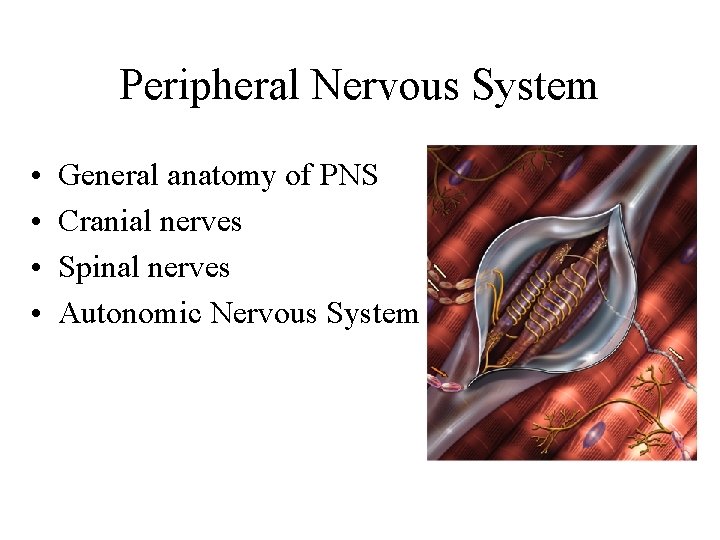
Peripheral Nervous System • • General anatomy of PNS Cranial nerves Spinal nerves Autonomic Nervous System
I. Subdivisions of the PNS A. Major Components – Sensory (afferent) division carries sensory signals from receptors to CNS – Motor (efferent) division carries motor signals from CNS to effectors (glands and muscles) B. Subdivisions – Somatic Nervous System (SNS) includes all nerves controlling the muscular system and external sensory receptors. External sense organs (including skin) are receptors. – The Autonomic Nervous System (ANS) consists of motor neurons that control internal organs. Sympathetic Division- involved in the fight or flight response. Parasympathetic Division- involved in conservation of energy
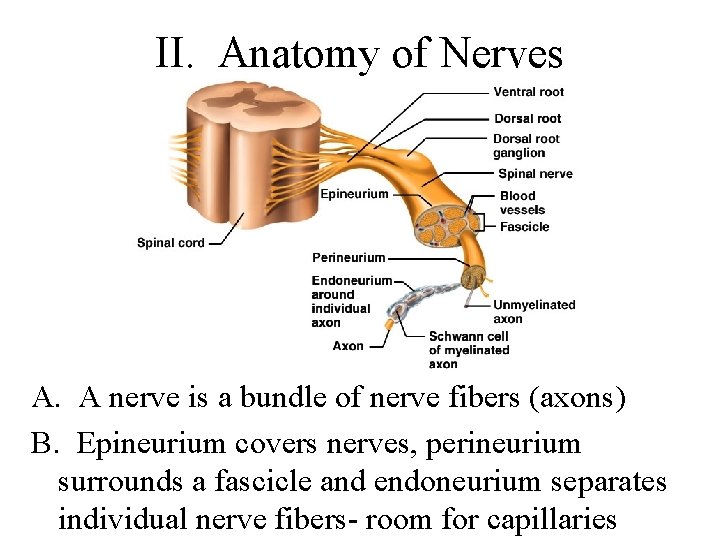
II. Anatomy of Nerves A. A nerve is a bundle of nerve fibers (axons) B. Epineurium covers nerves, perineurium surrounds a fascicle and endoneurium separates individual nerve fibers- room for capillaries
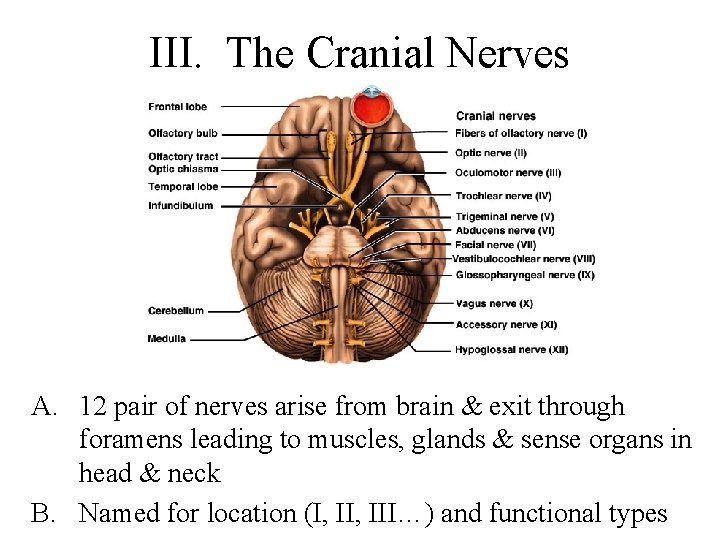
III. The Cranial Nerves A. 12 pair of nerves arise from brain & exit through foramens leading to muscles, glands & sense organs in head & neck B. Named for location (I, III…) and functional types
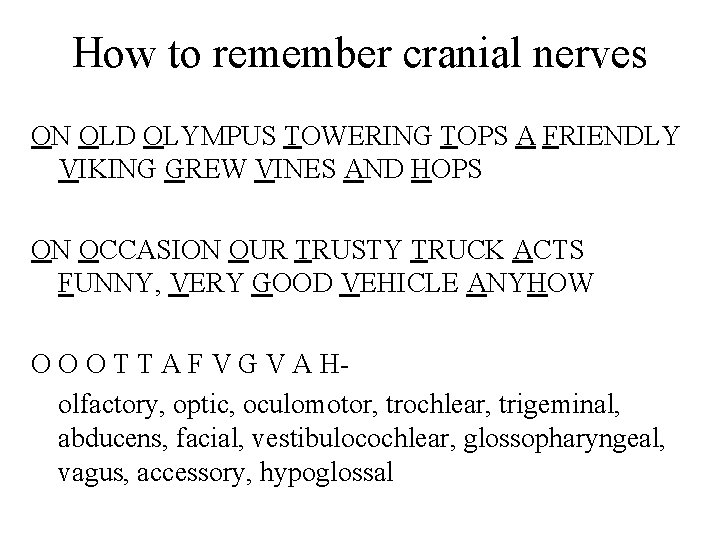
How to remember cranial nerves ON OLD OLYMPUS TOWERING TOPS A FRIENDLY VIKING GREW VINES AND HOPS ON OCCASION OUR TRUSTY TRUCK ACTS FUNNY, VERY GOOD VEHICLE ANYHOW O O O T T A F V G V A Holfactory, optic, oculomotor, trochlear, trigeminal, abducens, facial, vestibulocochlear, glossopharyngeal, vagus, accessory, hypoglossal
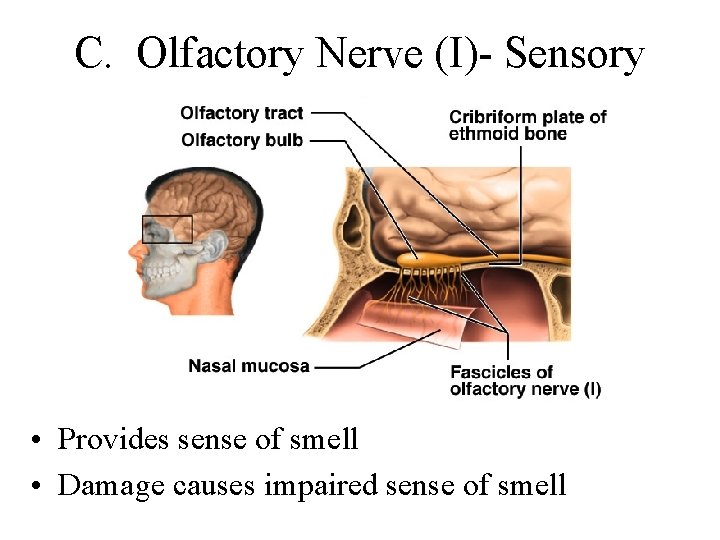
C. Olfactory Nerve (I)- Sensory • Provides sense of smell • Damage causes impaired sense of smell
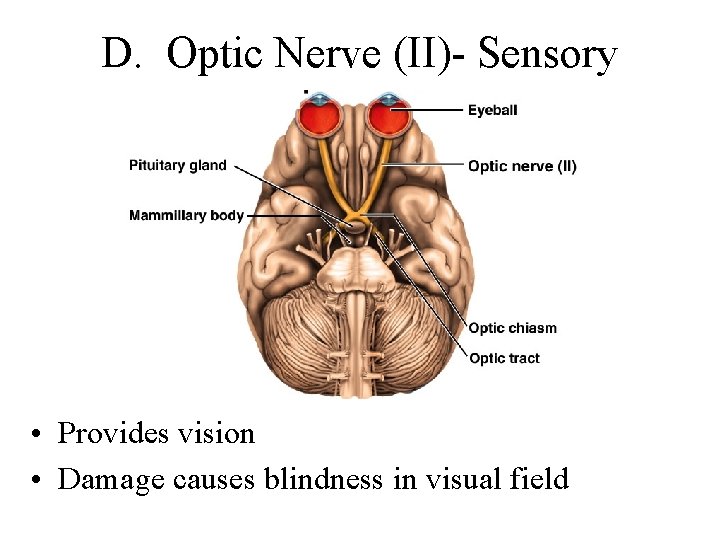
D. Optic Nerve (II)- Sensory • Provides vision • Damage causes blindness in visual field
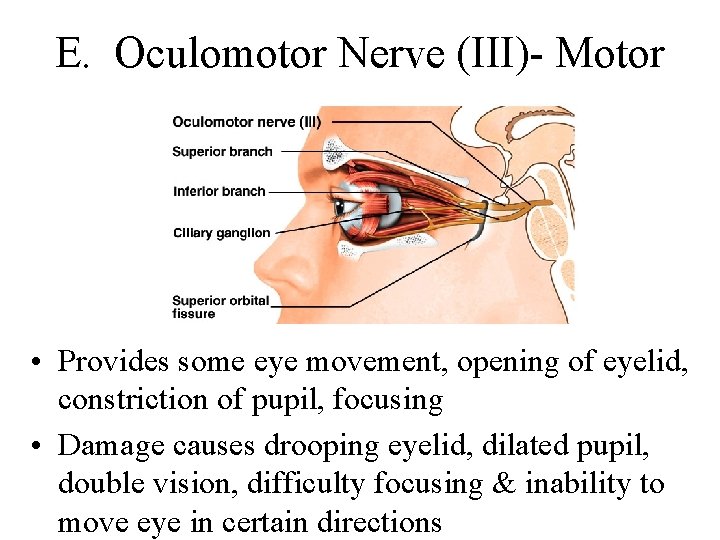
E. Oculomotor Nerve (III)- Motor • Provides some eye movement, opening of eyelid, constriction of pupil, focusing • Damage causes drooping eyelid, dilated pupil, double vision, difficulty focusing & inability to move eye in certain directions
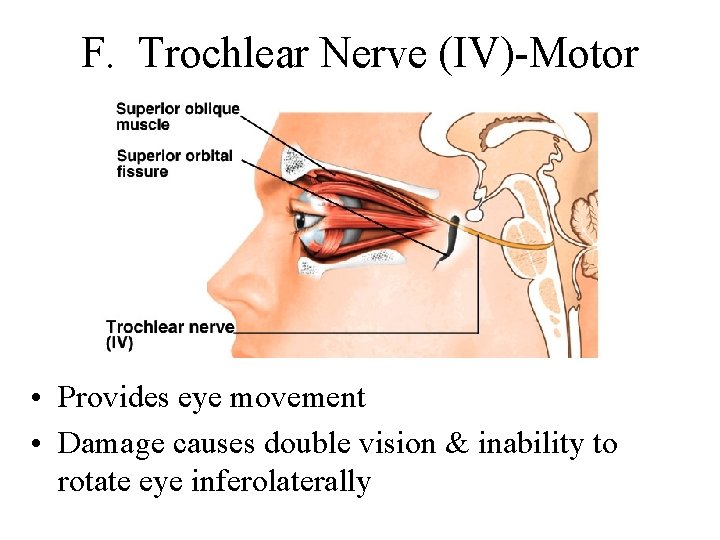
F. Trochlear Nerve (IV)-Motor • Provides eye movement • Damage causes double vision & inability to rotate eye inferolaterally
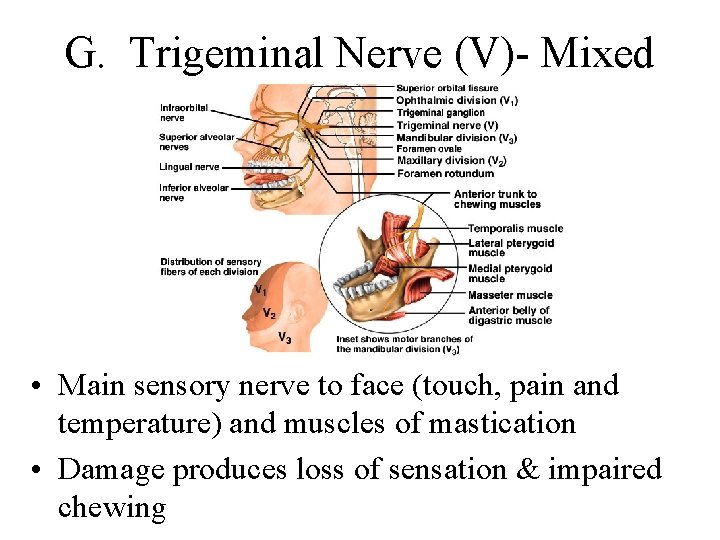
G. Trigeminal Nerve (V)- Mixed • Main sensory nerve to face (touch, pain and temperature) and muscles of mastication • Damage produces loss of sensation & impaired chewing
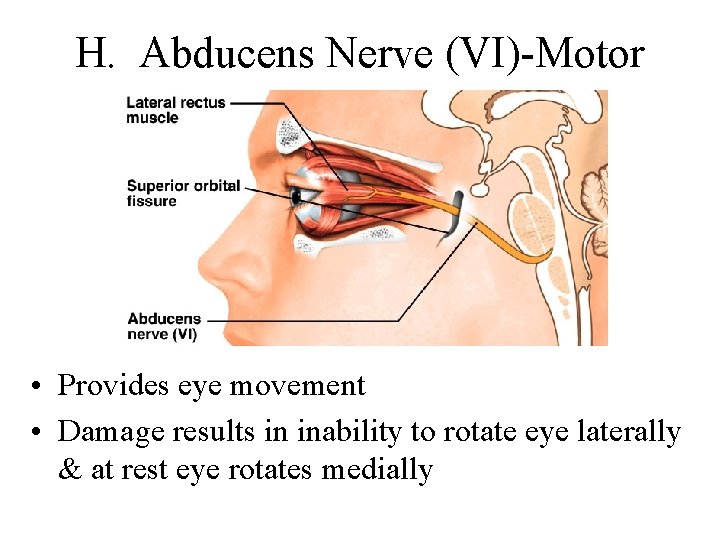
H. Abducens Nerve (VI)-Motor • Provides eye movement • Damage results in inability to rotate eye laterally & at rest eye rotates medially
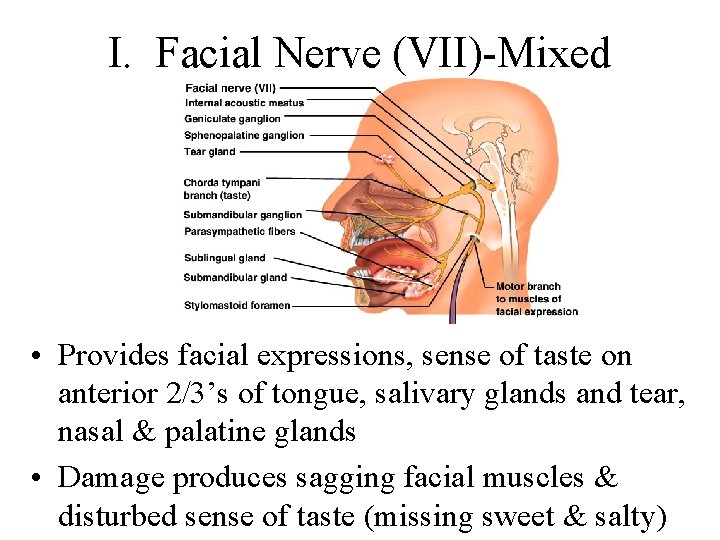
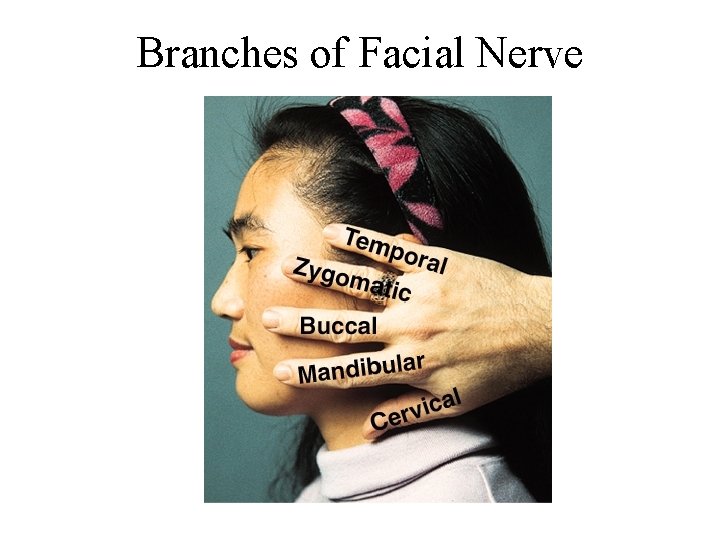
I. Facial Nerve (VII)-Mixed • Provides facial expressions, sense of taste on anterior 2/3’s of tongue, salivary glands and tear, nasal & palatine glands • Damage produces sagging facial muscles & disturbed sense of taste (missing sweet & salty)
Branches of Facial Nerve
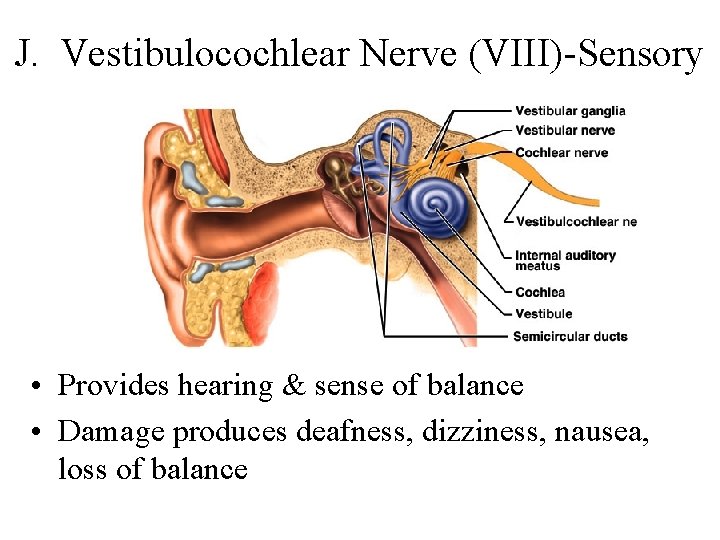
J. Vestibulocochlear Nerve (VIII)-Sensory • Provides hearing & sense of balance • Damage produces deafness, dizziness, nausea, loss of balance
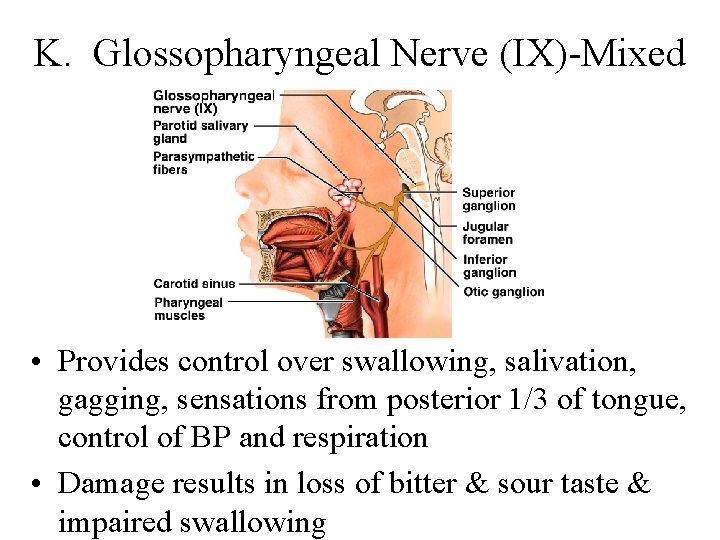
K. Glossopharyngeal Nerve (IX)-Mixed • Provides control over swallowing, salivation, gagging, sensations from posterior 1/3 of tongue, control of BP and respiration • Damage results in loss of bitter & sour taste & impaired swallowing
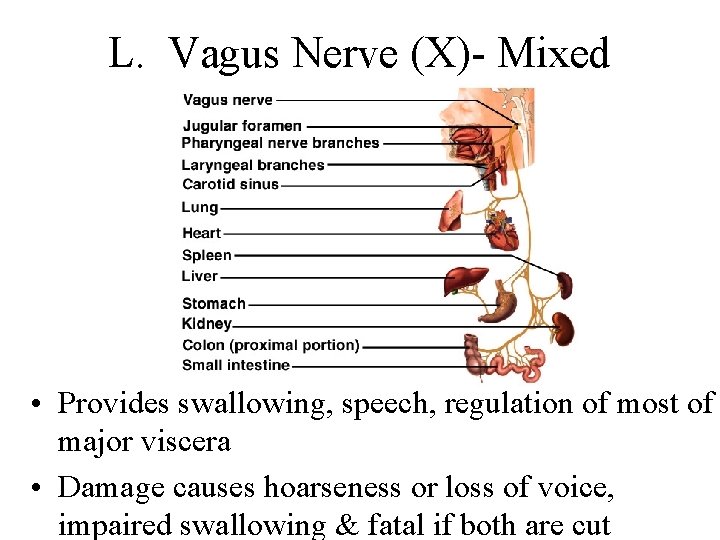
L. Vagus Nerve (X)- Mixed • Provides swallowing, speech, regulation of most of major viscera • Damage causes hoarseness or loss of voice, impaired swallowing & fatal if both are cut
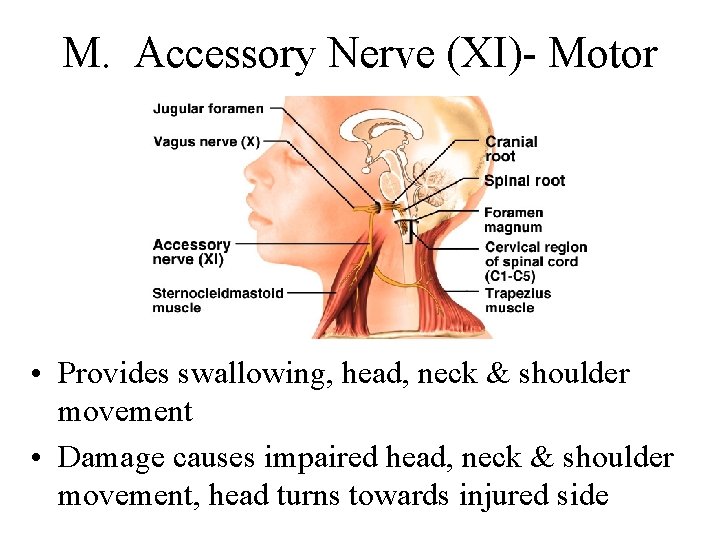
M. Accessory Nerve (XI)- Motor • Provides swallowing, head, neck & shoulder movement • Damage causes impaired head, neck & shoulder movement, head turns towards injured side
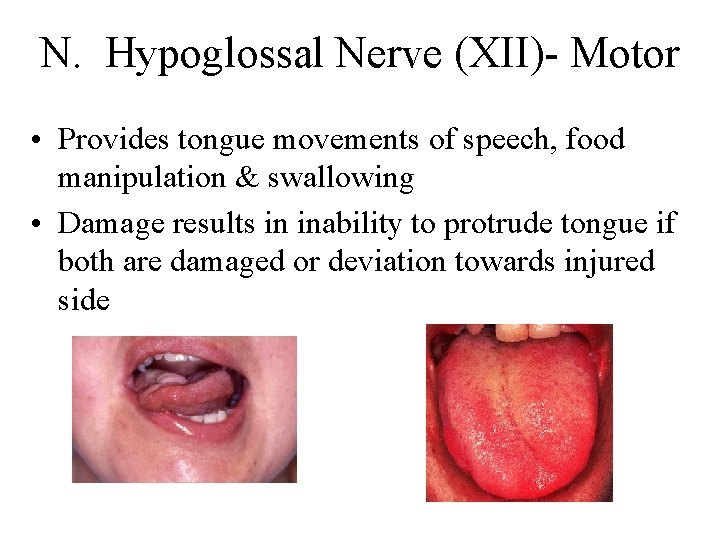
N. Hypoglossal Nerve (XII)- Motor • Provides tongue movements of speech, food manipulation & swallowing • Damage results in inability to protrude tongue if both are damaged or deviation towards injured side
IV. The Spinal Nerves A. Spinal nerves – 31 pairs – originate from spinal cord – 8 cervical (C), 12 thoracic(T), 5 lumbar(L), 5 sacral(S), 1 coccygeal (Co or Cx). – All mixed nerves, Numbered – as they fall on the spinal cord. • Major nerve plexuses and peripheral nerves – Cervical – C 1 to C 5 - Phrenic (C 5) – Most important – sends impulses to the diaphragm – without we cannot do pulmonary ventilation. – Brachial – C 5 to C 8 and T 1 - In charge of arm and shoulder.
– Lumbar – L 2 to L 5 – larger area - Femoral nerve – nerves of the leg. – Sacral – L 4 to L 5, S 1 to S 4 - Sciatic nerve (largest of body) causes immobilization in leg and affects foot – Coccygeal (Cx) – mainly nerve function to pelvic region.
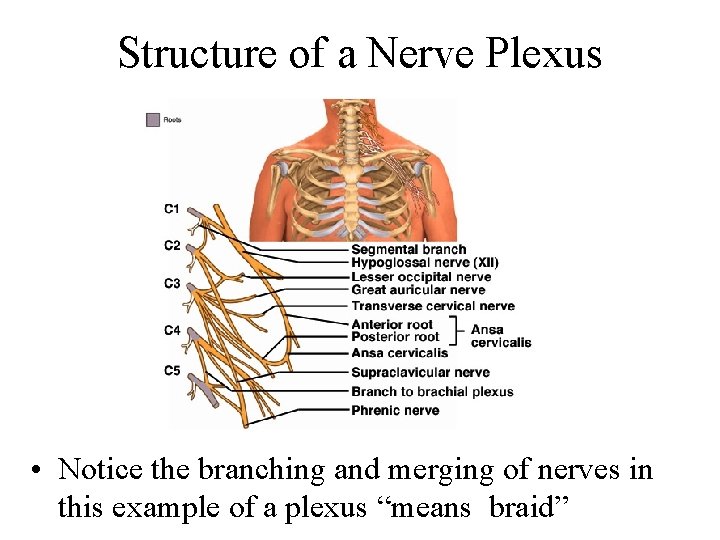
Structure of a Nerve Plexus • Notice the branching and merging of nerves in this example of a plexus “means braid”
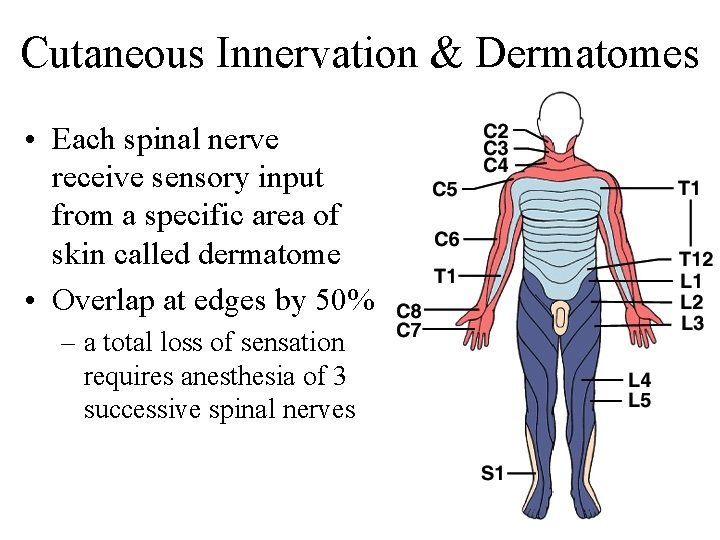
Cutaneous Innervation & Dermatomes • Each spinal nerve receive sensory input from a specific area of skin called dermatome • Overlap at edges by 50% – a total loss of sensation requires anesthesia of 3 successive spinal nerves
V. ANS Divisions A. Sympathetic nervous system – “ stress division” or fight or flight – body readying itself to handle stressful/emergency situations – high heart rate, dilation of pupils and bronchial, constriction of blood vessels, sweat glands active, mouth dry (digestive process decreases redirecting blood to heart), faster respiration, bladder relaxes.
B. Parasympathetic nervous system – “peaceful/housekeeping” maintenance division – conservation and storage of energy, has no effects – sets self back to a normal pace