
Peripheral Nervous System Cranial nerves arising from the
- Slides: 15
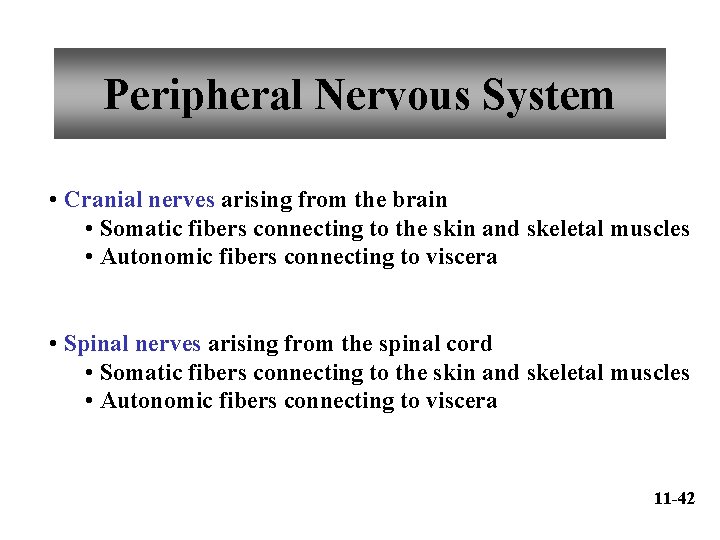
Peripheral Nervous System • Cranial nerves arising from the brain • Somatic fibers connecting to the skin and skeletal muscles • Autonomic fibers connecting to viscera • Spinal nerves arising from the spinal cord • Somatic fibers connecting to the skin and skeletal muscles • Autonomic fibers connecting to viscera 11 -42
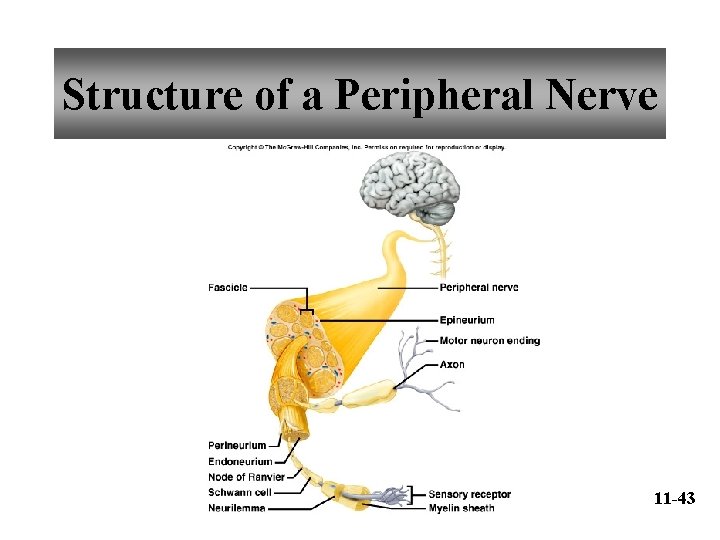
Structure of a Peripheral Nerve 11 -43
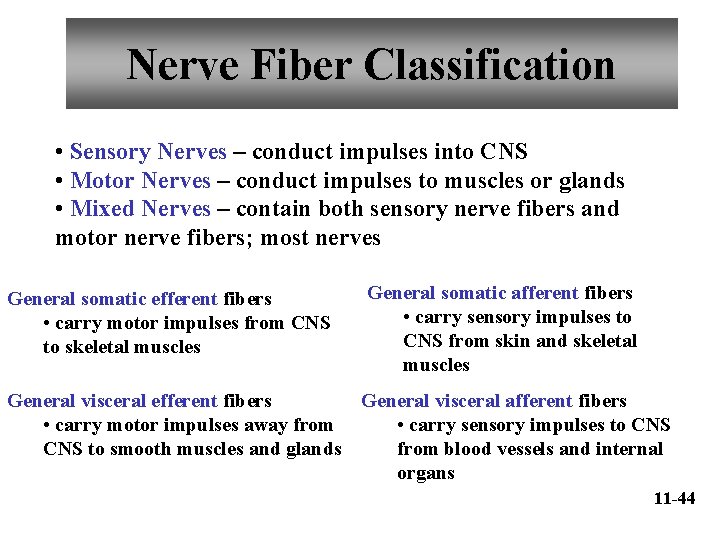
Nerve Fiber Classification • Sensory Nerves – conduct impulses into CNS • Motor Nerves – conduct impulses to muscles or glands • Mixed Nerves – contain both sensory nerve fibers and motor nerve fibers; most nerves General somatic efferent fibers • carry motor impulses from CNS to skeletal muscles General somatic afferent fibers • carry sensory impulses to CNS from skin and skeletal muscles General visceral efferent fibers General visceral afferent fibers • carry motor impulses away from • carry sensory impulses to CNS to smooth muscles and glands from blood vessels and internal organs 11 -44
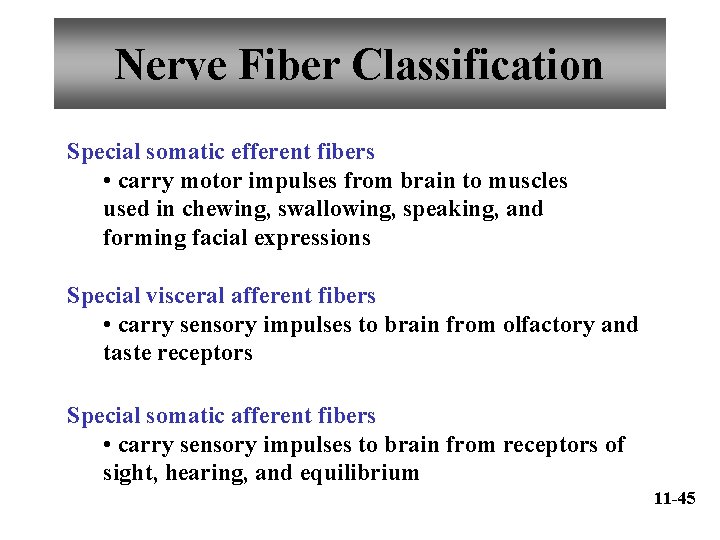
Nerve Fiber Classification Special somatic efferent fibers • carry motor impulses from brain to muscles used in chewing, swallowing, speaking, and forming facial expressions Special visceral afferent fibers • carry sensory impulses to brain from olfactory and taste receptors Special somatic afferent fibers • carry sensory impulses to brain from receptors of sight, hearing, and equilibrium 11 -45
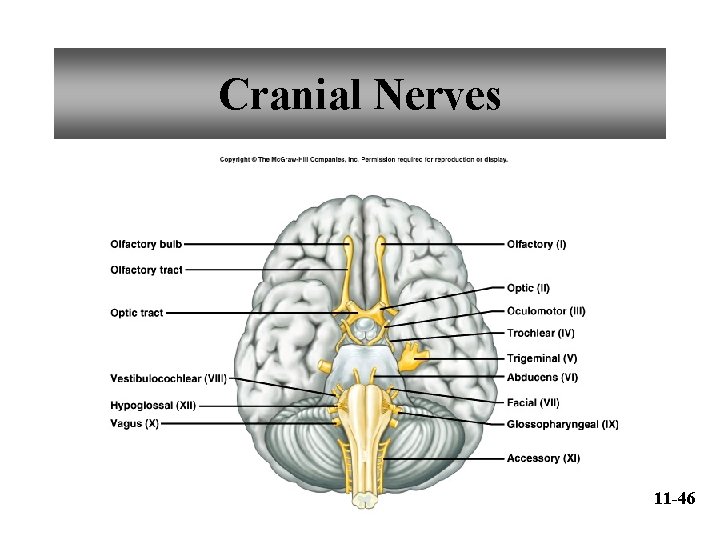
Cranial Nerves 11 -46
Cranial Nerves I and II Olfactory (I) • sensory • fibers transmit impulses associated with smell Optic (II) • sensory • fibers transmit impulses associated with vision 11 -47
Cranial Nerves III and IV Oculomotor (III) • primarily motor • motor impulses to muscles that • raise eyelids • move the eyes • focus lens • adjust light entering eye Trochlear (IV) • primarily motor • motor impulses to muscles that move the eyes 11 -48
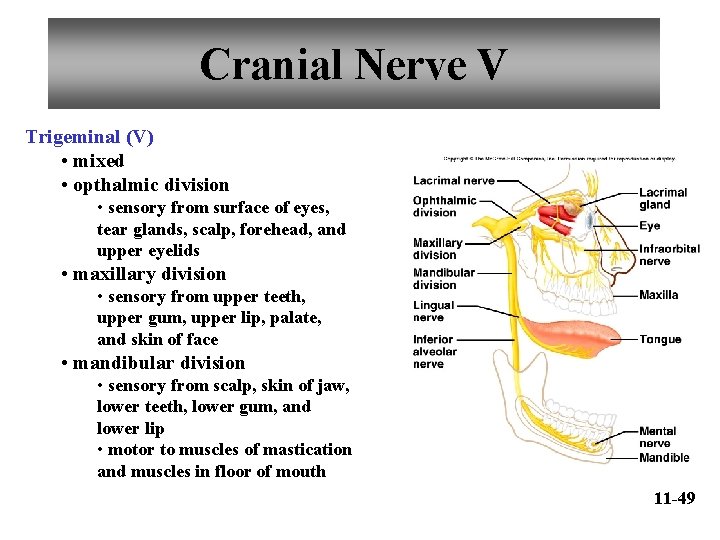
Cranial Nerve V Trigeminal (V) • mixed • opthalmic division • sensory from surface of eyes, tear glands, scalp, forehead, and upper eyelids • maxillary division • sensory from upper teeth, upper gum, upper lip, palate, and skin of face • mandibular division • sensory from scalp, skin of jaw, lower teeth, lower gum, and lower lip • motor to muscles of mastication and muscles in floor of mouth 11 -49
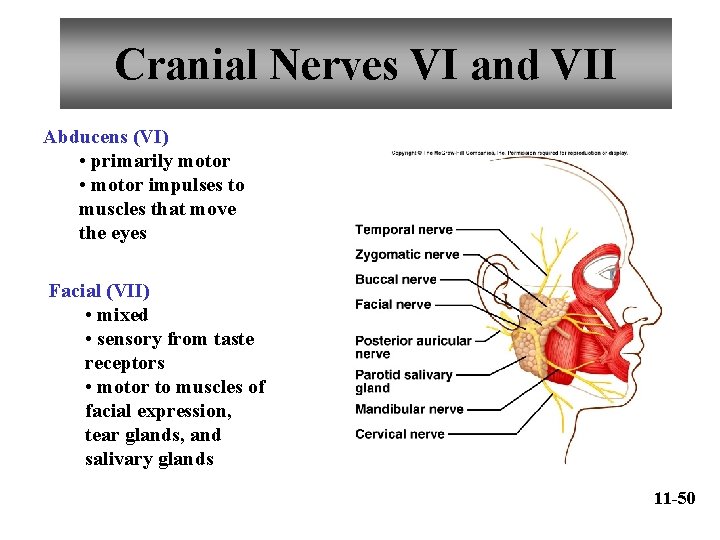
Cranial Nerves VI and VII Abducens (VI) • primarily motor • motor impulses to muscles that move the eyes Facial (VII) • mixed • sensory from taste receptors • motor to muscles of facial expression, tear glands, and salivary glands 11 -50
Cranial Nerves VIII and IX Vestibulocochlear (VIII) • sensory from equilibrium receptors of ear • sensory from hearing receptors Glossopharyngeal (IX) • mixed • sensory from pharynx, tonsils, tongue, and carotid arteries • motor to salivary glands and muscles of pharynx 11 -51
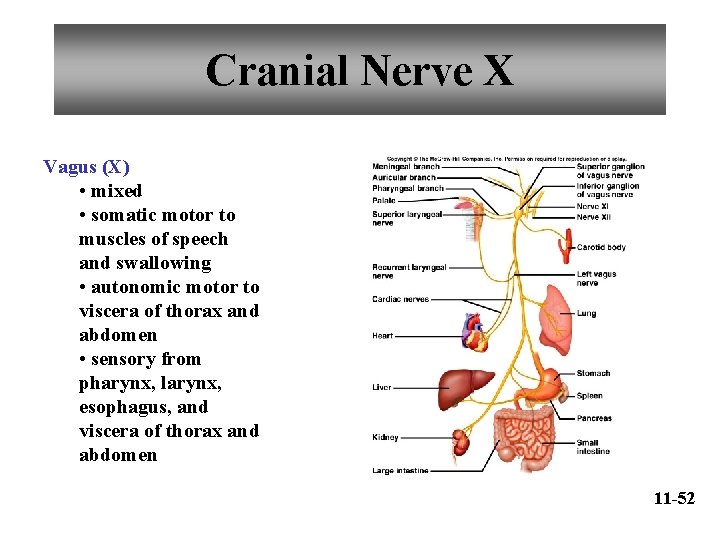
Cranial Nerve X Vagus (X) • mixed • somatic motor to muscles of speech and swallowing • autonomic motor to viscera of thorax and abdomen • sensory from pharynx, larynx, esophagus, and viscera of thorax and abdomen 11 -52
Cranial Nerves XI and XII Accessory (XI) • primarily motor • motor to muscles of soft palate, pharynx, larynx, neck, and back Hypoglossal (XII) • primarily motor • motor to muscles of the tongue 11 -53
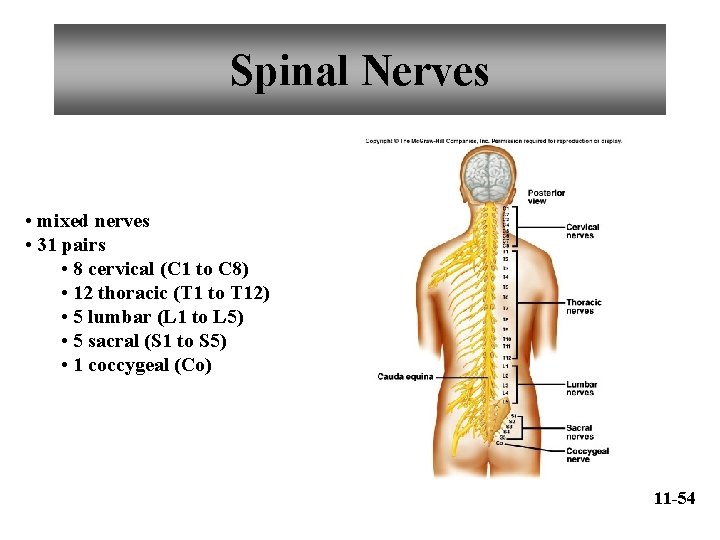
Spinal Nerves • mixed nerves • 31 pairs • 8 cervical (C 1 to C 8) • 12 thoracic (T 1 to T 12) • 5 lumbar (L 1 to L 5) • 5 sacral (S 1 to S 5) • 1 coccygeal (Co) 11 -54
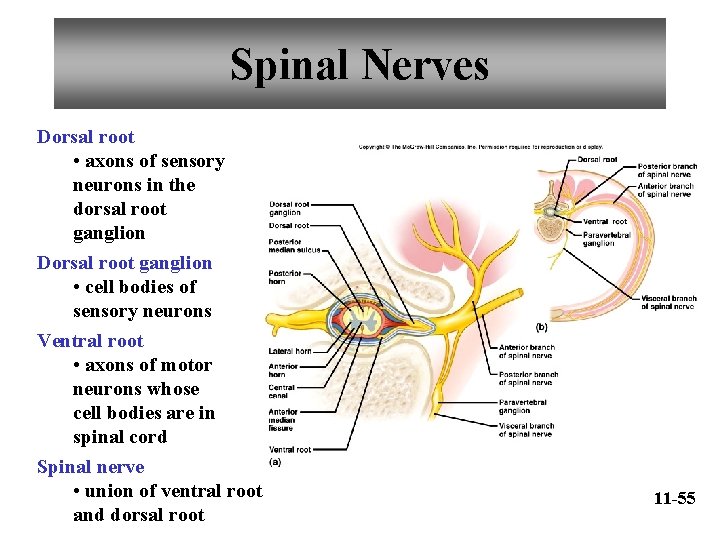
Spinal Nerves Dorsal root • axons of sensory neurons in the dorsal root ganglion Dorsal root ganglion • cell bodies of sensory neurons Ventral root • axons of motor neurons whose cell bodies are in spinal cord Spinal nerve • union of ventral root and dorsal root 11 -55
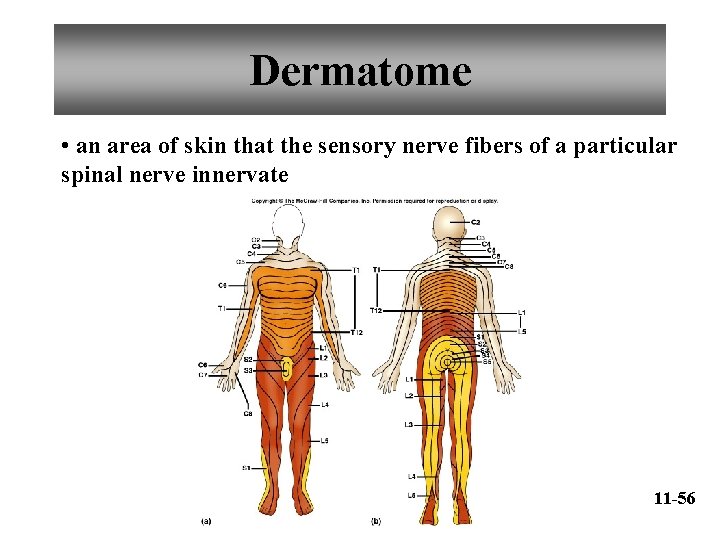
Dermatome • an area of skin that the sensory nerve fibers of a particular spinal nerve innervate 11 -56