
PERIPHERAL NERVOUS SYSTEM CN VII SENSE OF TASTE
- Slides: 25
PERIPHERAL NERVOUS SYSTEM CN VII & SENSE OF TASTE Dr. Aiman Q. Afar Surgical Anatomist College of Medicine / University of Mutah 29. 1. 2020 29 January 2020 Dr. Aiman Q Afar 1
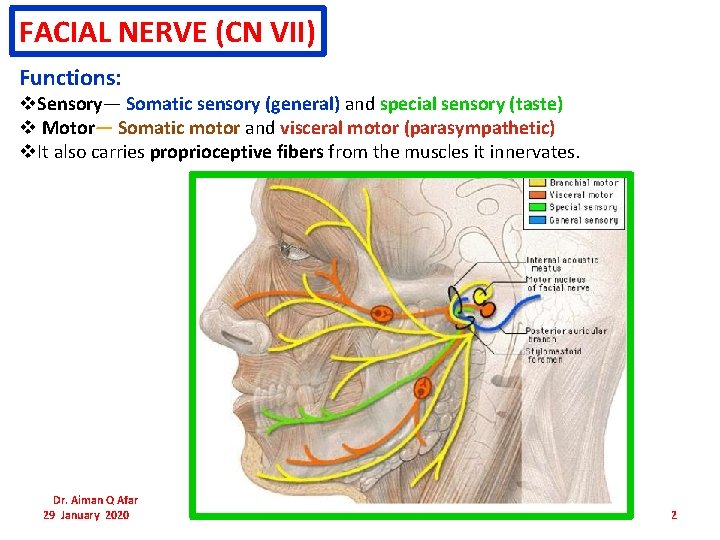
FACIAL NERVE (CN VII) Functions: v. Sensory— Somatic sensory (general) and special sensory (taste) v Motor— Somatic motor and visceral motor (parasympathetic) v. It also carries proprioceptive fibers from the muscles it innervates. Dr. Aiman Q Afar 29 January 2020 2
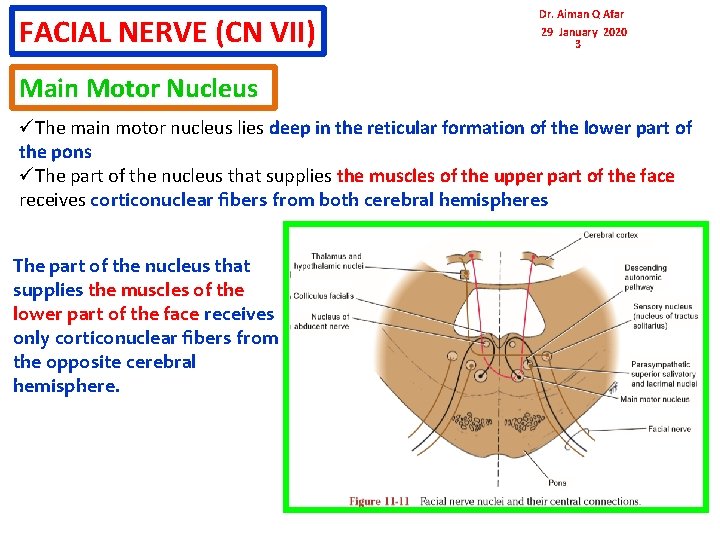
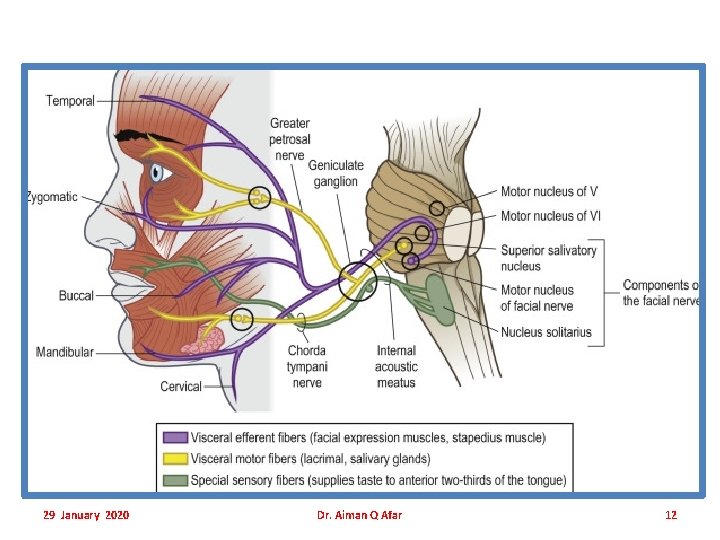
FACIAL NERVE (CN VII) Dr. Aiman Q Afar 29 January 2020 3 Main Motor Nucleus üThe main motor nucleus lies deep in the reticular formation of the lower part of the pons üThe part of the nucleus that supplies the muscles of the upper part of the face receives corticonuclear fibers from both cerebral hemispheres The part of the nucleus that supplies the muscles of the lower part of the face receives only corticonuclear fibers from the opposite cerebral hemisphere.
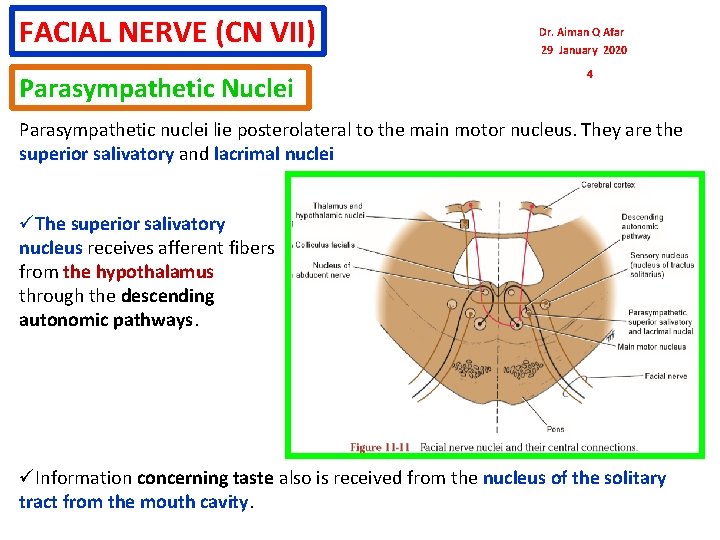
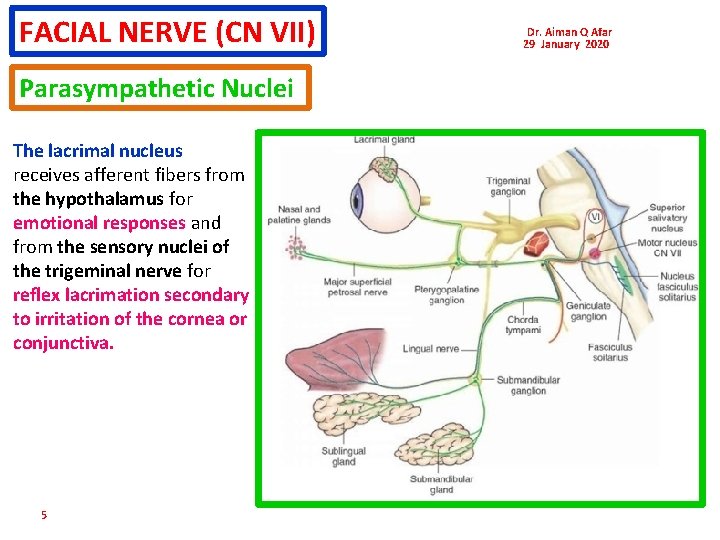
FACIAL NERVE (CN VII) Parasympathetic Nuclei Dr. Aiman Q Afar 29 January 2020 4 Parasympathetic nuclei lie posterolateral to the main motor nucleus. They are the superior salivatory and lacrimal nuclei üThe superior salivatory nucleus receives afferent fibers from the hypothalamus through the descending autonomic pathways. üInformation concerning taste also is received from the nucleus of the solitary tract from the mouth cavity.
FACIAL NERVE (CN VII) Parasympathetic Nuclei The lacrimal nucleus receives afferent fibers from the hypothalamus for emotional responses and from the sensory nuclei of the trigeminal nerve for reflex lacrimation secondary to irritation of the cornea or conjunctiva. 5 Dr. Aiman Q Afar 29 January 2020
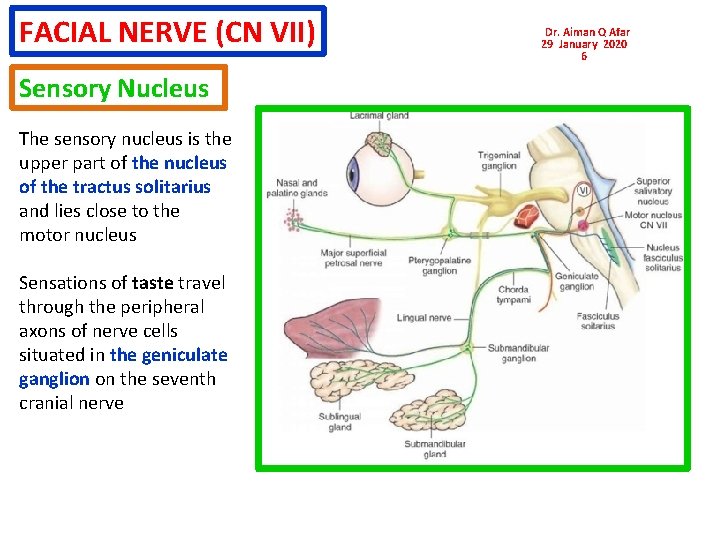
FACIAL NERVE (CN VII) Sensory Nucleus The sensory nucleus is the upper part of the nucleus of the tractus solitarius and lies close to the motor nucleus Sensations of taste travel through the peripheral axons of nerve cells situated in the geniculate ganglion on the seventh cranial nerve Dr. Aiman Q Afar 29 January 2020 6
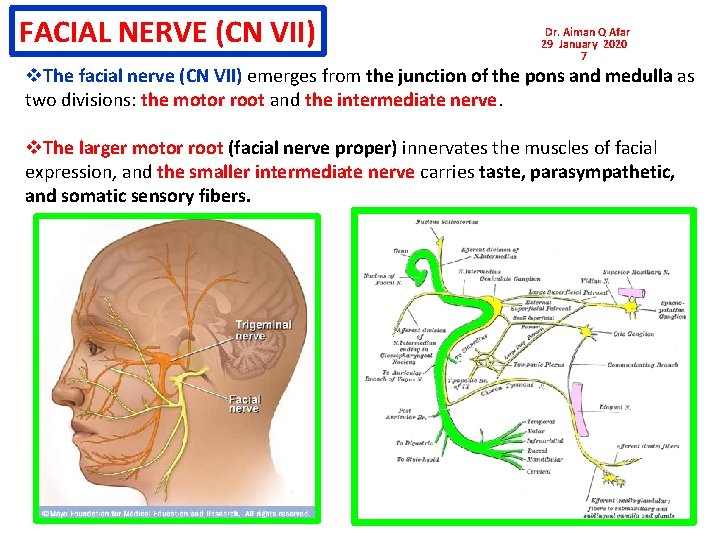
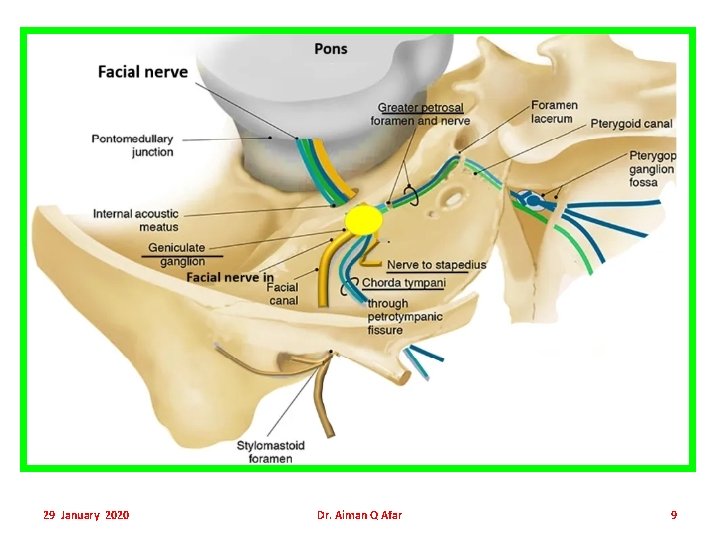
FACIAL NERVE (CN VII) Dr. Aiman Q Afar 29 January 2020 7 v. The facial nerve (CN VII) emerges from the junction of the pons and medulla as two divisions: the motor root and the intermediate nerve. v. The larger motor root (facial nerve proper) innervates the muscles of facial expression, and the smaller intermediate nerve carries taste, parasympathetic, and somatic sensory fibers.
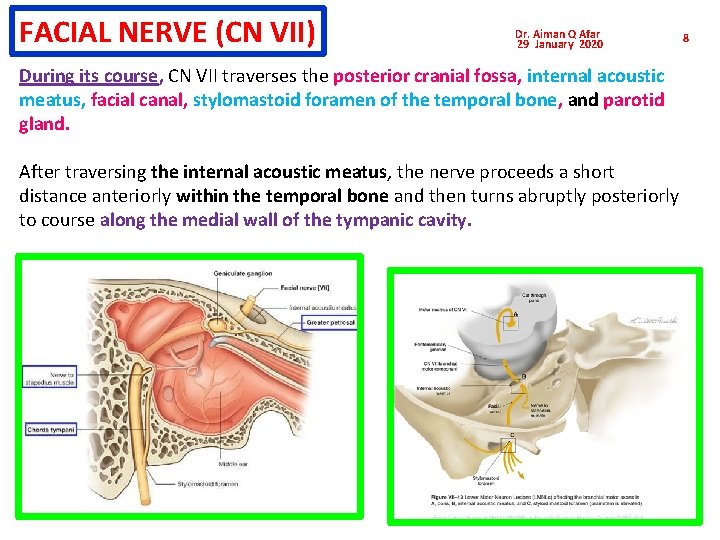
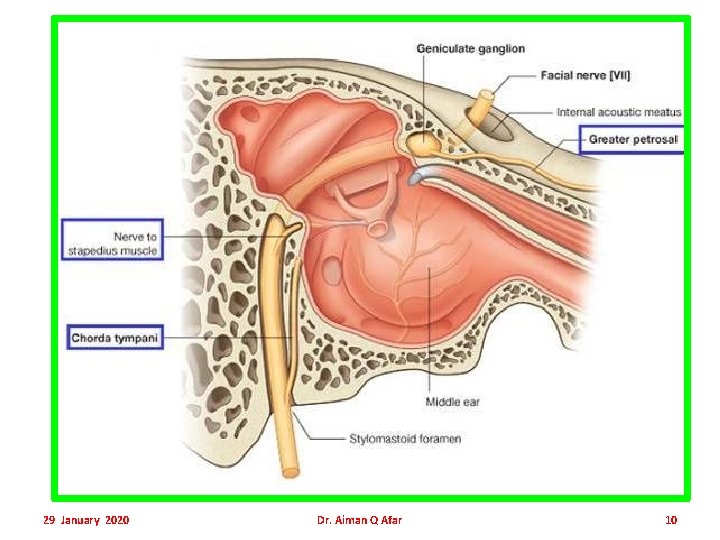
FACIAL NERVE (CN VII) Dr. Aiman Q Afar 29 January 2020 During its course, CN VII traverses the posterior cranial fossa, internal acoustic meatus, facial canal, stylomastoid foramen of the temporal bone, and parotid gland. After traversing the internal acoustic meatus, the nerve proceeds a short distance anteriorly within the temporal bone and then turns abruptly posteriorly to course along the medial wall of the tympanic cavity. 8
29 January 2020 Dr. Aiman Q Afar 9
29 January 2020 Dr. Aiman Q Afar 10
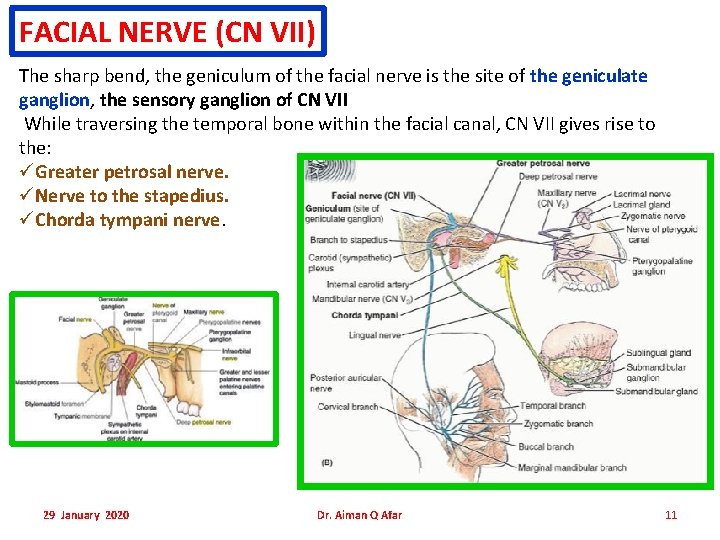
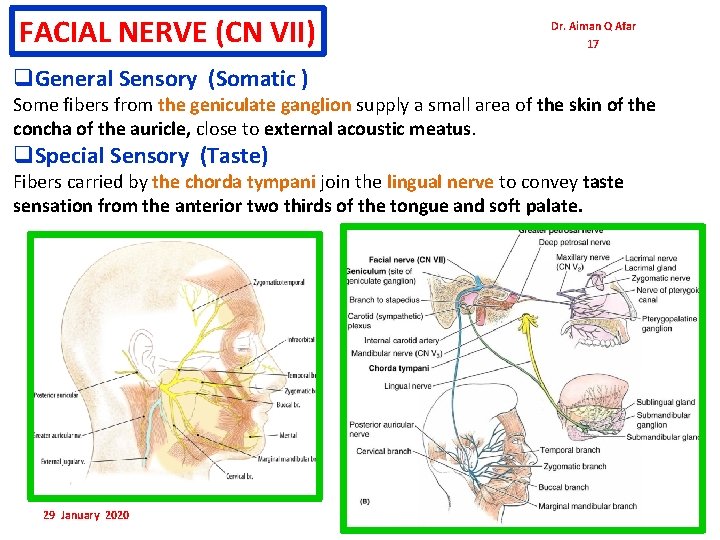
FACIAL NERVE (CN VII) The sharp bend, the geniculum of the facial nerve is the site of the geniculate ganglion, the sensory ganglion of CN VII While traversing the temporal bone within the facial canal, CN VII gives rise to the: üGreater petrosal nerve. üNerve to the stapedius. üChorda tympani nerve. 29 January 2020 Dr. Aiman Q Afar 11
29 January 2020 Dr. Aiman Q Afar 12
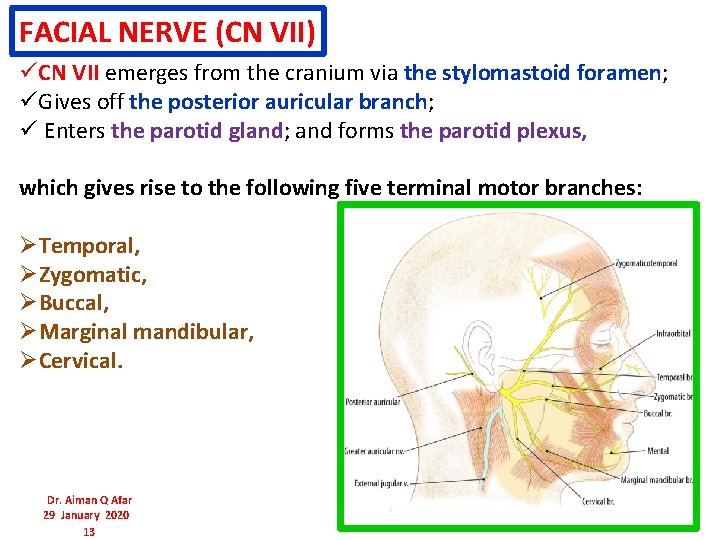
FACIAL NERVE (CN VII) üCN VII emerges from the cranium via the stylomastoid foramen; üGives off the posterior auricular branch; ü Enters the parotid gland; and forms the parotid plexus, which gives rise to the following five terminal motor branches: ØTemporal, ØZygomatic, ØBuccal, ØMarginal mandibular, ØCervical. Dr. Aiman Q Afar 29 January 2020 13
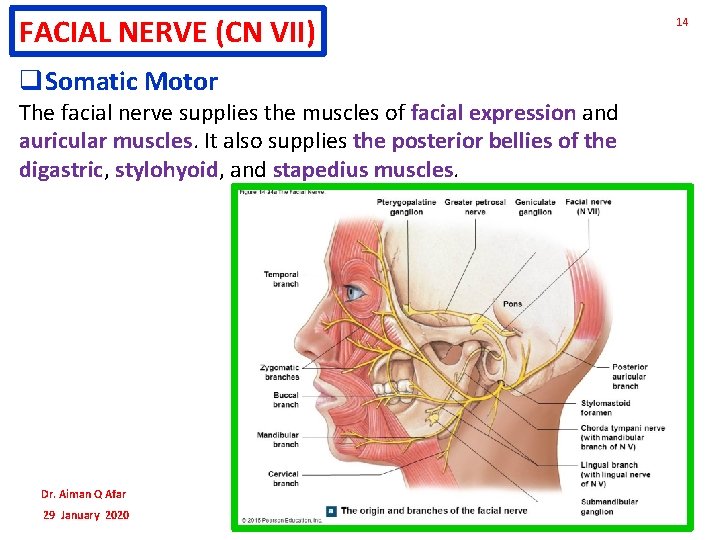
FACIAL NERVE (CN VII) q. Somatic Motor The facial nerve supplies the muscles of facial expression and auricular muscles. It also supplies the posterior bellies of the digastric, stylohyoid, and stapedius muscles. Dr. Aiman Q Afar 29 January 2020 14
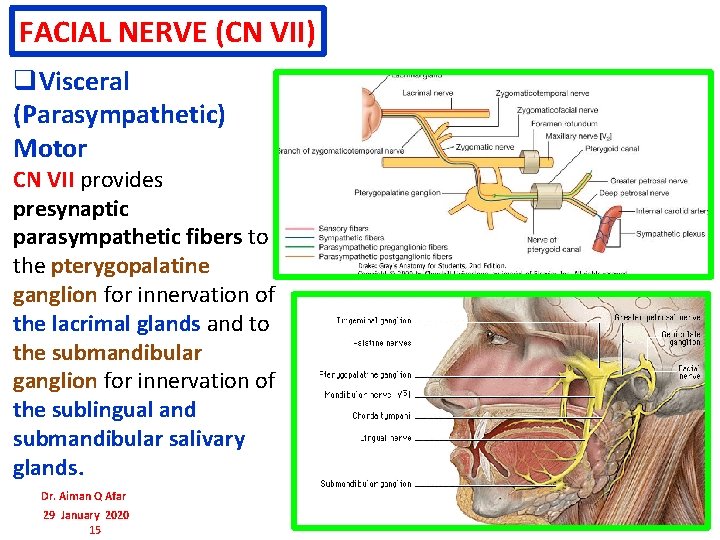
FACIAL NERVE (CN VII) q. Visceral (Parasympathetic) Motor CN VII provides presynaptic parasympathetic fibers to the pterygopalatine ganglion for innervation of the lacrimal glands and to the submandibular ganglion for innervation of the sublingual and submandibular salivary glands. Dr. Aiman Q Afar 29 January 2020 15
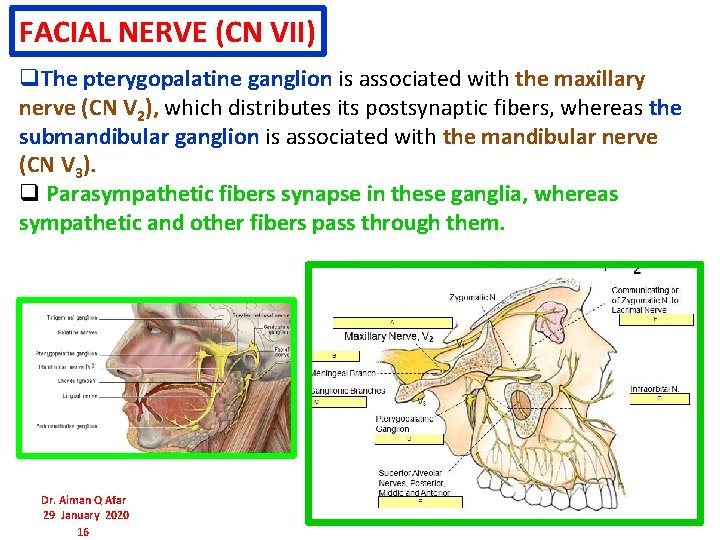
FACIAL NERVE (CN VII) q. The pterygopalatine ganglion is associated with the maxillary nerve (CN V 2), which distributes its postsynaptic fibers, whereas the submandibular ganglion is associated with the mandibular nerve (CN V 3). q Parasympathetic fibers synapse in these ganglia, whereas sympathetic and other fibers pass through them. Dr. Aiman Q Afar 29 January 2020 16
FACIAL NERVE (CN VII) Dr. Aiman Q Afar 17 q. General Sensory (Somatic ) Some fibers from the geniculate ganglion supply a small area of the skin of the concha of the auricle, close to external acoustic meatus. q. Special Sensory (Taste) Fibers carried by the chorda tympani join the lingual nerve to convey taste sensation from the anterior two thirds of the tongue and soft palate. 29 January 2020
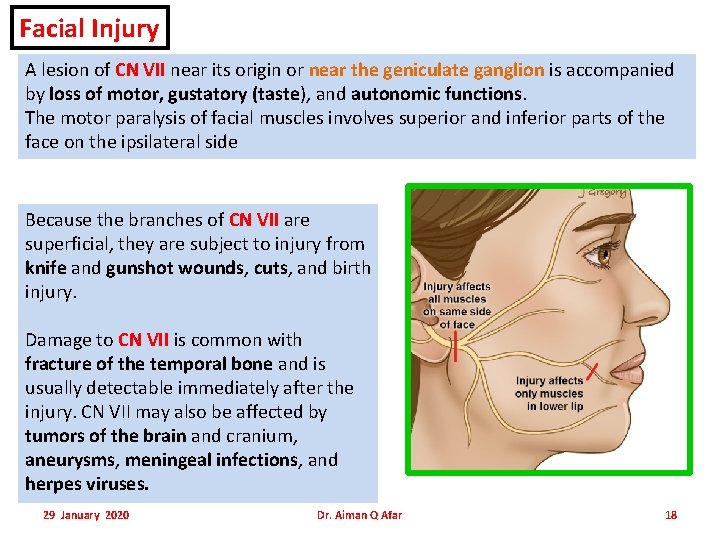
Facial Injury A lesion of CN VII near its origin or near the geniculate ganglion is accompanied by loss of motor, gustatory (taste), and autonomic functions. The motor paralysis of facial muscles involves superior and inferior parts of the face on the ipsilateral side Because the branches of CN VII are superficial, they are subject to injury from knife and gunshot wounds, cuts, and birth injury. Damage to CN VII is common with fracture of the temporal bone and is usually detectable immediately after the injury. CN VII may also be affected by tumors of the brain and cranium, aneurysms, meningeal infections, and herpes viruses. 29 January 2020 Dr. Aiman Q Afar 18
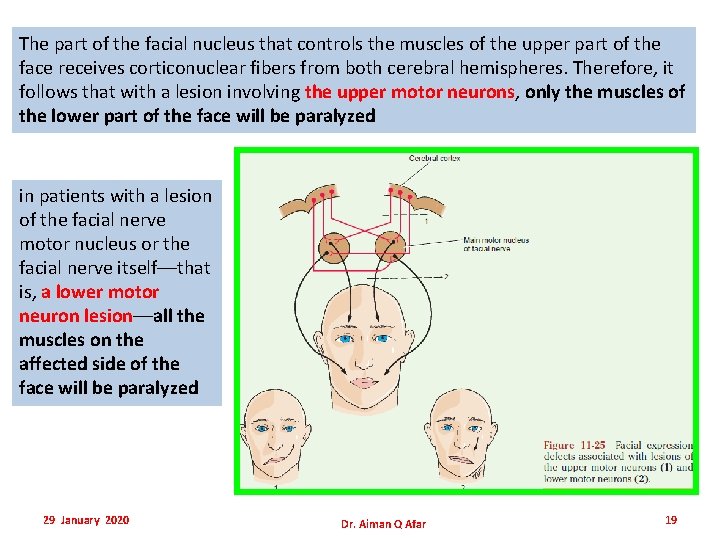
The part of the facial nucleus that controls the muscles of the upper part of the face receives corticonuclear fibers from both cerebral hemispheres. Therefore, it follows that with a lesion involving the upper motor neurons, only the muscles of the lower part of the face will be paralyzed in patients with a lesion of the facial nerve motor nucleus or the facial nerve itself––that is, a lower motor neuron lesion––all the muscles on the affected side of the face will be paralyzed 29 January 2020 Dr. Aiman Q Afar 19
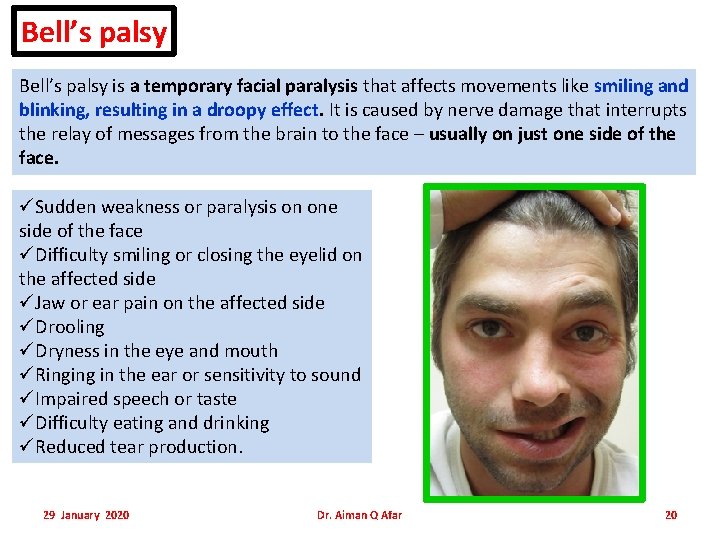
Bell’s palsy is a temporary facial paralysis that affects movements like smiling and blinking, resulting in a droopy effect. It is caused by nerve damage that interrupts the relay of messages from the brain to the face – usually on just one side of the face. üSudden weakness or paralysis on one side of the face üDifficulty smiling or closing the eyelid on the affected side üJaw or ear pain on the affected side üDrooling üDryness in the eye and mouth üRinging in the ear or sensitivity to sound üImpaired speech or taste üDifficulty eating and drinking üReduced tear production. 29 January 2020 Dr. Aiman Q Afar 20
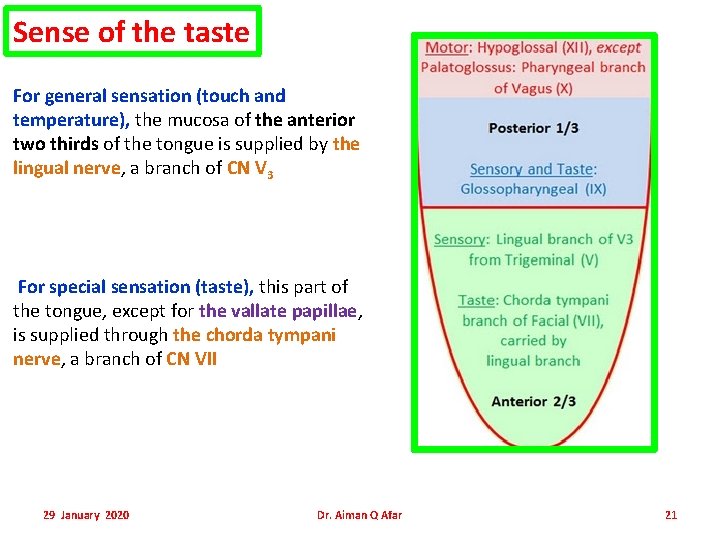
Sense of the taste For general sensation (touch and temperature), the mucosa of the anterior two thirds of the tongue is supplied by the lingual nerve, a branch of CN V 3 For special sensation (taste), this part of the tongue, except for the vallate papillae, is supplied through the chorda tympani nerve, a branch of CN VII 29 January 2020 Dr. Aiman Q Afar 21
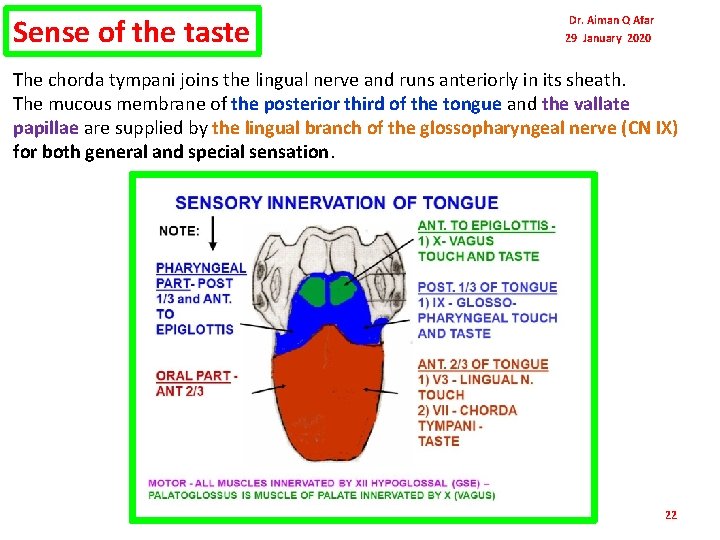
Sense of the taste Dr. Aiman Q Afar 29 January 2020 The chorda tympani joins the lingual nerve and runs anteriorly in its sheath. The mucous membrane of the posterior third of the tongue and the vallate papillae are supplied by the lingual branch of the glossopharyngeal nerve (CN IX) for both general and special sensation. 22
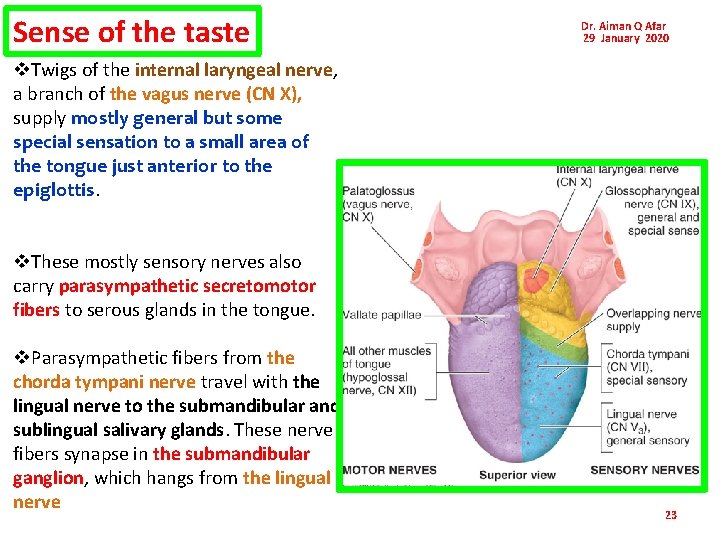
Sense of the taste Dr. Aiman Q Afar 29 January 2020 v. Twigs of the internal laryngeal nerve, a branch of the vagus nerve (CN X), supply mostly general but some special sensation to a small area of the tongue just anterior to the epiglottis. v. These mostly sensory nerves also carry parasympathetic secretomotor fibers to serous glands in the tongue. v. Parasympathetic fibers from the chorda tympani nerve travel with the lingual nerve to the submandibular and sublingual salivary glands. These nerve fibers synapse in the submandibular ganglion, which hangs from the lingual nerve 23
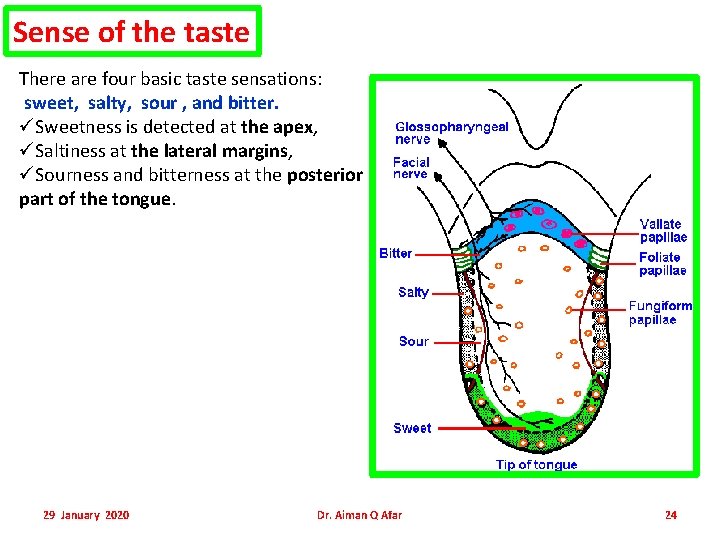
Sense of the taste There are four basic taste sensations: sweet, salty, sour , and bitter. üSweetness is detected at the apex, üSaltiness at the lateral margins, üSourness and bitterness at the posterior part of the tongue. 29 January 2020 Dr. Aiman Q Afar 24
Dr. Aiman Q Afar 29 January 2020 25