
Peripheral Nervous System Chapter 13 Cranial Nerves Chapter
- Slides: 32
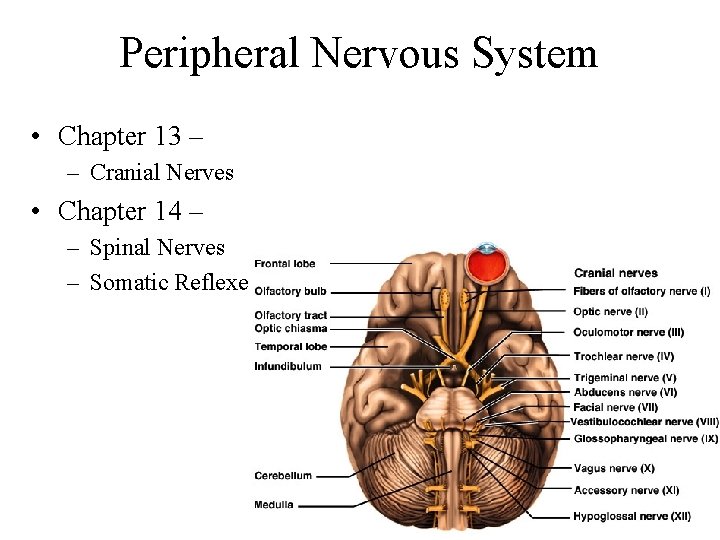
Peripheral Nervous System • Chapter 13 – – Cranial Nerves • Chapter 14 – – Spinal Nerves – Somatic Reflexes
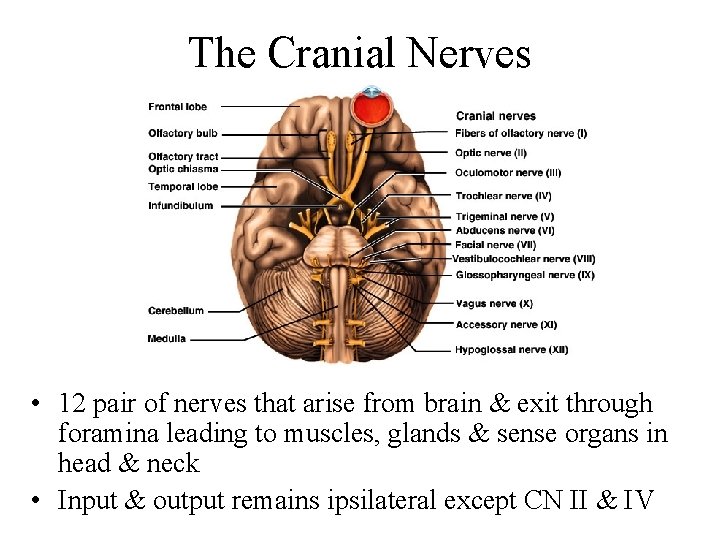
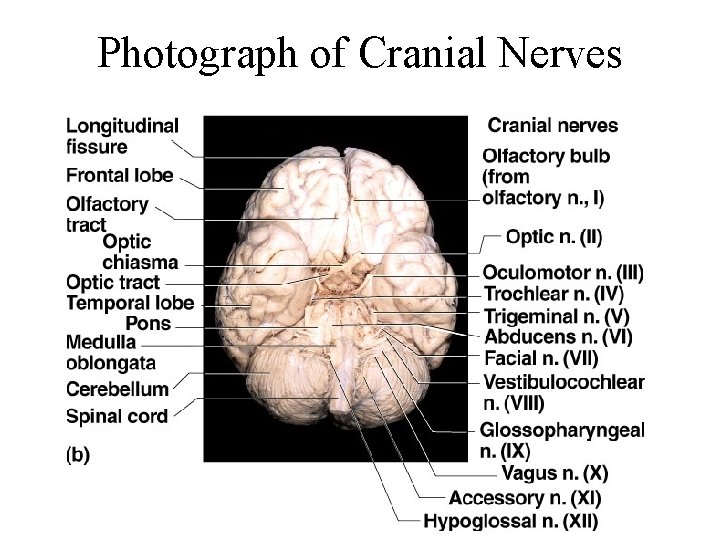
The Cranial Nerves • 12 pair of nerves that arise from brain & exit through foramina leading to muscles, glands & sense organs in head & neck • Input & output remains ipsilateral except CN II & IV
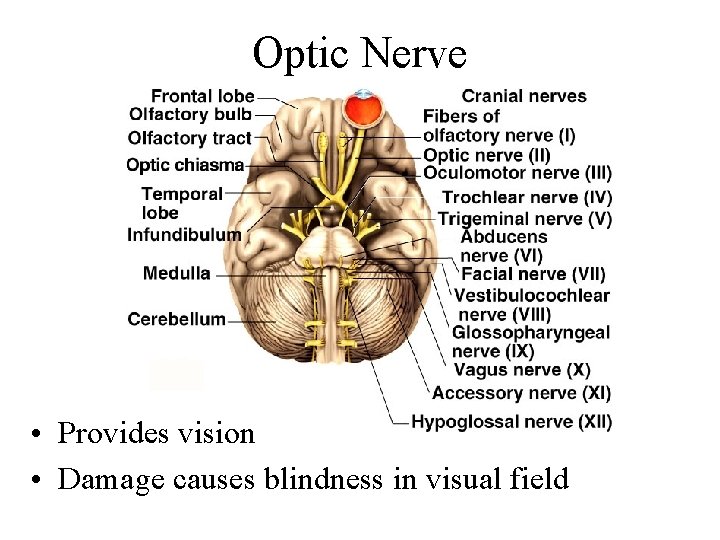
Photograph of Cranial Nerves
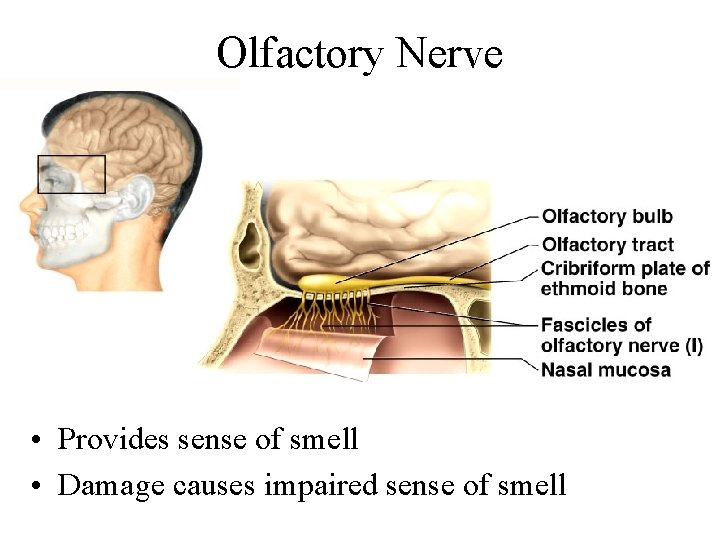
Olfactory Nerve • Provides sense of smell • Damage causes impaired sense of smell
Optic Nerve • Provides vision • Damage causes blindness in visual field
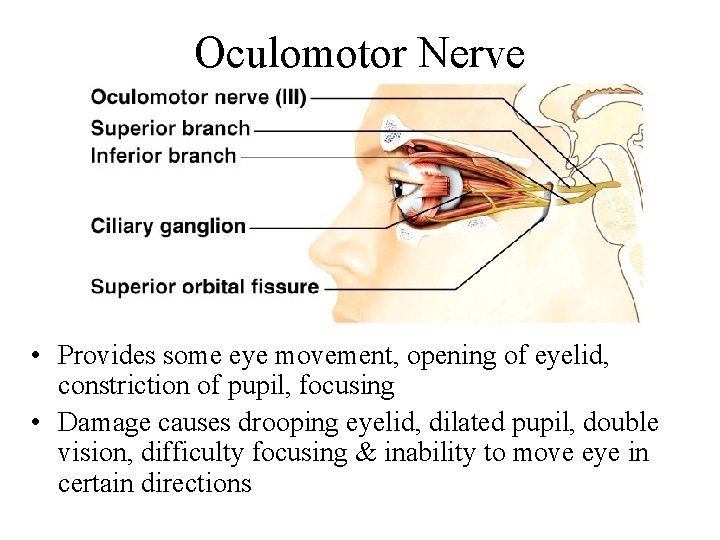
Oculomotor Nerve • Provides some eye movement, opening of eyelid, constriction of pupil, focusing • Damage causes drooping eyelid, dilated pupil, double vision, difficulty focusing & inability to move eye in certain directions
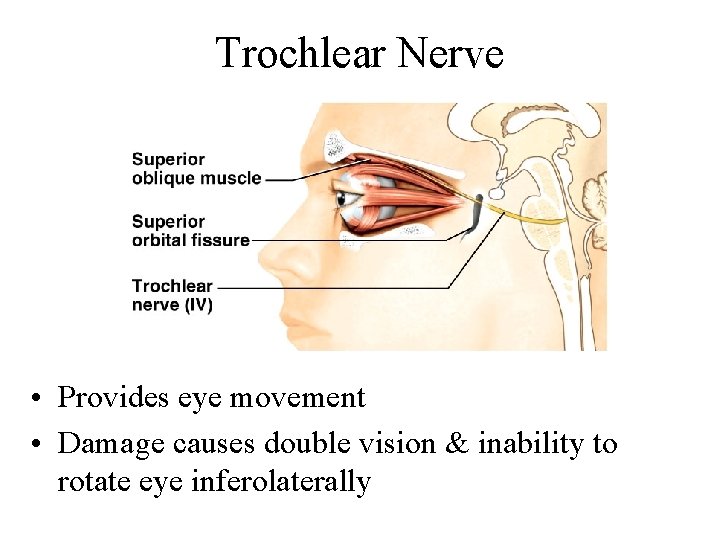
Trochlear Nerve • Provides eye movement • Damage causes double vision & inability to rotate eye inferolaterally
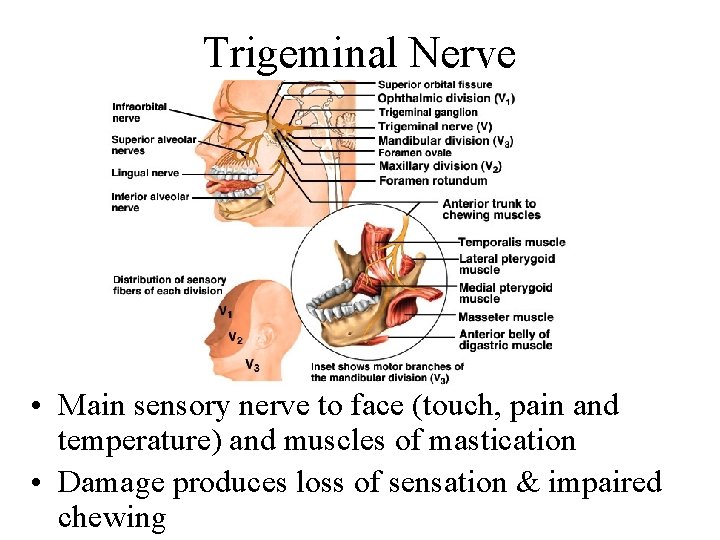
Trigeminal Nerve • Main sensory nerve to face (touch, pain and temperature) and muscles of mastication • Damage produces loss of sensation & impaired chewing
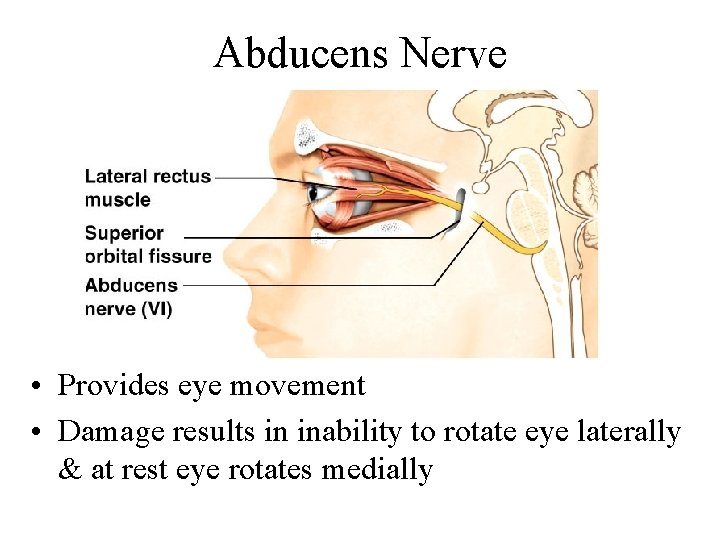
Abducens Nerve • Provides eye movement • Damage results in inability to rotate eye laterally & at rest eye rotates medially
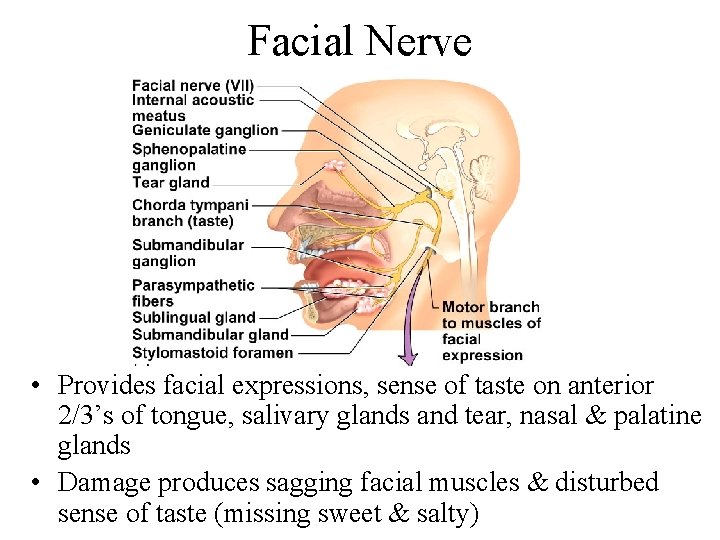
Facial Nerve • Provides facial expressions, sense of taste on anterior 2/3’s of tongue, salivary glands and tear, nasal & palatine glands • Damage produces sagging facial muscles & disturbed sense of taste (missing sweet & salty)
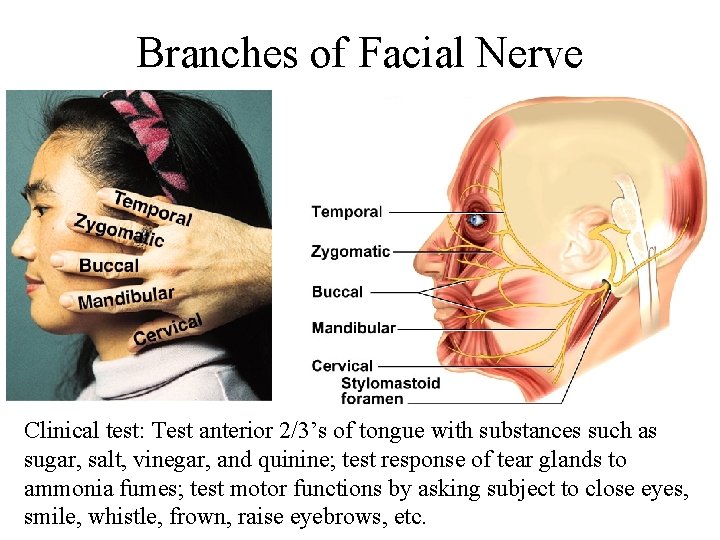
Branches of Facial Nerve Clinical test: Test anterior 2/3’s of tongue with substances such as sugar, salt, vinegar, and quinine; test response of tear glands to ammonia fumes; test motor functions by asking subject to close eyes, smile, whistle, frown, raise eyebrows, etc.
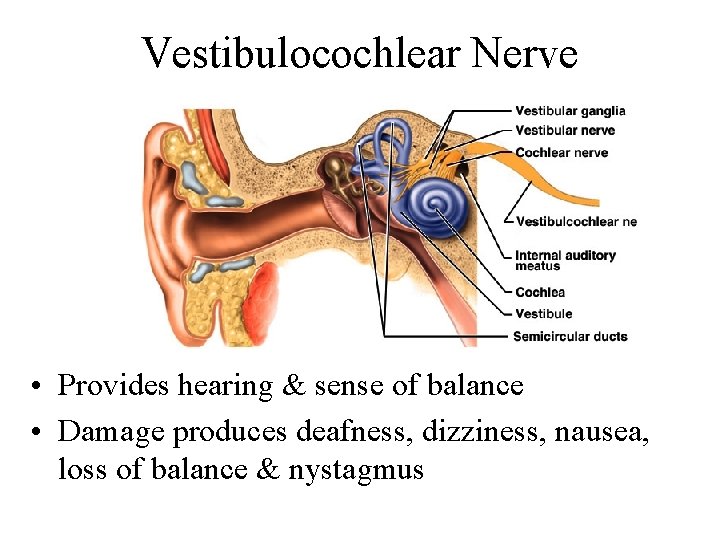
Vestibulocochlear Nerve • Provides hearing & sense of balance • Damage produces deafness, dizziness, nausea, loss of balance & nystagmus
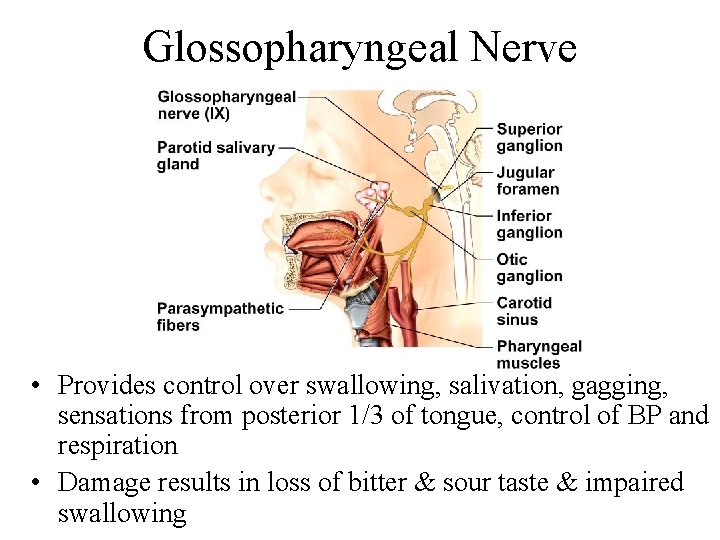
Glossopharyngeal Nerve • Provides control over swallowing, salivation, gagging, sensations from posterior 1/3 of tongue, control of BP and respiration • Damage results in loss of bitter & sour taste & impaired swallowing
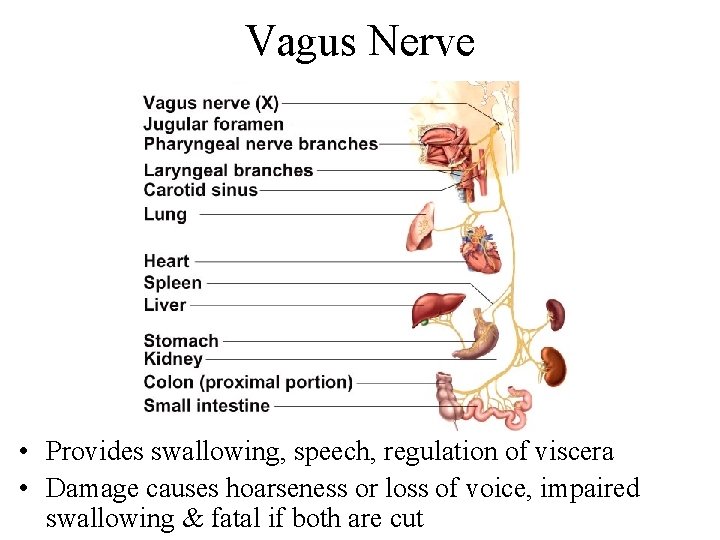
Vagus Nerve • Provides swallowing, speech, regulation of viscera • Damage causes hoarseness or loss of voice, impaired swallowing & fatal if both are cut
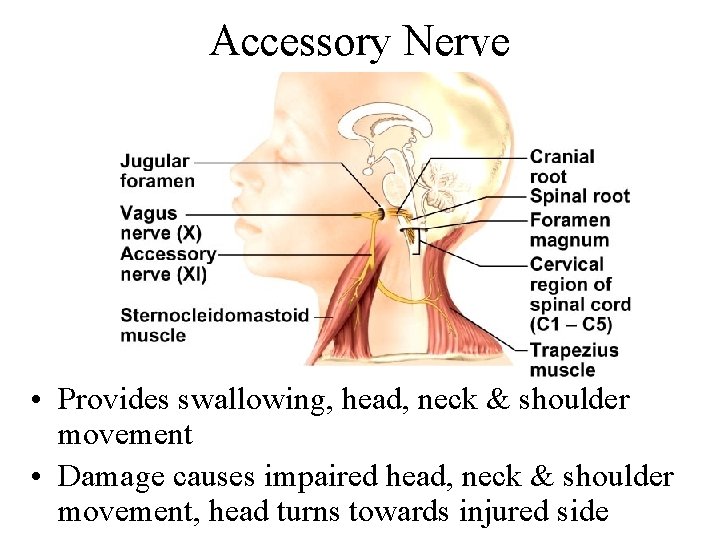
Accessory Nerve • Provides swallowing, head, neck & shoulder movement • Damage causes impaired head, neck & shoulder movement, head turns towards injured side
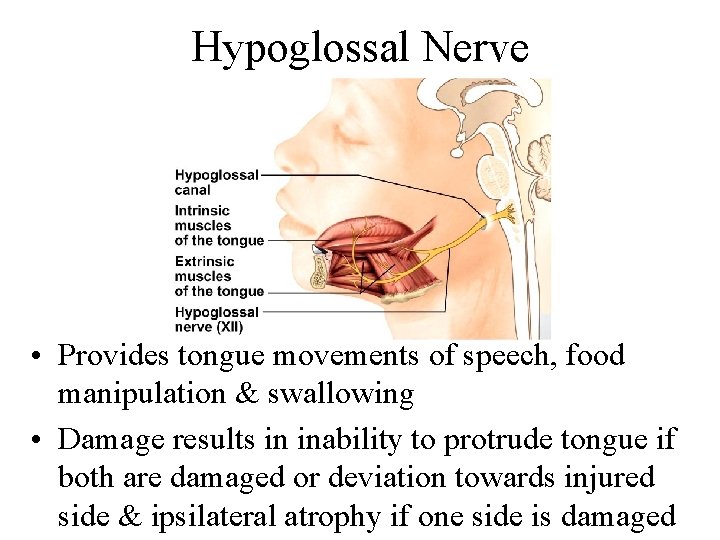
Hypoglossal Nerve • Provides tongue movements of speech, food manipulation & swallowing • Damage results in inability to protrude tongue if both are damaged or deviation towards injured side & ipsilateral atrophy if one side is damaged
Cranial Nerve Disorders • Trigeminal neuralgia (tic douloureux) – recurring episodes of intense stabbing pain in trigeminal nerve area (near mouth or nose) – pain triggered by touch, drinking, washing face – treatment is cutting of nerve • Bell palsy – degenerative disorder of facial nerve – paralysis of facial muscles on one side – may appear abruptly & disappear within 3 -5 weeks
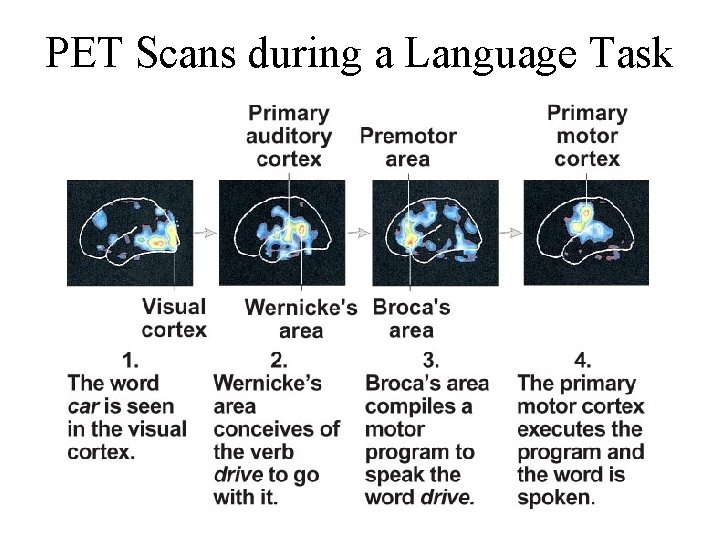
PET Scans during a Language Task
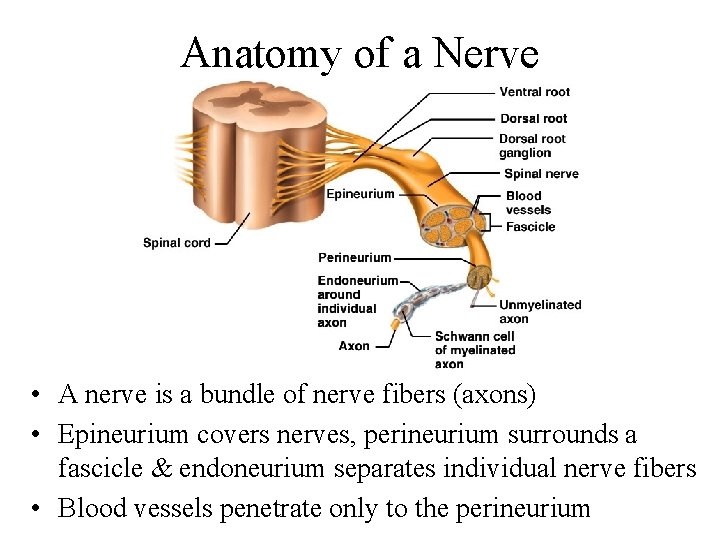
Anatomy of a Nerve • A nerve is a bundle of nerve fibers (axons) • Epineurium covers nerves, perineurium surrounds a fascicle & endoneurium separates individual nerve fibers • Blood vessels penetrate only to the perineurium
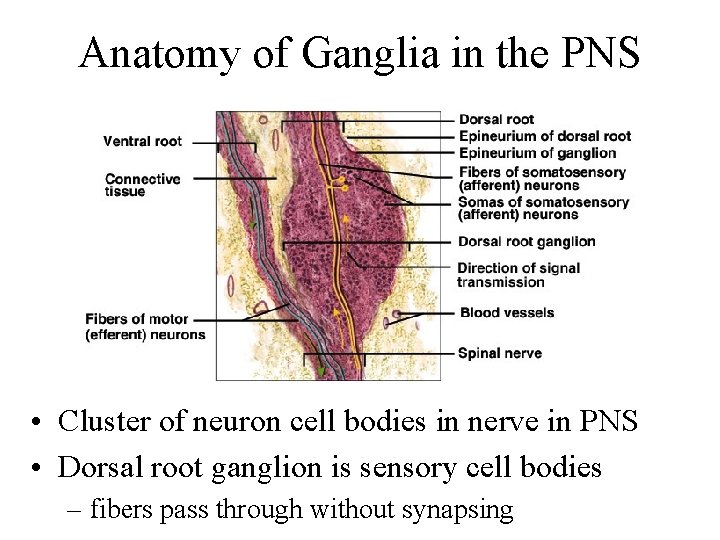
Anatomy of Ganglia in the PNS • Cluster of neuron cell bodies in nerve in PNS • Dorsal root ganglion is sensory cell bodies – fibers pass through without synapsing
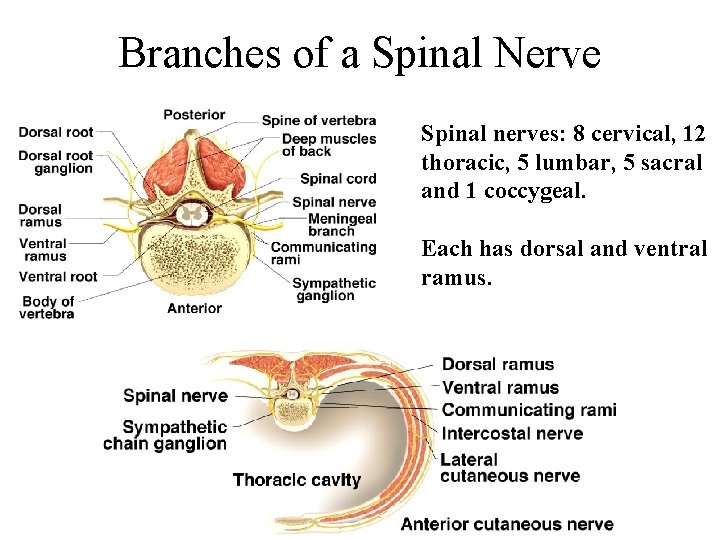
Branches of a Spinal Nerve Spinal nerves: 8 cervical, 12 thoracic, 5 lumbar, 5 sacral and 1 coccygeal. Each has dorsal and ventral ramus.
Shingles • Skin eruptions along path of nerve • Varicella-zoster virus (chicken pox) remains for life in dorsal root ganglia • Occurs after age 50 if immune system is compromised • No special treatment
Nerve Plexuses • Ventral rami branch & anastomose repeatedly to form 5 nerve plexuses – cervical in the neck, C 1 to C 5 • supplies neck and phrenic nerve to the diaphragm – brachial in the armpit, C 5 to T 1 • supplies upper limb and some of shoulder & neck – lumbar in the low back, L 1 to L 4 • supplies abdominal wall, anterior thigh & genitalia – sacral in the pelvis, L 4, L 5 & S 1 to S 4 • supplies remainder of butt & lower limb – coccygeal, S 4, S 5 and C 0
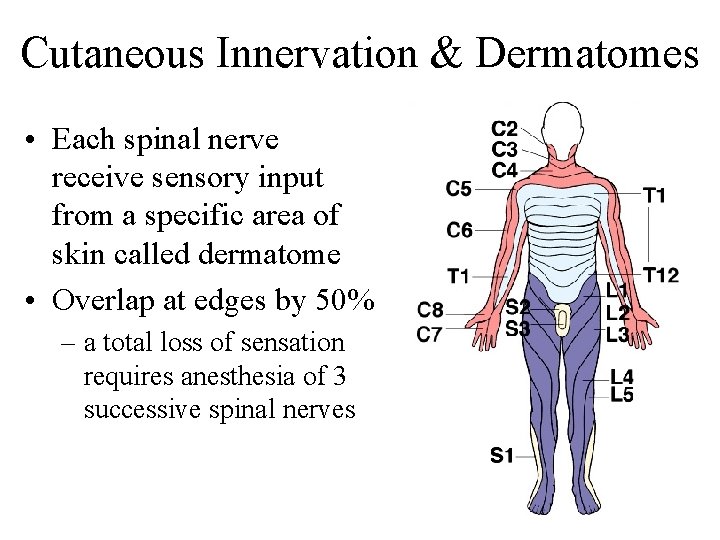
Cutaneous Innervation & Dermatomes • Each spinal nerve receive sensory input from a specific area of skin called dermatome • Overlap at edges by 50% – a total loss of sensation requires anesthesia of 3 successive spinal nerves
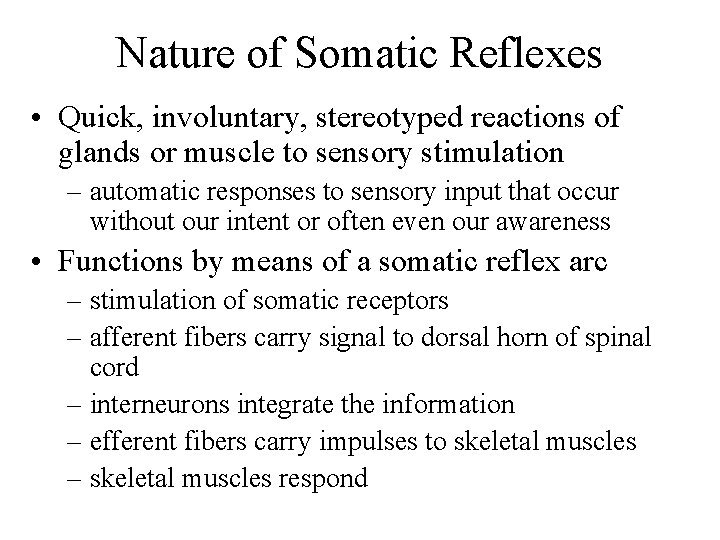
Nature of Somatic Reflexes • Quick, involuntary, stereotyped reactions of glands or muscle to sensory stimulation – automatic responses to sensory input that occur without our intent or often even our awareness • Functions by means of a somatic reflex arc – stimulation of somatic receptors – afferent fibers carry signal to dorsal horn of spinal cord – interneurons integrate the information – efferent fibers carry impulses to skeletal muscles – skeletal muscles respond
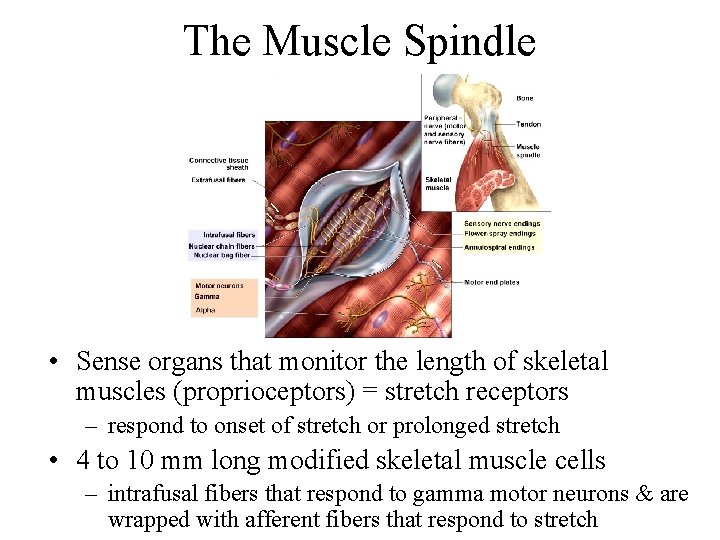
The Muscle Spindle • Sense organs that monitor the length of skeletal muscles (proprioceptors) = stretch receptors – respond to onset of stretch or prolonged stretch • 4 to 10 mm long modified skeletal muscle cells – intrafusal fibers that respond to gamma motor neurons & are wrapped with afferent fibers that respond to stretch
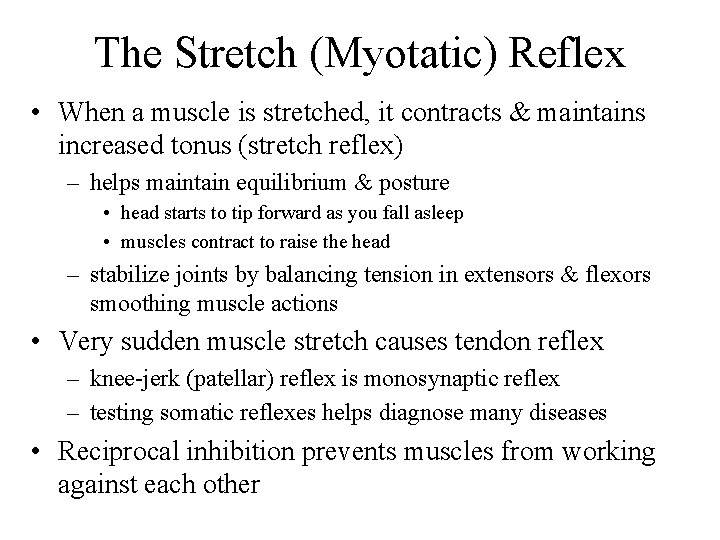
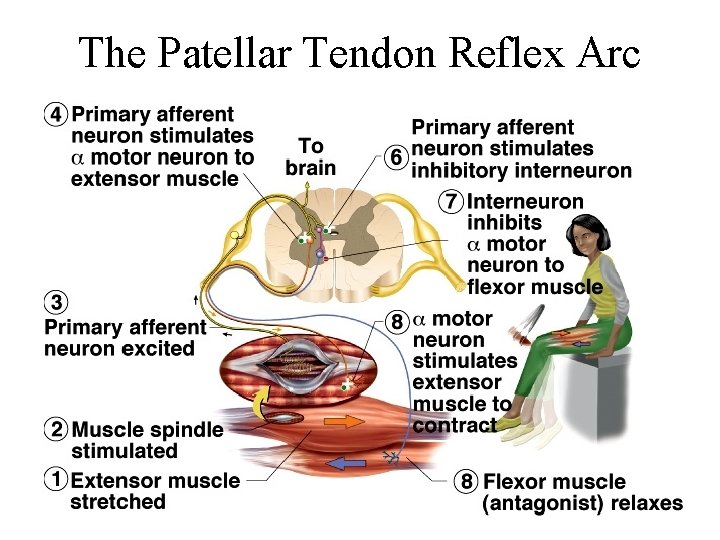
The Stretch (Myotatic) Reflex • When a muscle is stretched, it contracts & maintains increased tonus (stretch reflex) – helps maintain equilibrium & posture • head starts to tip forward as you fall asleep • muscles contract to raise the head – stabilize joints by balancing tension in extensors & flexors smoothing muscle actions • Very sudden muscle stretch causes tendon reflex – knee-jerk (patellar) reflex is monosynaptic reflex – testing somatic reflexes helps diagnose many diseases • Reciprocal inhibition prevents muscles from working against each other
The Patellar Tendon Reflex Arc
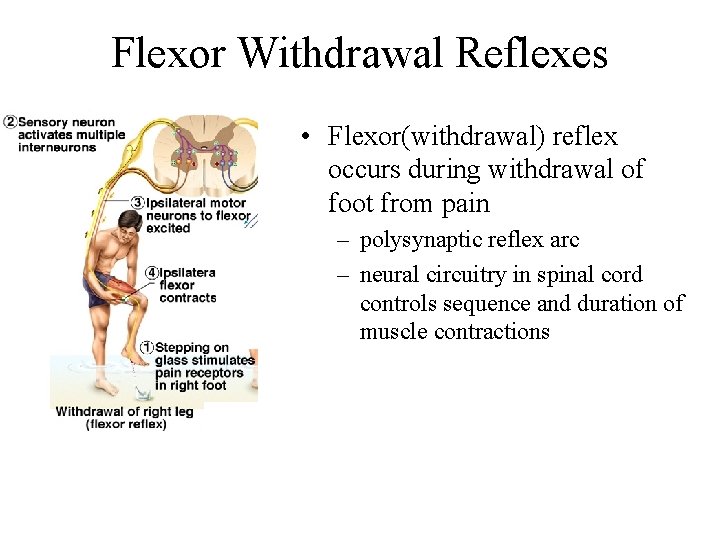
Flexor Withdrawal Reflexes • Flexor(withdrawal) reflex occurs during withdrawal of foot from pain – polysynaptic reflex arc – neural circuitry in spinal cord controls sequence and duration of muscle contractions
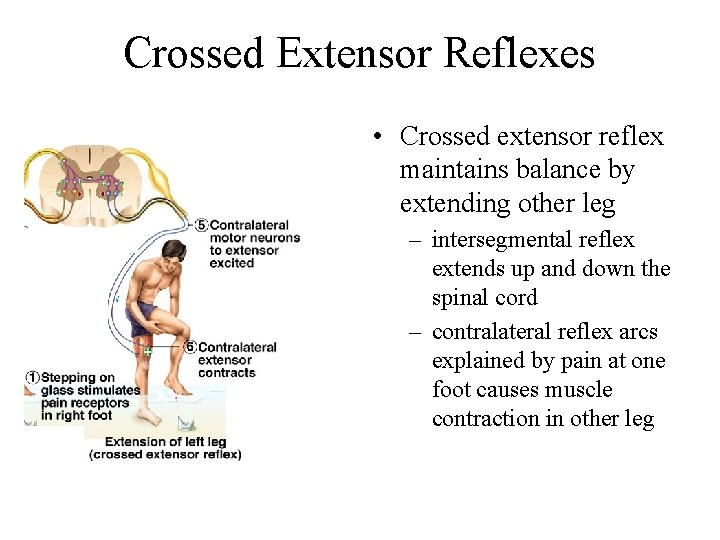
Crossed Extensor Reflexes • Crossed extensor reflex maintains balance by extending other leg – intersegmental reflex extends up and down the spinal cord – contralateral reflex arcs explained by pain at one foot causes muscle contraction in other leg
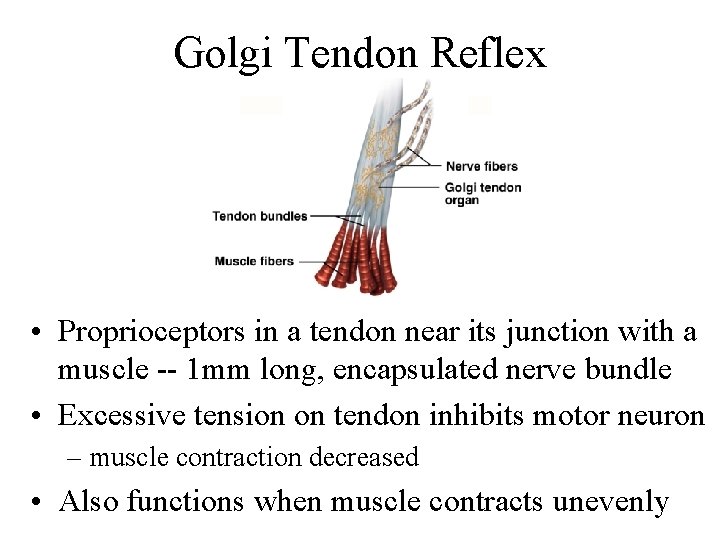
Golgi Tendon Reflex • Proprioceptors in a tendon near its junction with a muscle -- 1 mm long, encapsulated nerve bundle • Excessive tension on tendon inhibits motor neuron – muscle contraction decreased • Also functions when muscle contracts unevenly
Spinal Cord Trauma • • • 10 -12, 000 people/ year are paralyzed 55% occur in traffic accidents This damage poses risk of respiratory failure Early symptoms are called spinal shock Tissue damage at time of injury is followed by post-traumatic infarction