
Peripheral nerve lesions Plexopathy Mononeuropathy Polyneuropathy 16 05
- Slides: 37
Peripheral nerve lesions Plexopathy Mononeuropathy Polyneuropathy 16. 05. 2018
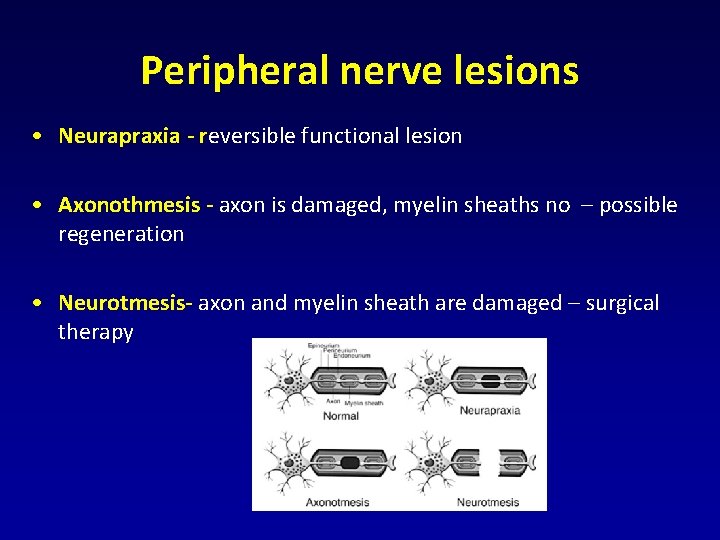
Peripheral nerve lesions • Neurapraxia - reversible functional lesion • Axonothmesis - axon is damaged, myelin sheaths no – possible regeneration • Neurotmesis- axon and myelin sheath are damaged – surgical therapy
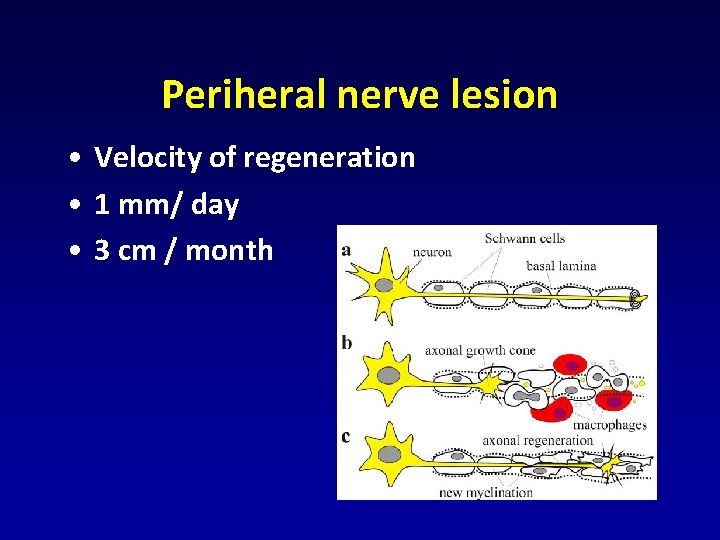
Periheral nerve lesion • Velocity of regeneration • 1 mm/ day • 3 cm / month
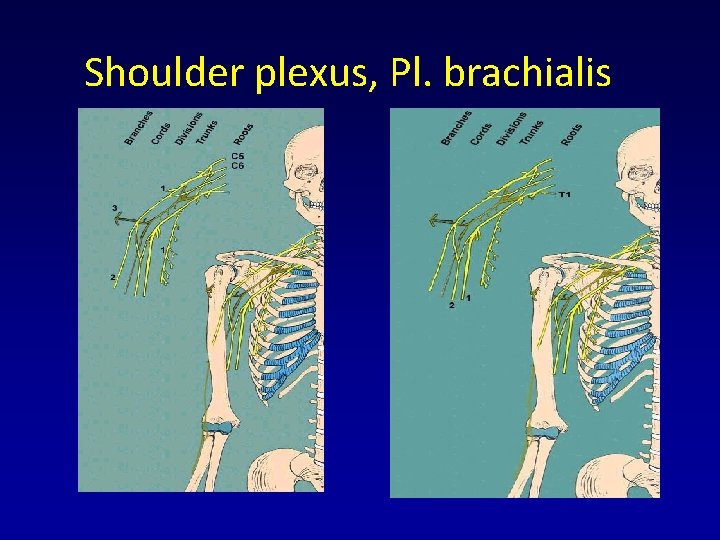
Shoulder plexus, Pl. brachialis
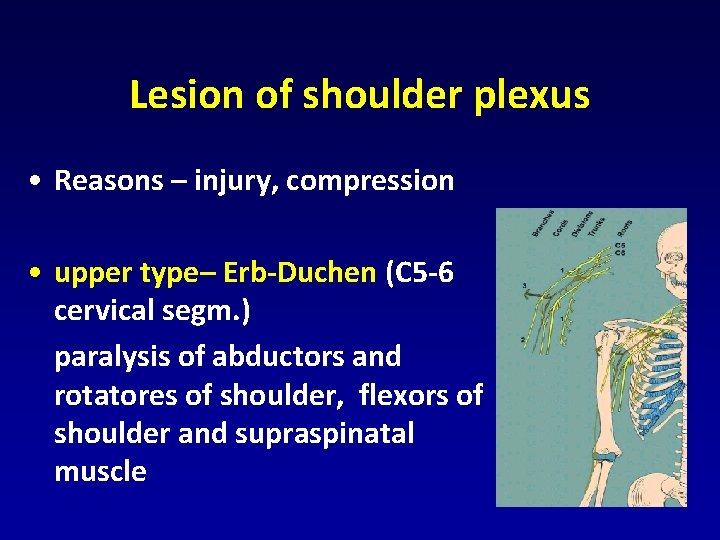
Lesion of shoulder plexus • Reasons – injury, compression • upper type– Erb-Duchen (C 5 -6 cervical segm. ) paralysis of abductors and rotatores of shoulder, flexors of shoulder and supraspinatal muscle
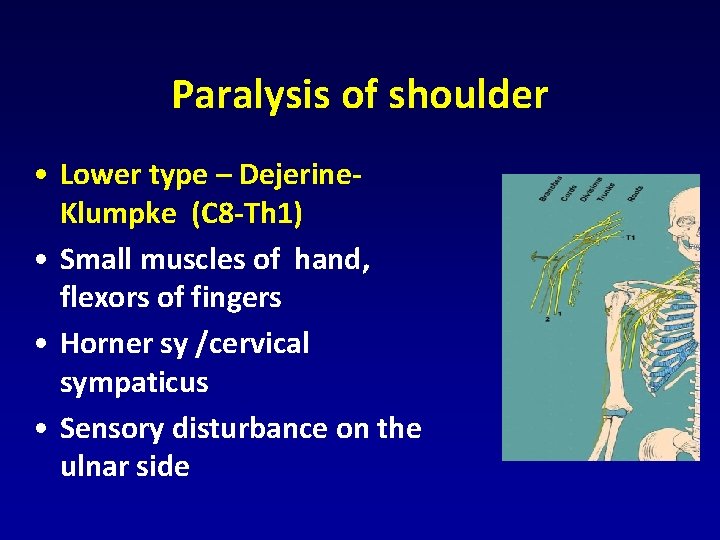
Paralysis of shoulder • Lower type – Dejerine. Klumpke (C 8 -Th 1) • Small muscles of hand, flexors of fingers • Horner sy /cervical sympaticus • Sensory disturbance on the ulnar side
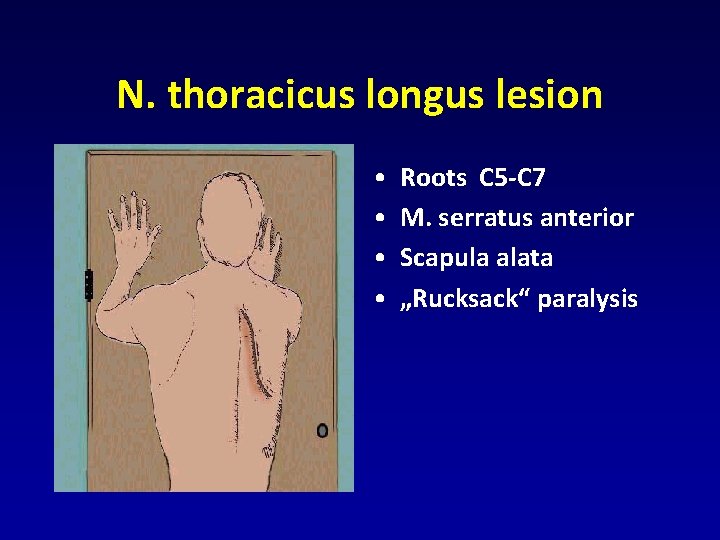
N. thoracicus longus lesion • • Roots C 5 -C 7 M. serratus anterior Scapula alata „Rucksack“ paralysis
Lesion of axillar nerve • Roots C 5 -C 6 • Deltoid muscle • Reduction of shoulder abduction • Ethiology: elbow Llxation, injury
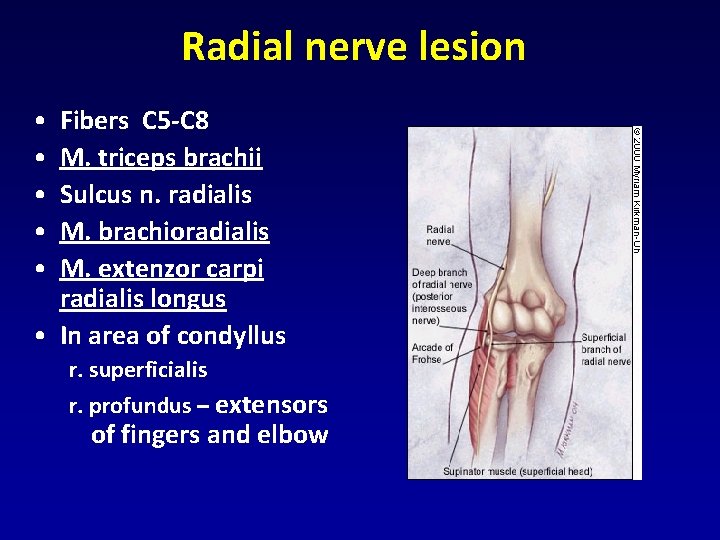
Radial nerve lesion • • • Fibers C 5 -C 8 M. triceps brachii Sulcus n. radialis M. brachioradialis M. extenzor carpi radialis longus • In area of condyllus r. superficialis r. profundus – extensors of fingers and elbow
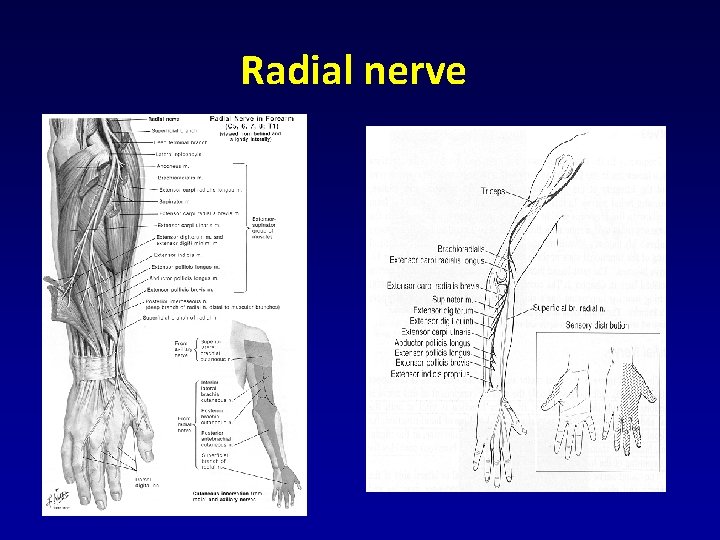
Radial nerve
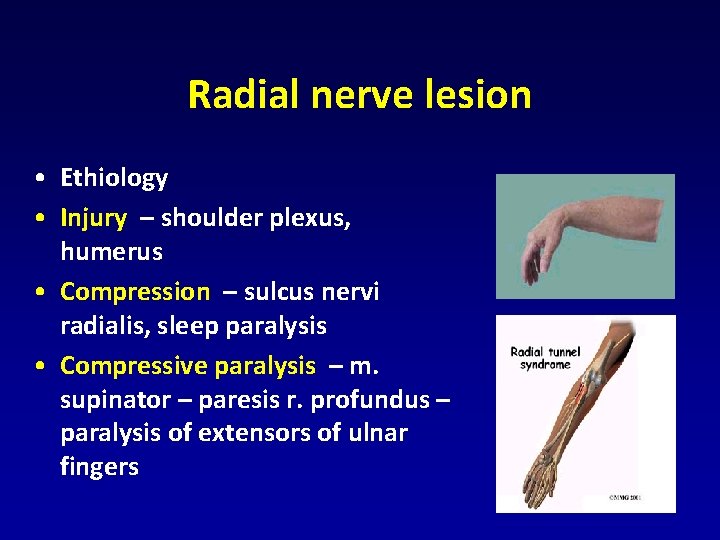
Radial nerve lesion • Ethiology • Injury – shoulder plexus, humerus • Compression – sulcus nervi radialis, sleep paralysis • Compressive paralysis – m. supinator – paresis r. profundus – paralysis of extensors of ulnar fingers
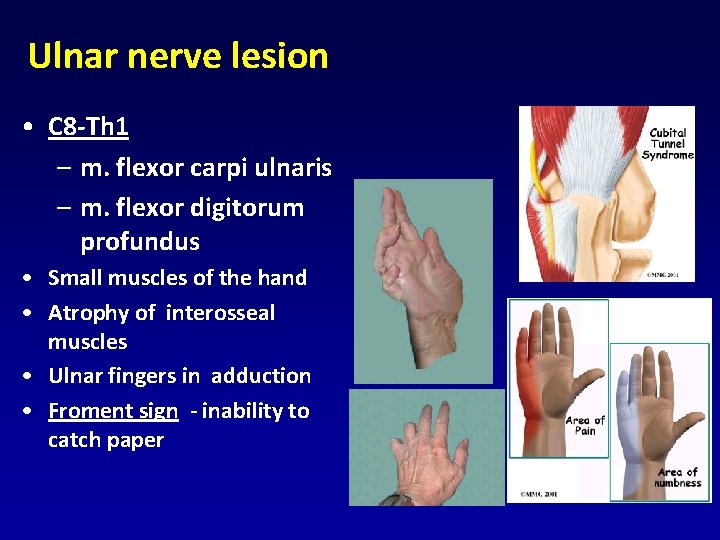
Ulnar nerve lesion • C 8 -Th 1 – m. flexor carpi ulnaris – m. flexor digitorum profundus • Small muscles of the hand • Atrophy of interosseal muscles • Ulnar fingers in adduction • Froment sign - inability to catch paper
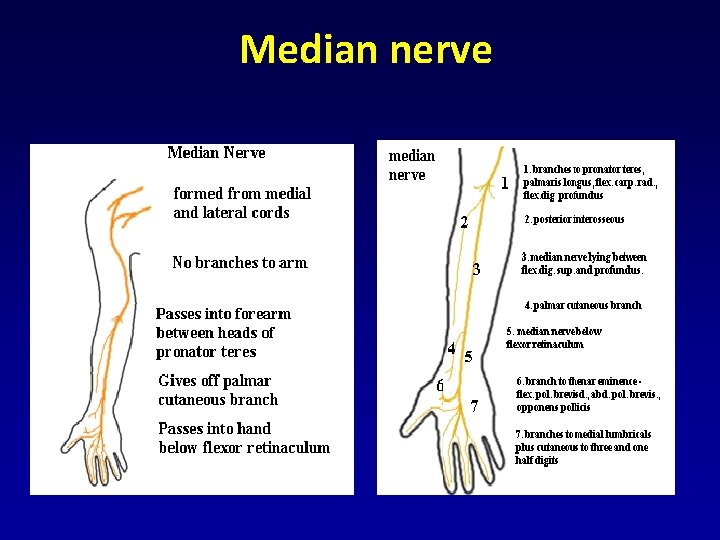
Median nerve
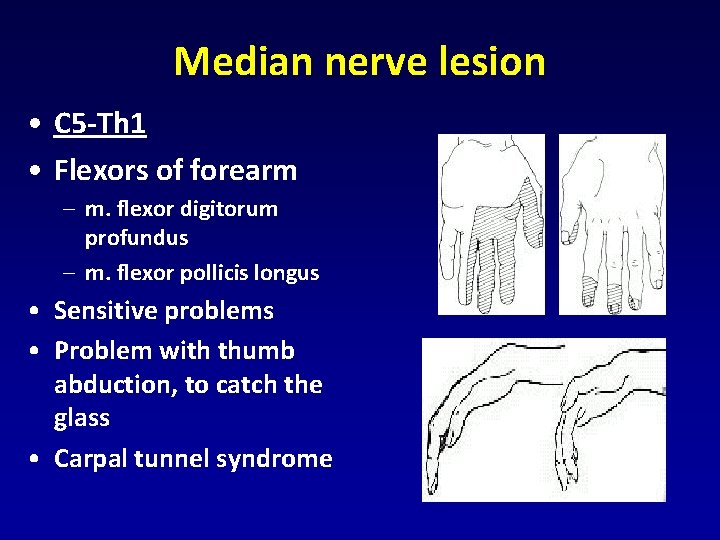
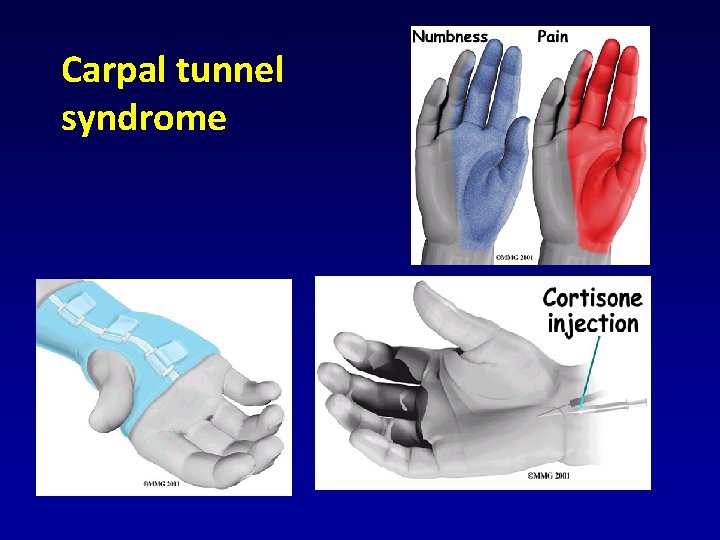
Median nerve lesion • C 5 -Th 1 • Flexors of forearm – m. flexor digitorum profundus – m. flexor pollicis longus • Sensitive problems • Problem with thumb abduction, to catch the glass • Carpal tunnel syndrome
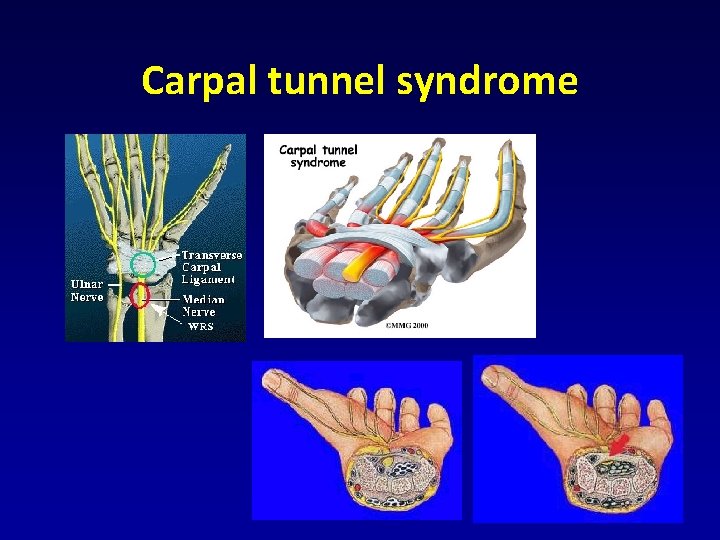
Carpal tunnel syndrome
Carpal tunnel syndrome
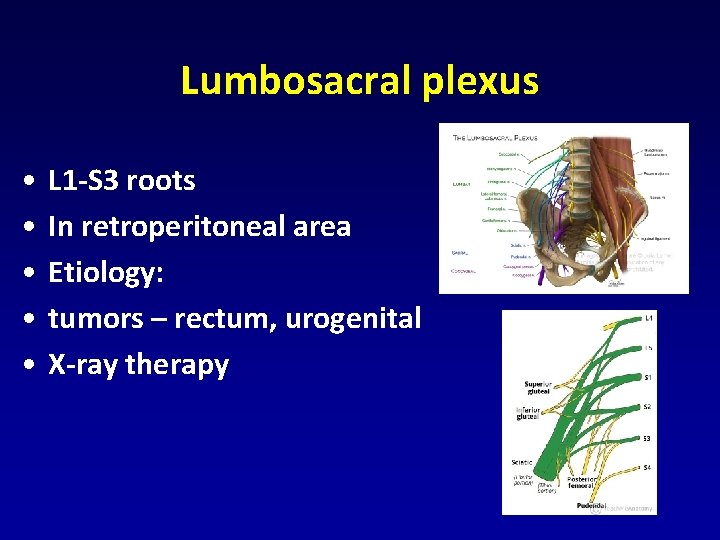
Lumbosacral plexus • • • L 1 -S 3 roots In retroperitoneal area Etiology: tumors – rectum, urogenital X-ray therapy
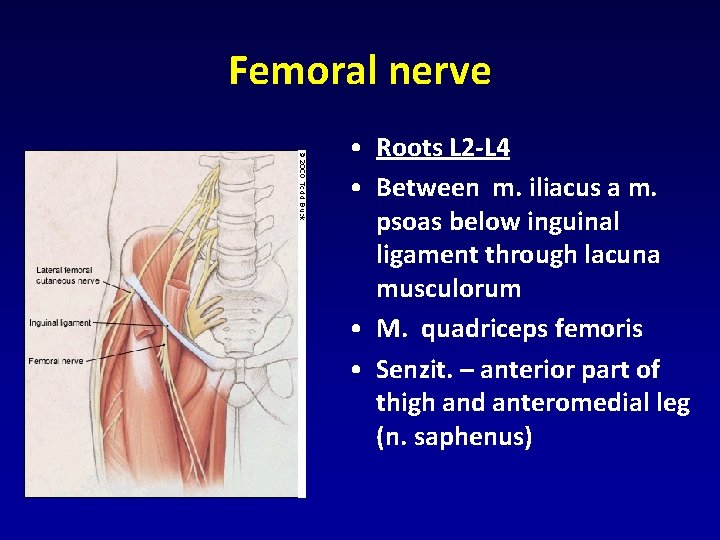
Femoral nerve • Roots L 2 -L 4 • Between m. iliacus a m. psoas below inguinal ligament through lacuna musculorum • M. quadriceps femoris • Senzit. – anterior part of thigh and anteromedial leg (n. saphenus)
Femoral nerve lesion • • • Clinical features Weakness of leg extension Weakness of hip flexion Loss of knee jerk Etiology: pelvic tumors and operations, diabetes, injury • Dif. dg: Compression of L 3, L 4 root
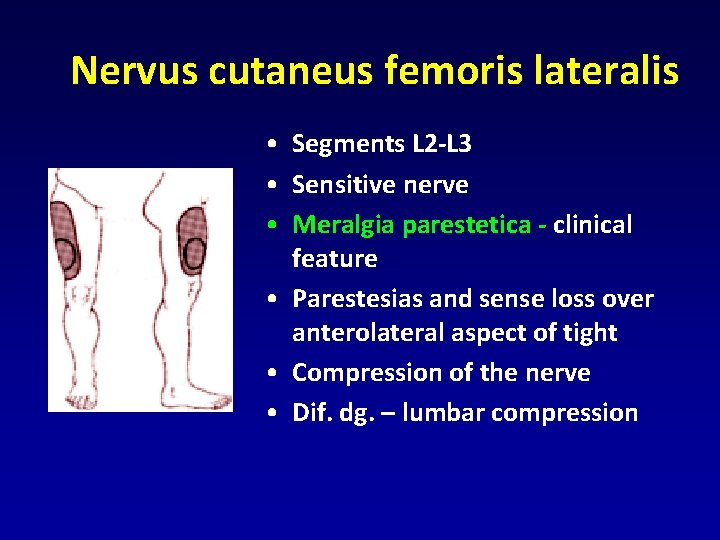
Nervus cutaneus femoris lateralis • Segments L 2 -L 3 • Sensitive nerve • Meralgia parestetica - clinical feature • Parestesias and sense loss over anterolateral aspect of tight • Compression of the nerve • Dif. dg. – lumbar compression
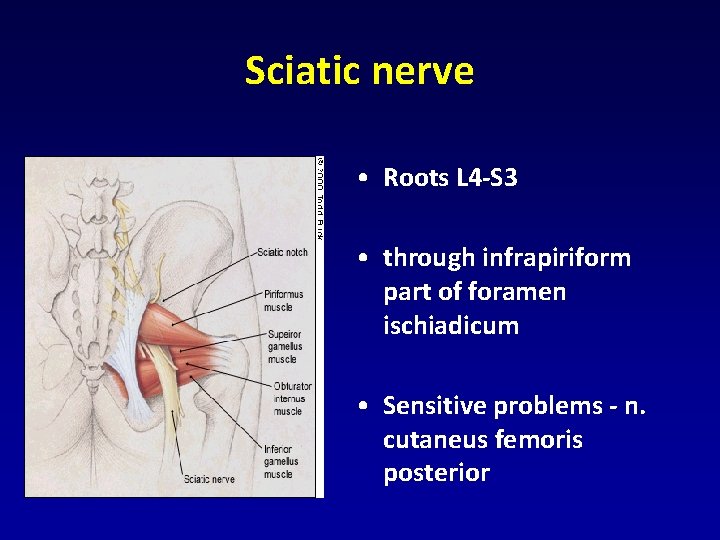
Sciatic nerve • Roots L 4 -S 3 • through infrapiriform part of foramen ischiadicum • Sensitive problems - n. cutaneus femoris posterior
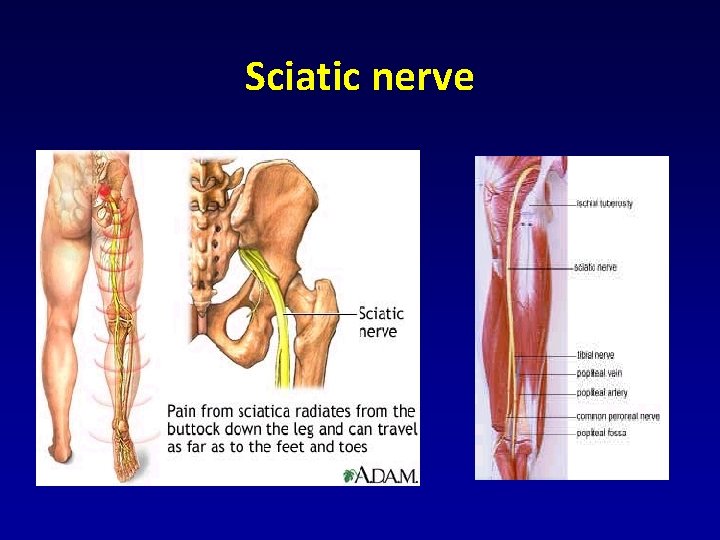
Sciatic nerve
Sciatic nerve lesion • Clinical feature • Weakness of leg flexors and all muscles below knee • Weakness of gluteal muscles with pelvic lesions, decreased sensation of the posterior tigh, posterior and lateral leg, and sole • Etiology: atherosclerosis, occlusion of abdominal aorta (Lerich syndrome), i. m. injection
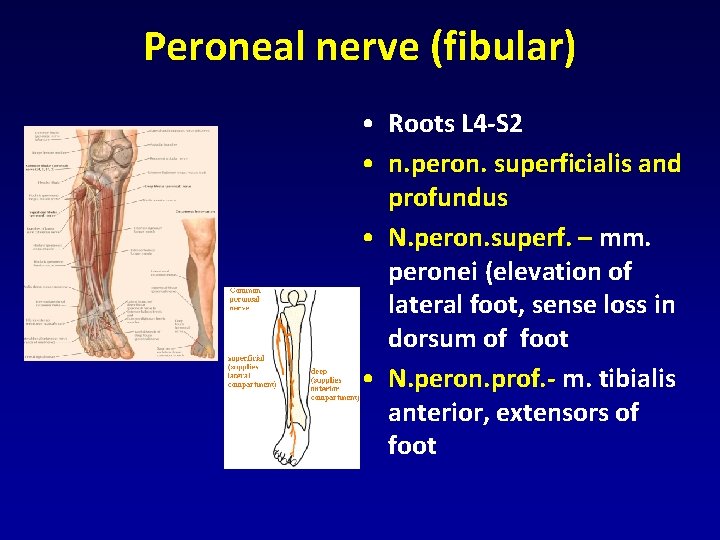
Peroneal nerve (fibular) • Roots L 4 -S 2 • n. peron. superficialis and profundus • N. peron. superf. – mm. peronei (elevation of lateral foot, sense loss in dorsum of foot • N. peron. prof. - m. tibialis anterior, extensors of foot
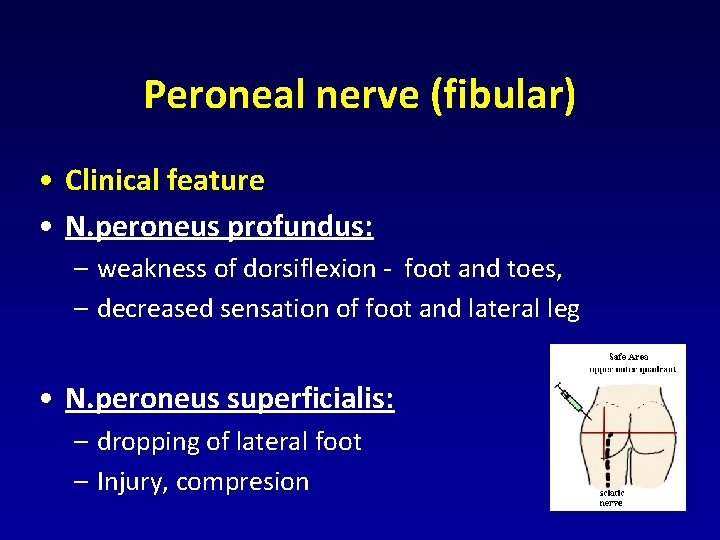
Peroneal nerve (fibular) • Clinical feature • N. peroneus profundus: – weakness of dorsiflexion - foot and toes, – decreased sensation of foot and lateral leg • N. peroneus superficialis: – dropping of lateral foot – Injury, compresion
Peroneal nerve (fibular) • Dif. dg. • Prolaps of disc L 4/L 5 and compression of root L 5 • Abduction of hip – radiculopathy L 5
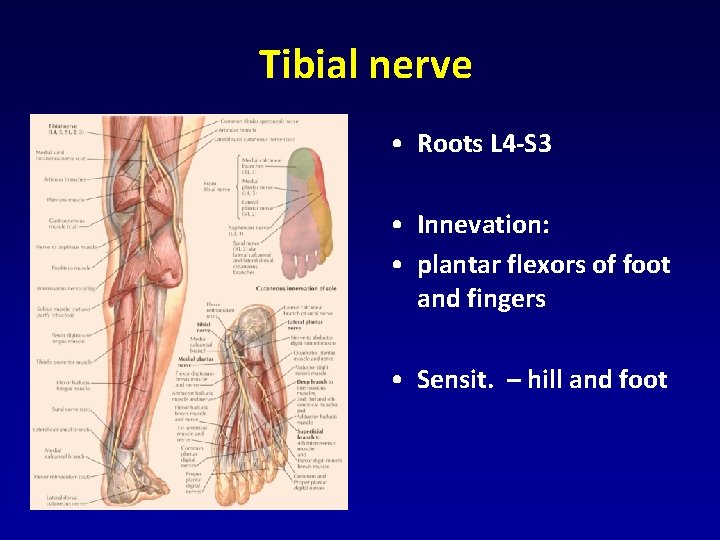
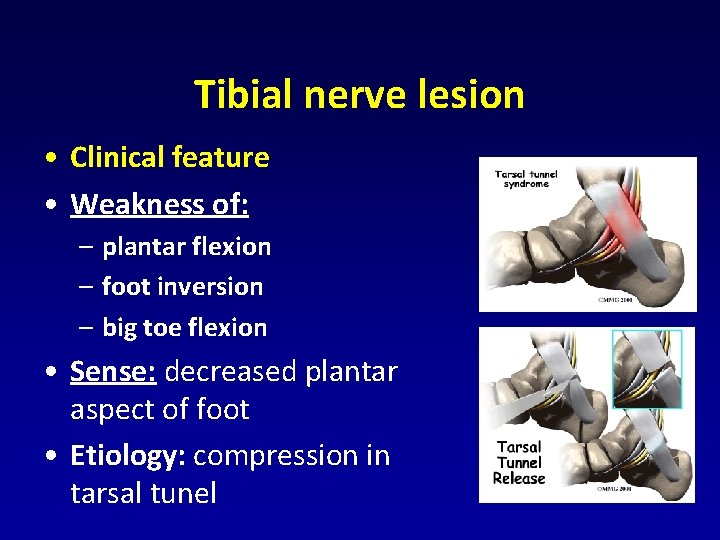
Tibial nerve • Roots L 4 -S 3 • Innevation: • plantar flexors of foot and fingers • Sensit. – hill and foot
Tibial nerve lesion • Clinical feature • Weakness of: – plantar flexion – foot inversion – big toe flexion • Sense: decreased plantar aspect of foot • Etiology: compression in tarsal tunel
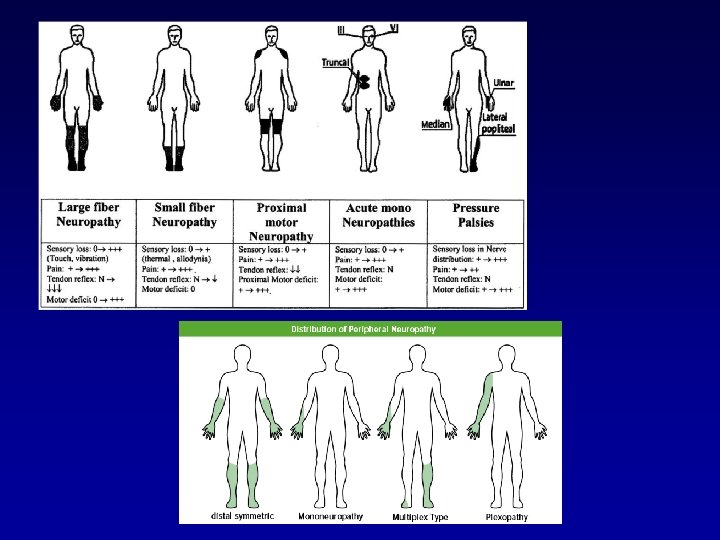
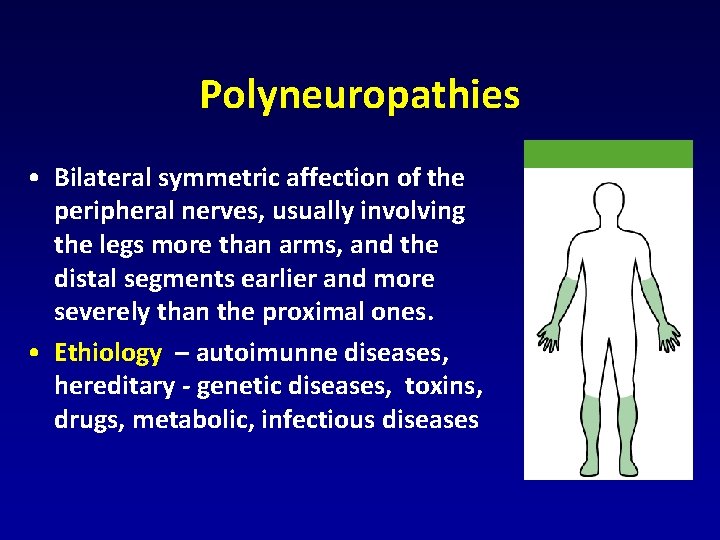
Polyneuropathies • Bilateral symmetric affection of the peripheral nerves, usually involving the legs more than arms, and the distal segments earlier and more severely than the proximal ones. • Ethiology – autoimunne diseases, hereditary - genetic diseases, toxins, drugs, metabolic, infectious diseases
Polyneuropathies – symptomatology • Numbness and sensory problems numbness, tingling, burning, the loss of proprioceptive fibers gives rise to sensory ataxia and tremor • Motor symptoms (rare) symmetric, lower extremities, later upper E • Loss of reflexes – ankle, patellar, UE • Trophic changes – muscle atrophies, dryness of the skin, trophic changes (ulcers), foot deformations
Polyneuropathies - diagnosis • • • EMG Nerve biopsy Lumbar puncture- CSF Blood examination and serology : Blood count, sugar, kreatinin, urea, liver enzymes, vit. B 12, B 1, uroporfyrins, koproporfyrins, rheumatoid serology, CIK, phytan acid (M. Refsum), ELFO, serology – infectious diseases
Polyneuropathies – classification • • • Acute, chronic type Histopatological classification Axonal, demyelinating type According EMG According ethiology
Polyneuropathies – ethiological classification • • • Genetically determined Metabolic disorders Nutritional polyneuropathy Dys- and paraproteinemias Infectious diseases Poisoning with heavy metals, alcohol, drugs, . . .
Polyneuropathies – genetically determined • Hereditary motoric a sensory neuropathies (HMSN) – type I – VII • Type I – Charcot-Marie-Tooth • AD, distal, LE, foot deformation, thickening of peripheral nerves, decreased velocity, biopsy – axonal degeneration, de- and re-myelinisation, onion bulb formations • Type IV – M. Refsum – AR, retinitis pigmentosa, loss of hearing, heart and skin signs, skeleton deformations, phytan acid
Polyneuropathies – genetically determined • In acute liver porphyria moneuritis multiplex, motoric polyradiculoneuritis, quadruparesis • Primary amyloidosis
Polyneuropathies – metabolicaly determined • • Diabetic Uraemic Liver cirrhosis Malnutrition – vit. B 12, B 1 deficiency