
Peripheral circulation I Physiology of the vascular wall
![VSM inactivation n [Ca 2+]i n n influx pumping outside • Ca 2+ ATPase](https://slidetodoc.com/presentation_image_h2/d8bb56637e075ed55b761eb94086f631/image-7.jpg "VSM inactivation n [Ca 2+]i n n influx pumping outside • Ca 2+ ATPase")
- Slides: 28
Peripheral circulation I: Physiology of the vascular wall vaclav. hampl@lf 2. cuni. cz http: //physiology. lf 2. cuni. cz/ Vascular wall physiology
Regulation of regional blood flow n Resistance vessels (arterioles): changes in diameter n n Vasodilation Vasoconstriction Prerequisite: basal tone • nerve-independent • sympathetic tone • Changes in the diameter of open vessels • Changes in the number of open vessels („recruitment“) 10/20/2021 Vascular wall physiology 2
Vascular smooth muscle contraction n Actin (thin filaments) n n attached to dense bodies made of -actin (in cytoplasm & inner side of membrane) Myosin (thick filaments) n hexamere of 2 heavy & 2 different pairs of light chains 10/20/2021 Vascular wall physiology 3
Vascular smooth muscle (VSM) contraction 10/20/2021 Vascular wall physiology 4
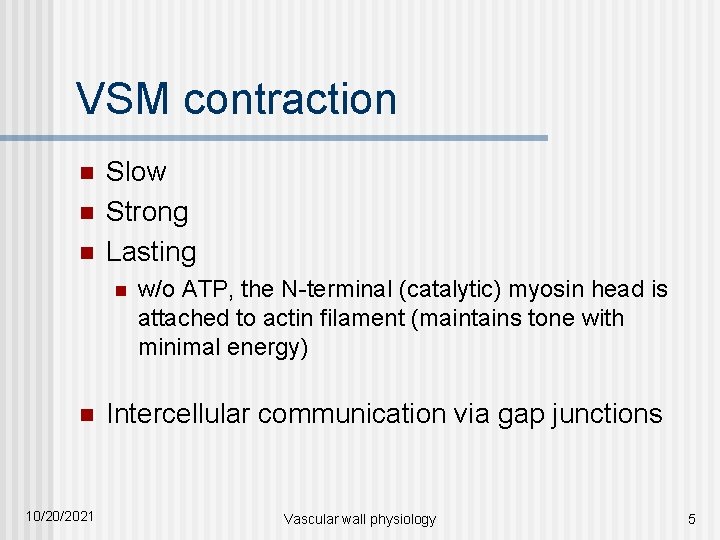
VSM contraction n Slow Strong Lasting n n 10/20/2021 w/o ATP, the N-terminal (catalytic) myosin head is attached to actin filament (maintains tone with minimal energy) Intercellular communication via gap junctions Vascular wall physiology 5
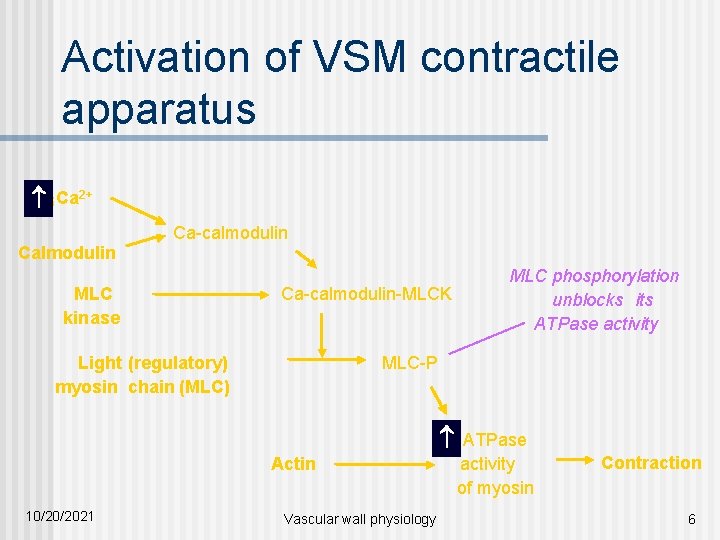
Activation of VSM contractile apparatus a Ca 2+ Calmodulin Ca-calmodulin MLC kinase Ca-calmodulin-MLCK Light (regulatory) myosin chain (MLC) MLC-P Actin 10/20/2021 MLC phosphorylation unblocks its ATPase activity Vascular wall physiology a ATPase activity of myosin Contraction 6
VSM inactivation n [Ca 2+]i n n influx pumping outside • Ca 2+ ATPase • Na/Ca antiport n n pumping to reticulum (SERCA) Ca 2+-independent MLC phosphatase prevails over MLCK MLC phosphorylation ( activity) 10/20/2021 Vascular wall physiology 7
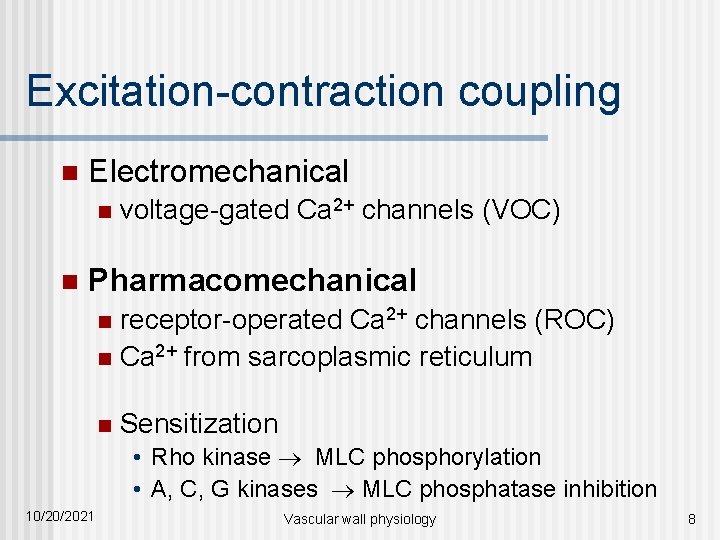
Excitation-contraction coupling n Electromechanical n n voltage-gated Ca 2+ channels (VOC) Pharmacomechanical receptor-operated Ca 2+ channels (ROC) n Ca 2+ from sarcoplasmic reticulum n n Sensitization • Rho kinase MLC phosphorylation • A, C, G kinases MLC phosphatase inhibition 10/20/2021 Vascular wall physiology 8
Phospholipase C IP 3 + DAG n from membrane phospholipids n IP 3 activates Ca channel of endoplasmic reticulum • DAG PKC affinity to Ca 10/20/2021 Vascular wall physiology 9
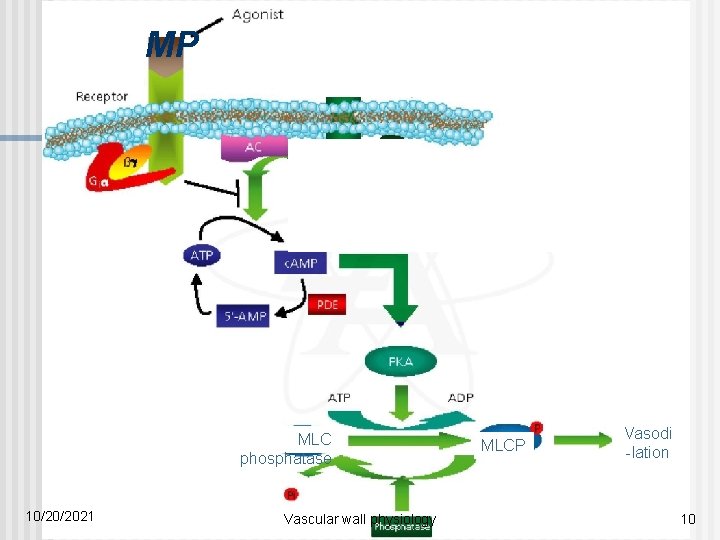
c. AMP MLC phosphatase 10/20/2021 Vascular wall physiology MLCP Vasodi -lation 10
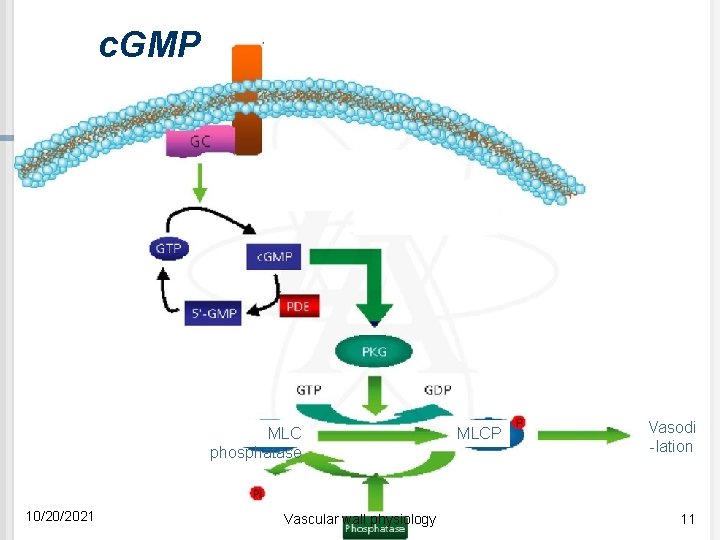
c. GMP MLC phosphatase 10/20/2021 Vascular wall physiology MLCP Vasodi -lation 11
Vascular tone regulation n Local (mainly , brain, kidney): autoregulation of blood flow n Neural (mainly skin, GIT): inter-organ distribution n important where local flow can be reduced for the sake of the whole body (blood pressure maintenance) almost not at all in brain & Humoral - total PVR 10/20/2021 Vascular wall physiology 12
Local autoregulation of blood flow Blood flow (ml/min/kg) Perfusion pressure (mm. Hg) 10/20/2021 Vascular wall physiology 13
Blood flow autoregulation n Importance: Adjusts perfusion to metabolic needs n Constant flow during pressure alterations n Rises towards periphery n n Mechanisms: Myogenic response n Metabolic regulation n 10/20/2021 Vascular wall physiology 14
Myogenic response to pressure changes Normalized diameter Transmural pressure (cm. H 2 O) 10/20/2021 Vascular wall physiology Flow = 0 15
Myogenic response n Mechanisms unclear Stretch-activated cation channel n Ca 2+ influx n n Important e. g. for orthostasis upright transmural pressure in legs n myogenic vasoconstriction prevents excessive redistribution of blood to legs & edema n 10/20/2021 Vascular wall physiology 16
Metabolic regulation Candidates (complement each other): n n n O 2 CO 2 H+ lactate K+ adenosine Flow Pressure (probably also NE release from SNS terminals) 10/20/2021 Vascular wall physiology 17
Organs without autoregulation (skin, …) n Metabolic component minimal due to low metabolism n Myogenic component suppressed by NO n 10/20/2021 NO inhibition unmasks skin myogenic autoregulation Vascular wall physiology 18
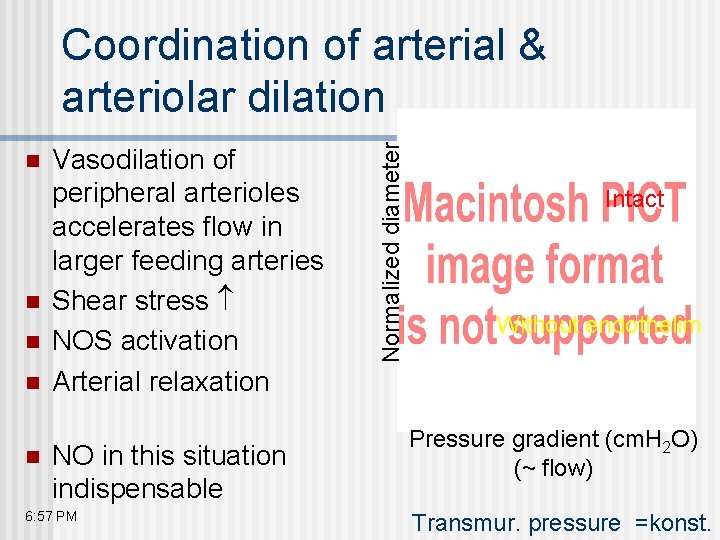
n n n Vasodilation of peripheral arterioles accelerates flow in larger feeding arteries Shear stress NOS activation Arterial relaxation NO in this situation indispensable 6: 57 PM Normalized diameter Coordination of arterial & arteriolar dilation Intact Without endothelim Pressure gradient (cm. H 2 O) (~ flow) Transmur. pressure =konst.
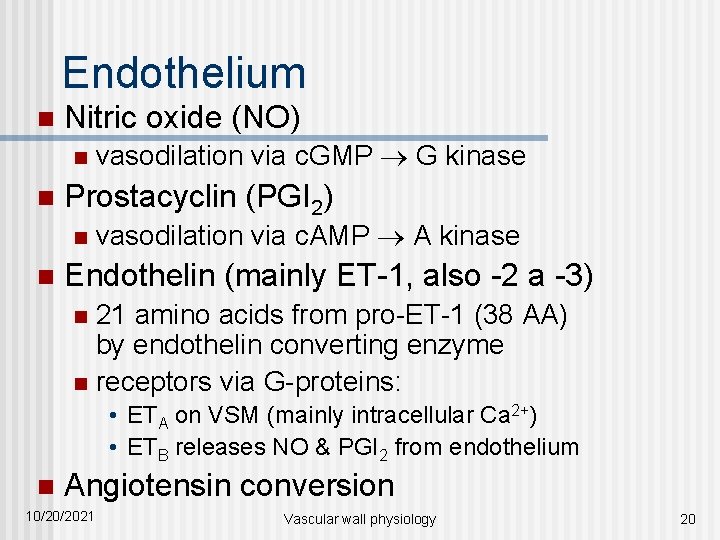
Endothelium n Nitric oxide (NO) n n Prostacyclin (PGI 2) n n vasodilation via c. GMP G kinase vasodilation via c. AMP A kinase Endothelin (mainly ET-1, also -2 a -3) 21 amino acids from pro-ET-1 (38 AA) by endothelin converting enzyme n receptors via G-proteins: n • ETA on VSM (mainly intracellular Ca 2+) • ETB releases NO & PGI 2 from endothelium n Angiotensin conversion 10/20/2021 Vascular wall physiology 20
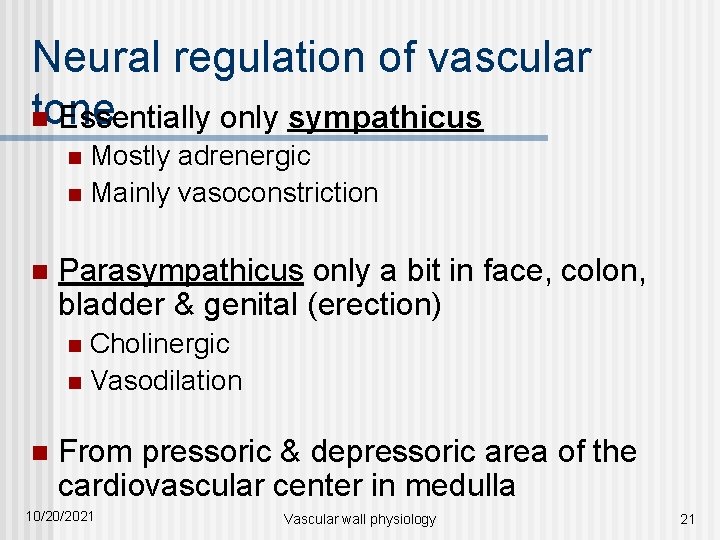
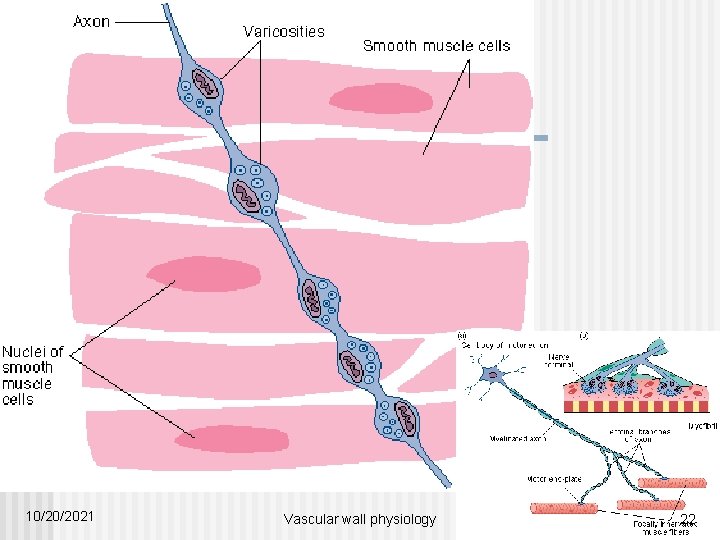
Neural regulation of vascular tone n Essentially only sympathicus Mostly adrenergic n Mainly vasoconstriction n n Parasympathicus only a bit in face, colon, bladder & genital (erection) Cholinergic n Vasodilation n n From pressoric & depressoric area of the cardiovascular center in medulla 10/20/2021 Vascular wall physiology 21
10/20/2021 Vascular wall physiology 22
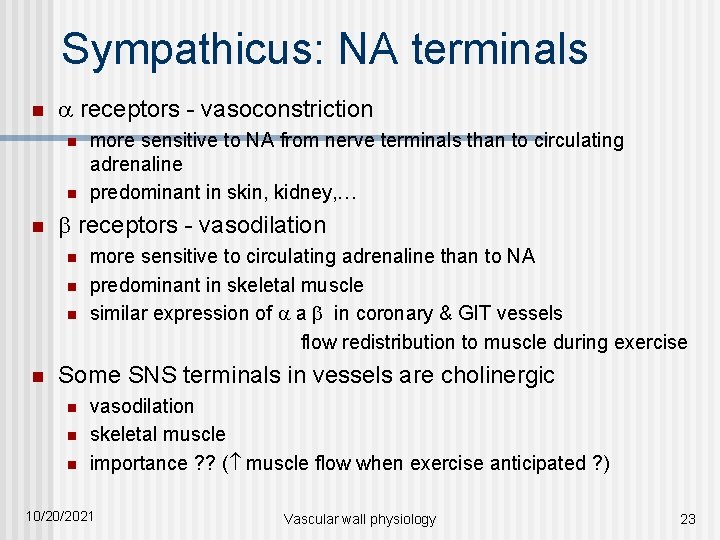
Sympathicus: NA terminals n receptors - vasoconstriction n receptors - vasodilation n n more sensitive to NA from nerve terminals than to circulating adrenaline predominant in skin, kidney, … more sensitive to circulating adrenaline than to NA predominant in skeletal muscle similar expression of a in coronary & GIT vessels flow redistribution to muscle during exercise Some SNS terminals in vessels are cholinergic n n n vasodilation skeletal muscle importance ? ? ( muscle flow when exercise anticipated ? ) 10/20/2021 Vascular wall physiology 23
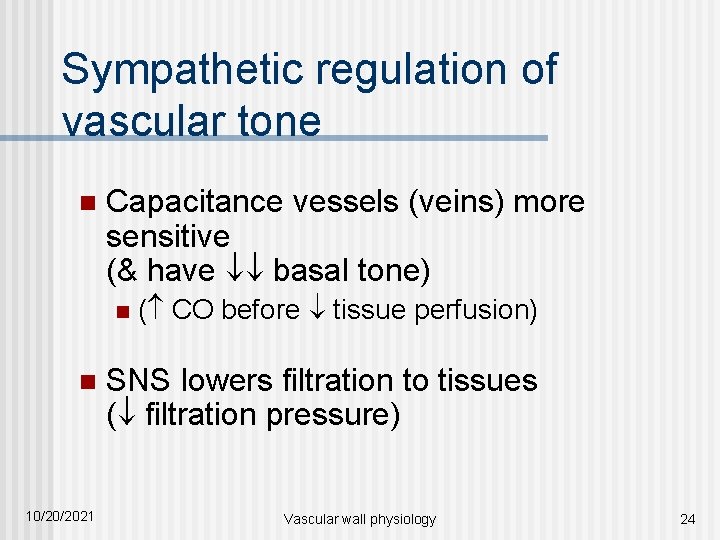
Sympathetic regulation of vascular tone n Capacitance vessels (veins) more sensitive (& have basal tone) n n 10/20/2021 ( CO before tissue perfusion) SNS lowers filtration to tissues ( filtration pressure) Vascular wall physiology 24
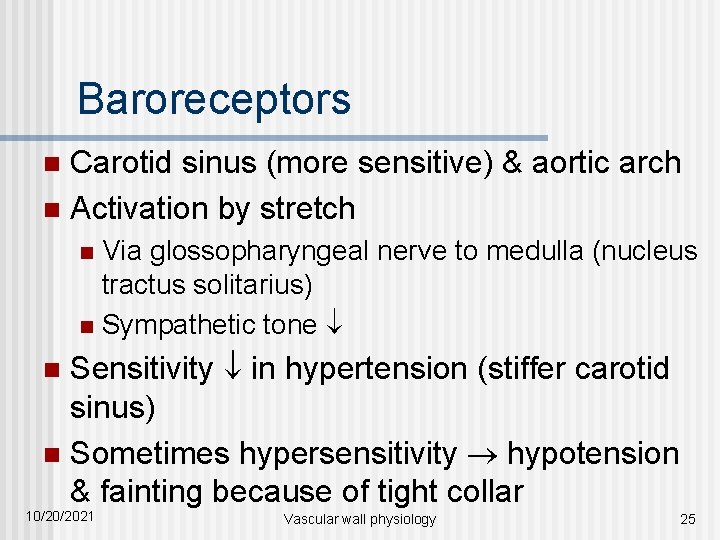
Baroreceptors Carotid sinus (more sensitive) & aortic arch n Activation by stretch n Via glossopharyngeal nerve to medulla (nucleus tractus solitarius) n Sympathetic tone n Sensitivity in hypertension (stiffer carotid sinus) n Sometimes hypersensitivity hypotension & fainting because of tight collar n 10/20/2021 Vascular wall physiology 25
Chemoreceptors n Peripheral (O 2 in carotid & aortic bodies): only small, supportive role n Central (CO 2/p. H in hypothalamus): massive vasoconstriction (protects CNS from ischemia) 10/20/2021 Vascular wall physiology 26
Humoral regulation of VSM: circulating hormones n Adrenaline: (importance < NA from SNS) Skeletal muscles: vasodilation @ low dose, vasoconstriction @ high dose n Skin & other organs: only vasoconstriction n n Angiotensin II: ACE from A-I, A-I from angiotensinogen by renin (released from kidny in hypotension or volume) n mainly AT 1 receptors n AT 2 opposite effects, but little AT 2 in vessels n • (their activation can during AT 1 inhibition because of feed-back A II - therapeutic significance) 10/20/2021 Vascular wall physiology 27
Humoral regulation of VSM: circulating hormones n ANP: n n n atrial distention natriuresis, vasodilation via c. GMP Endogenous ouabain (Na-K ATPase inhibitor) n Na/K ATPase is electrogenic (3 Na out, 2 K in) its inhibition depolarizes • but natriuresis by inhibition of Na pumping from primary urine volume pressure n Adrenomedullin (peptide from adrenal medulla) n n c. AMP in VSM NO in endothelium 10/20/2021 Vascular wall physiology 28