
Periods of English Literature 428 1100 Old English

- Slides: 14
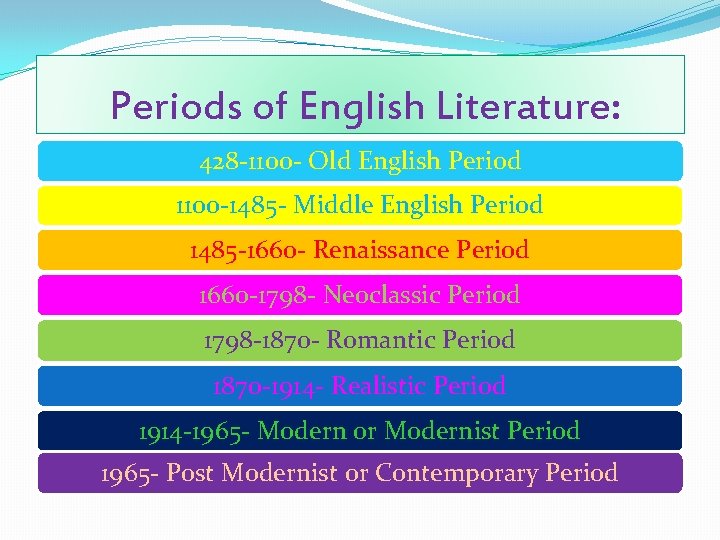
Periods of English Literature: 428 -1100 - Old English Period 1100 -1485 - Middle English Period 1485 -1660 - Renaissance Period 1660 -1798 - Neoclassic Period 1798 -1870 - Romantic Period 1870 -1914 - Realistic Period 1914 -1965 - Modern or Modernist Period 1965 - Post Modernist or Contemporary Period
English literature consists of poetry, prose, and drama, written in the English language by authors in England, Scotland Wales since 1707. English literature is also one of the oldest national literatures in the Western world. English authors wrote important literary works as early as A. D. 700 s.
MAIN FEATURES OF THE OLD ENGLISH POETRY �Alliteration (words that begin with the same sound); �Kennings (elaborate descriptive phrases); �Internal rhyme (word within a line rhymes with a word ar the end of the line).
CAEDMON �The first English poet; �Lived during the 600 s; �“Hymn”- his only surviving work- a nine-line poem that praises God.
CYNEWULF �the leading Northumbrian poet; �the main theme- lives and hardships of saints; �religious poems “The fates of the Apostles”, “Elene”, “Jiliana”.
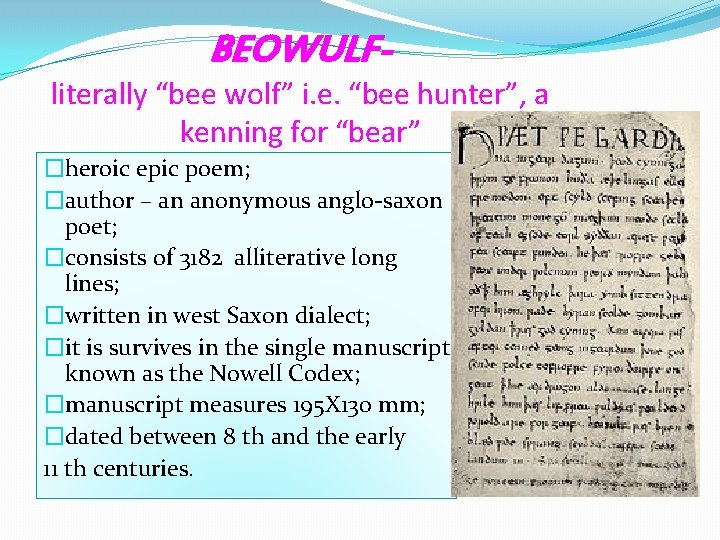
BEOWULF- literally “bee wolf” i. e. “bee hunter”, a kenning for “bear” �heroic epic poem; �author – an anonymous anglo-saxon poet; �consists of 3182 alliterative long lines; �written in west Saxon dialect; �it is survives in the single manuscript known as the Nowell Codex; �manuscript measures 195 X 130 mm; �dated between 8 th and the early 11 th centuries.
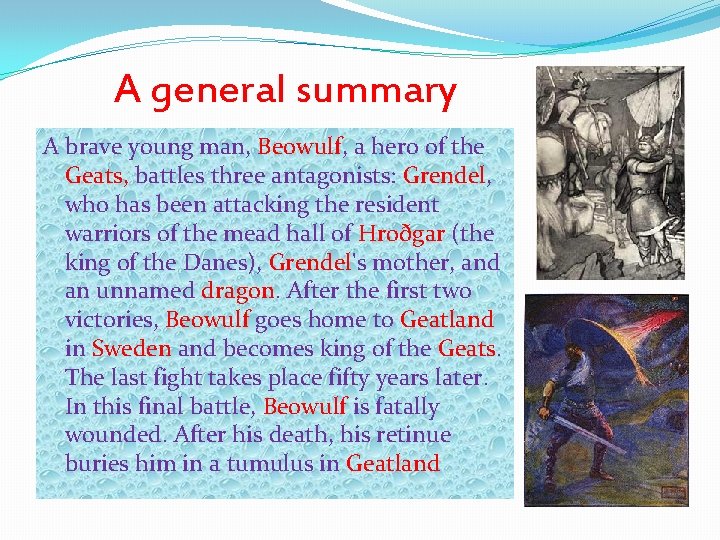
A general summary A brave young man, Beowulf, a hero of the Geats, battles three antagonists: Grendel, who has been attacking the resident warriors of the mead hall of Hroðgar (the king of the Danes), Grendel's mother, and an unnamed dragon. After the first two victories, Beowulf goes home to Geatland in Sweden and becomes king of the Geats. The last fight takes place fifty years later. In this final battle, Beowulf is fatally wounded. After his death, his retinue buries him in a tumulus in Geatland
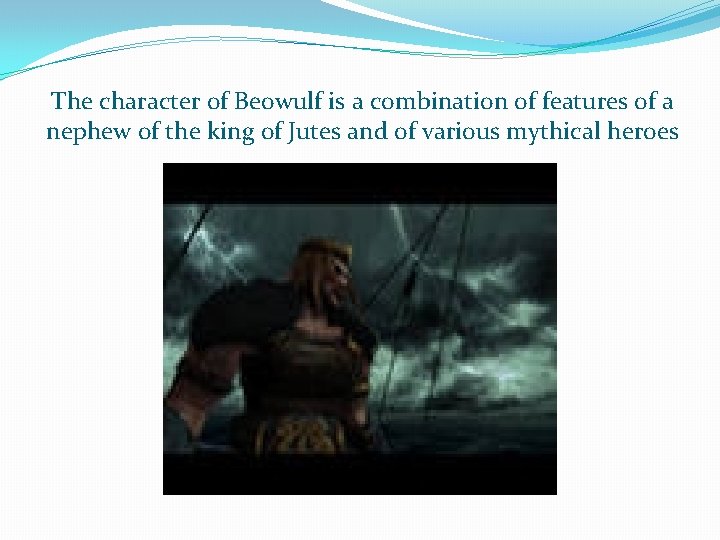
The character of Beowulf is a combination of features of a nephew of the king of Jutes and of various mythical heroes
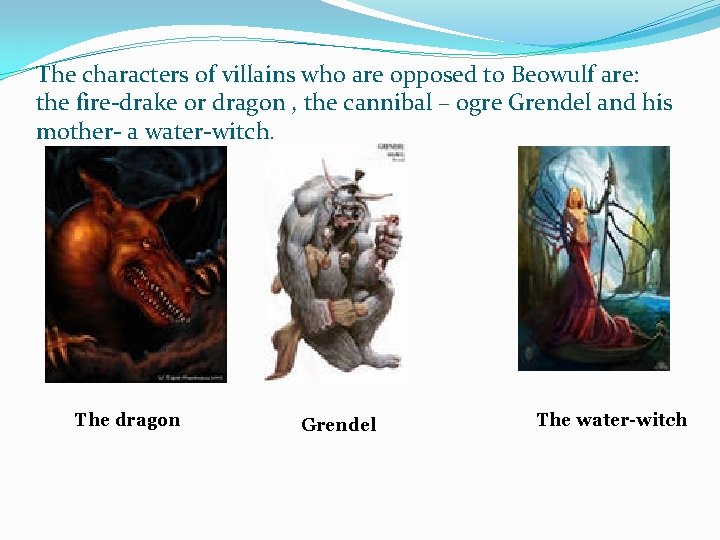
The characters of villains who are opposed to Beowulf are: the fire-drake or dragon , the cannibal – ogre Grendel and his mother- a water-witch. The dragon Grendel The water-witch
The tone of the poem is dark, melancholy and austere. In simple, direct and majestic verse an exciting story of adventure and heroism is told.
OLD ENGLISH PROSE �most prose was written in Latin until the late 800 s; �“Ecclasiastical History of the English Nation” written by monk venerable Bede – the first history of the English people and a valuable source of information about English life from the late 500 s to 731; �during 990 s a monk Aelfrik wrote a series of homilies (short moral essays); �from about 892 to 1154 a number of authors contributed to the “Anglo-Saxon Chronicle”- a record of current events in England.
THANK YOU FOR YOUR ATTENTION!