
Periodic Trends History of the Periodic Table 1817

Periodic Trends
History of the Periodic Table 1817 - Johann Dobereiner grouped elements into triads 1869 - Dmitri Mendeleev and Lothar Meyer published near identical tables 1913 – Henry Moseley reordered tables based on atomic number
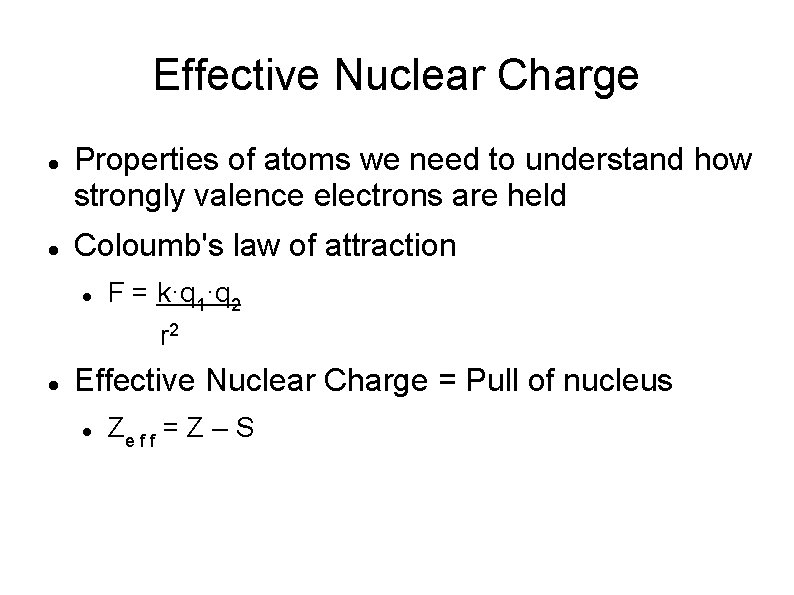
Effective Nuclear Charge Properties of atoms we need to understand how strongly valence electrons are held Coloumb's law of attraction F = k·q 1·q 2 r 2 Effective Nuclear Charge = Pull of nucleus Ze f f = Z – S
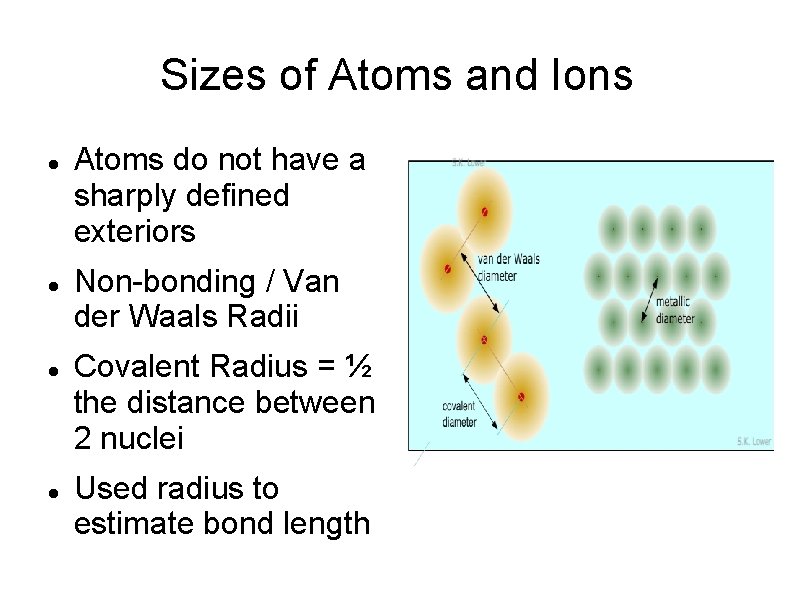
Sizes of Atoms and Ions Atoms do not have a sharply defined exteriors Non-bonding / Van der Waals Radii Covalent Radius = ½ the distance between 2 nuclei Used radius to estimate bond length
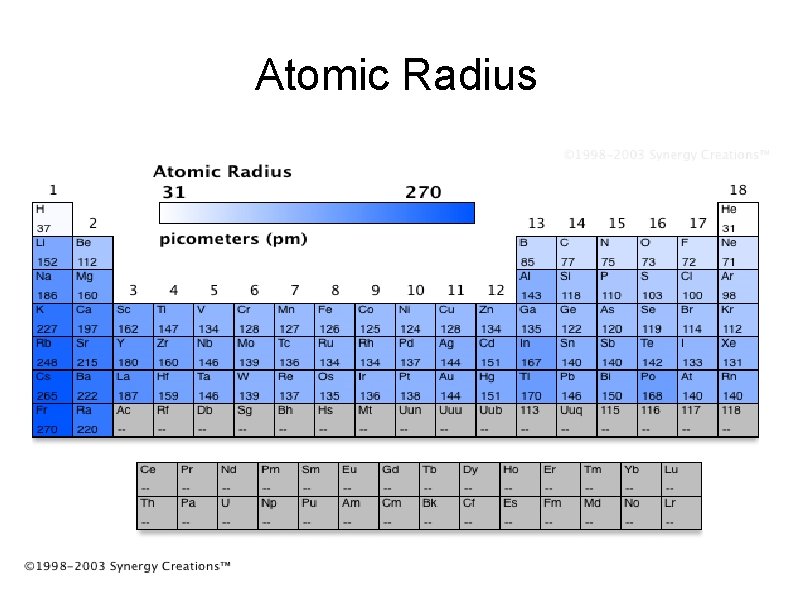
Atomic Radius
Estimating Bond Length Example Natural gas used in home heating and cooking is odorless. Because natural gas leaks pose the danger of explosion or suffocation, various smelly substances are added to the gas to allow detection of a leak. One such substance is methyl mercaptan, CH 3 SH, whose structure is shown in the margin. Predict the lengths of the C—S, C—H, and S—H bonds in the molecule.
Estimating Bond Length Practice Which bond length will be greater, the P—Br bond in PBr 3 or the As—Cl bond length in As. Cl 3?
Trends in Atomic Radius increases as you move down a column Principle quantum number (n) increases Shielding increases Atomic Radius decreases as you move across a row from left to right Ze ff increases
Arranging Atoms in Size Practice Arrange the following atoms in order of increasing size: P, S, As, Se Arrange the following atoms in order of increasing size: Na, Be, Mg
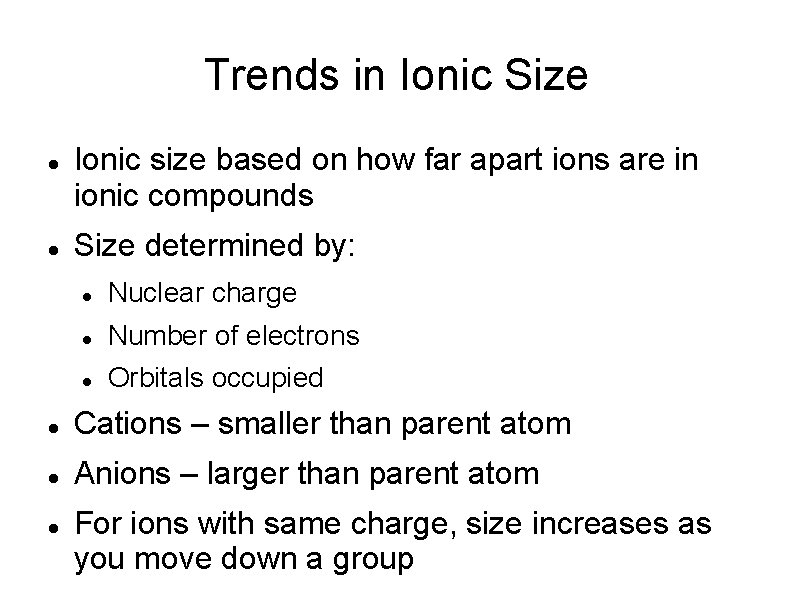
Trends in Ionic Size Ionic size based on how far apart ions are in ionic compounds Size determined by: Nuclear charge Number of electrons Orbitals occupied Cations – smaller than parent atom Anions – larger than parent atom For ions with same charge, size increases as you move down a group
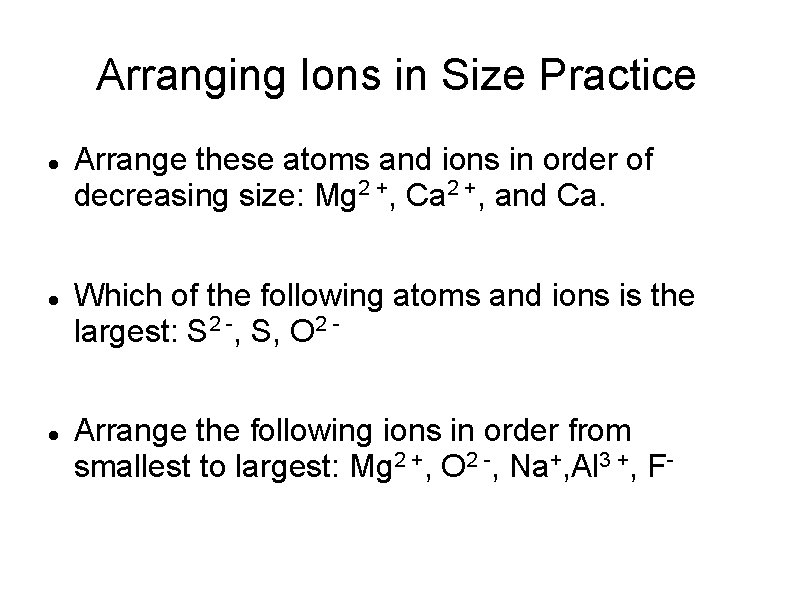
Arranging Ions in Size Practice Arrange these atoms and ions in order of decreasing size: Mg 2 +, Ca 2 +, and Ca. Which of the following atoms and ions is the largest: S 2 -, S, O 2 Arrange the following ions in order from smallest to largest: Mg 2 +, O 2 -, Na+, Al 3 +, F-
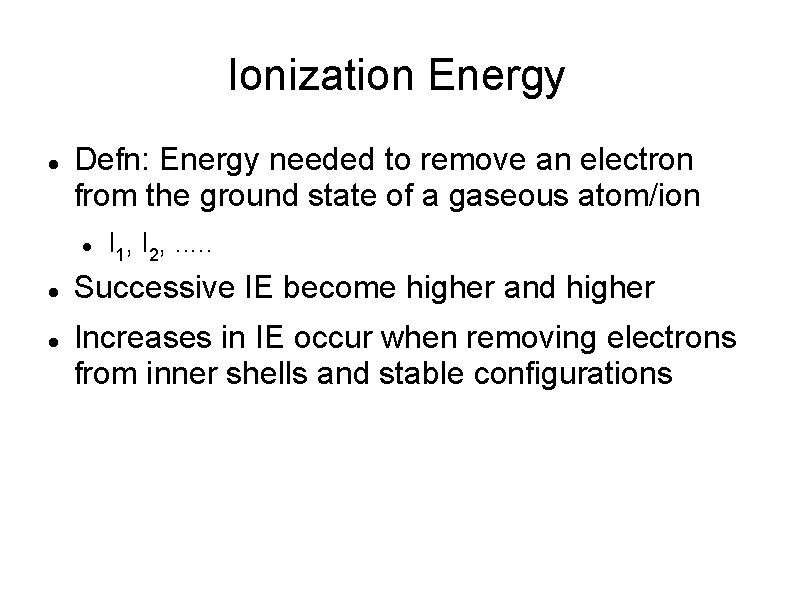
Ionization Energy Defn: Energy needed to remove an electron from the ground state of a gaseous atom/ion I 1, I 2, . . . Successive IE become higher and higher Increases in IE occur when removing electrons from inner shells and stable configurations
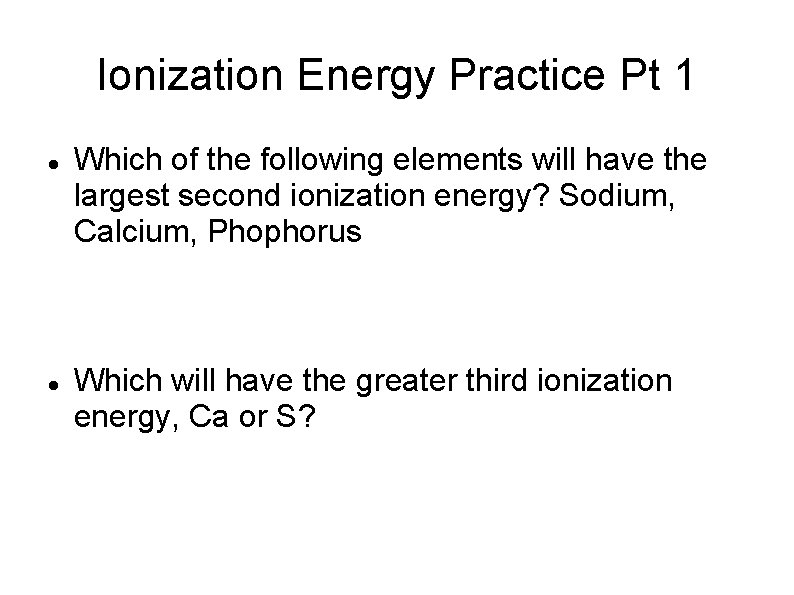
Ionization Energy Practice Pt 1 Which of the following elements will have the largest second ionization energy? Sodium, Calcium, Phophorus Which will have the greater third ionization energy, Ca or S?
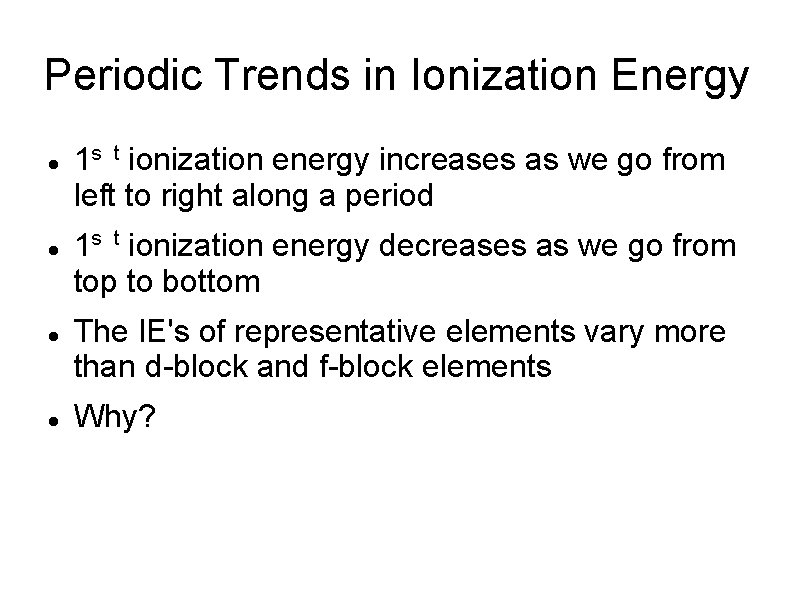
Periodic Trends in Ionization Energy 1 s t ionization energy increases as we go from left to right along a period 1 s t ionization energy decreases as we go from top to bottom The IE's of representative elements vary more than d-block and f-block elements Why?
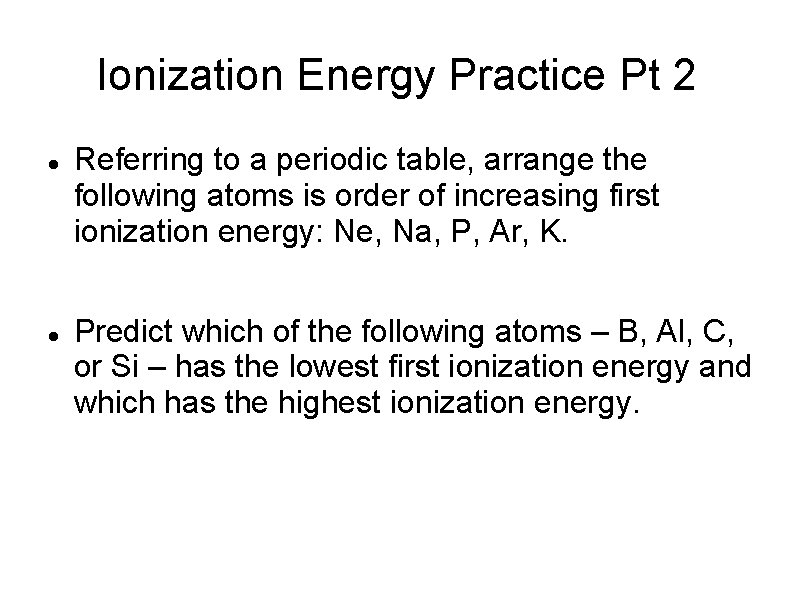
Ionization Energy Practice Pt 2 Referring to a periodic table, arrange the following atoms is order of increasing first ionization energy: Ne, Na, P, Ar, K. Predict which of the following atoms – B, Al, C, or Si – has the lowest first ionization energy and which has the highest ionization energy.
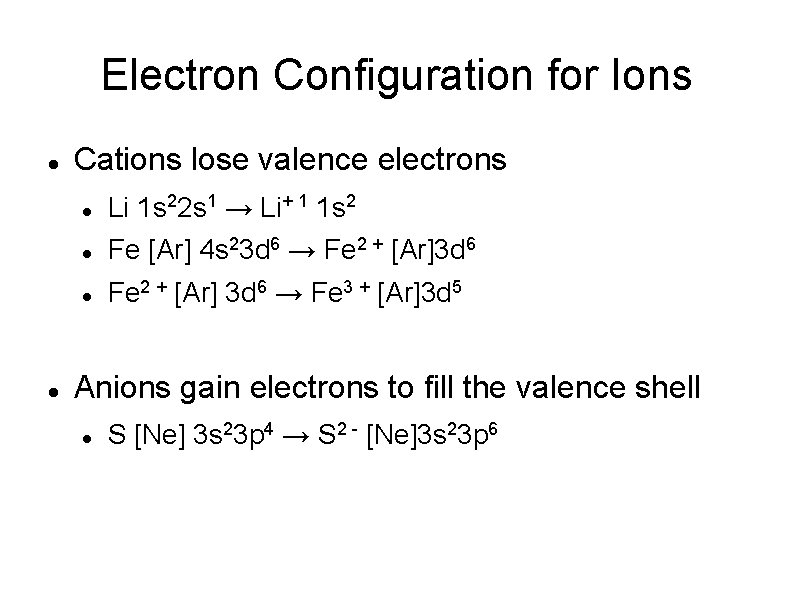
Electron Configuration for Ions Cations lose valence electrons Li 1 s 22 s 1 → Li+ 1 1 s 2 Fe [Ar] 4 s 23 d 6 → Fe 2 + [Ar]3 d 6 Fe 2 + [Ar] 3 d 6 → Fe 3 + [Ar]3 d 5 Anions gain electrons to fill the valence shell S [Ne] 3 s 23 p 4 → S 2 - [Ne]3 s 23 p 6
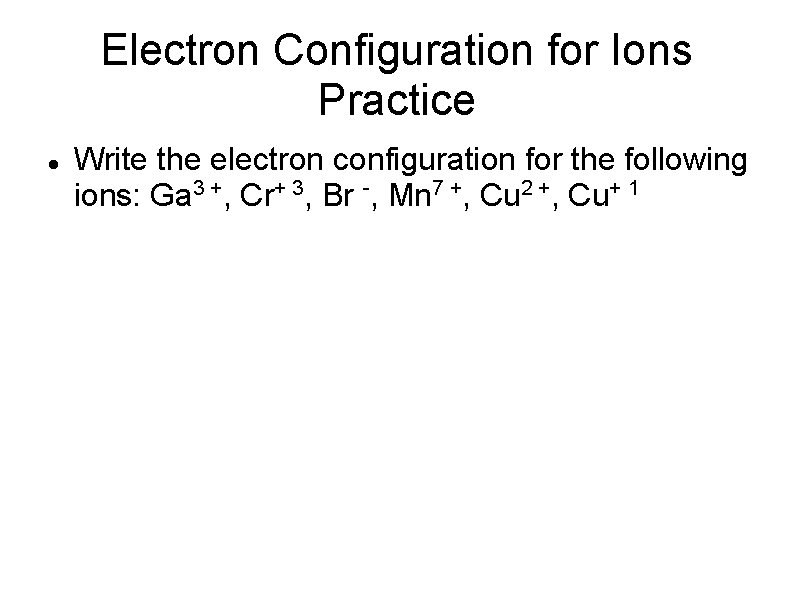
Electron Configuration for Ions Practice Write the electron configuration for the following ions: Ga 3 +, Cr+ 3, Br -, Mn 7 +, Cu 2 +, Cu+ 1
Electron Affinity Energy change that occurs when electrons are added to a gaseous atom For most atoms E is released when electrons are added Cl + e- → Cl- ΔE = -349 k. J/mol IE = ease of losing e-'s EA = ease of gaining e-'s When EA >> 0 the ion does not form Ar + e- → Ar- ΔE > 0
Metals, Non Metals, Metalloids Most elements are metals Non-metals Are located to the left of the staircase line Are located to the right of the staircase line Metalloids Form the staircase line B, Si, Ge, As, Sb, Te, At
Metals Metallic character increases ← and ↓ Properties Shiny (have luster) Various colors Malleable/Ductile Good conductors of heat and electricity High Melting points Form cations in solution Most metal oxides are ionic solids that are basic Ca. O + H 2 O → Ca(OH)2
Metals Cont. Properties Cont. Have low IE Easily oxidized by oxygen and acids Alkali have + charge Alkaline Earth have +2 charge Transitional Metals form more than one ion except for Zn, Cd, and Ag Most are solid at room temp. except who? Metals + non metals = ionic compounds
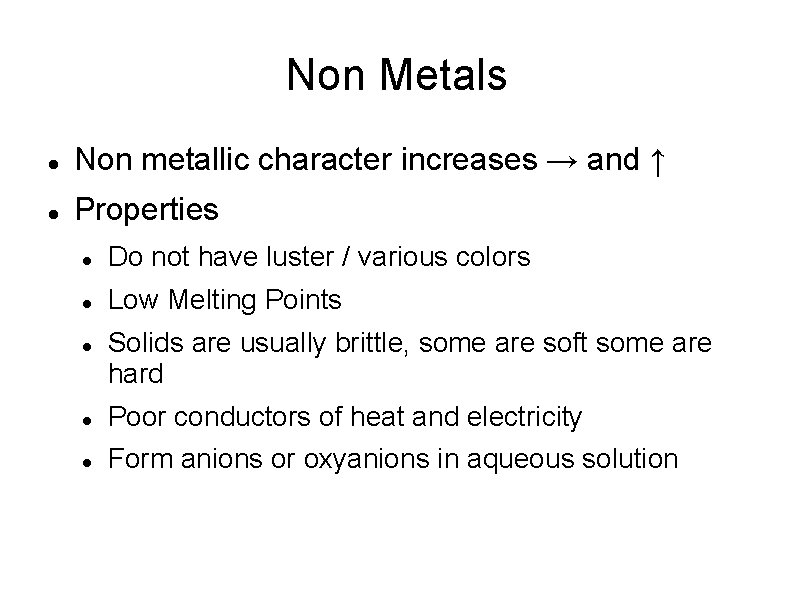
Non Metals Non metallic character increases → and ↑ Properties Do not have luster / various colors Low Melting Points Solids are usually brittle, some are soft some are hard Poor conductors of heat and electricity Form anions or oxyanions in aqueous solution
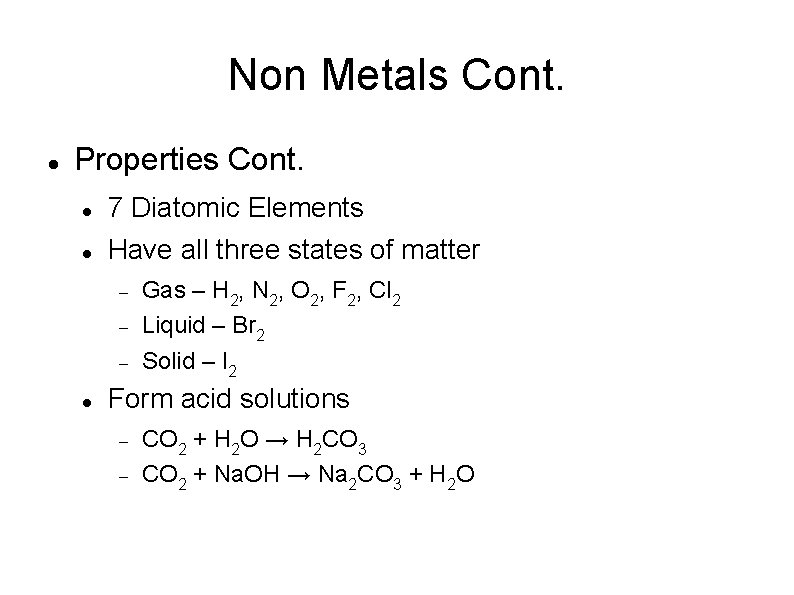
Non Metals Cont. Properties Cont. 7 Diatomic Elements Have all three states of matter Gas – H 2, N 2, O 2, F 2, Cl 2 Liquid – Br 2 Solid – I 2 Form acid solutions CO 2 + H 2 O → H 2 CO 3 CO 2 + Na. OH → Na 2 CO 3 + H 2 O
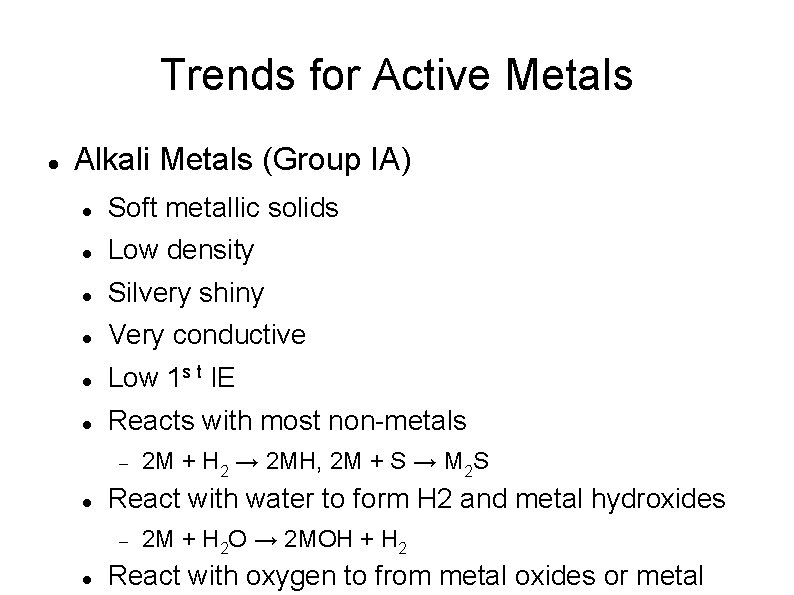
Trends for Active Metals Alkali Metals (Group IA) Soft metallic solids Low density Silvery shiny Very conductive Low 1 s t IE Reacts with most non-metals React with water to form H 2 and metal hydroxides 2 M + H 2 → 2 MH, 2 M + S → M 2 S 2 M + H 2 O → 2 MOH + H 2 React with oxygen to from metal oxides or metal
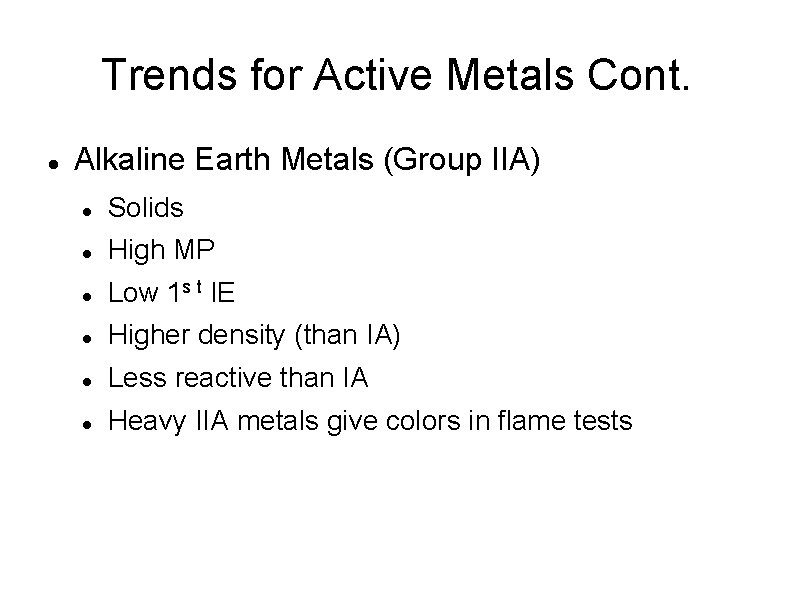
Trends for Active Metals Cont. Alkaline Earth Metals (Group IIA) Solids High MP Low 1 s t IE Higher density (than IA) Less reactive than IA Heavy IIA metals give colors in flame tests
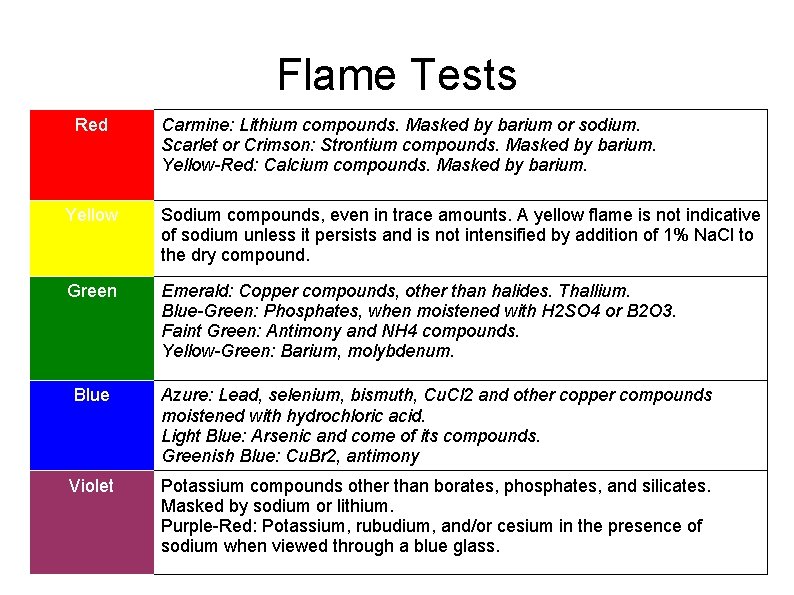
Flame Tests Red Carmine: Lithium compounds. Masked by barium or sodium. Scarlet or Crimson: Strontium compounds. Masked by barium. Yellow-Red: Calcium compounds. Masked by barium. Yellow Sodium compounds, even in trace amounts. A yellow flame is not indicative of sodium unless it persists and is not intensified by addition of 1% Na. Cl to the dry compound. Green Emerald: Copper compounds, other than halides. Thallium. Blue-Green: Phosphates, when moistened with H 2 SO 4 or B 2 O 3. Faint Green: Antimony and NH 4 compounds. Yellow-Green: Barium, molybdenum. Blue Azure: Lead, selenium, bismuth, Cu. Cl 2 and other copper compounds moistened with hydrochloric acid. Light Blue: Arsenic and come of its compounds. Greenish Blue: Cu. Br 2, antimony Violet Potassium compounds other than borates, phosphates, and silicates. Masked by sodium or lithium. Purple-Red: Potassium, rubudium, and/or cesium in the presence of sodium when viewed through a blue glass.
Reaction Predictions Write the balanced equations that predict the reactions of cesium with chlorine, waterm and hydrogen.
Trends for Non Metals Hydrogen Placed in group IA b/c electron configuration High 1 s t IE Can be both cation and anion Reactions btwn hydrogen and non metals are very exothermic Reacts w/ reactive metals to form metal hydrides
Trends for Non Metals Group VIA Goes from non metals to metals Oxygen Only gas in the group Two major forms of oxygen: O 2, O 3 Oxygen anions – O 2 -, O 2 - Sulfur has several allotropes S 8 (yellow solid) most common Usually found as metal sulfides Does not form anions as easily as
Trends for Non Metals Group VIIA - Halogens All non metals Each exists as a diatomic molecule Fluorine and Chlorine are the most reactive React w/ Ionic Halides Dissolved in water to form acids Group VIIIA – Noble Gases All monotomic Non-reactive High 1 s t IE
Homework Ch. 7 – 15, 20, 24, 27, 31, 35, 37, 49, 51, 55, 59, 61, 63
- Slides: 31