
PERIODIC TRENDS Fill in the arrows on the


- Slides: 34
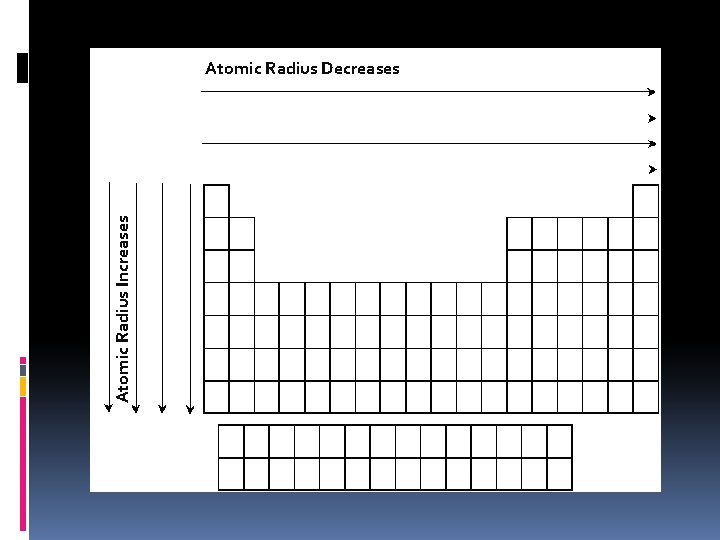
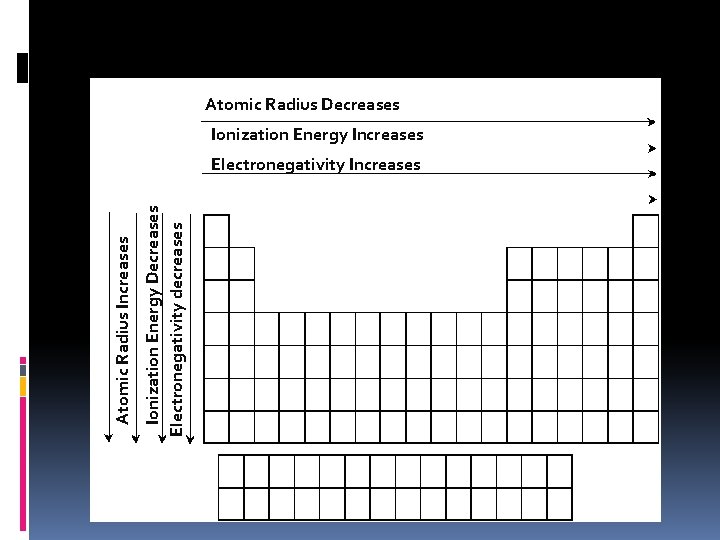
PERIODIC TRENDS Fill in the arrows on the blank periodic table with trends using your graphs made during last class.
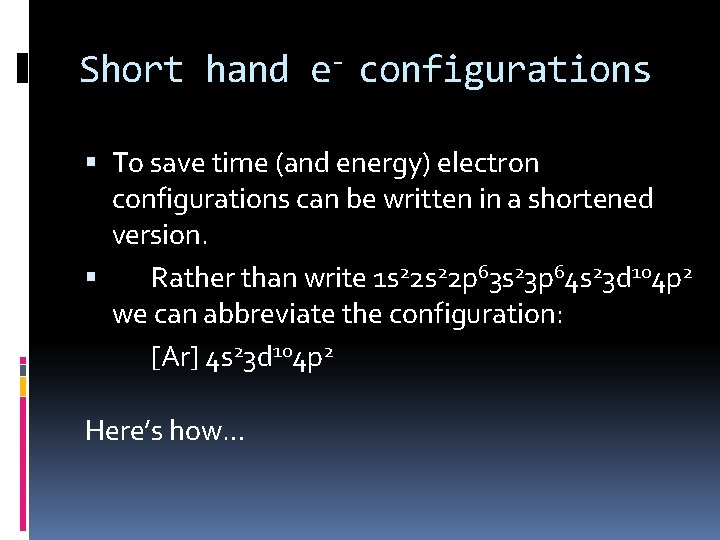
Short hand e- configurations To save time (and energy) electron configurations can be written in a shortened version. Rather than write 1 s 22 p 63 s 23 p 64 s 23 d 104 p 2 we can abbreviate the configuration: [Ar] 4 s 23 d 104 p 2 Here’s how…
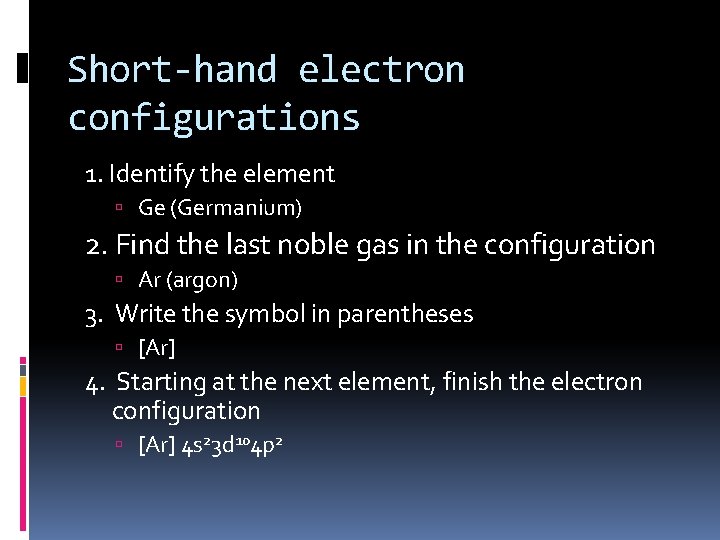
Short-hand electron configurations 1. Identify the element Ge (Germanium) 2. Find the last noble gas in the configuration Ar (argon) 3. Write the symbol in parentheses [Ar] 4. Starting at the next element, finish the electron configuration [Ar] 4 s 23 d 104 p 2
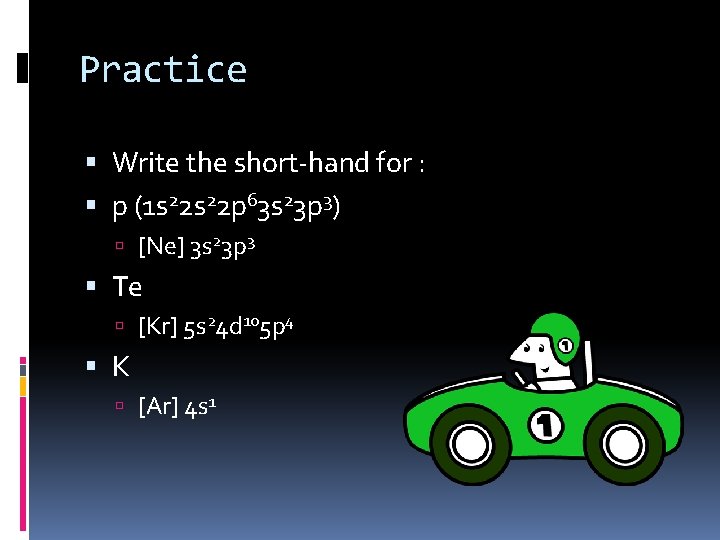
Practice Write the short-hand for : p (1 s 22 p 63 s 23 p 3) [Ne] 3 s 23 p 3 Te [Kr] 5 s 24 d 105 p 4 K [Ar] 4 s 1
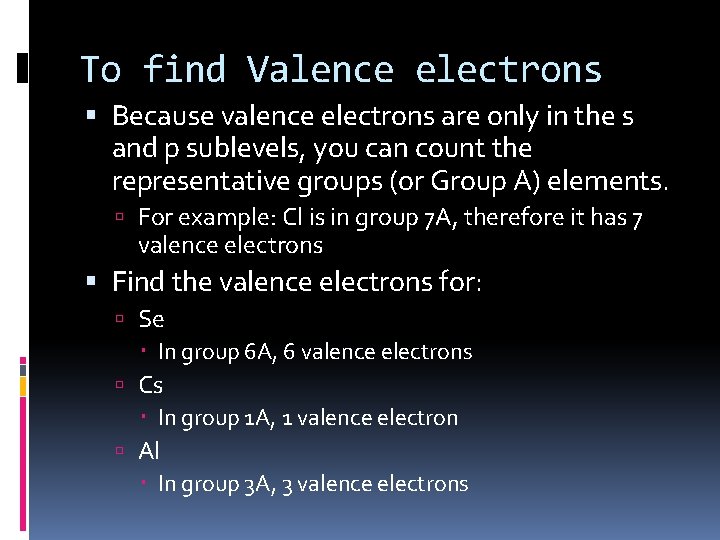
To find Valence electrons Because valence electrons are only in the s and p sublevels, you can count the representative groups (or Group A) elements. For example: Cl is in group 7 A, therefore it has 7 valence electrons Find the valence electrons for: Se In group 6 A, 6 valence electrons Cs In group 1 A, 1 valence electron Al In group 3 A, 3 valence electrons
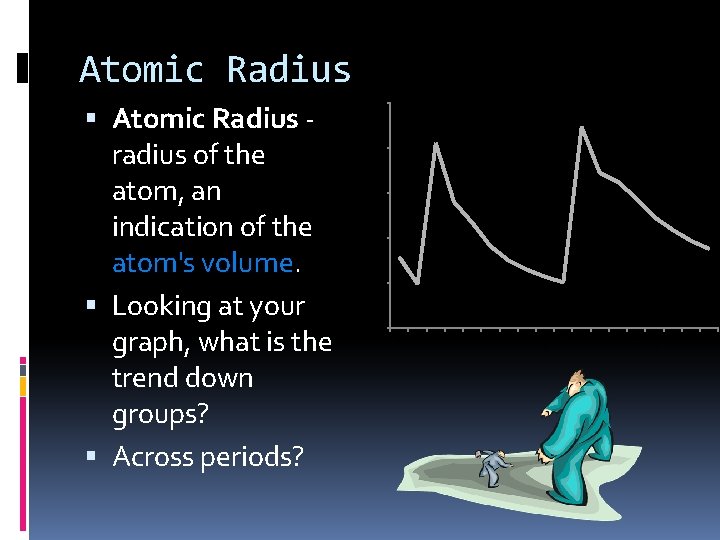
Atomic Radius radius of the atom, an indication of the atom's volume. Looking at your graph, what is the trend down groups? Across periods? 2, 5 2 1, 5 1 0, 5 0 1 2 3 4 5 6 7 8 9 10 11 12 13 14 15 16 17 18
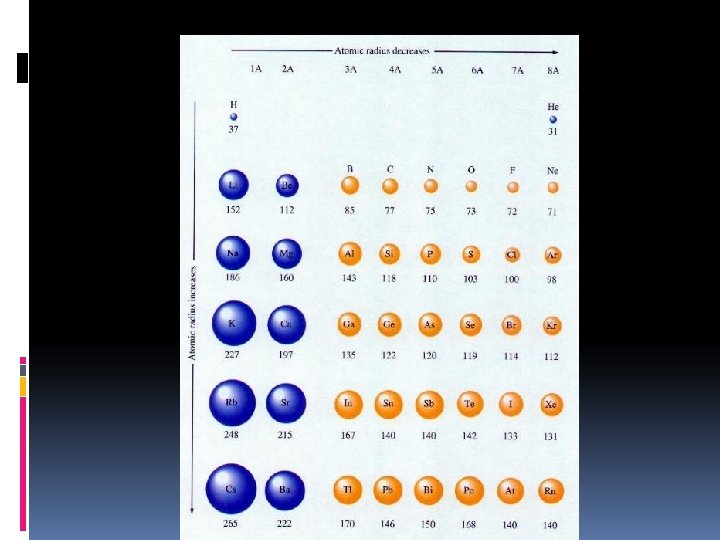
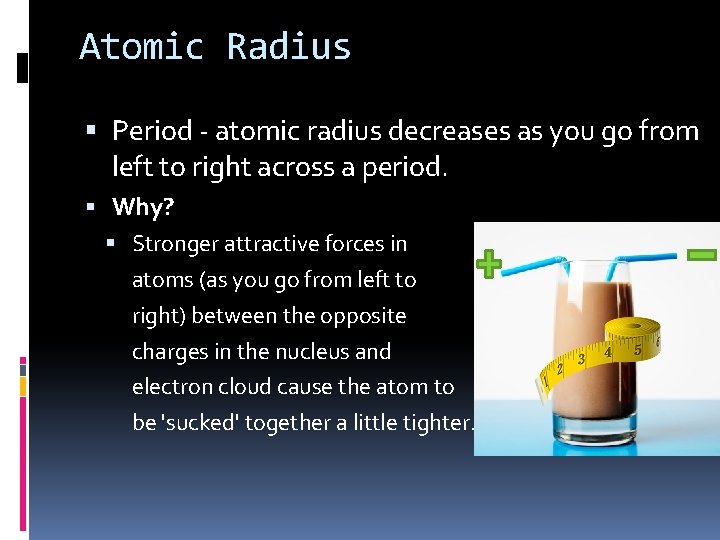
Atomic Radius Period - atomic radius decreases as you go from left to right across a period. Why? Stronger attractive forces in atoms (as you go from left to right) between the opposite charges in the nucleus and electron cloud cause the atom to be 'sucked' together a little tighter.
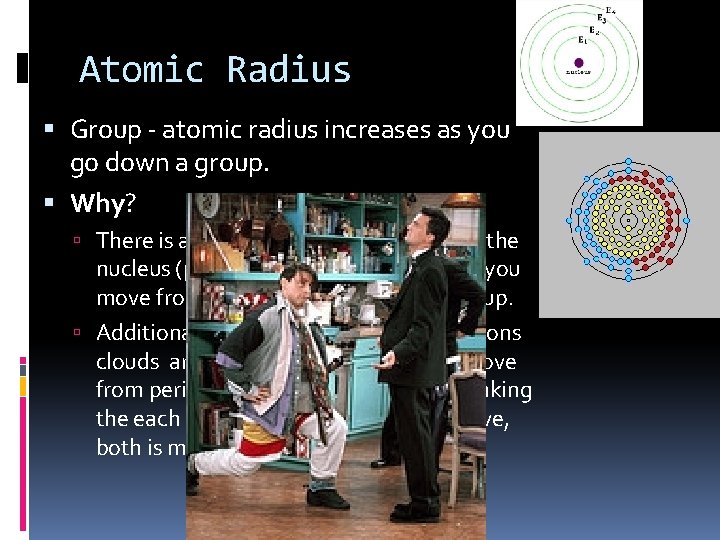
Atomic Radius Group - atomic radius increases as you go down a group. Why? There is a significant jump in the size of the nucleus (protons + neutrons) each time you move from period to period down a group. Additionally, new energy levels of elections clouds are added to the atom as you move from period to period down a group, making the each atom significantly more massive, both is mass and volume.
Atomic Radius Increases Atomic Radius Decreases
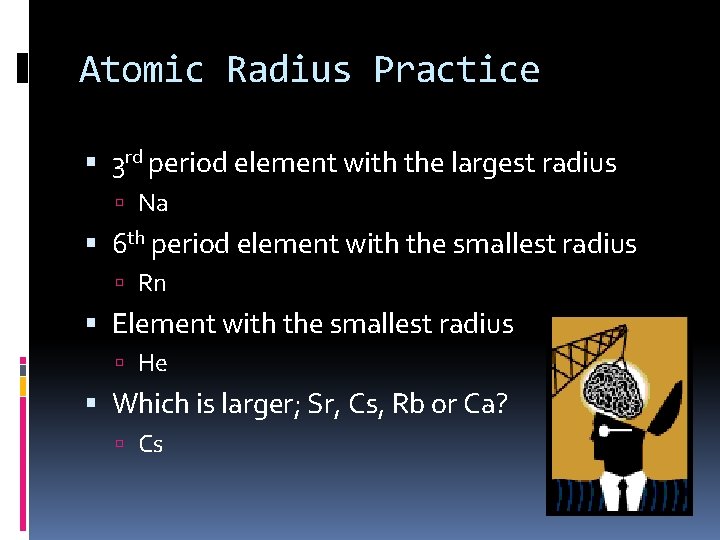
Atomic Radius Practice 3 rd period element with the largest radius Na 6 th period element with the smallest radius Rn Element with the smallest radius He Which is larger; Sr, Cs, Rb or Ca? Cs
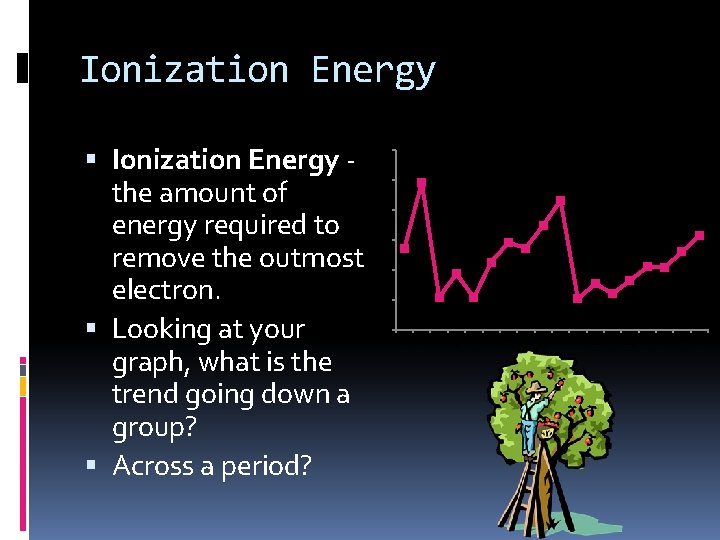
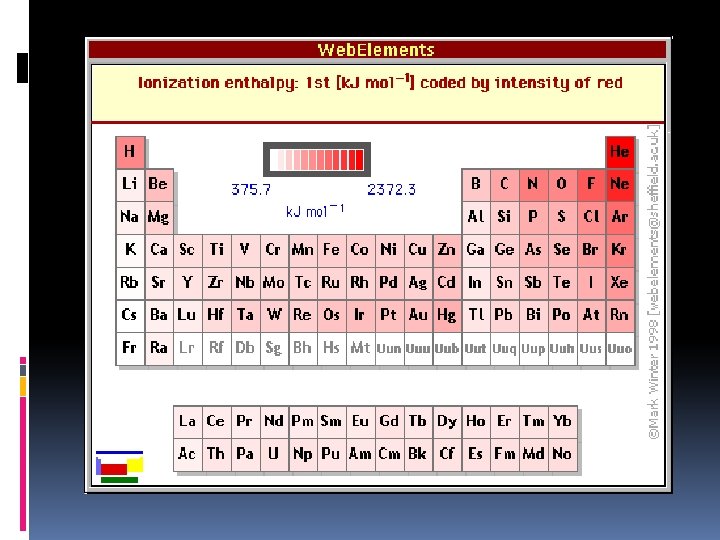
Ionization Energy the amount of energy required to remove the outmost electron. Looking at your graph, what is the trend going down a group? Across a period? 3000 2500 2000 1500 1000 500 0 1 2 3 4 5 6 7 8 9 10 11 12 13 14 15 16 17 18
Ionization Energy Period - ionization energy increases as you go from left to right across a period. Why? Elements on the right of the chart want to take others atom's electron (not given them up) because they are close to achieving the octet. This means it will require more energy to remove the outer most electron. Elements on the left of the chart would prefer to give up their electrons so it is easy to remove them, requiring less energy (low ionization energy).
Ionization Energy Group - ionization energy decreases as you go down a group. Why? The shielding affect makes it easier to remove the outer most electrons from those atoms that have many electrons (those near the bottom of the chart).
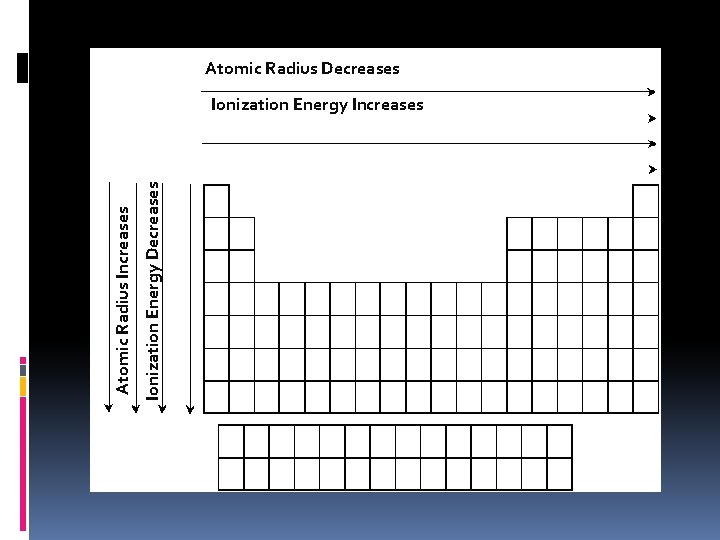
Atomic Radius Decreases Ionization Energy Decreases Atomic Radius Increases Ionization Energy Increases
Ionization Energy Practice problems Element with the highest ionization energy: He Which has a lower ionization energy; I, Cl, F, Br? I Element in the 2 nd period with the highest ionization energy: Ne
Atomic Radius of ions Negatively charged ions are larger than their neutral atoms More electrons without adding protons has more repulsion between outer electrons Positively charged ions are smaller than their neutral atoms Loses a shell when loses valence electrons
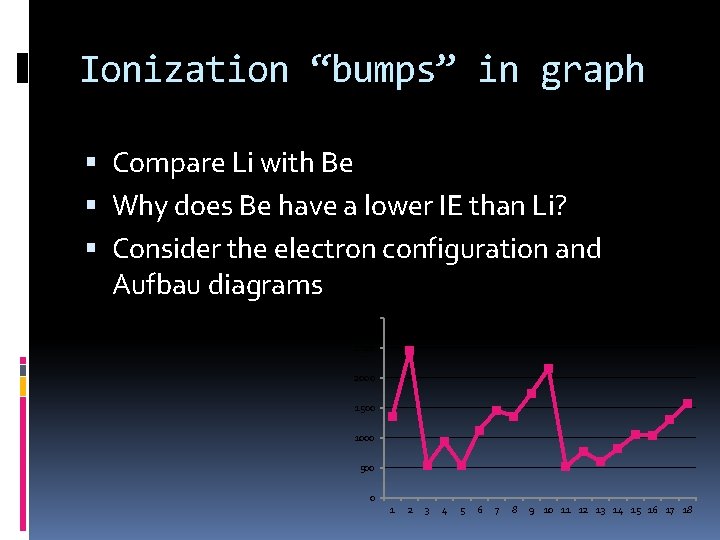
Ionization “bumps” in graph Compare Li with Be Why does Be have a lower IE than Li? Consider the electron configuration and Aufbau diagrams 3000 2500 2000 1500 1000 500 0 1 2 3 4 5 6 7 8 9 10 11 12 13 14 15 16 17 18
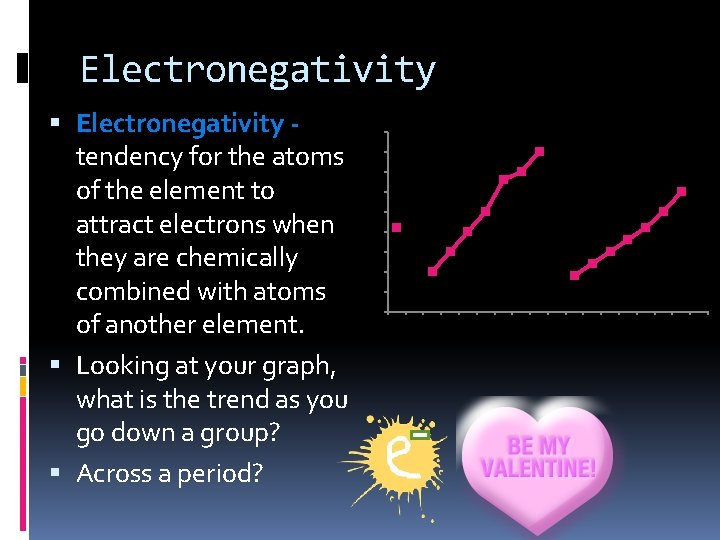
Electronegativity tendency for the atoms of the element to attract electrons when they are chemically combined with atoms of another element. Looking at your graph, what is the trend as you go down a group? Across a period? 4, 5 4 3, 5 3 2, 5 2 1, 5 1 0, 5 0 1 2 3 4 5 6 7 8 9 10 11 12 13 14 15 16 17 18
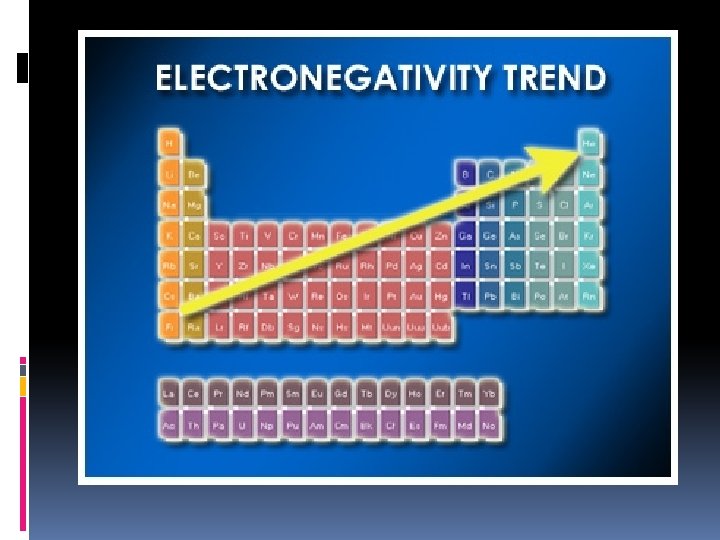
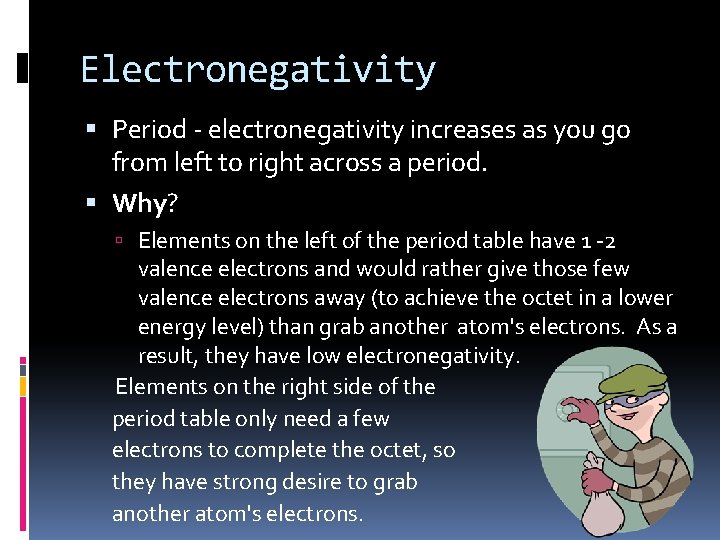
Electronegativity Period - electronegativity increases as you go from left to right across a period. Why? Elements on the left of the period table have 1 -2 valence electrons and would rather give those few valence electrons away (to achieve the octet in a lower energy level) than grab another atom's electrons. As a result, they have low electronegativity. Elements on the right side of the period table only need a few electrons to complete the octet, so they have strong desire to grab another atom's electrons.
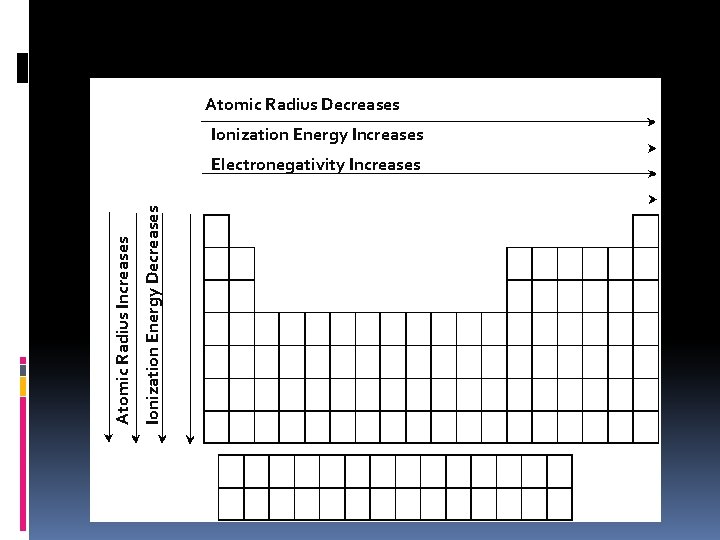
Atomic Radius Decreases Ionization Energy Increases Ionization Energy Decreases Atomic Radius Increases Electronegativity Increases
Electronegativity Group - electronegativity decreases as you go down a group. Why? Elements near the top of the period table have few electrons to begin with; every electron is a big deal. They have a stronger desire to acquire more electrons. Elements near the bottom of the chart have so many electrons that losing or acquiring an electron is not as big a deal.
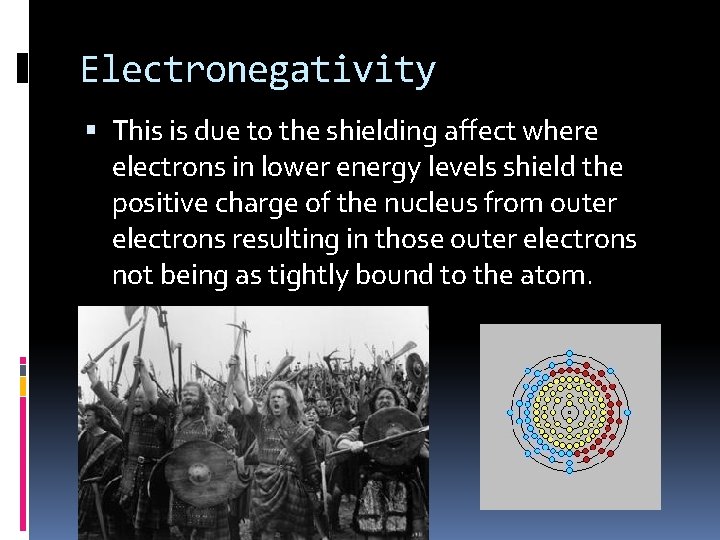
Electronegativity This is due to the shielding affect where electrons in lower energy levels shield the positive charge of the nucleus from outer electrons resulting in those outer electrons not being as tightly bound to the atom.
Atomic Radius Decreases Ionization Energy Increases Ionization Energy Decreases Electronegativity decreases Atomic Radius Increases Electronegativity Increases
Electronegativity Practice Problems Element with the lowest electronegativity: Fr 4 th period element with the highest electronegativity: Br Which has a lower electronegativity: Li, Be, Na, or Mg? Na
Reactivity Reactivity: refers to how likely or vigorously an atom is to react with other substances. This is usually determined by how easily electrons can be removed (ionization energy) and how badly they want to take other atom's electrons (electronegativity) because it is the transfer/interaction of electrons that is the basis of chemical reactions.
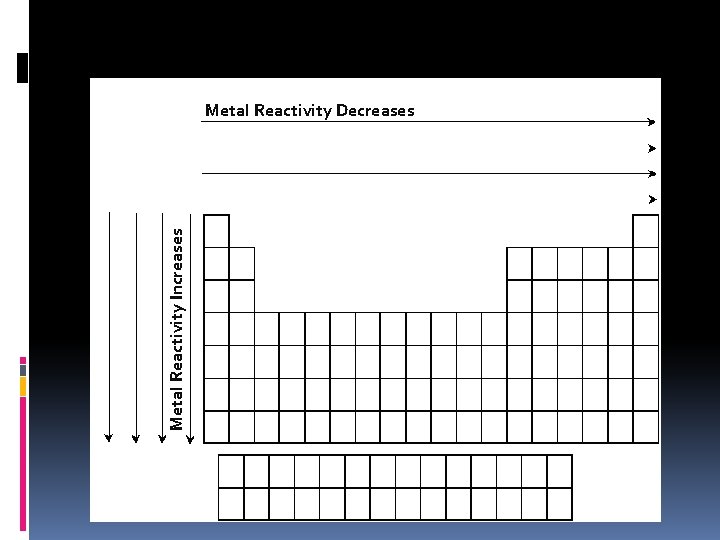
Metal Reactivity Period - reactivity decreases as you go from left to right across a period. Group - reactivity increases as you go down a group Why? The farther to the left and down the periodic chart you go, the easier it is for electrons to be given or taken away, resulting in higher reactivity.
Metal Reactivity Increases Metal Reactivity Decreases
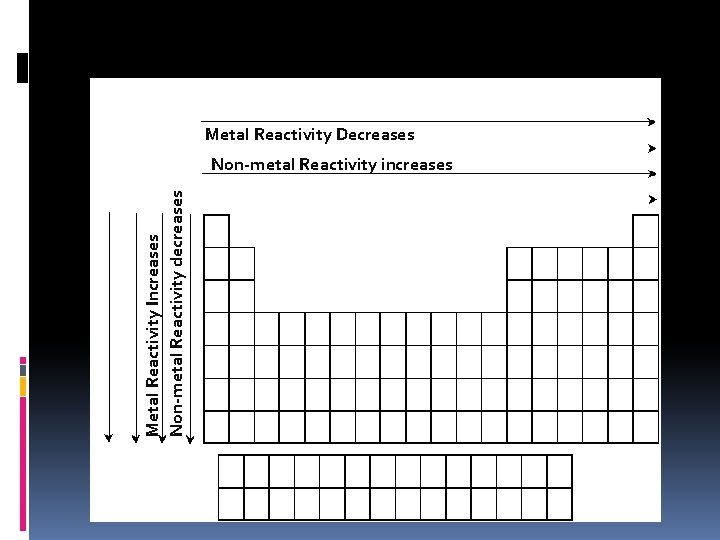
Non-metal Reactivity Period - reactivity increases as you go from the left to the right across a period. Group - reactivity decreases as you go down the group. Why? The farther right and up you go on the periodic table, the higher the electronegativity, resulting in a more vigorous exchange of electron.
Metal Reactivity Decreases Metal Reactivity Increases Non-metal Reactivity decreases Non-metal Reactivity increases
Reactivity Practice Metal with the lowest reactivity: Al Nonmetal with the highest reactivity: F (noble gases are stable and have a full octet) Which has a higher reactivity: Se, S, As, P? S Which has a lower reactivity: Cd, In, Hg, Tl? In