
Periodic Table Trends Text p 52 59 Periodic
Periodic Table Trends Text p. 52 -59
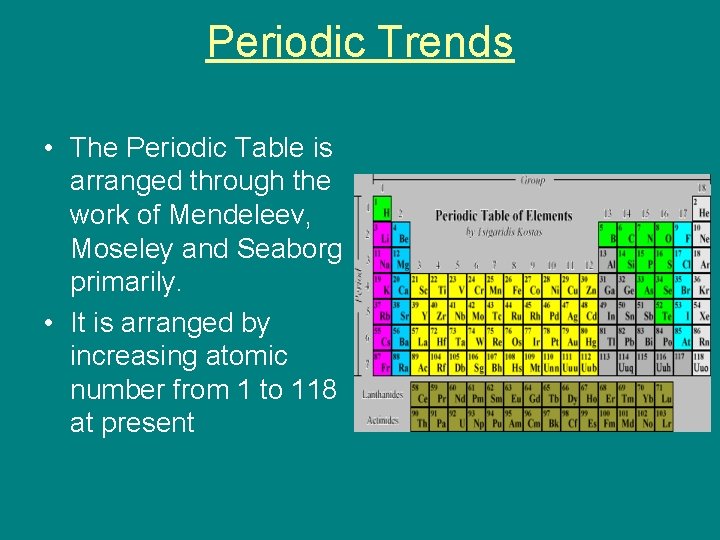
Periodic Trends • The Periodic Table is arranged through the work of Mendeleev, Moseley and Seaborg primarily. • It is arranged by increasing atomic number from 1 to 118 at present
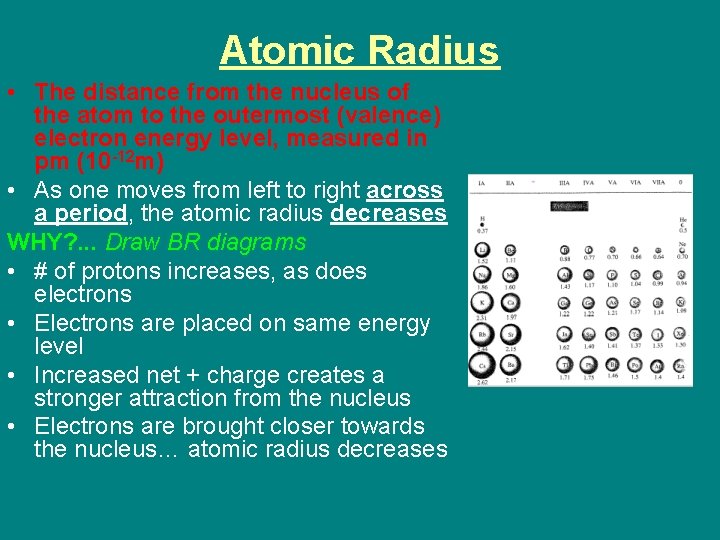
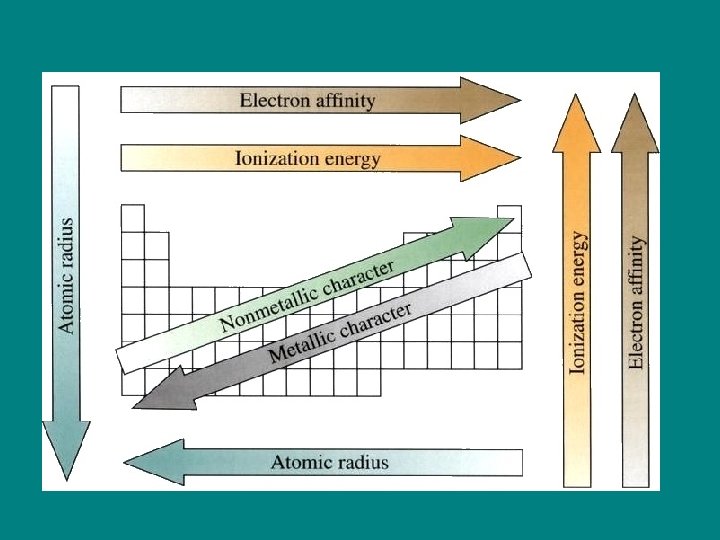
Atomic Radius • The distance from the nucleus of the atom to the outermost (valence) electron energy level, measured in pm (10 -12 m) • As one moves from left to right across a period, the atomic radius decreases WHY? . . . Draw BR diagrams • # of protons increases, as does electrons • Electrons are placed on same energy level • Increased net + charge creates a stronger attraction from the nucleus • Electrons are brought closer towards the nucleus… atomic radius decreases

Atomic Radius • As one moves down a group, the atomic radius increases WHY? . . . Draw BR diagrams • Electrons are being placed in increasingly higher energy levels • These higher energy levels are at fixed distances further and further from nucleus • The electrons are further away from the nucleus such that the attraction from the nucleus on the electrons is less and therefore the atomic radius increases • Shielding of outer electrons from inner energy levels

Atomic Radius • Ex: 1. K > Na > Li 2. Na > Mg > Al > Si > P > Sl > Ar • Element with the highest AR: – Fr • Element with the lowest AR: – He
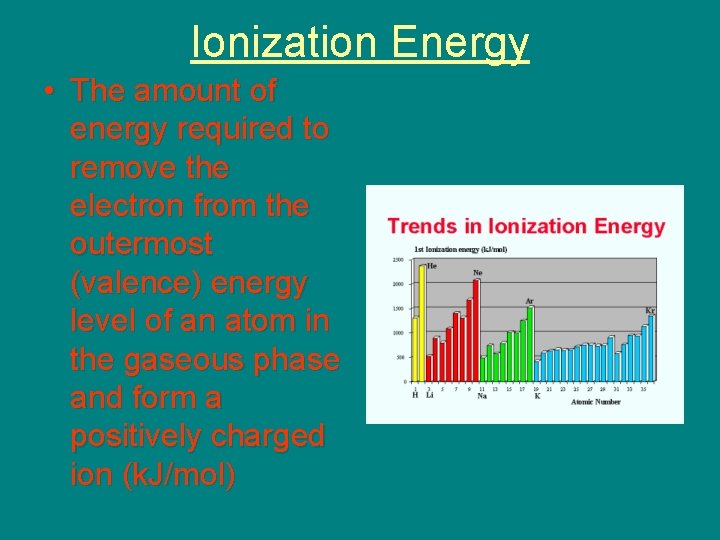
Ionization Energy • The amount of energy required to remove the electron from the outermost (valence) energy level of an atom in the gaseous phase and form a positively charged ion (k. J/mol)
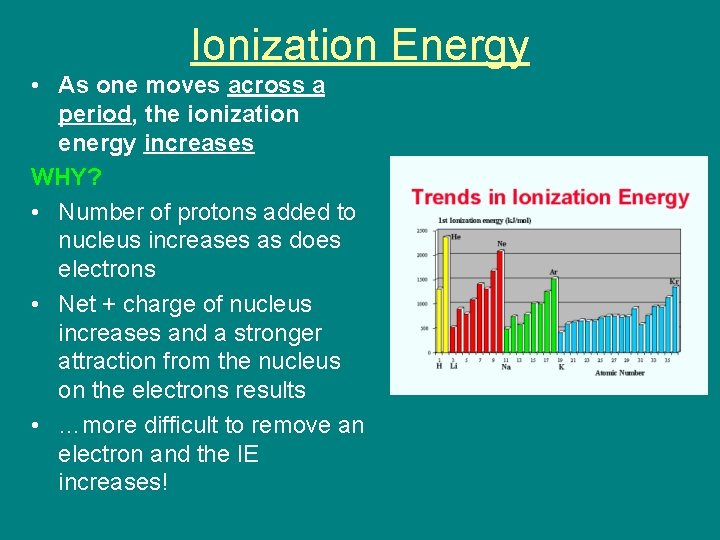
Ionization Energy • As one moves across a period, the ionization energy increases WHY? • Number of protons added to nucleus increases as does electrons • Net + charge of nucleus increases and a stronger attraction from the nucleus on the electrons results • …more difficult to remove an electron and the IE increases!
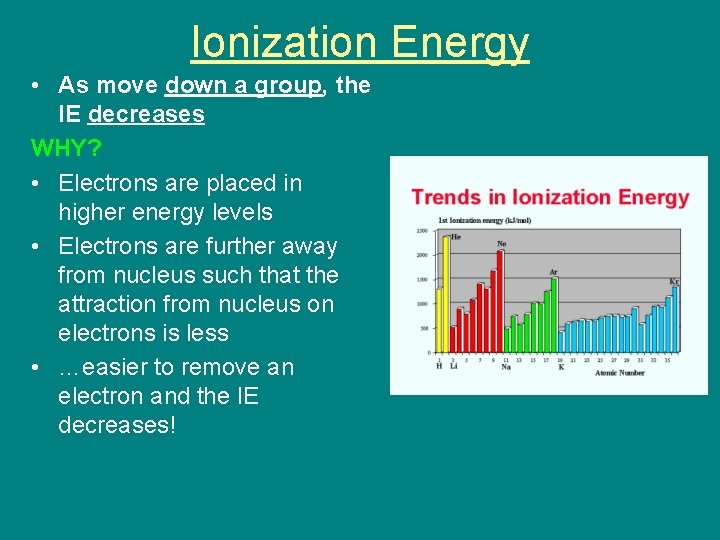
Ionization Energy • As move down a group, the IE decreases WHY? • Electrons are placed in higher energy levels • Electrons are further away from nucleus such that the attraction from nucleus on electrons is less • …easier to remove an electron and the IE decreases!
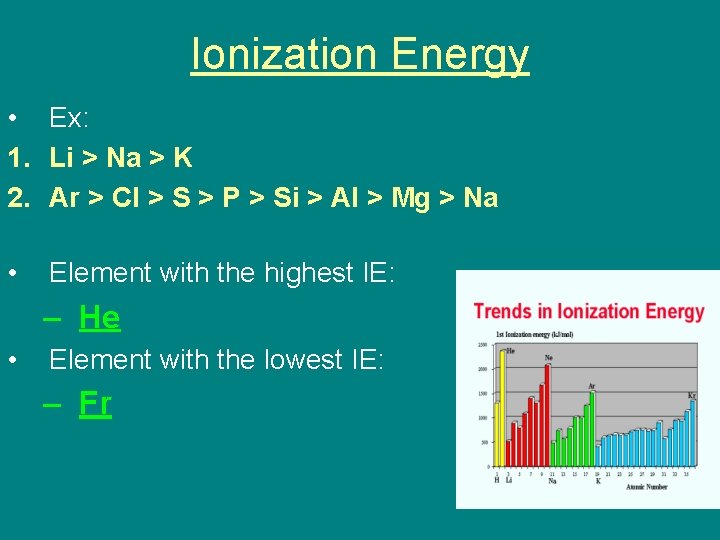
Ionization Energy • Ex: 1. Li > Na > K 2. Ar > Cl > S > P > Si > Al > Mg > Na • Element with the highest IE: – He • Element with the lowest IE: – Fr
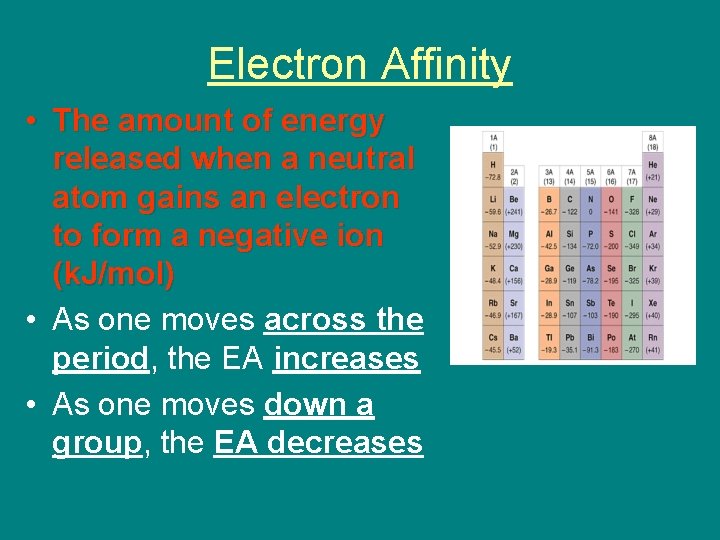
Electron Affinity • The amount of energy released when a neutral atom gains an electron to form a negative ion (k. J/mol) • As one moves across the period, the EA increases • As one moves down a group, the EA decreases
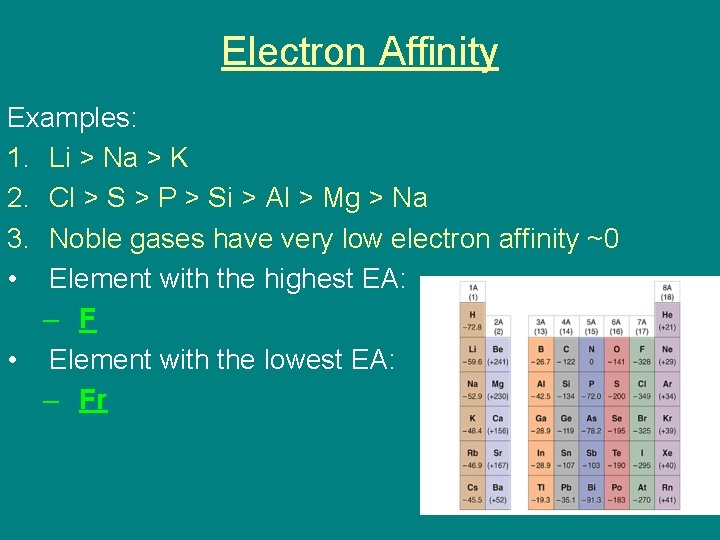
Electron Affinity Examples: 1. Li > Na > K 2. Cl > S > P > Si > Al > Mg > Na 3. Noble gases have very low electron affinity ~0 • Element with the highest EA: – F • Element with the lowest EA: – Fr
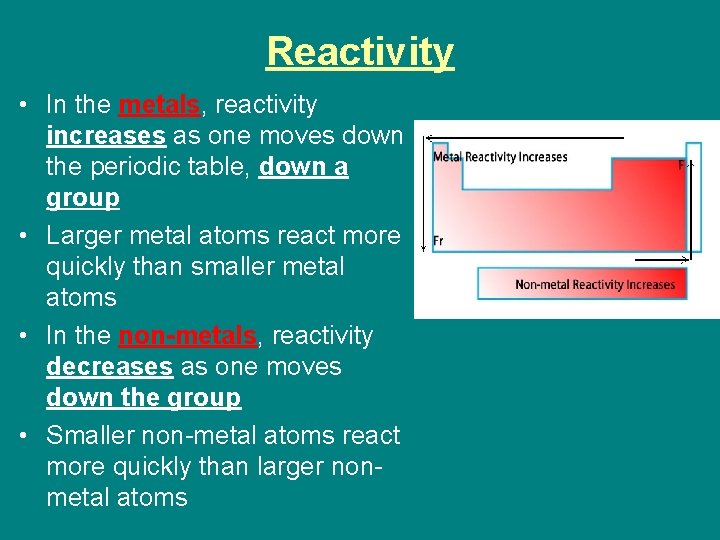
Reactivity • In the metals, reactivity increases as one moves down the periodic table, down a group • Larger metal atoms react more quickly than smaller metal atoms • In the non-metals, reactivity decreases as one moves down the group • Smaller non-metal atoms react more quickly than larger nonmetal atoms
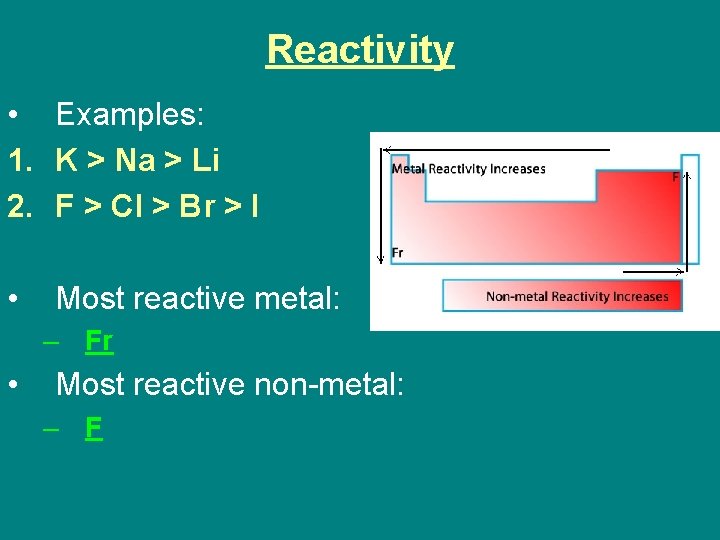
Reactivity • Examples: 1. K > Na > Li 2. F > Cl > Br > I • Most reactive metal: – Fr • Most reactive non-metal: – F
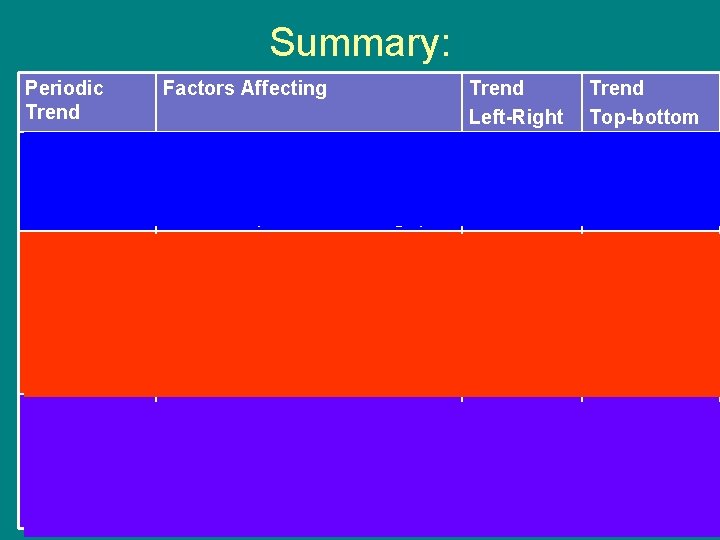
Summary: Periodic Trend Factors Affecting Atomic radius i) Number of energy levels ii) Number of protons in nucleus (nuclear charge) (first) Ionization Energy i) Atomic radius ii) Number of valence electrons iii) Number of protons in nucleus i) Atomic radius ii) Number of valence electrons iii) Nuclear charge Electron Affinity Trend Left-Right Trend Top-bottom Decreases Increases Decreases
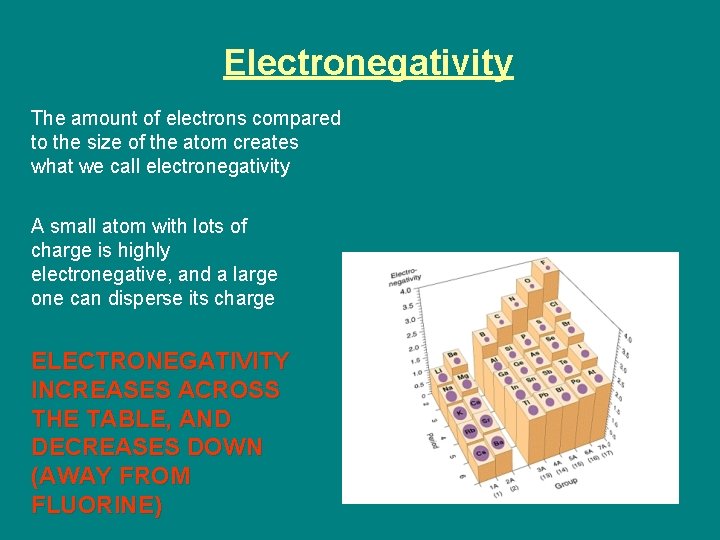
Electronegativity The amount of electrons compared to the size of the atom creates what we call electronegativity A small atom with lots of charge is highly electronegative, and a large one can disperse its charge ELECTRONEGATIVITY INCREASES ACROSS THE TABLE, AND DECREASES DOWN (AWAY FROM FLUORINE)
- Slides: 16