
Periodic Table Trends CP Bellwork 2718 1 Put

Periodic Table Trends
CP Bellwork 2/7/18 • 1) Put the following colors in order of increasing wavelength: blue, yellow, indigo • 2) Which has the most energy? Microwaves, radio waves, ultraviolet light • 3) As wavelength decreases, frequency _______.
Honors Bellwork 2/7/18 1. What is the frequency of a photon with the energy of 3. 45 X 10 -21 J. 2. 1. What is the trend for atomic radius as you move across a period? 2. Down a group? Calculate the energy of a photon with a frequency 3. Which has a smaller radius: C, O, Ne 11 /sec of 3. 20 X 10 4. Which has a smaller radius: Li, Rb, Fr 5. Which has a larger radius: Ca, As, Br
Bellwork 2/8/18 • 1. What is the trend for atomic radius as you move across a period? • 2. Down a group? • 3. Which has a smaller radius: C, O, Ne • 4. Which has a smaller radius: Li, Rb, Fr • 5. Which has a larger radius: Ca, As, Br
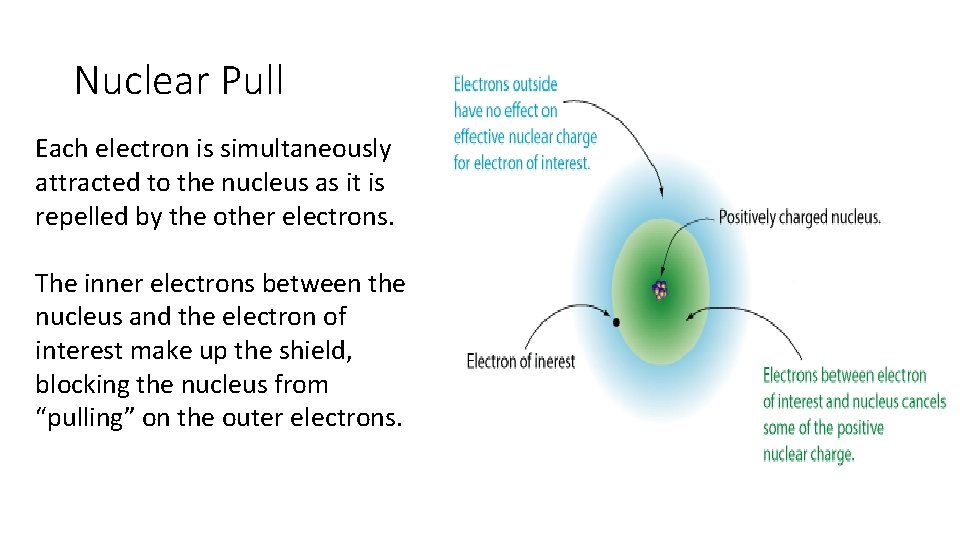
Nuclear Pull Each electron is simultaneously attracted to the nucleus as it is repelled by the other electrons. The inner electrons between the nucleus and the electron of interest make up the shield, blocking the nucleus from “pulling” on the outer electrons.
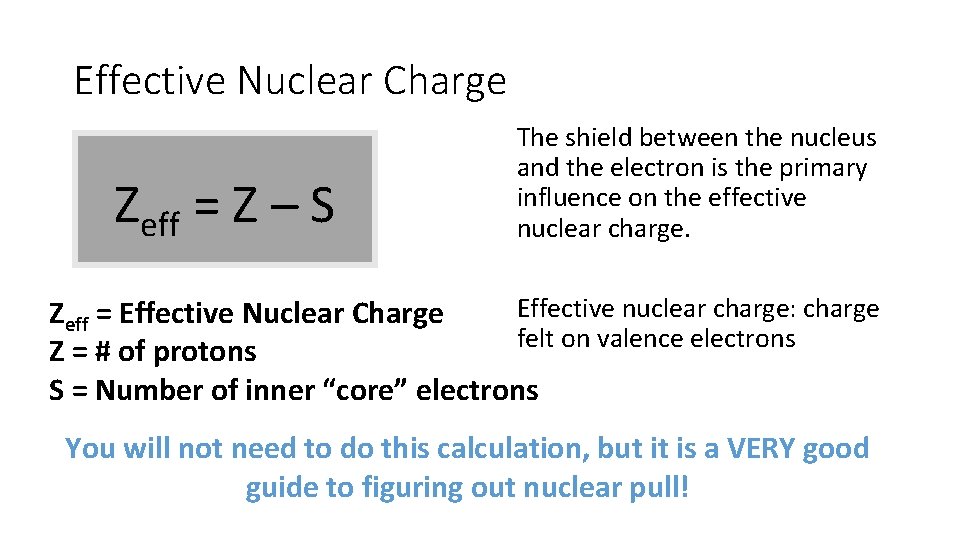
Effective Nuclear Charge Zeff = Z – S The shield between the nucleus and the electron is the primary influence on the effective nuclear charge. Effective nuclear charge: charge Zeff = Effective Nuclear Charge felt on valence electrons Z = # of protons S = Number of inner “core” electrons You will not need to do this calculation, but it is a VERY good guide to figuring out nuclear pull!
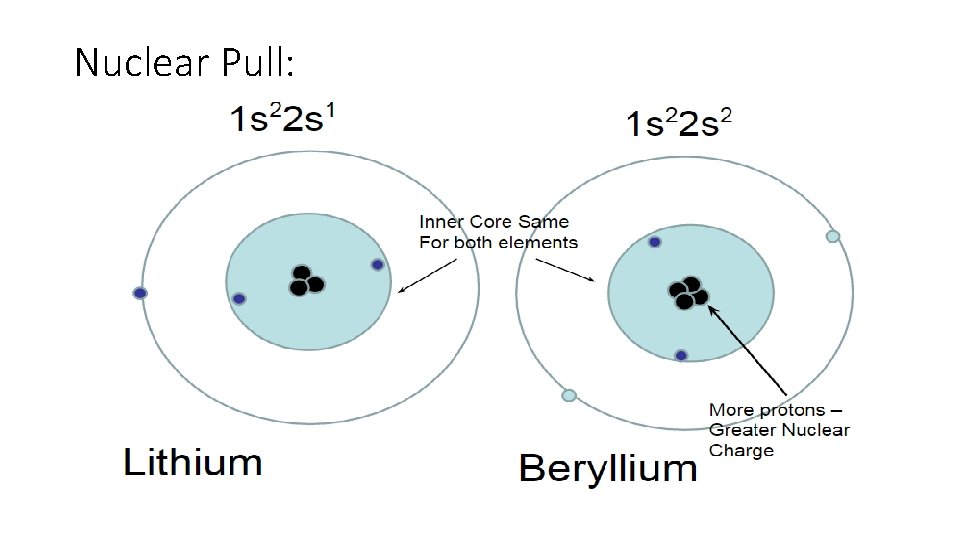
Nuclear Pull:
Learning Check: In the following pairs, pick the atom that has the greater nuclear pull: B or F Mg or Si S or Cl From left to right in a period, nuclear pull _______. From top to bottom in a group, nuclear pull _______.
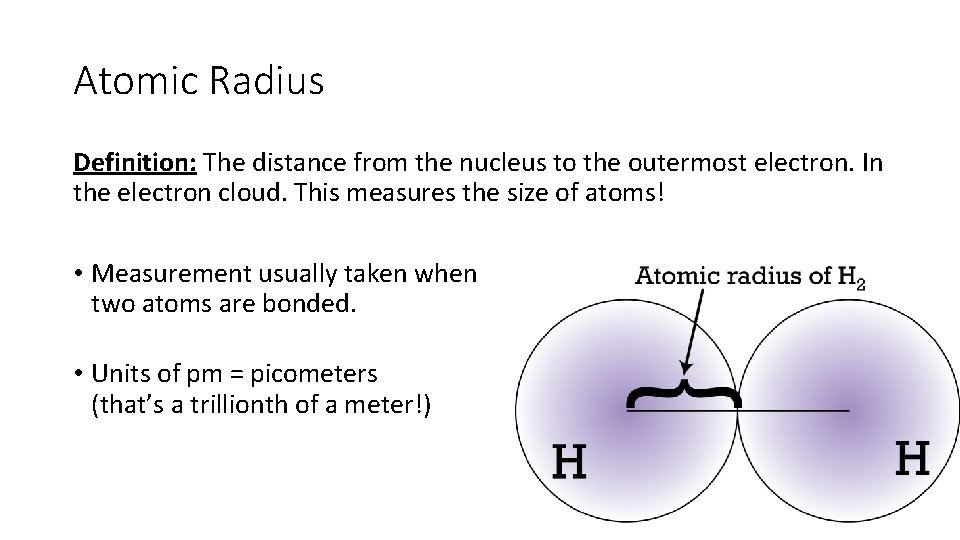
Atomic Radius Definition: The distance from the nucleus to the outermost electron. In the electron cloud. This measures the size of atoms! • Measurement usually taken when two atoms are bonded. • Units of pm = picometers (that’s a trillionth of a meter!)
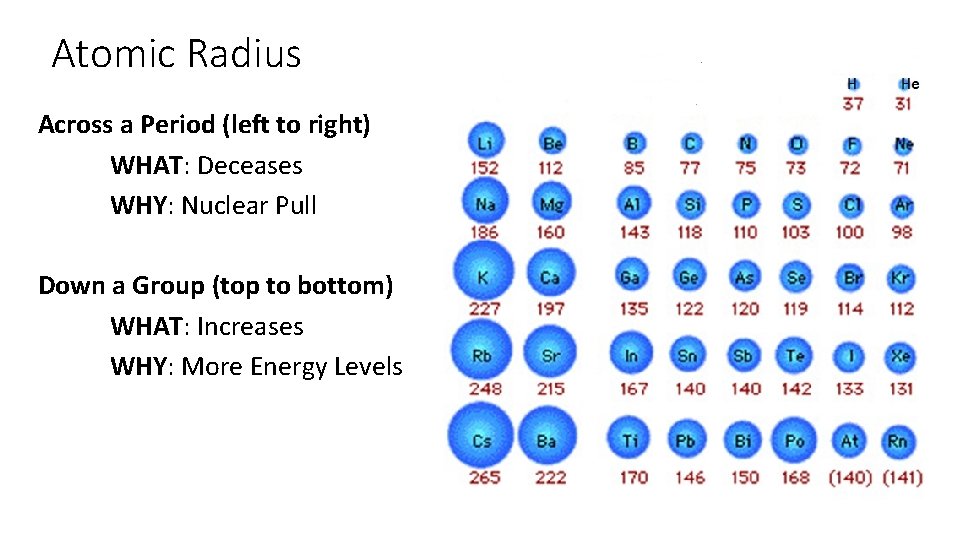
Atomic Radius Across a Period (left to right) WHAT: Deceases WHY: Nuclear Pull Down a Group (top to bottom) WHAT: Increases WHY: More Energy Levels
Learning Check: Atomic Radius In the following pairs, pick the atom that has the greater atomic radius: B or F Mg or Si S or Cl From left to right in a period, atomic radius _______. From top to bottom in a group, atomic radius _______.
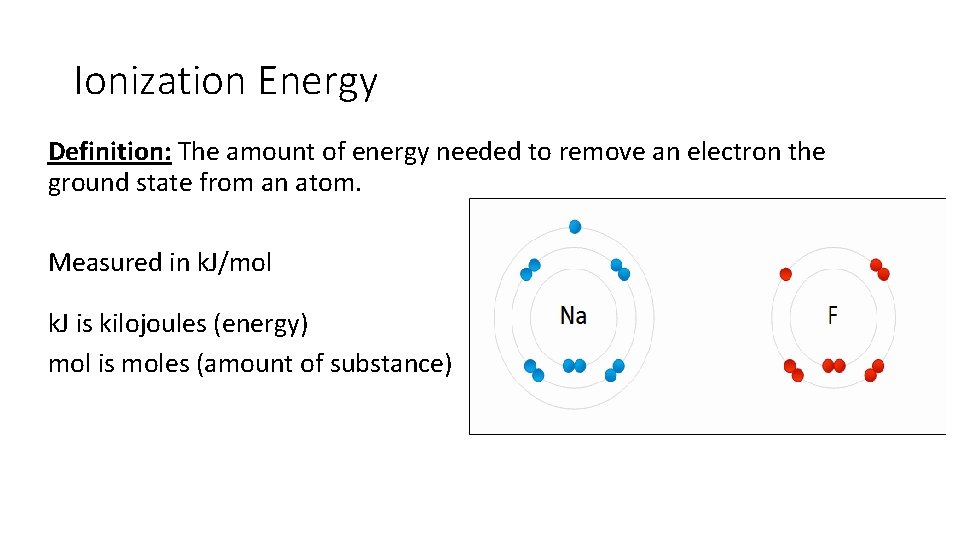
Ionization Energy Definition: The amount of energy needed to remove an electron the ground state from an atom. Measured in k. J/mol k. J is kilojoules (energy) mol is moles (amount of substance)
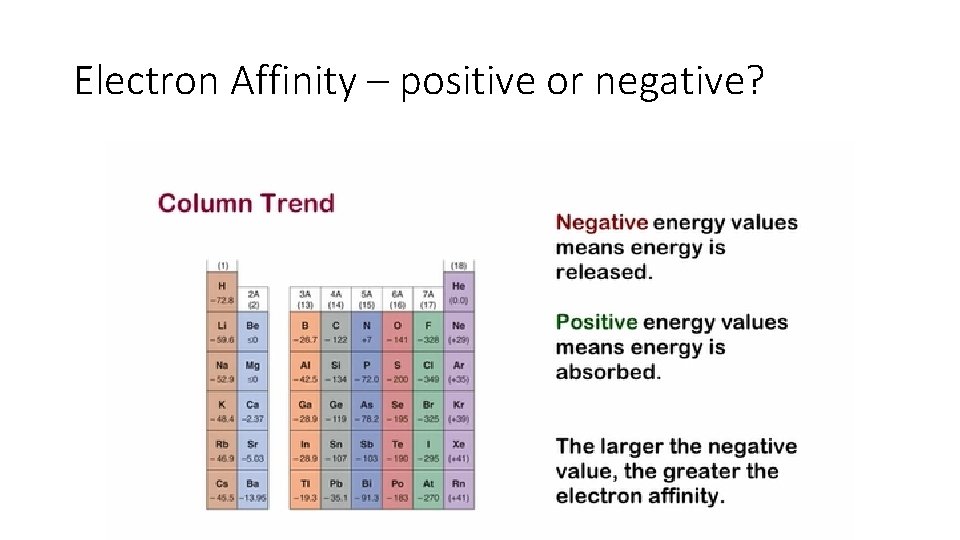
Electron Affinity – positive or negative?
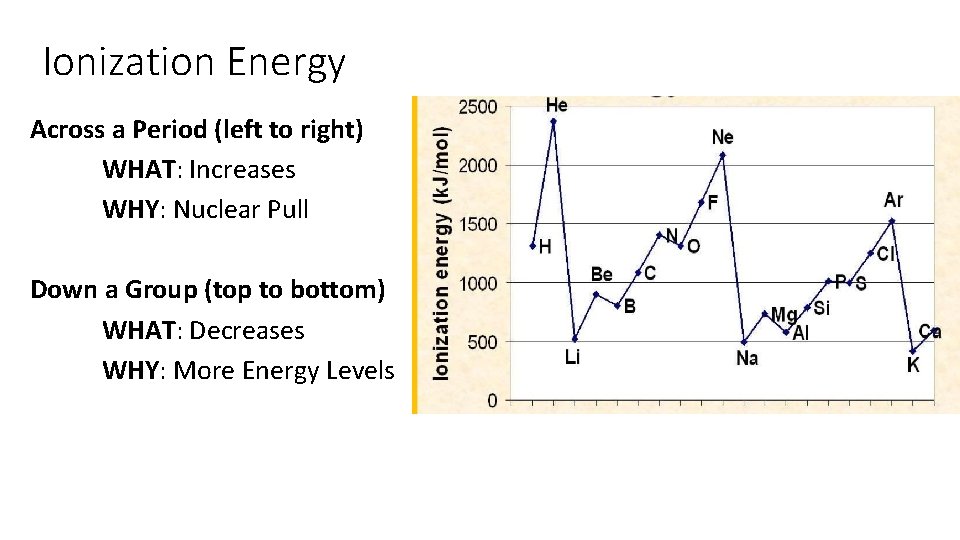
Ionization Energy Across a Period (left to right) WHAT: Increases WHY: Nuclear Pull Down a Group (top to bottom) WHAT: Decreases WHY: More Energy Levels
Learning Check: Ionization Energy In the following pairs, pick the atom that has the greater ionization energy: B or F Mg or Si S or Cl From left to right in a period, ionization energy _______. From top to bottom in a group, ionization energy _______.
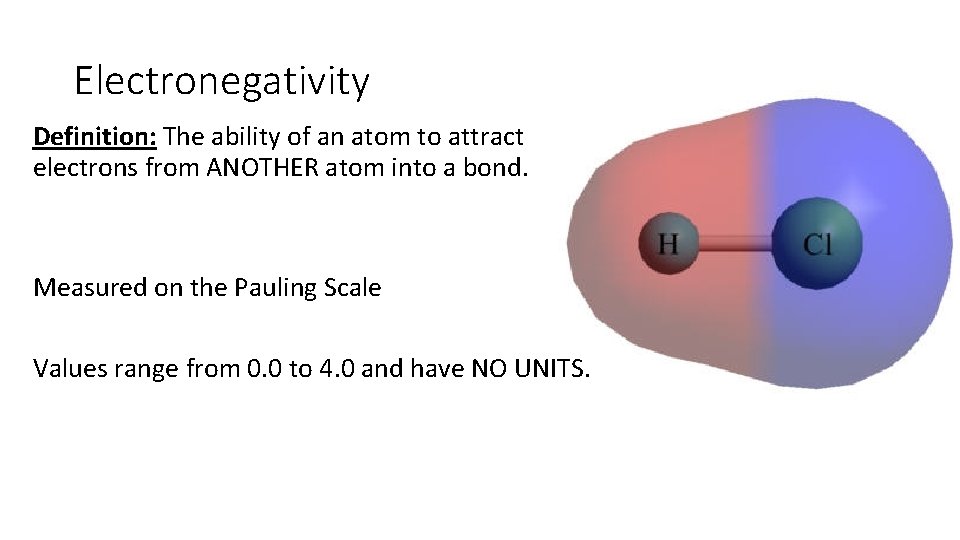
Electronegativity Definition: The ability of an atom to attract electrons from ANOTHER atom into a bond. Measured on the Pauling Scale Values range from 0. 0 to 4. 0 and have NO UNITS.
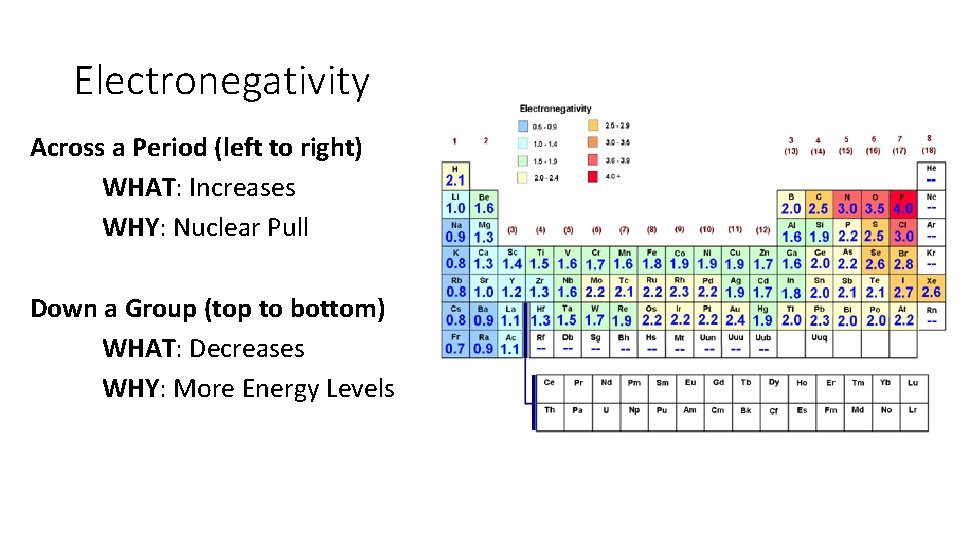
Electronegativity Across a Period (left to right) WHAT: Increases WHY: Nuclear Pull Down a Group (top to bottom) WHAT: Decreases WHY: More Energy Levels
Learning Check: Electronegativity In the following pairs, pick the atom that has the greater electronegativity: B or F Mg or Si S or Cl From left to right in a period, electronegativity _______. From top to bottom in a group, electronegativity _______.
- Slides: 18