
PERIODIC TABLE Dmitri Mendeleev 1871 Father of the
PERIODIC TABLE

Dmitri Mendeleev (1871) “Father of the Periodic Table” • Noticed that when the elements were arranged in order of increasing atomic mass, similarities in their chemical properties appeared at regular intervals (periodicity) • Placed all the known elements in his periodic table but several empty spaces were left. • Predicted the existence and properties of undiscovered elements (When found they fit where Mendeleev expected) • Published his findings

Mendeleev’s Periodic Table
Henry Moseley (1911) • Discovered the elements fit into patterns better when they were arranged according to atomic number rather than atomic weight. • Periodic Law: there is a periodic repetition of physical and chemical properties of the elements when arranged in atomic number order

What we already know about the Periodic Table Classified as metals, non-metals, and metalloids Rows = PERIODS Columns = GROUPS or FAMILIES Separated into blocks indicating sublevels being occupied: s, p, d, and f Each member of a specific group have the same number of valence electrons
Certain sections or families on the periodic table are given specific names. Representative Elements: the s and p blocks combined (groups 1 -2, 13 -18 or designated with an A) Transition Elements: the d block elements (groups 3 -12 or designated with a B) Inner Transition Elements: the f block elements

• The elements of Group 1: alkali metals • The elements of Group 2: alkaline-earth metals • The elements of Group 17: halogens • The elements of Group 18: noble gases • The elements of Group 11: coinage elements
• The first row of the f block, the lanthanides, are shiny metals similar in reactivity to the Group 2 alkaline metals. • The second row of the f block, the actinides. The actinides are all radioactive.

Periodic Trends Atomic Radius: distance from nucleus to outermost energy level (valence electrons) • Decrease across a period - caused by the increasing positive charge of the nucleus with electrons being added to the same energy level. • Increase down a group - caused by the increasing size of the electron cloud with electrons added to higher energy levels.
Ionization Energy • Energy required to remove one electron from an atom of an element is the ionization energy • Energy to remove additional electrons from the same element is referred to as: 2 nd ionization energy, 3 rd ionization energy, and so on. Each one takes more and more energy. Octet Rule: states that atoms tend to gain, lose or share electrons in order to acquire a full set of valence electrons (they want to be like a noble gas)
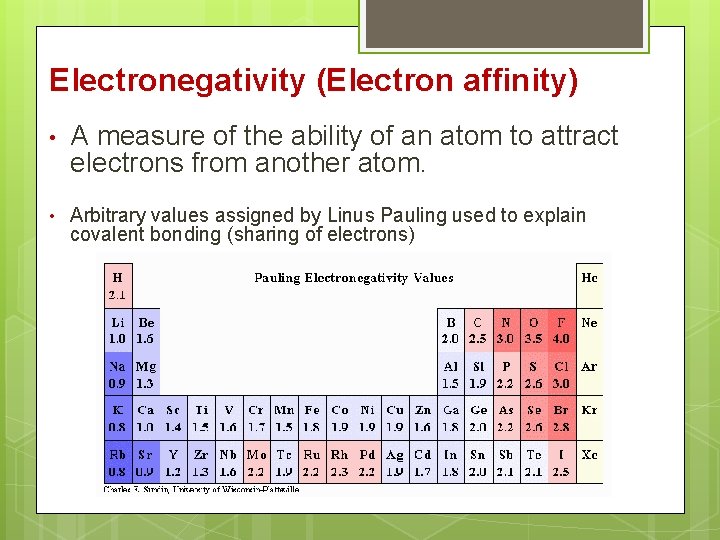
Electronegativity (Electron affinity) • A measure of the ability of an atom to attract electrons from another atom. • Arbitrary values assigned by Linus Pauling used to explain covalent bonding (sharing of electrons)
Ionic Radius: Atoms can gain or lose one or more electrons to form ions • An ion is an atom or group of bonded atoms that has a positive or negative charge. • When atoms lose electrons (and form a positive ion called a cation) they always become smaller. • When atoms gain electrons (and form a negative ion called an anion) they always become larger.
- Slides: 12