
Periodic table data and Isotopes Learning Objectives All
Periodic table data and Isotopes Learning Objectives All will recall the meanings of the terms Atomic Number, Mass number and Relative atomic mass. Most will understand the term ‘Isotope’ Some will be able to calculate the relative atomic mass using the mass numbers and abundance of isotopes.
Atomic Number (Proton Number) This is the number of Protons found in the nucleus of an atom. All atoms of a particular element have the same number of protons in their nuclei. Relative Atomic Mass (Ar) This is the mass of an atom compared to all the other atoms in the period table. It is a ratio and has no unit Mass Number This is the relative mass of atoms. It is calculated from adding the number of protons (Ar = 1) to the number of neutrons (Ar = 1). Electrons are regarded as having a mass of zero.

Relative atomic mass = 7 Protons = 3 Electrons = 3 Neutrons = 7 - 3 = 4 Atomic number = 3
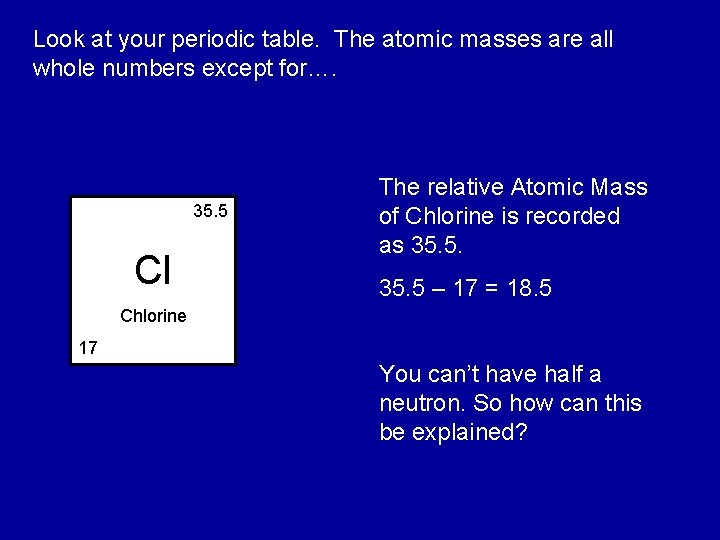
Look at your periodic table. The atomic masses are all whole numbers except for…. 35. 5 Cl The relative Atomic Mass of Chlorine is recorded as 35. 5 – 17 = 18. 5 Chlorine 17 You can’t have half a neutron. So how can this be explained?
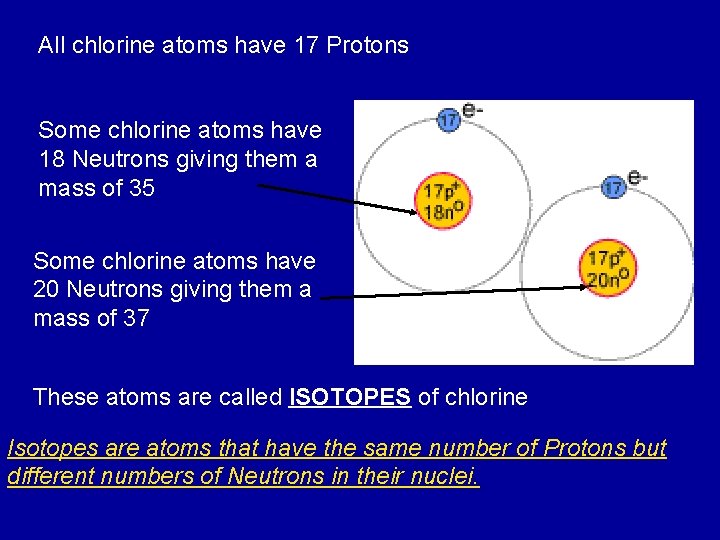
All chlorine atoms have 17 Protons Some chlorine atoms have 18 Neutrons giving them a mass of 35 Some chlorine atoms have 20 Neutrons giving them a mass of 37 These atoms are called ISOTOPES of chlorine Isotopes are atoms that have the same number of Protons but different numbers of Neutrons in their nuclei.
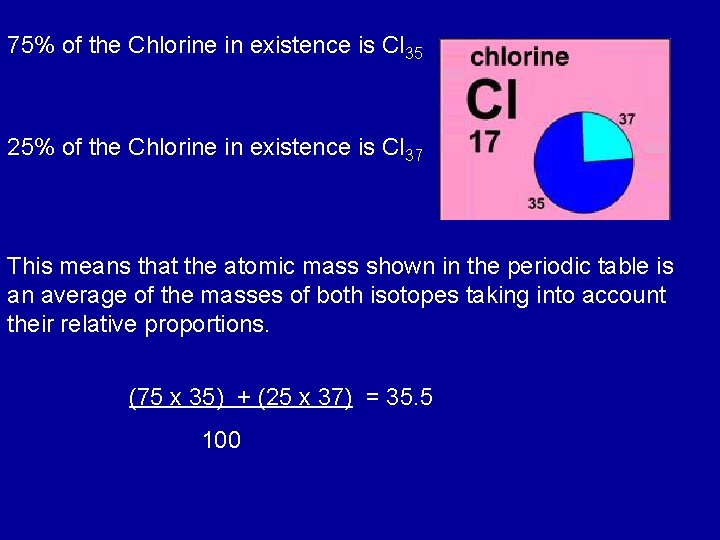
75% of the Chlorine in existence is Cl 35 25% of the Chlorine in existence is Cl 37 This means that the atomic mass shown in the periodic table is an average of the masses of both isotopes taking into account their relative proportions. (75 x 35) + (25 x 37) = 35. 5 100
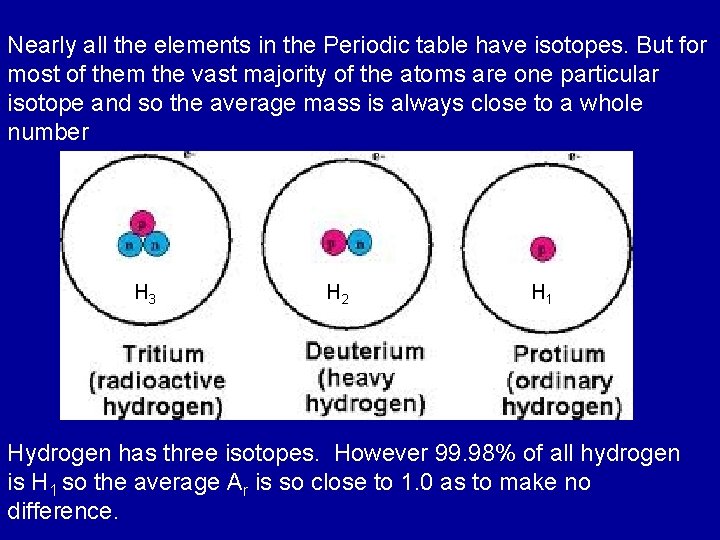
Nearly all the elements in the Periodic table have isotopes. But for most of them the vast majority of the atoms are one particular isotope and so the average mass is always close to a whole number H 3 H 2 H 1 Hydrogen has three isotopes. However 99. 98% of all hydrogen is H 1 so the average Ar is so close to 1. 0 as to make no difference.
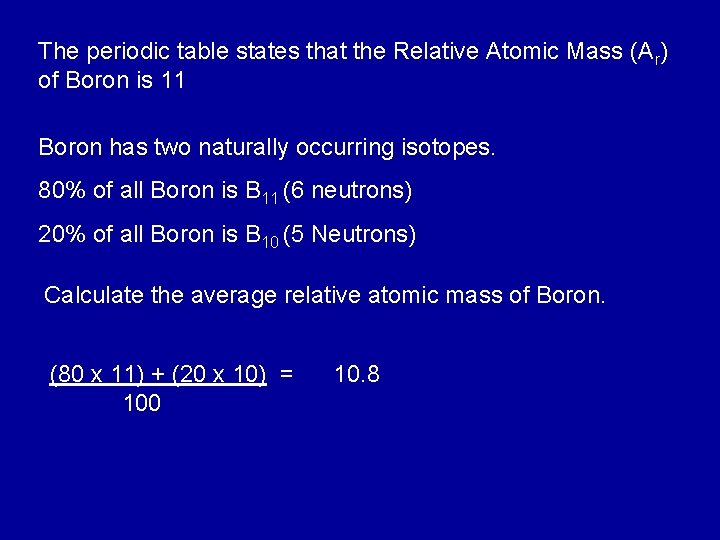
The periodic table states that the Relative Atomic Mass (Ar) of Boron is 11 Boron has two naturally occurring isotopes. 80% of all Boron is B 11 (6 neutrons) 20% of all Boron is B 10 (5 Neutrons) Calculate the average relative atomic mass of Boron. (80 x 11) + (20 x 10) = 100 10. 8
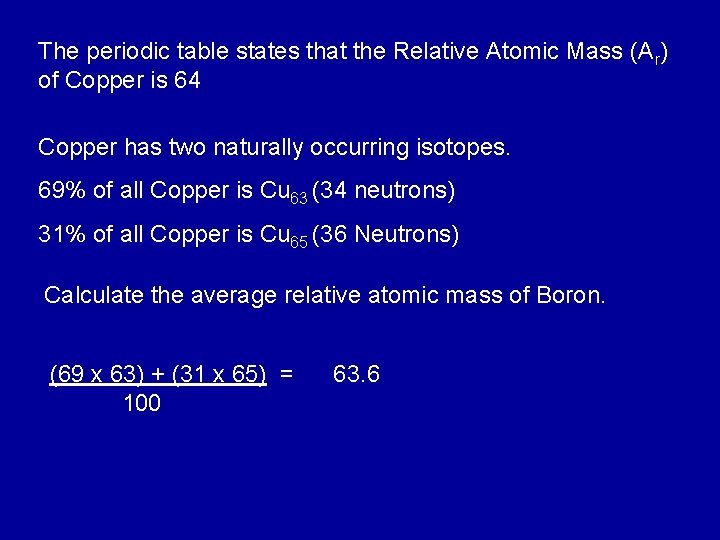
The periodic table states that the Relative Atomic Mass (Ar) of Copper is 64 Copper has two naturally occurring isotopes. 69% of all Copper is Cu 63 (34 neutrons) 31% of all Copper is Cu 65 (36 Neutrons) Calculate the average relative atomic mass of Boron. (69 x 63) + (31 x 65) = 100 63. 6
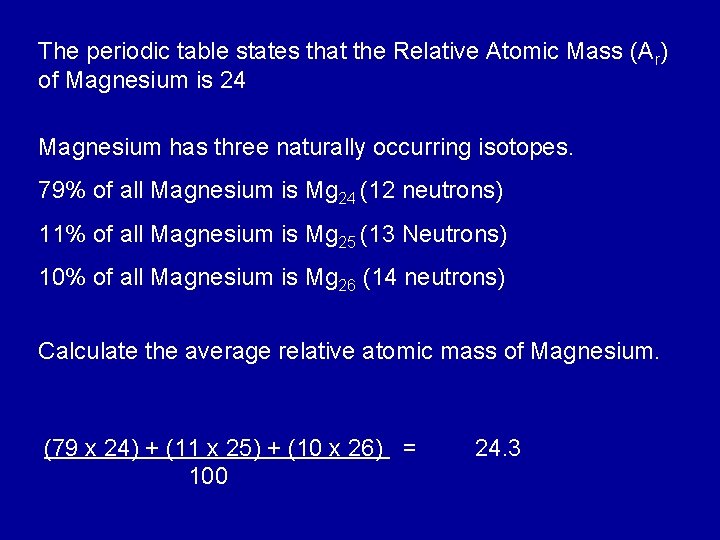
The periodic table states that the Relative Atomic Mass (Ar) of Magnesium is 24 Magnesium has three naturally occurring isotopes. 79% of all Magnesium is Mg 24 (12 neutrons) 11% of all Magnesium is Mg 25 (13 Neutrons) 10% of all Magnesium is Mg 26 (14 neutrons) Calculate the average relative atomic mass of Magnesium. (79 x 24) + (11 x 25) + (10 x 26) = 100 24. 3
Periodic table data and Isotopes Learning Objectives All will recall the meanings of the terms Atomic Number, Mass number and Relative atomic mass. Most will understand the term ‘Isotope’ Some will be able to calculate the relative atomic mass using the mass numbers and abundance of isotopes.
- Slides: 11