
PERIODIC TABLE Chapter 5 1 ORGANIZING THE ELEMENTS
PERIODIC TABLE Chapter 5 1
ORGANIZING THE ELEMENTS Section 1 2
LET’S REVIEW! • Chemical properties • Any property that can only be tested by changing the chemical make-up of the substance. • Physical properties • Any property that can be tested without changing the chemical make-up of the substance • Atomic mass • Mass of protons and neutrons • Atomic number • Unique to each element, same as number of protons 3
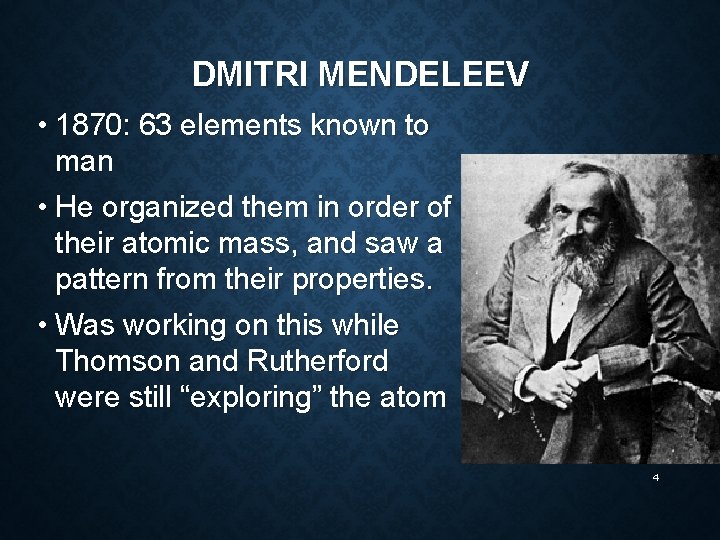
DMITRI MENDELEEV • 1870: 63 elements known to man • He organized them in order of their atomic mass, and saw a pattern from their properties. • Was working on this while Thomson and Rutherford were still “exploring” the atom 4
DMITRI MENDELEEV • Arranged his table with repeating properties in columns, starting a new row each time the chemical properties repeated • Left blank spaces in his table, concluding that these spaces were elements that hadn’t been discovered yet. • Based on the patterns and the other elements around the blank space, he predicted the properties of those elements 5
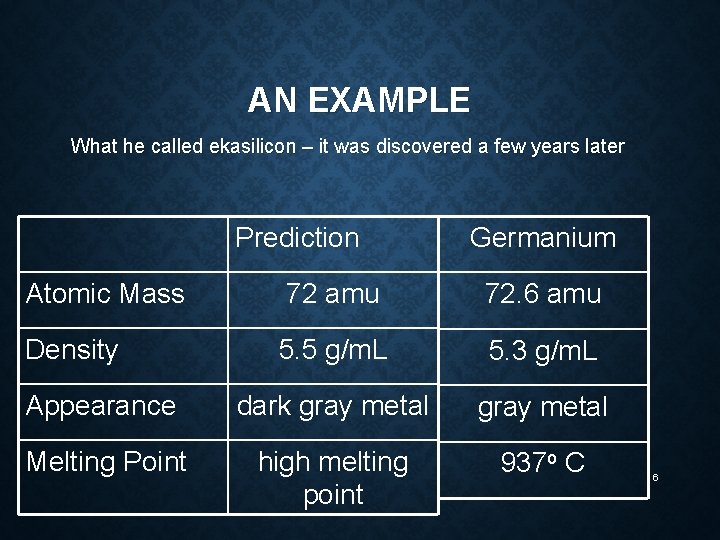
AN EXAMPLE What he called ekasilicon – it was discovered a few years later Prediction Germanium Atomic Mass 72 amu 72. 6 amu Density 5. 5 g/m. L 5. 3 g/m. L Appearance dark gray metal Melting Point high melting point 937 o C 6
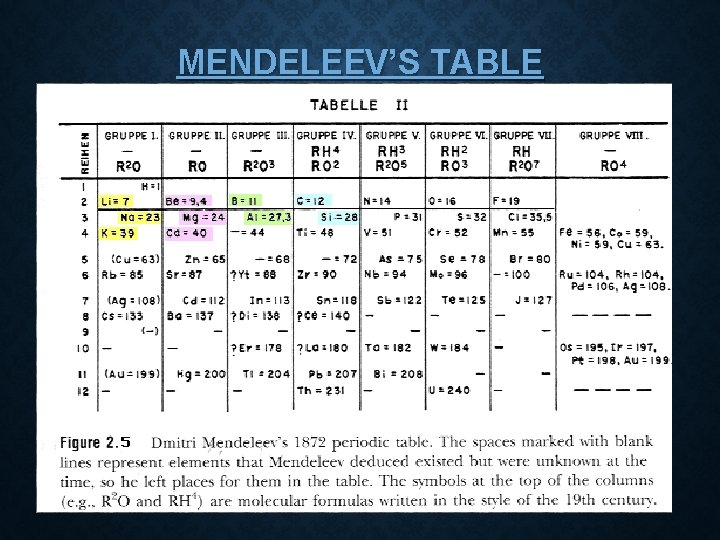
MENDELEEV’S TABLE 7
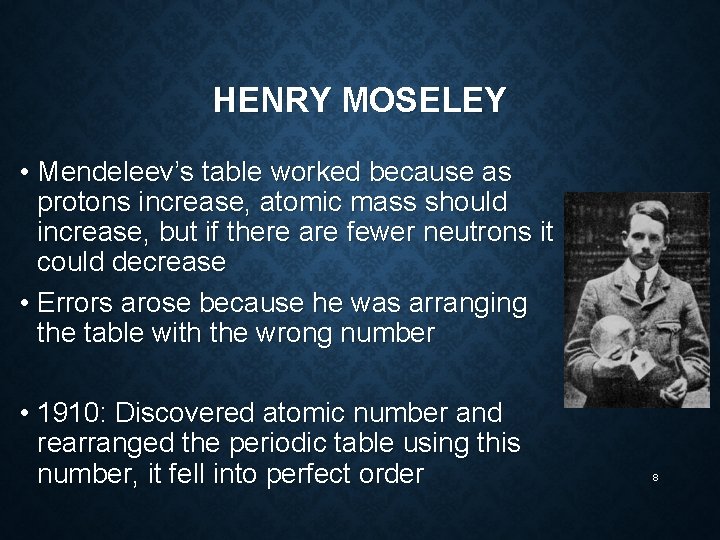
HENRY MOSELEY • Mendeleev’s table worked because as protons increase, atomic mass should increase, but if there are fewer neutrons it could decrease • Errors arose because he was arranging the table with the wrong number • 1910: Discovered atomic number and rearranged the periodic table using this number, it fell into perfect order 8
PERIODIC LAW • Periodic Law: physical and chemical properties of the elements are periodic functions of their atomic numbers • In other words, when the elements are arranged by their atomic numbers, you should see chemical and physical properties repeating themselves 9
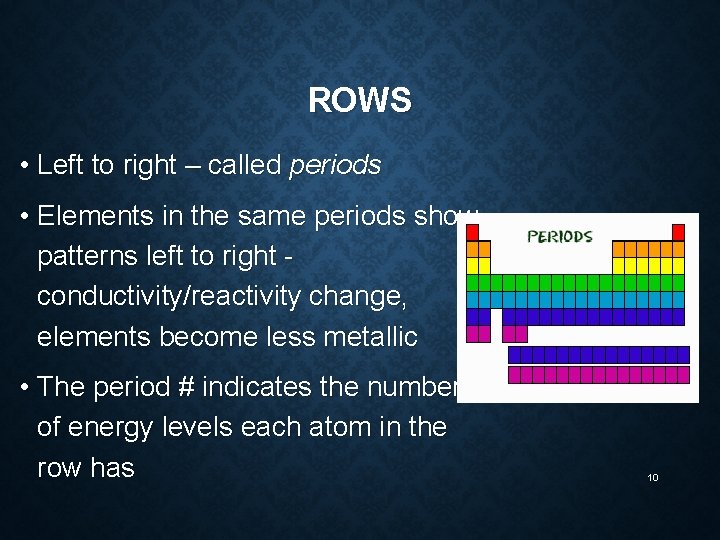
ROWS • Left to right – called periods • Elements in the same periods show patterns left to right conductivity/reactivity change, elements become less metallic • The period # indicates the number of energy levels each atom in the row has 10
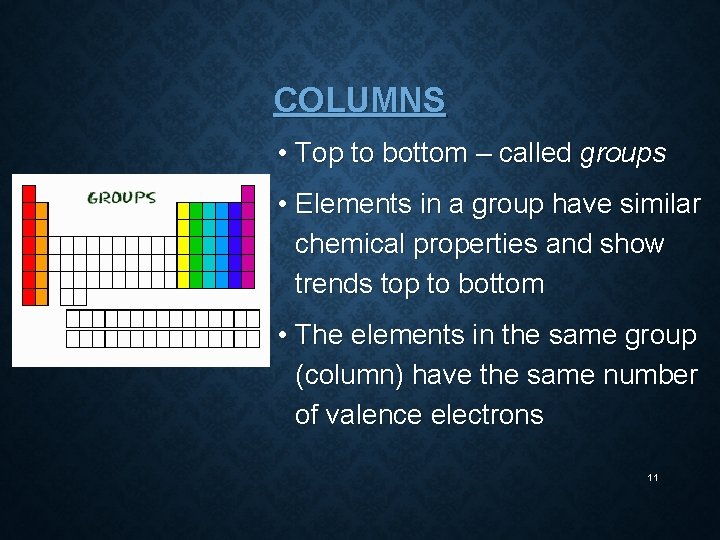
COLUMNS • Top to bottom – called groups • Elements in a group have similar chemical properties and show trends top to bottom • The elements in the same group (column) have the same number of valence electrons 11
EXPLORING THE PERIODIC TABLE Section 2 12
REMEMBER • The periodic table is organized by atomic number • For a neutral atom, the number of protons equals the number of electrons 13
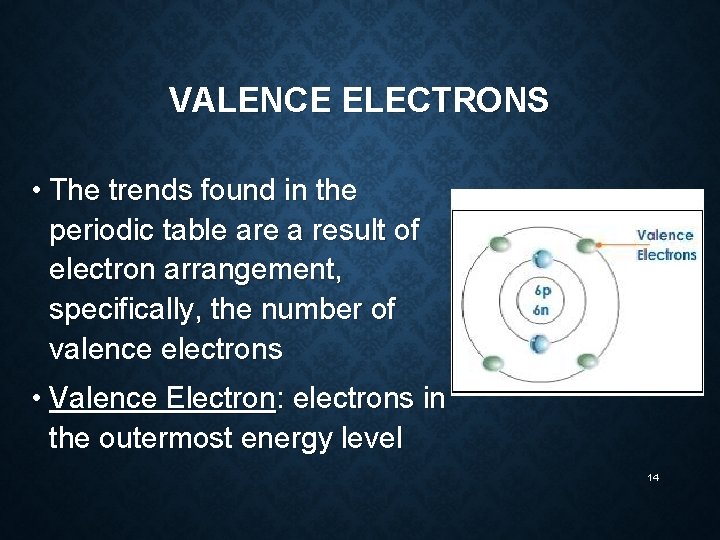
VALENCE ELECTRONS • The trends found in the periodic table are a result of electron arrangement, specifically, the number of valence electrons • Valence Electron: electrons in the outermost energy level 14
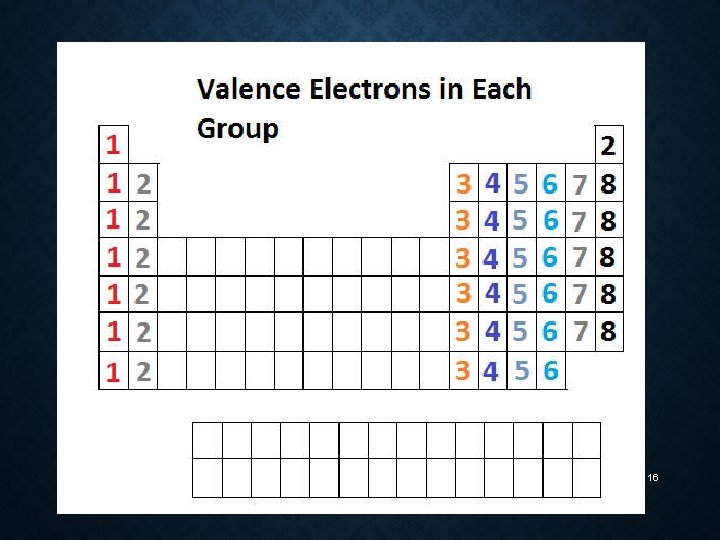
VALENCE ELECTRONS • The group number of an element will tell you the number of valence electrons it has • Group 1: 1 valence electron • Group 2: 2 valence e- ’s • Skip 3 -12 • Group 13: 3 valence e- ’s • Groups 14 -18: 4, 5, 6, 7, and 8 valence e- ’s respectively. 15
16

ION • When a neutral atom gains/loses electron(s) through bonding, the atom is no longer neutral and has an excess charge • It becomes an ion • Ion: a charged atom 17
ION • All atoms want 8 valence electrons in the outer shell – this makes the shell full and the atom stable • Elements close to having 8 tend to be the most reactive. • Elements already “full” are considered inert, they don’t react because they don’t need to • The number of electrons an atom can gain or lose is equal to the number of valence electrons it has 18
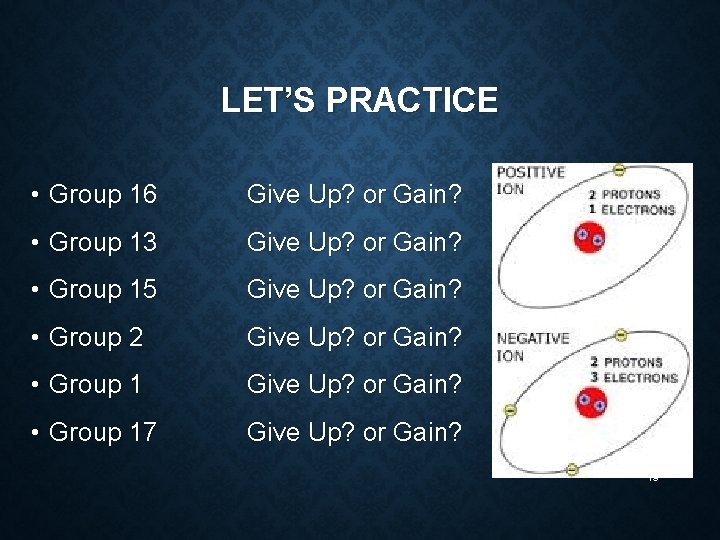
LET’S PRACTICE • Group 16 Give Up? or Gain? • Group 13 Give Up? or Gain? • Group 15 Give Up? or Gain? • Group 2 Give Up? or Gain? • Group 17 Give Up? or Gain? 19
ION • Protons = positive charge • Electrons = negative charge • p+ # CANNOT change, but e- # can • So… • If an atom GAINS electrons, is it more positive, or negative? • If they LOST electrons? 20
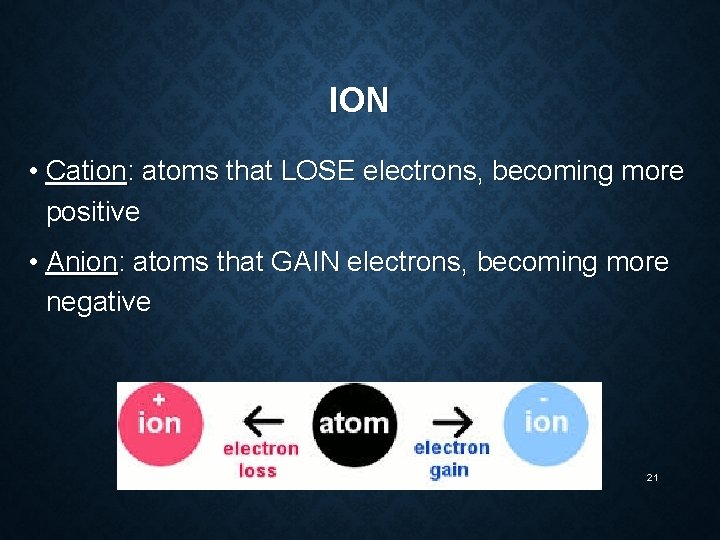
ION • Cation: atoms that LOSE electrons, becoming more positive • Anion: atoms that GAIN electrons, becoming more negative 21
ION • How do we know if an atom is an ion? • Cations have a +, and anions have a – superscript • If an atom has gained 3 electrons • It has 3 MORE negative particles than positive particles, it is more negative = Al 3 - • If an atom has lost 3 electrons • It has 3 LESS negative particles than positive particles, it is more positive = Al 3+ 22
THE PERIODIC TABLE Section 3 23
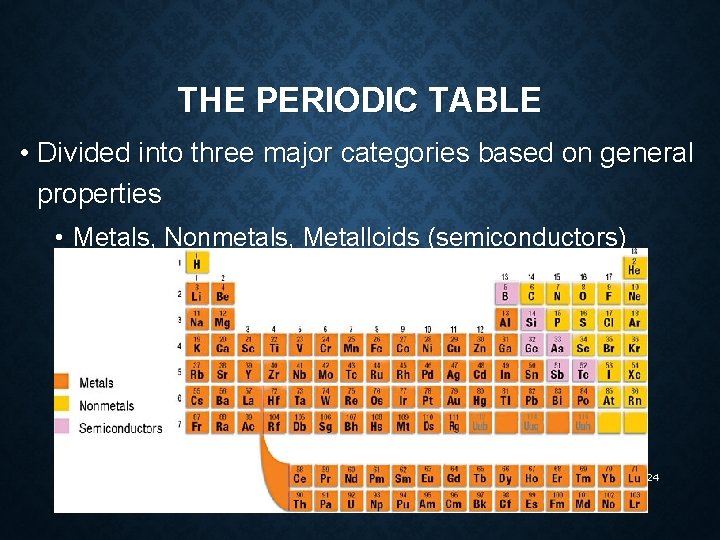
THE PERIODIC TABLE • Divided into three major categories based on general properties • Metals, Nonmetals, Metalloids (semiconductors) 24
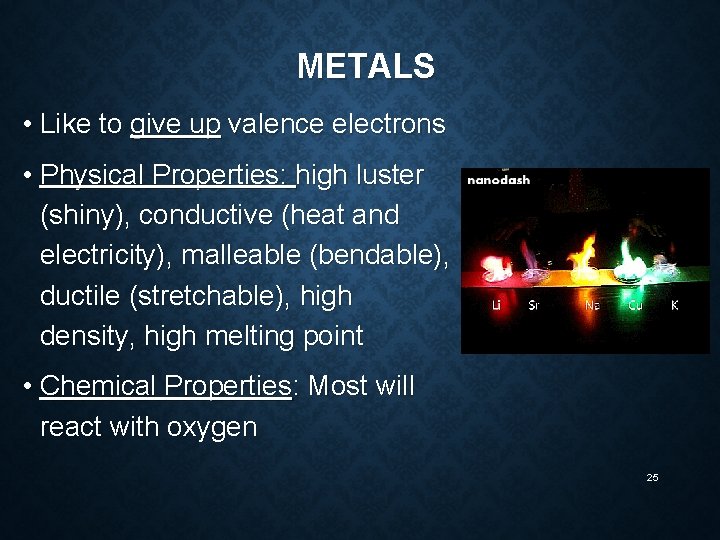
METALS • Like to give up valence electrons • Physical Properties: high luster (shiny), conductive (heat and electricity), malleable (bendable), ductile (stretchable), high density, high melting point • Chemical Properties: Most will react with oxygen 25
NONMETALS • Like to gain electrons • Physical Properties: dull, don’t conduct, brittle, low density, low melting points • Can be solid, liquid or gas at room temperature depending on the element. 26
METALLOIDS (SEMICONDUCTORS) • Share properties of both metals and nonmetals • Can be shiny or dull, conduct ok, ductile and malleable or brittle • These elements have become really important because of the computer revolution • Computer chips are made out of semiconductors (normally Si) 27
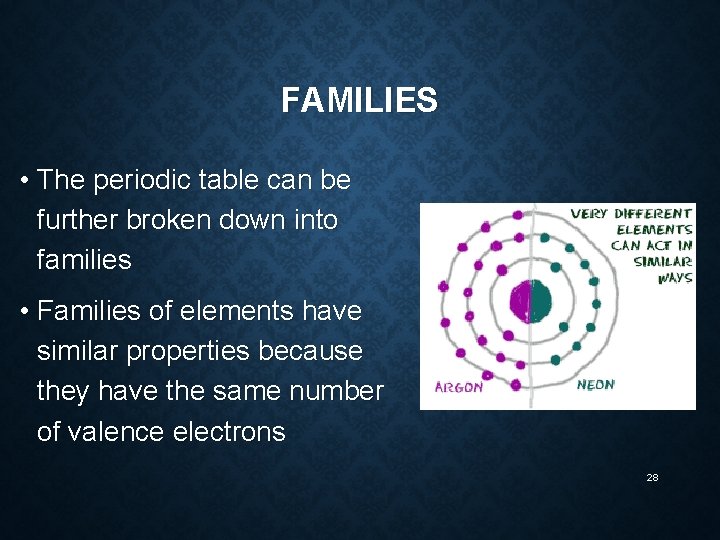
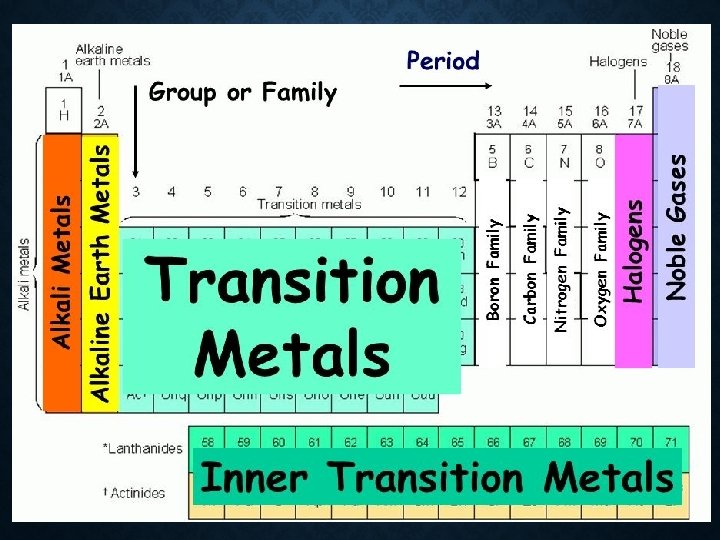
FAMILIES • The periodic table can be further broken down into families • Families of elements have similar properties because they have the same number of valence electrons 28
FAMILIES • Metals: Groups 1 -12 • Alkali Metals, Alkaline-Earth Metals, Transition Metals • Groups 13 -16 contain both nonmetals/metalloids • Nonmetals: Oxygen, Nitrogen, Carbon, Sulfur, Phosphorus, and Selenium • Metalloids: Boron, Silicon, Germanium, Arsenic Antimony, and Terellium • The group is named by the first element in the column • Nonmetals: Groups 17 -18 • Halogens, Noble Gases 29
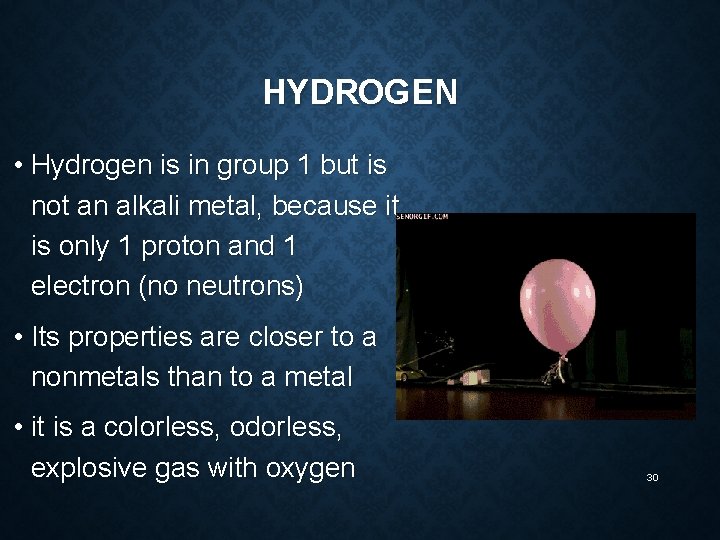
HYDROGEN • Hydrogen is in group 1 but is not an alkali metal, because it is only 1 proton and 1 electron (no neutrons) • Its properties are closer to a nonmetals than to a metal • it is a colorless, odorless, explosive gas with oxygen 30
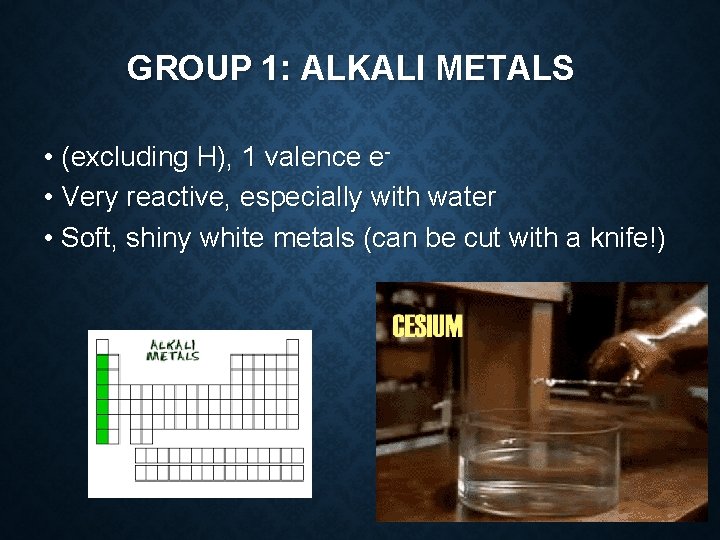
GROUP 1: ALKALI METALS • (excluding H), 1 valence e • Very reactive, especially with water • Soft, shiny white metals (can be cut with a knife!) 31
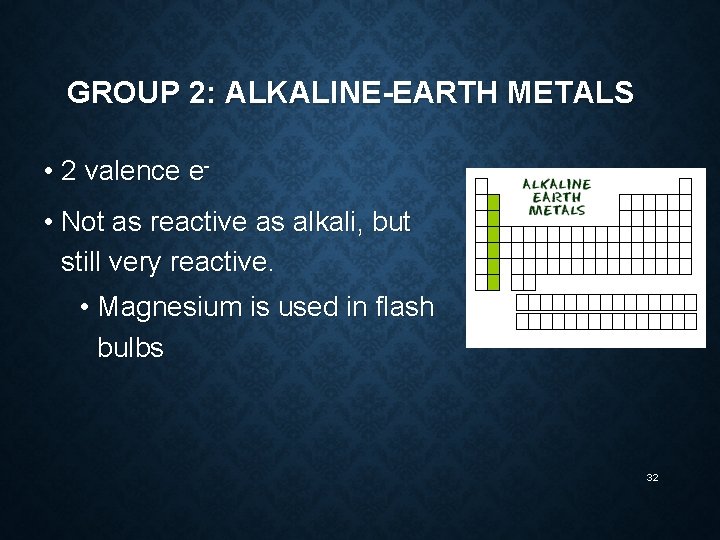
GROUP 2: ALKALINE-EARTH METALS • 2 valence e • Not as reactive as alkali, but still very reactive. • Magnesium is used in flash bulbs 32
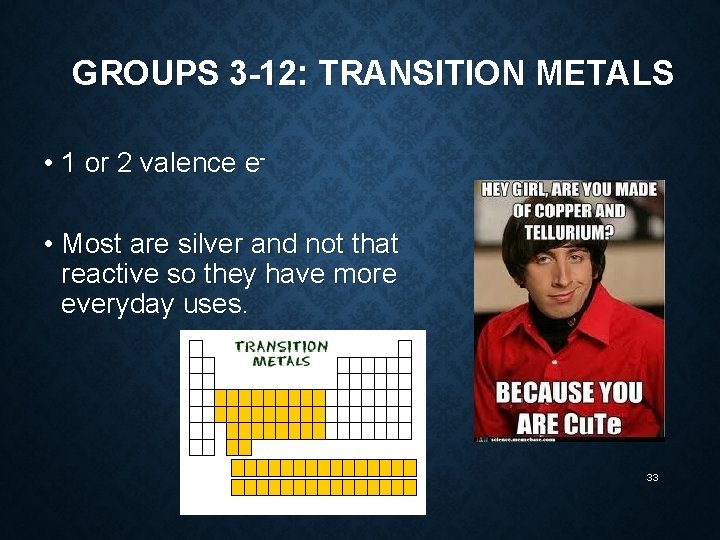
GROUPS 3 -12: TRANSITION METALS • 1 or 2 valence e • Most are silver and not that reactive so they have more everyday uses. 33
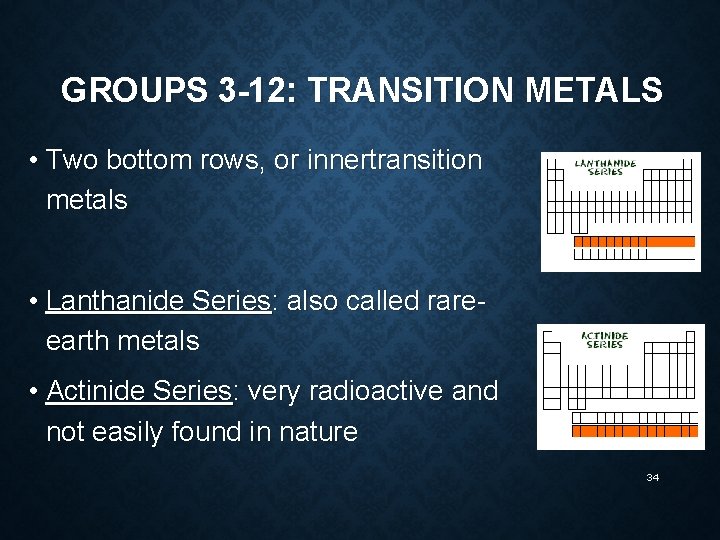
GROUPS 3 -12: TRANSITION METALS • Two bottom rows, or innertransition metals • Lanthanide Series: also called rareearth metals • Actinide Series: very radioactive and not easily found in nature 34
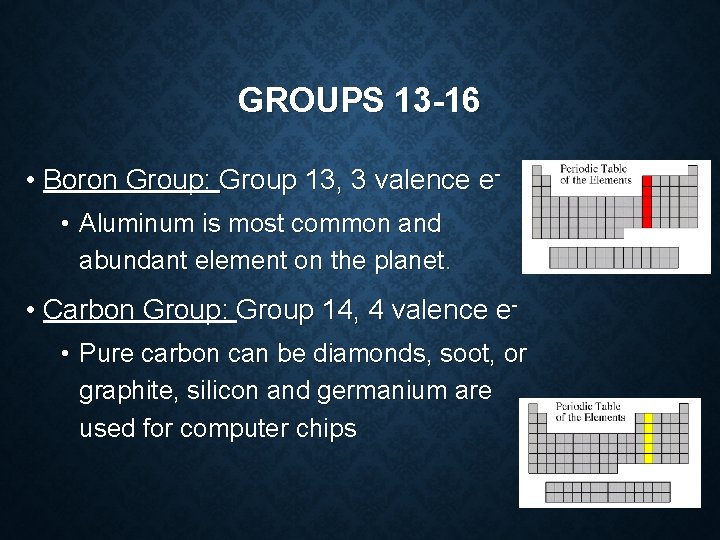
GROUPS 13 -16 • Boron Group: Group 13, 3 valence e • Aluminum is most common and abundant element on the planet. • Carbon Group: Group 14, 4 valence e • Pure carbon can be diamonds, soot, or graphite, silicon and germanium are used for computer chips 35
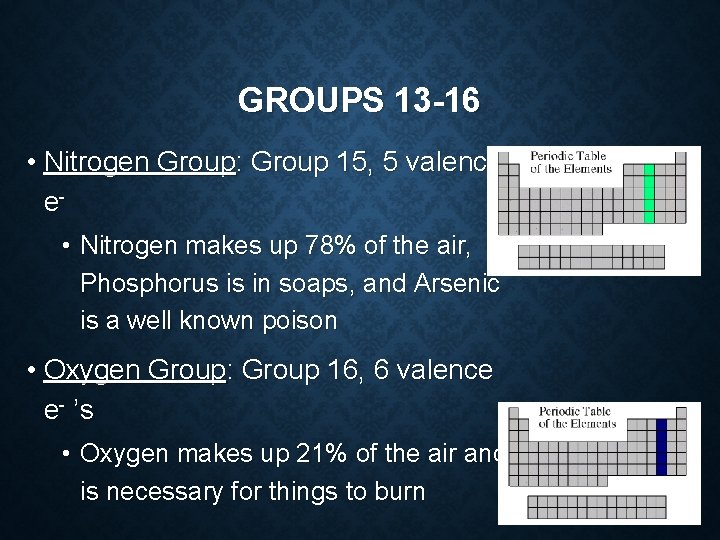
GROUPS 13 -16 • Nitrogen Group: Group 15, 5 valence e • Nitrogen makes up 78% of the air, Phosphorus is in soaps, and Arsenic is a well known poison • Oxygen Group: Group 16, 6 valence e- ’s • Oxygen makes up 21% of the air and is necessary for things to burn 36
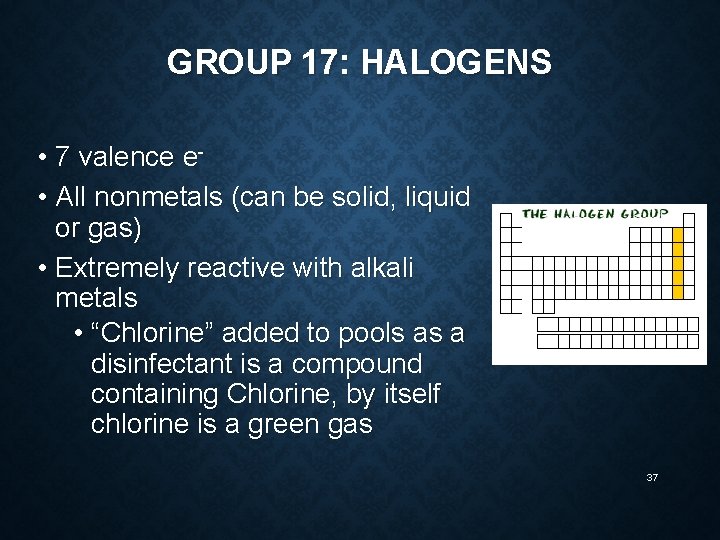
GROUP 17: HALOGENS • 7 valence e • All nonmetals (can be solid, liquid or gas) • Extremely reactive with alkali metals • “Chlorine” added to pools as a disinfectant is a compound containing Chlorine, by itself chlorine is a green gas 37
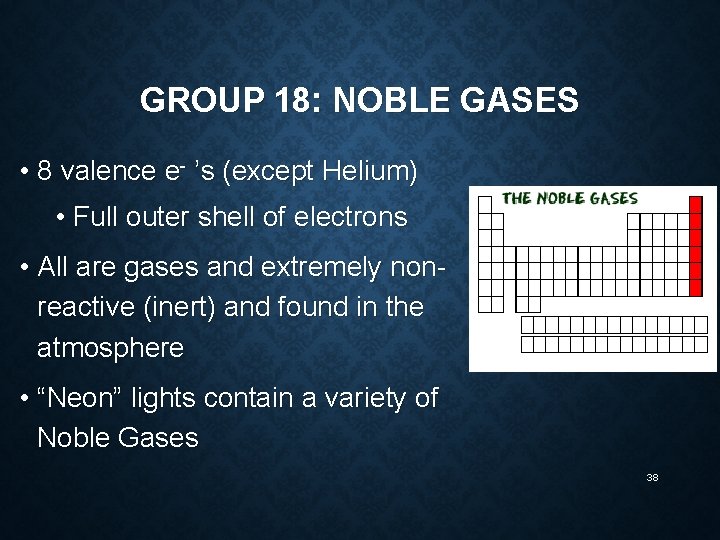
GROUP 18: NOBLE GASES • 8 valence e- ’s (except Helium) • Full outer shell of electrons • All are gases and extremely nonreactive (inert) and found in the atmosphere • “Neon” lights contain a variety of Noble Gases 38
39
- Slides: 39