
PERIODIC STOCK GRADE 12 ACCOUNTING LESSON 6 Mr
![PERIODIC STOCK GRADE 12 ACCOUNTING LESSON 6 Mr Golightly [Alex Rd] & Ms Stegmann](https://slidetodoc.com/presentation_image_h/fec0d937b197b3deb64b1293196a3335/image-1.jpg "PERIODIC STOCK GRADE 12 ACCOUNTING LESSON 6 Mr Golightly [Alex Rd] & Ms Stegmann")
![THE PURCHASES ACCOUNT (PERIODIC INVENTORY SYSTEM) Total [1] b/f 30000 [1] Total of the](https://slidetodoc.com/presentation_image_h/fec0d937b197b3deb64b1293196a3335/image-4.jpg "THE PURCHASES ACCOUNT (PERIODIC INVENTORY SYSTEM) Total [1] b/f 30000 [1] Total of the")
![THE PURCHASES ACCOUNT (PERIODIC INVENTORY SYSTEM) Total [1] b/f 30000 Bank [2] CPJ 45000](https://slidetodoc.com/presentation_image_h/fec0d937b197b3deb64b1293196a3335/image-5.jpg "THE PURCHASES ACCOUNT (PERIODIC INVENTORY SYSTEM) Total [1] b/f 30000 Bank [2] CPJ 45000")
![THE PURCHASES ACCOUNT (PERIODIC INVENTORY SYSTEM) Total [1] b/f 30000 Bank [2] CPJ 45000](https://slidetodoc.com/presentation_image_h/fec0d937b197b3deb64b1293196a3335/image-6.jpg "THE PURCHASES ACCOUNT (PERIODIC INVENTORY SYSTEM) Total [1] b/f 30000 Bank [2] CPJ 45000")
![THE PURCHASES ACCOUNT (PERIODIC INVENTORY SYSTEM) Total [1] b/f 30000 Bank [2] CPJ 45000](https://slidetodoc.com/presentation_image_h/fec0d937b197b3deb64b1293196a3335/image-7.jpg "THE PURCHASES ACCOUNT (PERIODIC INVENTORY SYSTEM) Total [1] b/f 30000 Bank [2] CPJ 45000")
![THE PURCHASES ACCOUNT (PERIODIC INVENTORY SYSTEM) Total [1] b/f 30000 Bank [2] CPJ 45000](https://slidetodoc.com/presentation_image_h/fec0d937b197b3deb64b1293196a3335/image-8.jpg "THE PURCHASES ACCOUNT (PERIODIC INVENTORY SYSTEM) Total [1] b/f 30000 Bank [2] CPJ 45000")
![THE PURCHASES ACCOUNT (PERIODIC INVENTORY SYSTEM) Total [1] b/f 30000 Creditors control [5] CAJ](https://slidetodoc.com/presentation_image_h/fec0d937b197b3deb64b1293196a3335/image-9.jpg "THE PURCHASES ACCOUNT (PERIODIC INVENTORY SYSTEM) Total [1] b/f 30000 Creditors control [5] CAJ")
![THE PURCHASES ACCOUNT (PERIODIC INVENTORY SYSTEM) Total [1] b/f 30000 Creditors control [5] CAJ](https://slidetodoc.com/presentation_image_h/fec0d937b197b3deb64b1293196a3335/image-10.jpg "THE PURCHASES ACCOUNT (PERIODIC INVENTORY SYSTEM) Total [1] b/f 30000 Creditors control [5] CAJ")
![THE PURCHASES ACCOUNT (PERIODIC INVENTORY SYSTEM) Total DURING THE YEAR [1] b/f 30000 Creditors](https://slidetodoc.com/presentation_image_h/fec0d937b197b3deb64b1293196a3335/image-11.jpg "THE PURCHASES ACCOUNT (PERIODIC INVENTORY SYSTEM) Total DURING THE YEAR [1] b/f 30000 Creditors")
- Slides: 17
PERIODIC STOCK GRADE 12 ACCOUNTING LESSON 6 Mr Golightly [Alex Rd] & Ms Stegmann [Hudson Park]
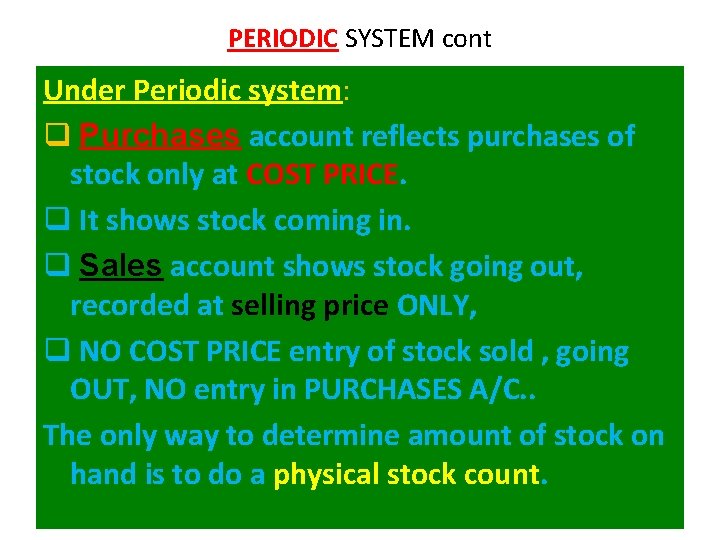
PERIODIC SYSTEM cont Under Periodic system: q Purchases account reflects purchases of stock only at COST PRICE. q It shows stock coming in. q Sales account shows stock going out, recorded at selling price ONLY, q NO COST PRICE entry of stock sold , going OUT, NO entry in PURCHASES A/C. . The only way to determine amount of stock on hand is to do a physical stock count.
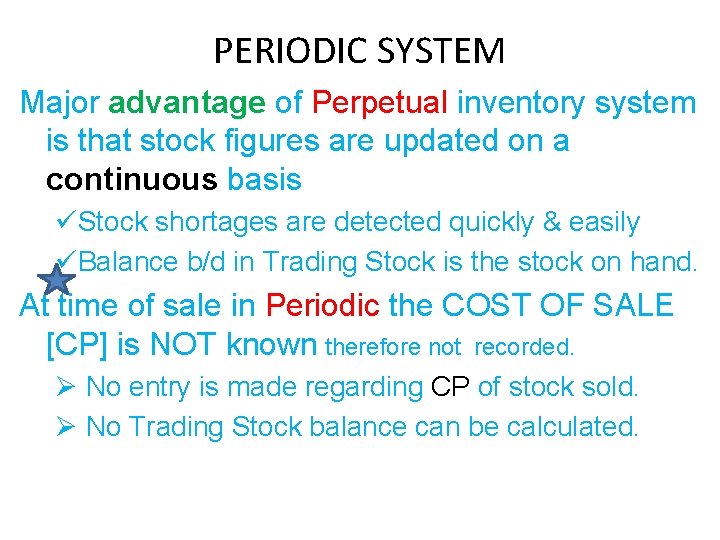
PERIODIC SYSTEM Major advantage of Perpetual inventory system is that stock figures are updated on a continuous basis üStock shortages are detected quickly & easily üBalance b/d in Trading Stock is the stock on hand. At time of sale in Periodic the COST OF SALE [CP] is NOT known therefore not recorded. Ø No entry is made regarding CP of stock sold. Ø No Trading Stock balance can be calculated.
THE PURCHASES ACCOUNT (PERIODIC INVENTORY SYSTEM) Total [1] b/f 30000 [1] Total of the Purchases account at the end of the previous month.
THE PURCHASES ACCOUNT (PERIODIC INVENTORY SYSTEM) Total [1] b/f 30000 Bank [2] CPJ 45000 [1] Total of the Purchases account at the end of the previous month. [2] Stock purchased and paid for cheque or electronic transfer.
THE PURCHASES ACCOUNT (PERIODIC INVENTORY SYSTEM) Total [1] b/f 30000 Bank [2] CPJ 45000 Creditors Control [3] CJ 62300 [1] Total of the Purchases account at the end of the previous month. [2] Stock purchased and paid for cheque or electronic transfer. [3] Stock purchased on credit.
THE PURCHASES ACCOUNT (PERIODIC INVENTORY SYSTEM) Total [1] b/f 30000 Bank [2] CPJ 45000 Creditors Control [3] CJ 62300 Petty cash [4] PCJ 200 [1] Total of the Purchases account at the end of the previous month. [2] Stock purchased and paid for cheque or electronic transfer. [3] Stock purchased on credit. [4] Stock purchased and paid for from petty cash.
THE PURCHASES ACCOUNT (PERIODIC INVENTORY SYSTEM) Total [1] b/f 30000 Bank [2] CPJ 45000 Creditors Control [3] CJ 62300 Petty cash [4] PCJ 200 Creditors control [5] CAJ 3500 [1] Total of the Purchases account at the end of the previous month. [2] Stock purchased and paid for cheque or electronic transfer. [3] Stock purchased on credit. [4] Stock purchased and paid for from petty cash. [5] Stock returned to suppliers (Creditors).
THE PURCHASES ACCOUNT (PERIODIC INVENTORY SYSTEM) Total [1] b/f 30000 Creditors control [5] CAJ 3500 Bank [2] CPJ 45000 Donation GJ 1000 Creditors Control [3] CJ 62300 Petty cash [4] PCJ 200 [6] [1] Total of the Purchases account at the end of the previous month. [2] Stock purchased and paid for cheque or electronic transfer. [3] Stock purchased on credit. [4] Stock purchased and paid for from petty cash. [5] Stock returned to suppliers (Creditors). [6] Stock donated.
THE PURCHASES ACCOUNT (PERIODIC INVENTORY SYSTEM) Total [1] b/f 30000 Creditors control [5] CAJ 3500 Bank [2] CPJ 45000 Donation [6] GJ 1000 Creditors Control [3] CJ 62300 Drawings [7] GJ 1800 Petty cash [4] PCJ 200 [1] Total of the Purchases account at the end of the previous month. [2] Stock purchased and paid for cheque or electronic transfer. [3] Stock purchased on credit. [4] Stock purchased and paid for from petty cash. [5] Stock returned to suppliers (Creditors). [6] Stock donated. [7]Stock taken by owners for their personal use.
THE PURCHASES ACCOUNT (PERIODIC INVENTORY SYSTEM) Total DURING THE YEAR [1] b/f 30000 Creditors control [5] CAJ 3500 Bank [2] CPJ 45000 Donation [6] GJ 1000 Creditors Control [3] CJ 62300 Drawings [7] GJ 1800 Petty cash [4] PCJ 200 Trading Account [8] GJ 131 200 [1] Total of the Purchases account at the end of the previous month. [2] Stock purchased and paid for cheque or electronic transfer. [3] Stock purchased on credit. [4] Stock purchased and paid for from petty cash. [5] Stock returned to suppliers (Creditors). [6] Stock donated. [7]Stock taken by owners for their personal use. [8] Year end close off to Trading account
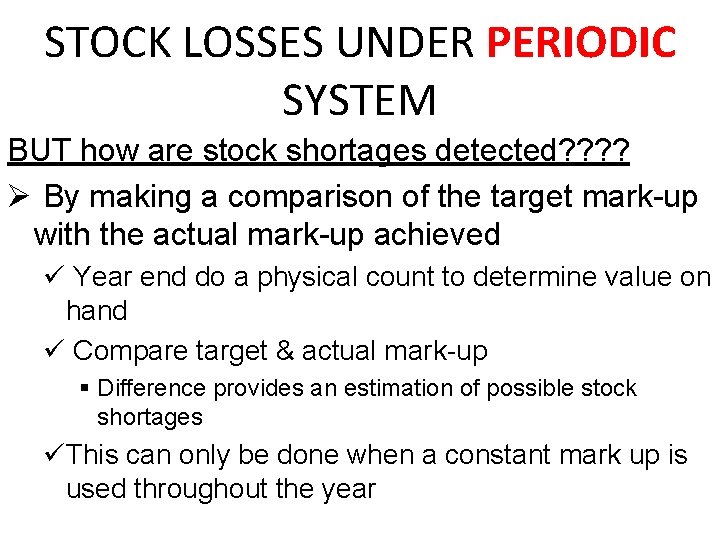
STOCK LOSSES UNDER PERIODIC SYSTEM BUT how are stock shortages detected? ? Ø By making a comparison of the target mark-up with the actual mark-up achieved ü Year end do a physical count to determine value on hand ü Compare target & actual mark-up § Difference provides an estimation of possible stock shortages üThis can only be done when a constant mark up is used throughout the year
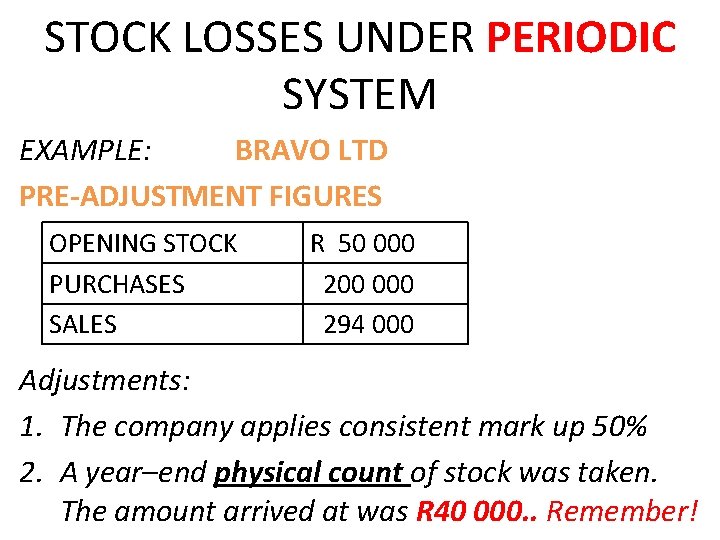
STOCK LOSSES UNDER PERIODIC SYSTEM EXAMPLE: BRAVO LTD PRE-ADJUSTMENT FIGURES OPENING STOCK PURCHASES SALES R 50 000 200 000 294 000 Adjustments: 1. The company applies consistent mark up 50% 2. A year–end physical count of stock was taken. The amount arrived at was R 40 000. . Remember!
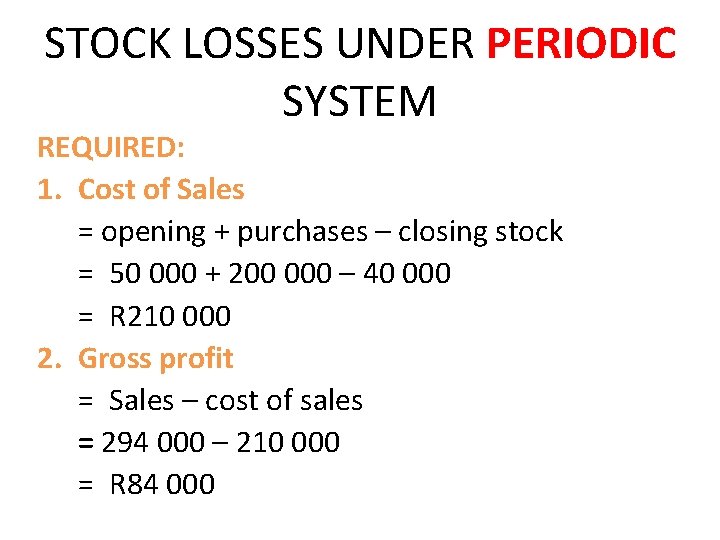
STOCK LOSSES UNDER PERIODIC SYSTEM REQUIRED: 1. Cost of Sales = opening + purchases – closing stock = 50 000 + 200 000 – 40 000 = R 210 000 2. Gross profit = Sales – cost of sales = 294 000 – 210 000 = R 84 000
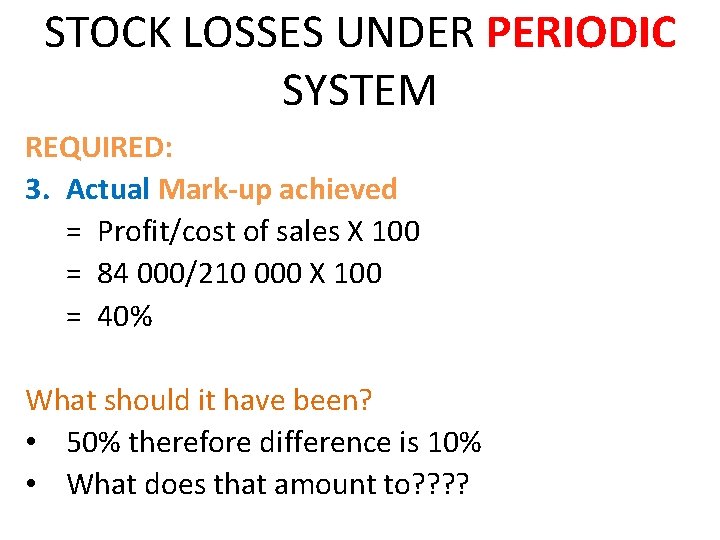
STOCK LOSSES UNDER PERIODIC SYSTEM REQUIRED: 3. Actual Mark-up achieved = Profit/cost of sales X 100 = 84 000/210 000 X 100 = 40% What should it have been? • 50% therefore difference is 10% • What does that amount to? ?
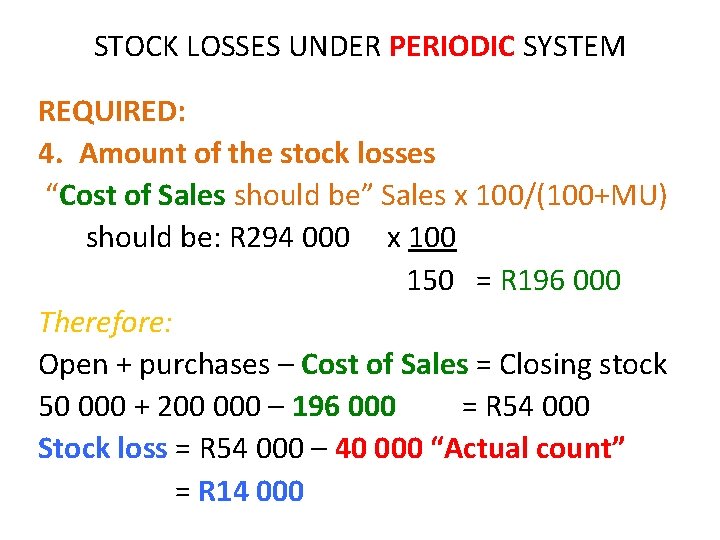
STOCK LOSSES UNDER PERIODIC SYSTEM REQUIRED: 4. Amount of the stock losses “Cost of Sales should be” Sales x 100/(100+MU) should be: R 294 000 x 100 150 = R 196 000 Therefore: Open + purchases – Cost of Sales = Closing stock 50 000 + 200 000 – 196 000 = R 54 000 Stock loss = R 54 000 – 40 000 “Actual count” = R 14 000
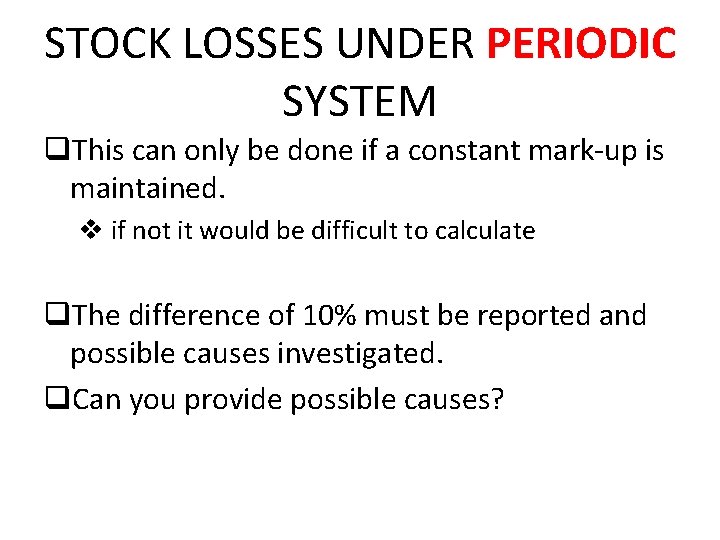
STOCK LOSSES UNDER PERIODIC SYSTEM q. This can only be done if a constant mark-up is maintained. v if not it would be difficult to calculate q. The difference of 10% must be reported and possible causes investigated. q. Can you provide possible causes?