
Periodic Reporting under UN Human Rights Treaties The


- Slides: 27
Periodic Reporting under UN Human Rights Treaties The Government’s report to the Committee on the Rights of the Child 4 – 5 June 2012 1
Overview • Introduction to the treaty reporting cycle • Preparation of treaty reports § Key steps • Appearance before a Committee § Key Steps • Concluding Observations and follow-up 2
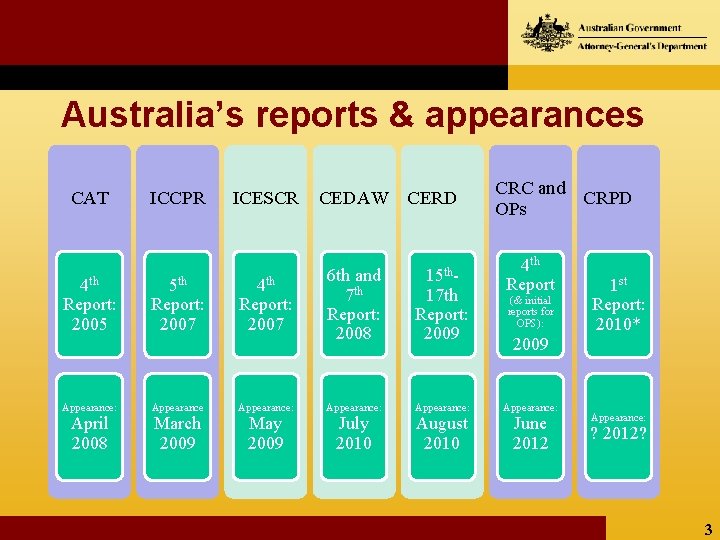
Australia’s reports & appearances CAT 4 th Report: 2005 Appearance: April 2008 ICCPR 5 th Report: 2007 Appearance March 2009 ICESCR 4 th Report: 2007 Appearance: May 2009 CEDAW CERD 6 th and 7 th Report: 2008 17 th Report: 2009 Appearance: July 2010 15 th- August 2010 CRC and CRPD OPs 4 th Report (& initial reports for OPS): 1 st Report: 2010* 2009 Appearance: June 2012 Appearance: ? 2012? 3
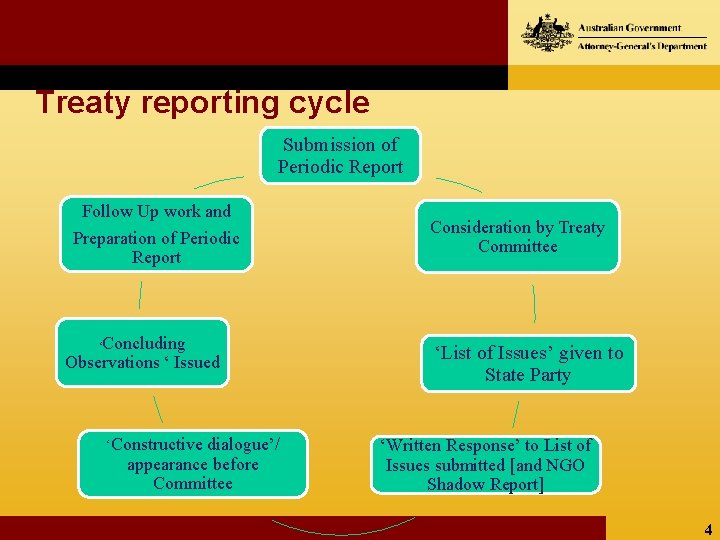
Treaty reporting cycle Submission of Periodic Report Follow Up work and Preparation of Periodic Report Concluding Observations ‘ Issued ‘ ‘Constructive dialogue’/ appearance before Committee Consideration by Treaty Committee ‘List of Issues’ given to State Party ‘Written Response’ to List of Issues submitted [and NGO Shadow Report] 4
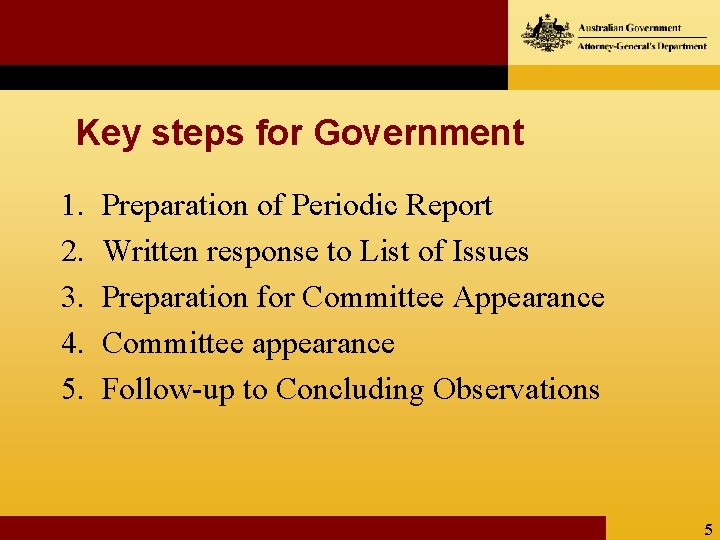
Key steps for Government 1. 2. 3. 4. 5. Preparation of Periodic Report Written response to List of Issues Preparation for Committee Appearance Committee appearance Follow-up to Concluding Observations 5
1. Preparation of Treaty Reports 6
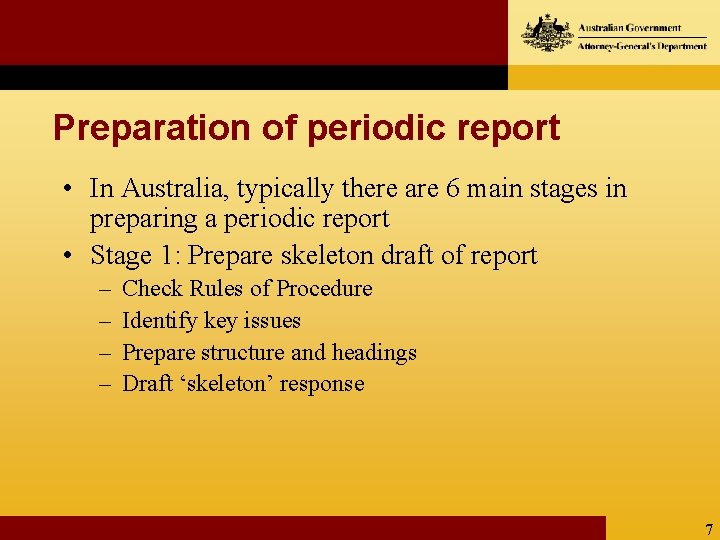
Preparation of periodic report • In Australia, typically there are 6 main stages in preparing a periodic report • Stage 1: Prepare skeleton draft of report – – Check Rules of Procedure Identify key issues Prepare structure and headings Draft ‘skeleton’ response 7
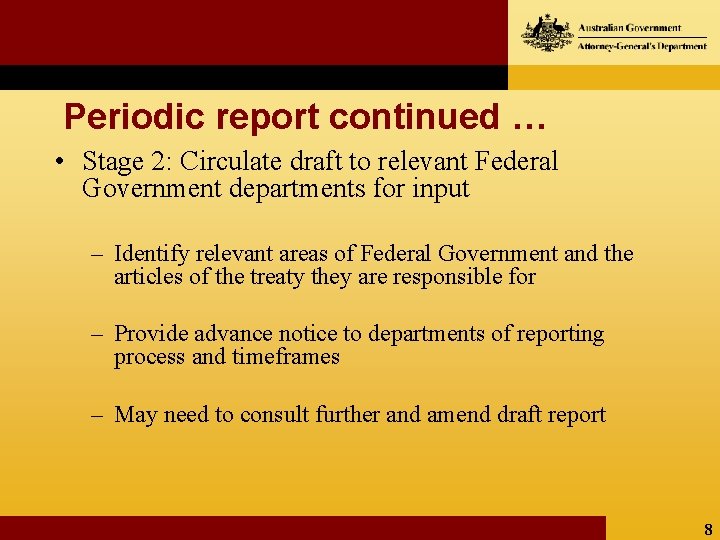
Periodic report continued … • Stage 2: Circulate draft to relevant Federal Government departments for input – Identify relevant areas of Federal Government and the articles of the treaty they are responsible for – Provide advance notice to departments of reporting process and timeframes – May need to consult further and amend draft report 8
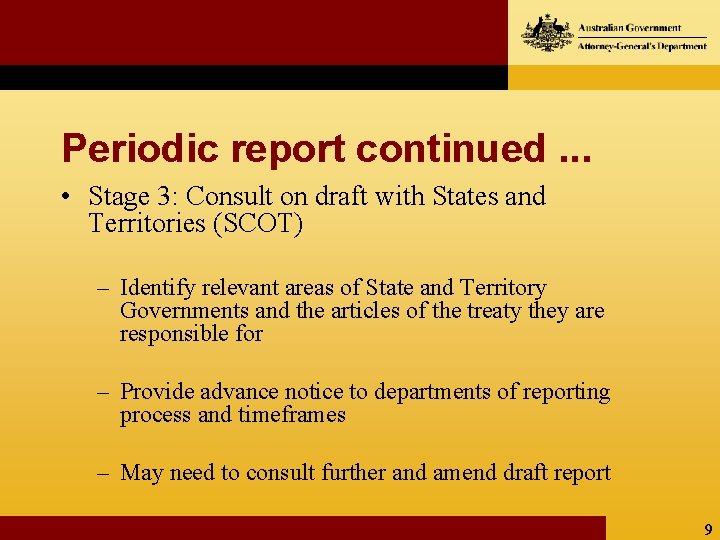
Periodic report continued. . . • Stage 3: Consult on draft with States and Territories (SCOT) – Identify relevant areas of State and Territory Governments and the articles of the treaty they are responsible for – Provide advance notice to departments of reporting process and timeframes – May need to consult further and amend draft report 9
Periodic report continued … • Stage 4: Seek the views of the general public – e. g. NGO input 10
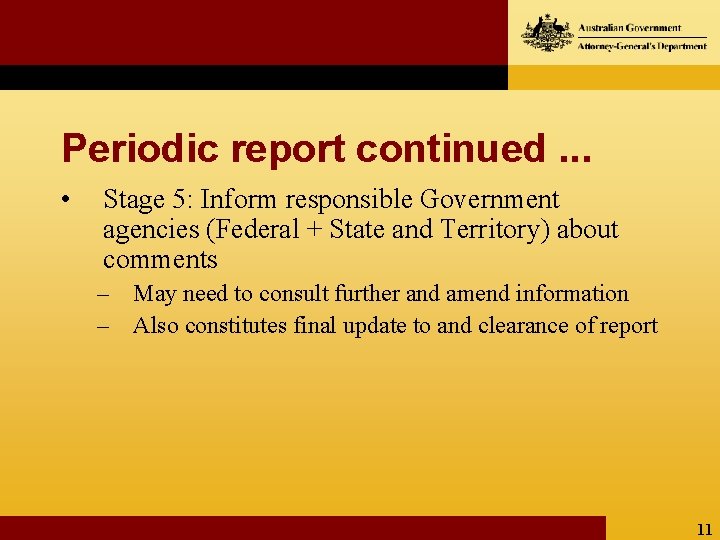
Periodic report continued. . . • Stage 5: Inform responsible Government agencies (Federal + State and Territory) about comments – May need to consult further and amend information – Also constitutes final update to and clearance of report 11
Periodic report continued. . . • Stage 6: Ministerial clearance and lodgement with UN 12
2. Written response to List of Issues 13
List of Issues • Questions on general issues and specific cases, and requests for statistics/data • Consult with relevant departments and States and Territories • Draft response • Ministerial clearance • Lodge with the UN within stated time frame (allow sufficient time for translation) 14
3. Preparation for Committee Appearance 15
Preparing delegation briefing • Key steps: – Identify issues (‘briefing matrix’) and prepare briefings – Prepare delegation briefing material – Draft Opening Statement – Draft Summary Statement (if required) 16
4. Committee Appearance 17
Appearances • One or two days; only a few hours in total • Geneva or New York • Purposes: – To answer questions relating to the periodic report, the Written Response and any other issues relating to the implementation of treaty obligations – To provide the Committee updates on progress – To identify and acknowledge areas that need improvement/more work – especially priority issues 18
Committee Appearance • • Opening Statement [& Summary Statement (if required)] Gathering questions Responding to questions – techniques Coordinating with Government – Key contacts in New York/ Geneva, at your department and other relevant Federal and State+ Territory departments – Advise key contacts of procedure relating to Committee appearances and timeframes – Processes for gathering further information if requested by the Committee 19
Committee appearance continued. . . • Reviewing UN press release at end of day • Managing media reporting • The role of non-government organisations (NGOs) and national human rights institutions 20
5. Follow-up to Concluding Observations 21
Concluding Observations and Follow-up • • • Anticipate Concluding Observations Prepare press release Review Concluding Observations Identify priority areas for follow-up Circulate to all stakeholders (AG publicises on website) • Develop plan for follow-up • Use as the basis for next periodic report 22
Further follow-up • Several Committees request information on follow-up action on particular Concluding Observations/recommendations within one year • Sometimes there additional requests for further information – eg CAT Committee 23
The role of civil society/NGOs • Increasingly NGOs are playing an important role in the treaty reporting process, e. g. – Shaping the list of issues – Providing a detailed and co-ordinated Shadow report – Meeting with the Committee and attending the appearance • NGOs comment on concluding observations and monitor Government’s follow up. 24
Third Optional Protocol to CRC • The Government is currently considering its position in relation to this instrument • Submissions from public were invited on website • Consultations within government are continuing 25
26
Any questions? Further information published on website http: //www. ag. gov. au/Humanrightsandantidiscrimination/Pages/Humanrights. aspx#reports 27