
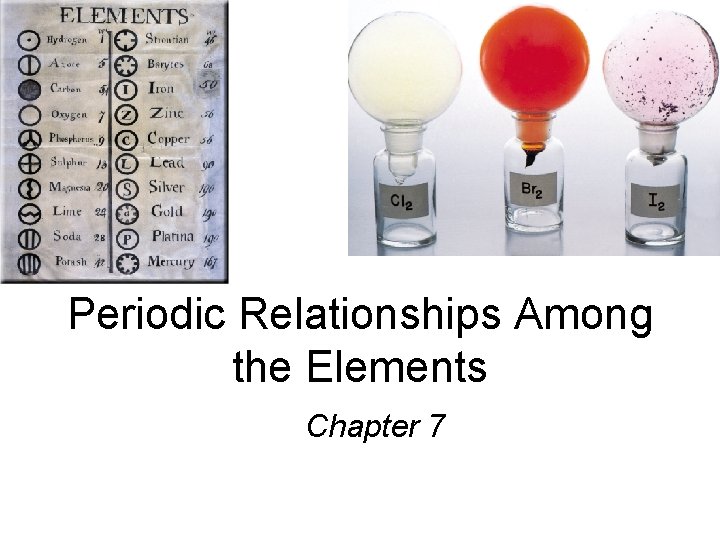
Periodic Relationships Among the Elements Chapter 7 When
![Electron Configurations of Cations and Anions Of Representative Elements Na [Ne]3 s 1 Na+](https://slidetodoc.com/presentation_image/183b5370837e60d3499fc4fabae34c1f/image-5.jpg "Electron Configurations of Cations and Anions Of Representative Elements Na [Ne]3 s 1 Na+")
![Na+: [Ne] Al 3+: [Ne] O 2 -: 1 s 22 p 6 or](https://slidetodoc.com/presentation_image/183b5370837e60d3499fc4fabae34c1f/image-7.jpg "Na+: [Ne] Al 3+: [Ne] O 2 -: 1 s 22 p 6 or")
- Slides: 24
Periodic Relationships Among the Elements Chapter 7
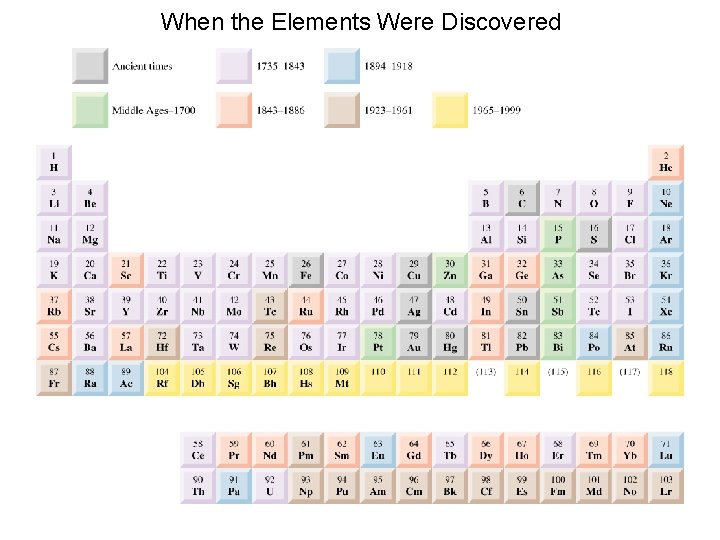
When the Elements Were Discovered
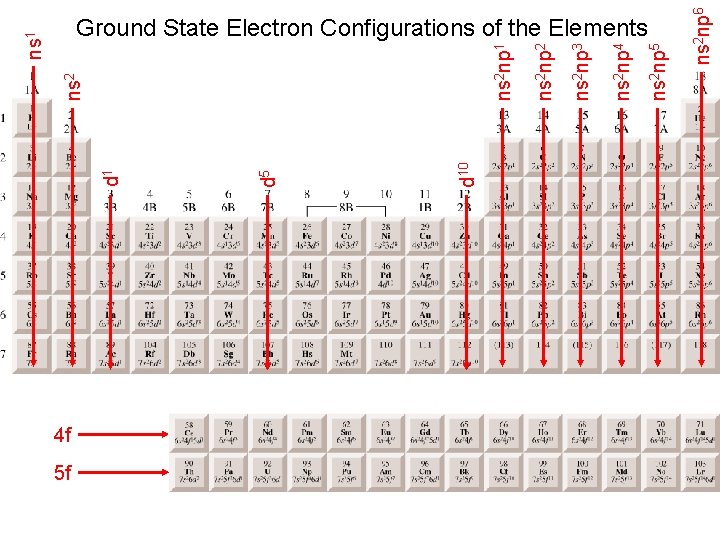
4 f 5 f ns 2 np 6 ns 2 np 5 ns 2 np 4 ns 2 np 3 ns 2 np 2 ns 2 np 1 d 10 d 5 d 1 ns 2 ns 1 Ground State Electron Configurations of the Elements
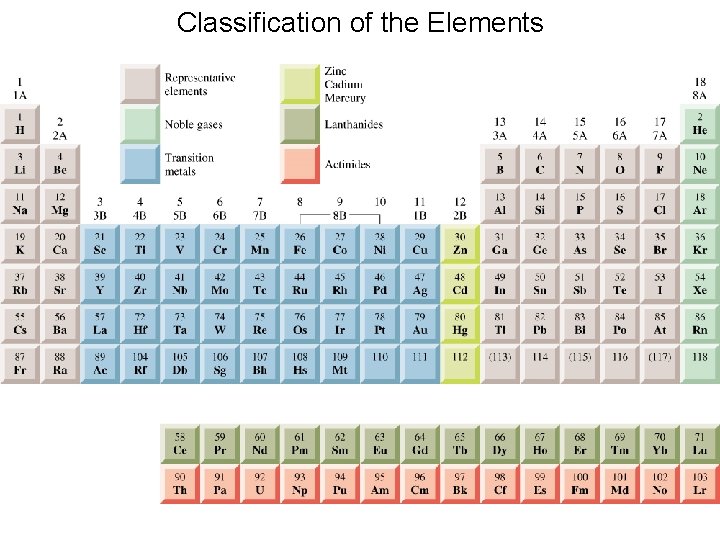
Classification of the Elements
Electron Configurations of Cations and Anions Of Representative Elements Na [Ne]3 s 1 Na+ [Ne] Ca [Ar]4 s 2 Ca 2+ [Ar] Al [Ne]3 s 23 p 1 Al 3+ [Ne] Atoms gain electrons so that anion has a noblegas outer electron configuration. Atoms lose electrons so that cation has a noble-gas outer electron configuration. H 1 s 1 H- 1 s 2 or [He] F 1 s 22 p 5 F- 1 s 22 p 6 or [Ne] O 1 s 22 p 4 O 2 - 1 s 22 p 6 or [Ne] N 1 s 22 p 3 N 3 - 1 s 22 p 6 or [Ne]
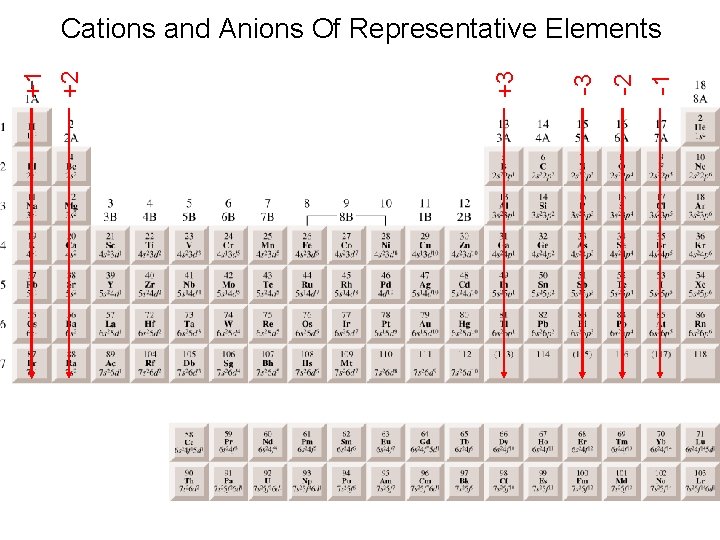
-1 -2 -3 +3 +2 +1 Cations and Anions Of Representative Elements
Na+: [Ne] Al 3+: [Ne] O 2 -: 1 s 22 p 6 or [Ne] F-: 1 s 22 p 6 or [Ne] N 3 -: 1 s 22 p 6 or [Ne] Na+, Al 3+, F-, O 2 -, and N 3 - are all isoelectronic with Ne What neutral atom is isoelectronic with H- ? H-: 1 s 2 same electron configuration as He
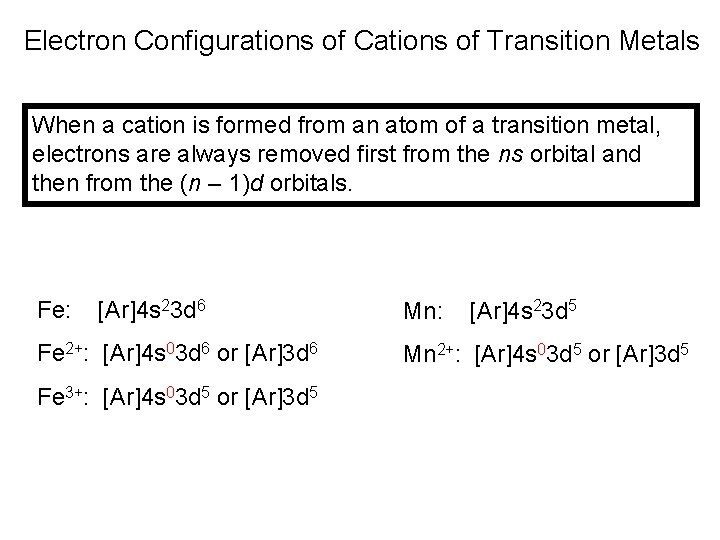
Electron Configurations of Cations of Transition Metals When a cation is formed from an atom of a transition metal, electrons are always removed first from the ns orbital and then from the (n – 1)d orbitals. Fe: [Ar]4 s 23 d 6 Fe 2+: [Ar]4 s 03 d 6 or [Ar]3 d 6 Fe 3+: [Ar]4 s 03 d 5 or [Ar]3 d 5 Mn: [Ar]4 s 23 d 5 Mn 2+: [Ar]4 s 03 d 5 or [Ar]3 d 5
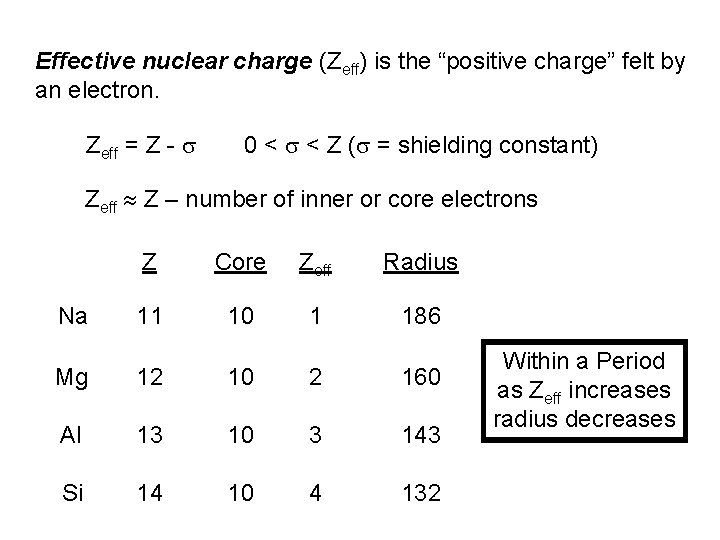
Effective nuclear charge (Zeff) is the “positive charge” felt by an electron. Zeff = Z - s 0 < s < Z (s = shielding constant) Zeff Z – number of inner or core electrons Na Z Core Zeff Radius 11 10 1 186 Mg 12 10 2 160 Al 13 10 3 143 Si 14 10 4 132 Within a Period as Zeff increases radius decreases
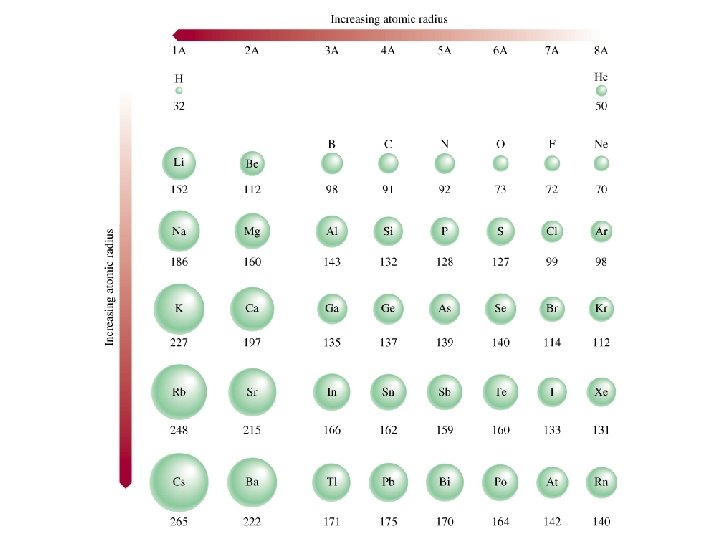
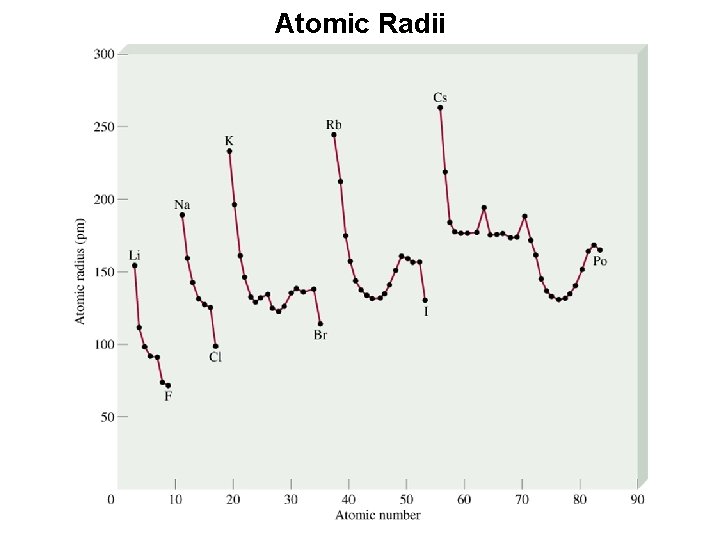
Atomic Radii
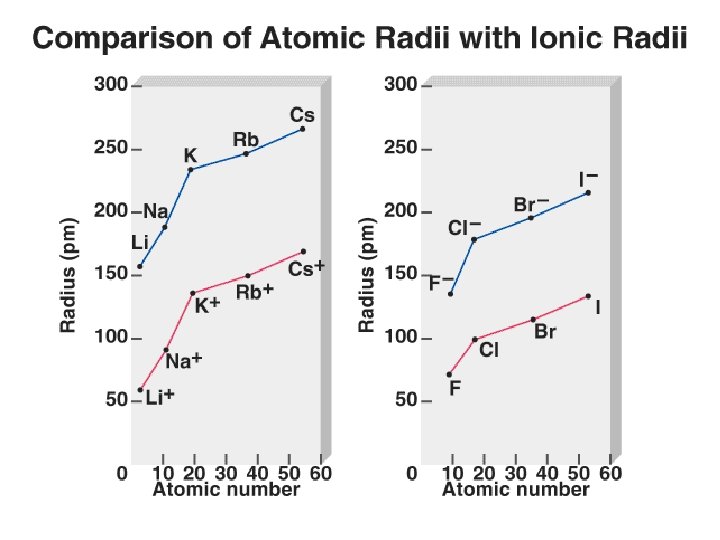
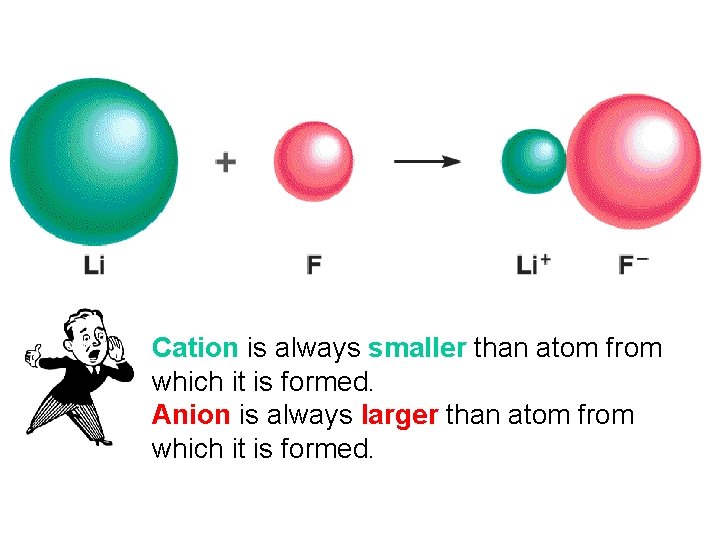
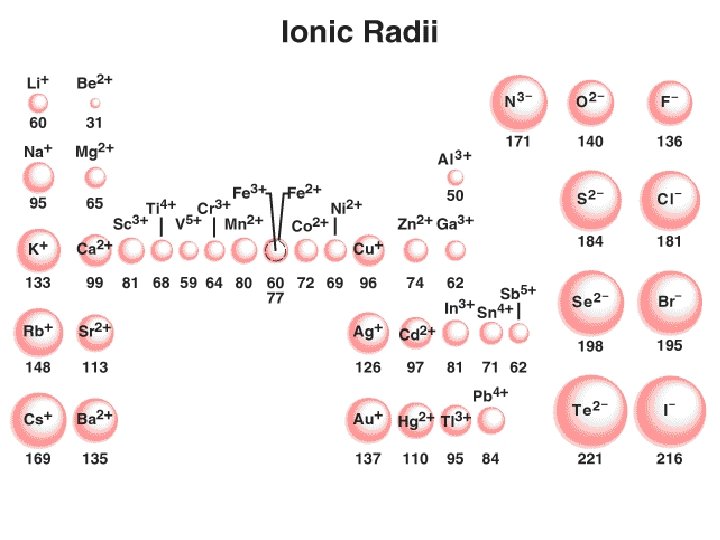
Cation is always smaller than atom from which it is formed. Anion is always larger than atom from which it is formed.
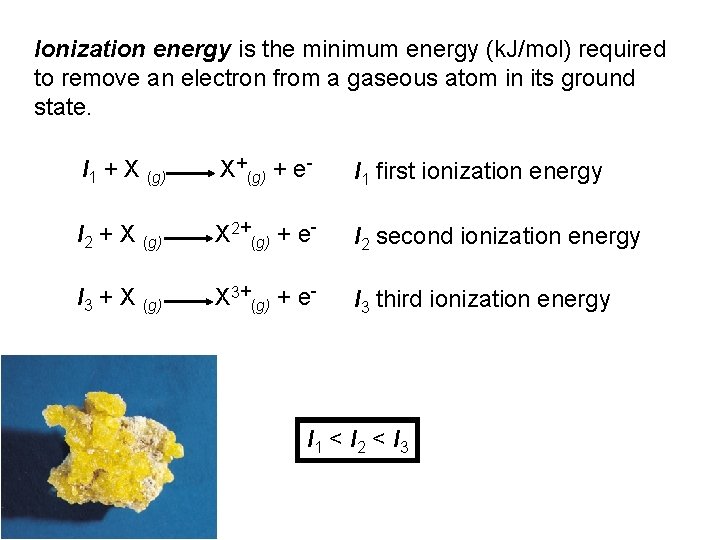
Ionization energy is the minimum energy (k. J/mol) required to remove an electron from a gaseous atom in its ground state. I 1 + X (g) X+(g) + e- I 1 first ionization energy I 2 + X (g) X 2+(g) + e- I 2 second ionization energy I 3 + X (g) X 3+(g) + e- I 3 third ionization energy I 1 < I 2 < I 3
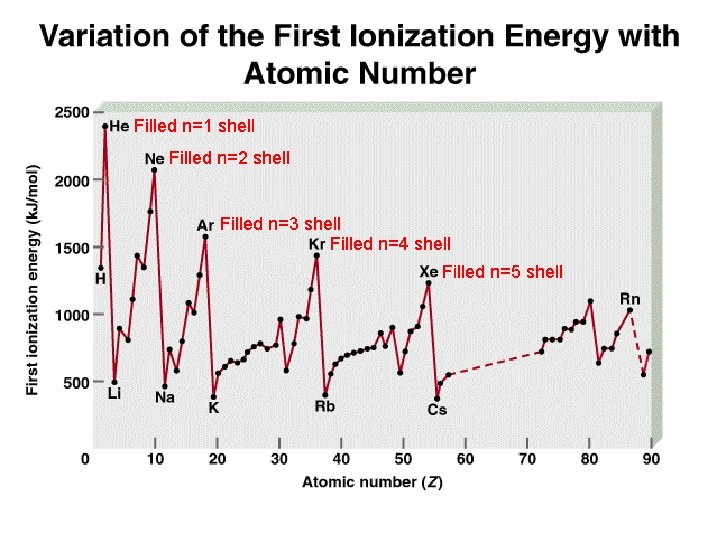
Filled n=1 shell Filled n=2 shell Filled n=3 shell Filled n=4 shell Filled n=5 shell
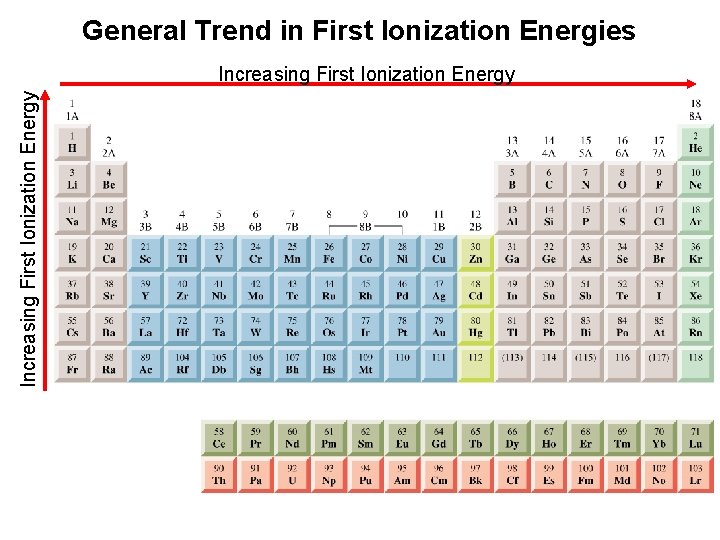
General Trend in First Ionization Energies Increasing First Ionization Energy
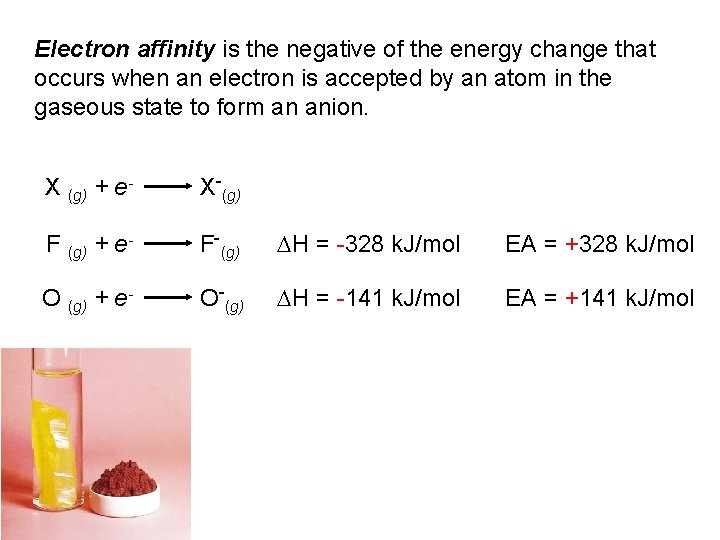
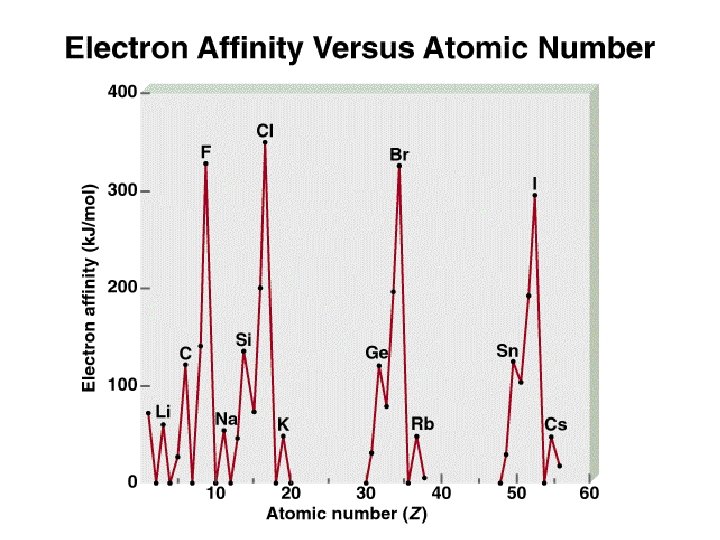
Electron affinity is the negative of the energy change that occurs when an electron is accepted by an atom in the gaseous state to form an anion. X (g) + e- X-(g) F (g) + e- F-(g) DH = -328 k. J/mol EA = +328 k. J/mol O (g) + e- O-(g) DH = -141 k. J/mol EA = +141 k. J/mol
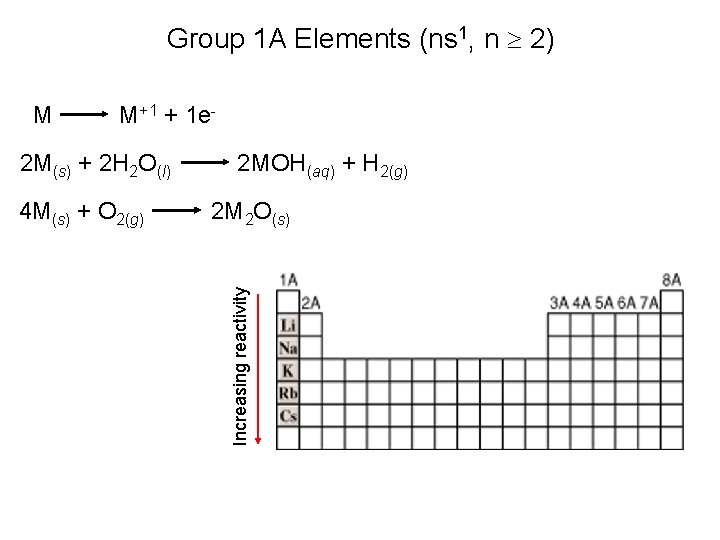
Group 1 A Elements (ns 1, n 2) M+1 + 1 e- 2 M(s) + 2 H 2 O(l) 4 M(s) + O 2(g) 2 MOH(aq) + H 2(g) 2 M 2 O(s) Increasing reactivity M
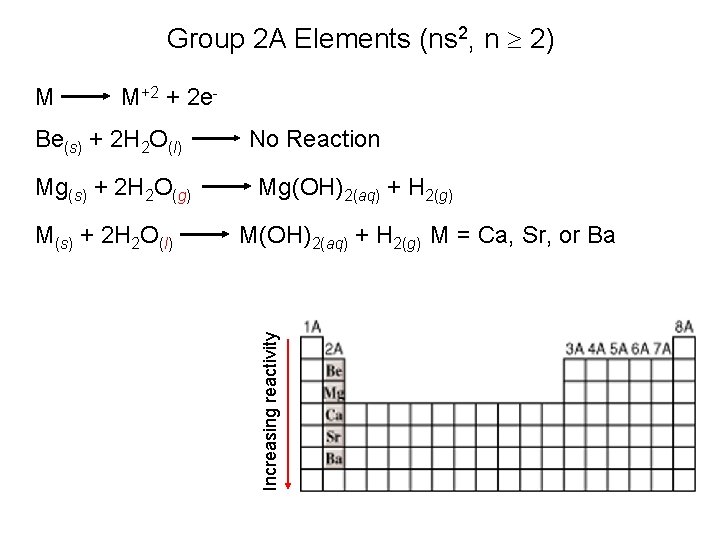
Group 2 A Elements (ns 2, n 2) M+2 + 2 e- Be(s) + 2 H 2 O(l) Mg(s) + 2 H 2 O(g) M(s) + 2 H 2 O(l) No Reaction Mg(OH)2(aq) + H 2(g) M = Ca, Sr, or Ba Increasing reactivity M
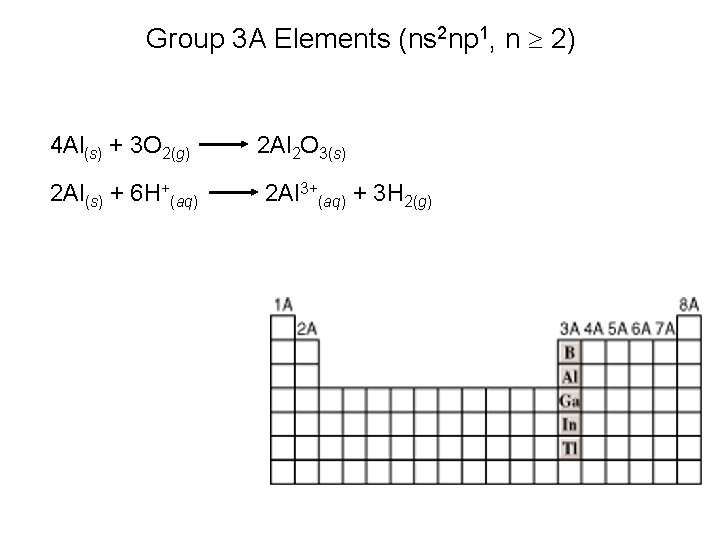
Group 3 A Elements (ns 2 np 1, n 2) 4 Al(s) + 3 O 2(g) 2 Al(s) + 6 H+(aq) 2 Al 2 O 3(s) 2 Al 3+(aq) + 3 H 2(g)
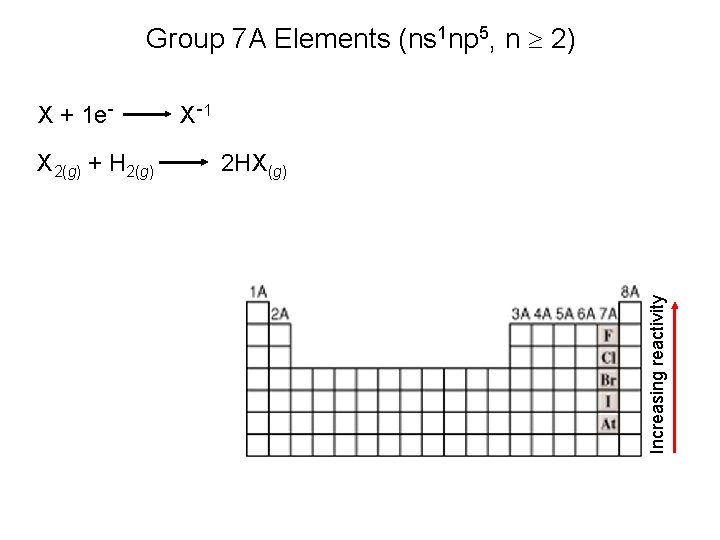
Group 7 A Elements (ns 1 np 5, n 2) X 2(g) + H 2(g) X -1 2 HX(g) Increasing reactivity X + 1 e-