
Periodic properties of elements 1 Atomic radius measured
- Slides: 5
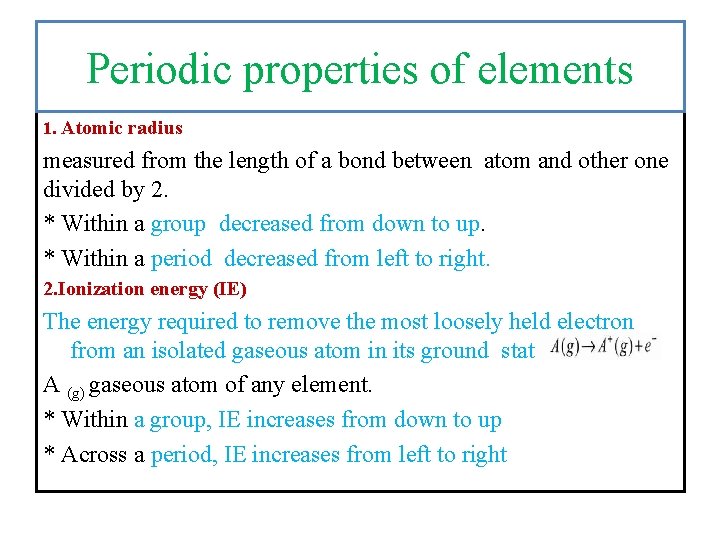
Periodic properties of elements 1. Atomic radius measured from the length of a bond between atom and other one divided by 2. * Within a group decreased from down to up. * Within a period decreased from left to right. 2. Ionization energy (IE) The energy required to remove the most loosely held electron from an isolated gaseous atom in its ground state. A (g) gaseous atom of any element. * Within a group, IE increases from down to up * Across a period, IE increases from left to right
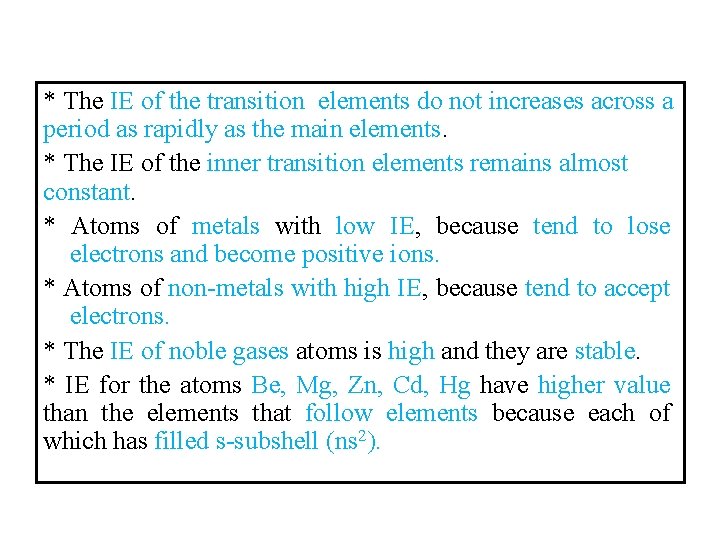
* The IE of the transition elements do not increases across a period as rapidly as the main elements. * The IE of the inner transition elements remains almost constant. * Atoms of metals with low IE, because tend to lose electrons and become positive ions. * Atoms of non-metals with high IE, because tend to accept electrons. * The IE of noble gases atoms is high and they are stable. * IE for the atoms Be, Mg, Zn, Cd, Hg have higher value than the elements that follow elements because each of which has filled s-subshell (ns 2).
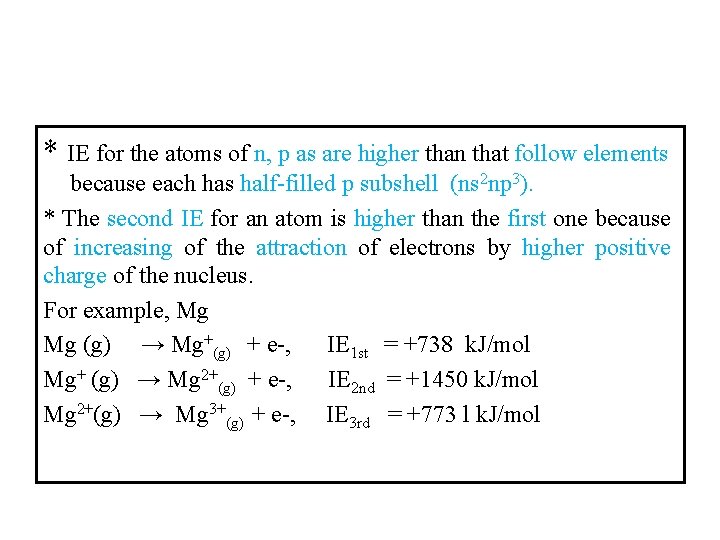
* IE for the atoms of n, p as are higher than that follow elements because each has half-filled p subshell (ns 2 np 3). * The second IE for an atom is higher than the first one because of increasing of the attraction of electrons by higher positive charge of the nucleus. For example, Mg Mg (g) → Mg+(g) + e-, IE 1 st = +738 k. J/mol Mg+ (g) → Mg 2+(g) + e-, IE 2 nd = +1450 k. J/mol Mg 2+(g) → Mg 3+(g) + e-, IE 3 rd = +773 l k. J/mol
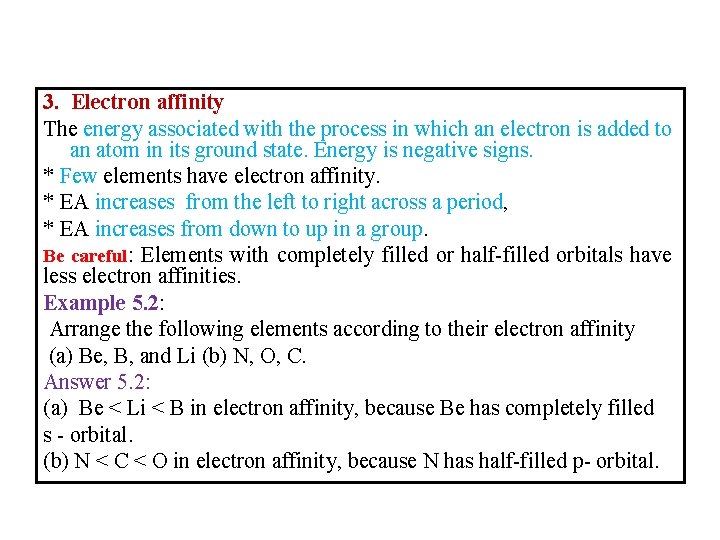
3. Electron affinity The energy associated with the process in which an electron is added to an atom in its ground state. Energy is negative signs. * Few elements have electron affinity. * EA increases from the left to right across a period, * EA increases from down to up in a group. Be careful: Elements with completely filled or half-filled orbitals have less electron affinities. Example 5. 2: Arrange the following elements according to their electron affinity (a) Be, B, and Li (b) N, O, C. Answer 5. 2: (a) Be < Li < B in electron affinity, because Be has completely filled s - orbital. (b) N < C < O in electron affinity, because N has half-filled p- orbital.
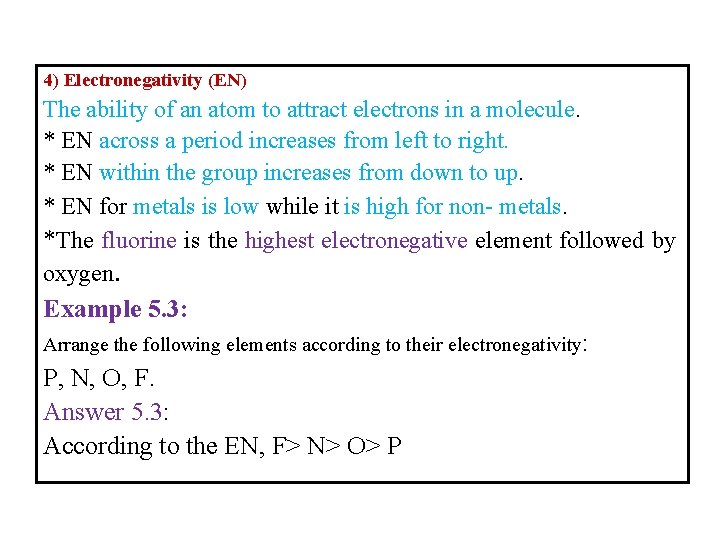
4) Electronegativity (EN) The ability of an atom to attract electrons in a molecule. * EN across a period increases from left to right. * EN within the group increases from down to up. * EN for metals is low while it is high for non- metals. *The fluorine is the highest electronegative element followed by oxygen. Example 5. 3: Arrange the following elements according to their electronegativity: P, N, O, F. Answer 5. 3: According to the EN, F> N> O> P