
PERIODIC MOTION PES 1000 PHYSICS IN EVERYDAY LIFE

- Slides: 6
PERIODIC MOTION PES 1000 – PHYSICS IN EVERYDAY LIFE
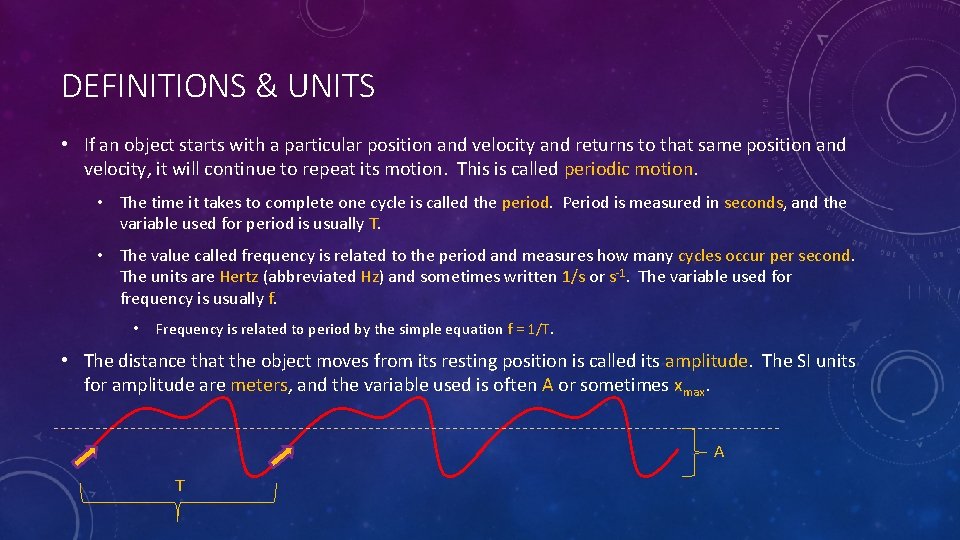
DEFINITIONS & UNITS • If an object starts with a particular position and velocity and returns to that same position and velocity, it will continue to repeat its motion. This is called periodic motion. • The time it takes to complete one cycle is called the period. Period is measured in seconds, and the variable used for period is usually T. • The value called frequency is related to the period and measures how many cycles occur per second. The units are Hertz (abbreviated Hz) and sometimes written 1/s or s-1. The variable used for frequency is usually f. • Frequency is related to period by the simple equation f = 1/T. • The distance that the object moves from its resting position is called its amplitude. The SI units for amplitude are meters, and the variable used is often A or sometimes xmax. A T
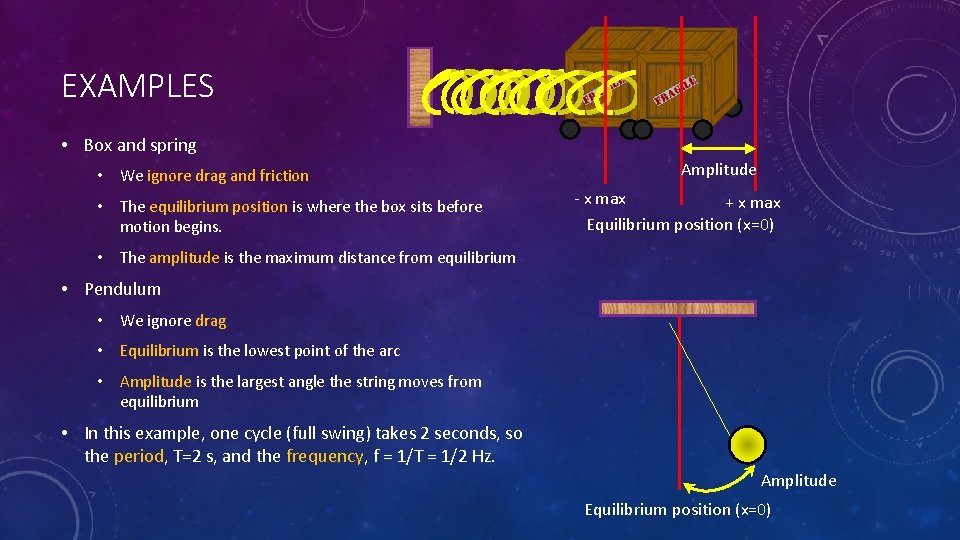
EXAMPLES • Box and spring • We ignore drag and friction • The equilibrium position is where the box sits before motion begins. Amplitude - x max + x max Equilibrium position (x=0) • The amplitude is the maximum distance from equilibrium • Pendulum • We ignore drag • Equilibrium is the lowest point of the arc • Amplitude is the largest angle the string moves from equilibrium • In this example, one cycle (full swing) takes 2 seconds, so the period, T=2 s, and the frequency, f = 1/T = 1/2 Hz. Amplitude Equilibrium position (x=0)
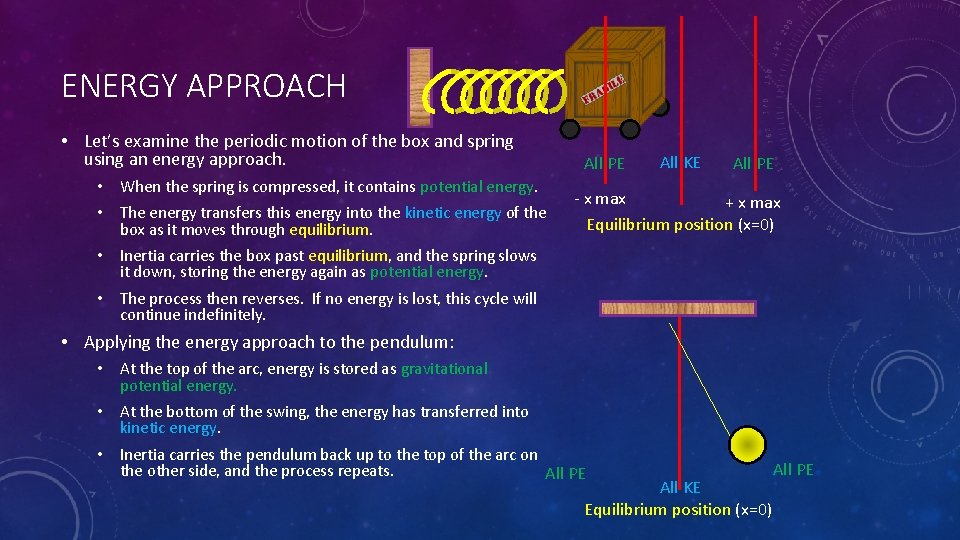
ENERGY APPROACH • Let’s examine the periodic motion of the box and spring using an energy approach. • When the spring is compressed, it contains potential energy. • The energy transfers this energy into the kinetic energy of the box as it moves through equilibrium. All PE All KE All PE - x max + x max Equilibrium position (x=0) • Inertia carries the box past equilibrium, and the spring slows it down, storing the energy again as potential energy. • The process then reverses. If no energy is lost, this cycle will continue indefinitely. • Applying the energy approach to the pendulum: • At the top of the arc, energy is stored as gravitational potential energy. • At the bottom of the swing, the energy has transferred into kinetic energy. • Inertia carries the pendulum back up to the top of the arc on the other side, and the process repeats. All PE All KE Equilibrium position (x=0) All PE
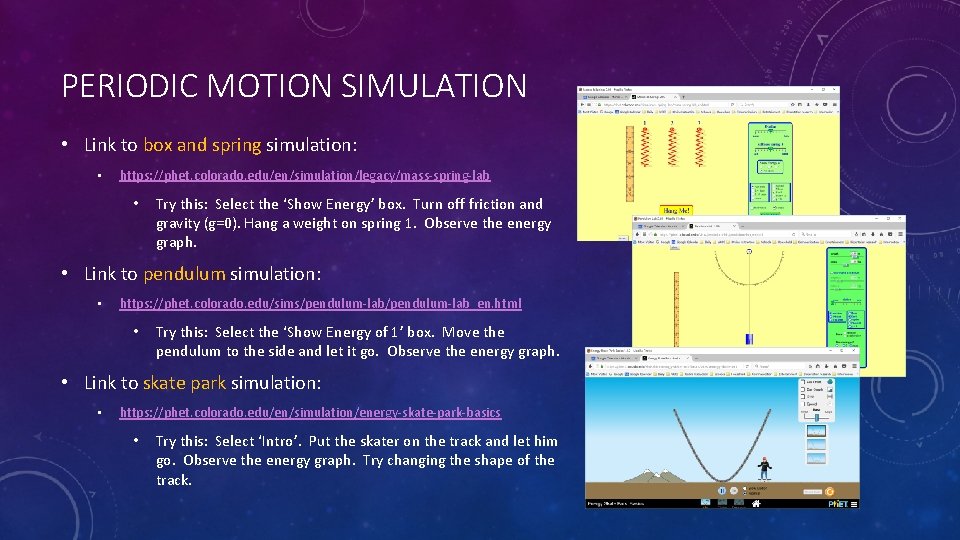
PERIODIC MOTION SIMULATION • Link to box and spring simulation: • https: //phet. colorado. edu/en/simulation/legacy/mass-spring-lab • Try this: Select the ‘Show Energy’ box. Turn off friction and gravity (g=0). Hang a weight on spring 1. Observe the energy graph. • Link to pendulum simulation: • https: //phet. colorado. edu/sims/pendulum-lab_en. html • Try this: Select the ‘Show Energy of 1’ box. Move the pendulum to the side and let it go. Observe the energy graph. • Link to skate park simulation: • https: //phet. colorado. edu/en/simulation/energy-skate-park-basics • Try this: Select ‘Intro’. Put the skater on the track and let him go. Observe the energy graph. Try changing the shape of the track.
CONCLUSIONS • Periodic motion is any motion that goes through a cycle that repeats. • Examples are a box & spring, a mass hanging from a spring, a pendulum, a marble in a bowl, etc. • Important quantities: • Period is how long it takes to go through one cycle. • Frequency is how many cycles it goes through in one second. It is the reciprocal of period. • Amplitude is the maximum distance from the equilibrium or rest point. • During periodic motion, energy transfers between potential energy and kinetic energy.